Gorean Lifestyle - House of Phoenix
A view of the Gorean Lifestyle and Philosophy based on the Books
Series 2.e – Aligning Words and Actions in Gorean Life

In Gorean philosophy, a promise carries the weight of law and is sealed with personal honor. One of the simplest yet most demanding principles in Gorean philosophy is this: words must align with deeds. On Gor, saying “I give you my word” is not a casual remark – it is a sacred bond, and if that bond is broken, the words become meaningless. A Gorean-inspired lifestyle thrives on integrity: spoken oaths, written agreements, and daily actions are all tightly woven together. In this episode, we’ll explore why your word is treated as your bond in Gorean culture, and how that plays out in modern Gorean-inspired relationships. We’ll cover:
- Alignment of word and action: How Gorean honor is built on doing what you say.
- Formal commitments: The role of contracts, household rules, and rituals of oath-making in Gorean life.
- Trust and broken promises: How breaking one’s word erodes trust in any power-exchange dynamic.
- Everyday honor: Why keeping small daily promises matters as much as grand gestures – coherence between your word and your daily actions is paramount.
If you’re new to this blog’s foundation, you may want to read 【Series 1.1 – Understanding the Gorean Lifestyle: Myths and Realities】 (fiction vs. real-life Gor and the primacy of consent) and 【Series 2.5 – Honor, Responsibility and Discipline: The Core of Gorean Philosophy】. Those episodes lay the groundwork for the focus on personal honor and integrity that we’ll build on here.
1) Word, Bond, and Honor: Aligning Speech with Action

In Gorean thinking, honor begins with a ruthless question: “Am I aligned with my word?” . It’s not about appearing honorable or spinning words to save face. It’s a stark reflection: do your actions consistently match what you have promised? On Gor – and in any Gorean-inspired life on Earth – a person’s word is a direct measure of their character and worth.
Consider how the warrior caste approaches honor. Warriors live and die by their oaths and codes. When a Gorean warrior gives his word, it is as precious as his life. As one essay puts it: “One of the greatest and most important points of personal honor is a person’s word… If one pledges his or her word… and then breaks faith, in short time that person’s ‘word of honor’ will mean nothing” . In other words, to break your word is to lose honor, and with it, the trust and respect of your peers. No one will take you seriously thereafter. This isn’t just abstract philosophy; it’s a very practical social currency. Trust on Gor is earned (or lost) by whether you do what you said you would do.
Modern Gorean lifestylers embrace this principle of aligning word and deed. While our contemporary world often shrugs off “little” broken promises or uses slippery language for convenience, the Gorean ethos “pushes against that performance” . It favors blunt honesty and clear commitments over socially convenient half-truths. There’s a saying on Gor that speaks volumes: “A person’s word is their bond.” When you give your word, you’re effectively staking your honor on fulfilling it.
Integrity in speech and action shows up in small ways day-to-day. If a Master says he will guide and protect, he must uphold that even when it’s difficult. If a kajira (submissive) swears to obey, her honor lies in carrying out that oath consistently, not only when she feels like it. Gorean honor asks each individual: Can you do what you said you would do, even when comfort or ease is at stake? This is why honor, in a Gorean sense, is often defined as “who you are when nobody is watching” . It’s an internal scorecard of personal integrity.
In fact, Gorean ethics make “do I do what I say?” a core test of character . By holding ourselves to our word, we cultivate self-discipline and self-respect. The moment your actions diverge from your promises, you create a rift in trust – not only others’ trust in you, but your own inner confidence. This alignment of word and deed is the bedrock; without it, all the elaborate power dynamics or rituals in the lifestyle would collapse like a house of cards.
2) From Contracts to Collars: Formal Commitments in Gorean Life
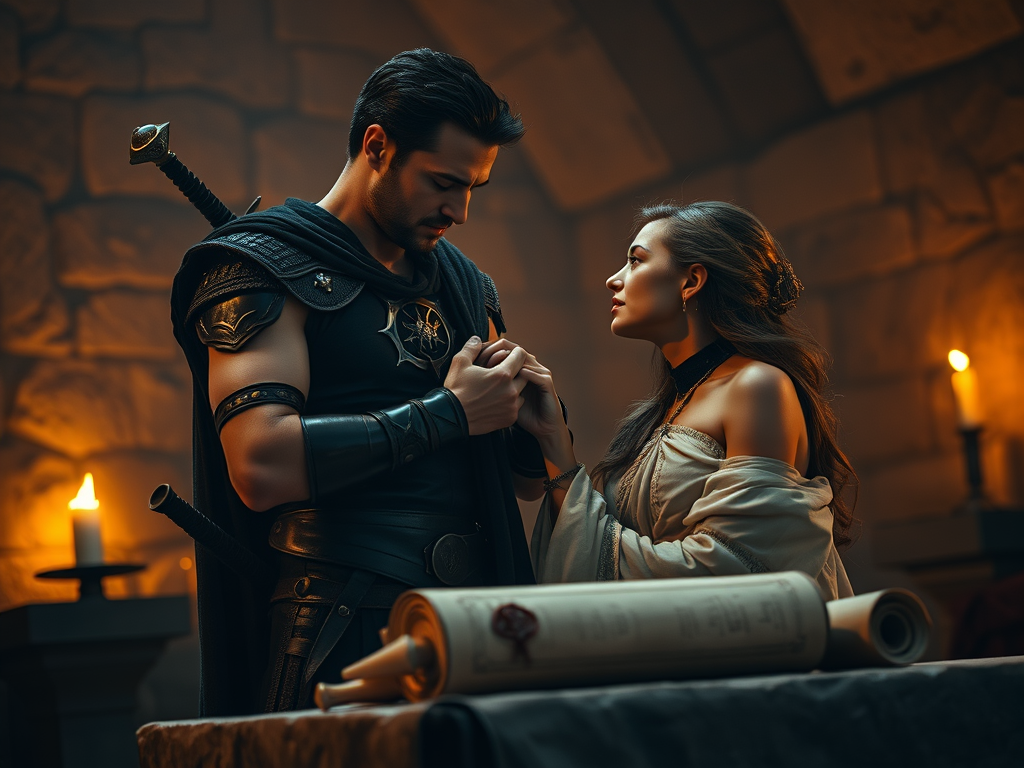
To make sure words and actions stay aligned, Gorean culture (in both the books and modern lifestyle) uses formal commitments – explicit contracts, spoken oaths, and ritual ceremonies. These aren’t mere formalities; they are deliberate anchor-points that bind word to action. By articulating roles and promises clearly, they set a standard that both parties are expected to live up to.
Free Companionship Contracts: In the world of Gor, a Free Companionship is akin to a marriage – and it’s sealed by a contract and oath. By Gorean law in the books, such a companionship “to be binding, must be annually renewed, pledged afresh with the wines of love.” This idea translates into modern practice too: many Gorean-inspired couples draw up an explicit agreement when they form a committed bond. A sample Free Companionship contract might include mutual vows – for example, “I pledge to be faithful to you and our companionship, to uphold your honor, to protect you in times of need… to honor you above all others…” . Typically, such contracts last one year and must be consciously renewed (rather than assuming they’ll just continue) . The yearly renewal is a powerful ritual in itself: it forces both partners to reaffirm their word actively, keeping the relationship purposeful rather than taken for granted.
Household Rules and Protocols: Beyond formal contracts, many Gorean households establish a clear set of rules or protocols that govern daily life. These might be written down or agreed upon verbally, but in either case they function as ongoing promises between the dominant and submissive. For instance, a Master may set rules about how his partner addresses him, chores to be done, or standards of behavior, and the partner in turn agrees to those rules as part of her surrender. These rules are essentially micro-contracts – each one is a little promise that “this is how we have agreed to live.” By writing them out or stating them clearly, both parties align on expectations. And importantly, both are accountable: the Dominant to enforce or uphold his end (e.g. providing structure, training, or care as promised), and the submissive to fulfill hers. The alignment between spoken agreement and action is continuously tested in these everyday rules. If a rule is consistently ignored, it’s a sign that someone’s word is out of alignment, and that’s taken seriously.
Rituals of Commitment: Gorean culture is rich with ceremonies that dramatize one’s word and bond. For example, the Collaring Ceremony is one of the most significant rituals for those adopting a Gorean-style D/s relationship. In a traditional collaring, the dominant physically places a collar on the submissive, and vows are spoken on both sides. A classic Gorean ceremony (described in Tribesmen of Gor) has the kneeling slave affirm her submission with words like: “I herewith submit myself, completely and totally, in all things, to him… his girl, his slave, an article of his property, his to do with as he pleases.” This public (or at least formalized) declaration isn’t just for show – it’s a line drawn in the sand. From that moment, her word is given; her identity is now bound up with keeping that commitment of total obedience. Likewise, the Master in such a ceremony often speaks his own promise – not always in flowery language, but by accepting the responsibility for her life. A simple phrase like “You are mine” on his lips is understood to mean “I pledge to care for you as my own”. These ritual words carry profound weight. They are often accompanied by symbols (the collar itself, perhaps a signed paper of ownership, or witnesses present), all reinforcing that this is a serious vow, not to be broken lightly.
Another example from the lore: the Home Stone ceremony for new citizens. When young people in Gor come of age, they partake in a ceremony that involves “the swearing of oaths, sharing of bread, fire, and salt.” Each young person holds and kisses the city’s Home Stone (the symbolic heart of the community) as they speak their allegiance . Only after this oath are they granted the laurel wreath of citizenship. This vivid scene illustrates how fundamental oath-taking is to Gorean society: even one’s civic status is confirmed by speaking promises aloud. To join a community is not a casual matter – it involves sacred words, elements of nature (bread, fire, salt) and a public commitment. Breaking such an oath would mark one as an oathbreaker – essentially a traitor to one’s city – a stigma no honorable Gorean would want to bear.
In modern Gorean-themed communities, people sometimes emulate these ideas with their own twist: they might create a “ceremony of the Home Stone” in which a household establishes a shared symbolic Home Stone and swears mutual loyalty to it. Or a couple might celebrate an annual oath-renewal ritual, perhaps on the anniversary of their collaring or companionship, to refresh their vows. All these practices serve the same key purpose: to align spoken words with a formal commitment, witnessed and remembered, which guides future action. They make it clear that “this was promised, in no uncertain terms”.
By formalizing commitments, Goreans remove ambiguity. The spoken or written contract becomes a north star for behavior. If ever there’s doubt or temptation to stray, one can recall: “I swore an oath to this. I gave my word.” That memory isn’t abstract – it’s often tied to a concrete moment (a signed document, a ceremony before friends, a physical collar locked around one’s neck) which makes the promise feel real. And because it feels so real, keeping one’s word becomes a point of pride, while breaking it would be a source of deep shame.
3) Broken Word, Broken Trust: The Cost of Breaking Promises

All the contracts and ceremonies in the world won’t save a relationship if the actual trust underlying them evaporates. Trust is the lifeblood of any power-exchange dynamic – without it, dominance and submission devolve into either hollow play-acting or outright abuse. And nothing erodes trust faster than a broken promise.
In the eyes of Gorean philosophy, to break one’s word is one of the most dishonorable things a person can do. Why? Because it undercuts the very basis of respect and predictability. Remember, a submissive in a consensual Gorean-style dynamic has often given her submission voluntarily on the faith that the dominant will honor certain vows (to lead responsibly, to keep her safe, to uphold his end of their agreement). Likewise, a dominant entrusts his honor to a submissive by accepting her vow of devotion and service, expecting that she will carry it out earnestly. When either side reneges – the dominant perhaps neglects his duties, or the submissive disobeys or deceives – the confidence in the power-exchange is shattered. The “exchange” can no longer occur freely, because doubt creeps in.
Imagine a kajira who has promised to serve her household diligently, but repeatedly slacks off or lies about her actions. Each time she breaks her word, her Master has to wonder: Can I rely on her? Similarly, imagine a Master who swore during collaring to never seriously harm his slave and to protect her well-being, but in anger he violates that promise or arbitrarily changes the core rules they agreed on. The slave will feel betrayed: Can I trust anything he says now? In either case, the magic of the dynamic – that sense of mutual exchange and polarity – fizzles. What replaces it is resentment, fear, or disillusionment.
The Gorean codes of honor come down hard on oath-breakers. A proverb from the warrior caste essentially says that those who “behave dishonorably, through lies or treachery… are seldom treated with respect or afforded the right to an honorable end.” In other words, if you prove yourself false, you lose your honor and forfeit others’ honor toward you. On Gor, a known oath-breaker might be cast out socially or worse. While we’re not on Gor, the principle holds: in a community or relationship, someone who gains a reputation for breaking their promises quickly finds themselves isolated. Others will not trust them with responsibility or vulnerability.
In a Gorean-inspired lifestyle, “excuses do not exist in such matters” . You either kept your word, or you did not – reasons aside. This might sound harsh, but it’s rooted in the idea that each person has control over how they respond to obstacles. If fulfilling a promise becomes unexpectedly hard, an honorable person doesn’t just shrug and walk away; they communicate, take corrective action, or at worst, atonement. For instance, if a Master cannot keep a promise due to unforeseen events, a Gorean approach would be to own up to it clearly and do whatever is necessary to remedy the broken trust. If a kajira slips in her obedience, she is expected to acknowledge it and redouble her discipline to re-earn confidence in search for atonement. The process of repairing trust itself must be concrete: more words won’t suffice, only consistent action over time can. This accountability loops back into the earlier point: responsibility and honor are two sides of the same coin. “If you swear on your honor to do something, you had better fulfill the promise. If that proves impossible, then you had better take necessary steps to remedy the situation.” Simply put, Goreans don’t let promises die quietly; they either fulfill them, or openly address the failure and its consequences.
It’s worth noting that in a consensual power-exchange, breaking your word doesn’t just erode trust – it also endangers the emotional (and sometimes physical) safety of the participants. Because these relationships involve unequal power by design, they rely even more on good faith. For a submissive to give up a significant degree of control, she must deeply trust that her dominant’s word is good – that if he says “I will keep you safe” or “Your limits will be respected,” she can take that to the bank. If he violates that promise, the damage is not just emotional hurt; it strikes at her sense of security and agency. Similarly, a dominant places enormous trust in the submissive’s honesty – he needs to know that her “yes” truly means yes, that her “I am fine” is truthful, etc. If she secretly harbors resentment or pretends to consent while plotting to bail, she undermines his ability to lead safely. Thus, honesty and promise-keeping are forms of protection in a D/s bond: they protect the submissive from harm and the dominant from misusing his power. Without that protection, a Gorean dynamic can turn into a minefield of doubts and second-guessing.
In short, breaking one’s word in a Gorean-inspired life is catastrophic. It’s not treated as a minor faux pas; it’s a breach of honor that can unravel the very fabric of the relationship. That’s why Gorean couples and communities put such an emphasis on vetting each other’s integrity. They know that all the beautiful philosophies about natural order or polarity mean nothing if the individuals involved can’t trust each other’s promises at a fundamental level.
4) Honor in the Little Things: Daily Promises, Big Impact
When people think of honor or oaths, they often imagine big, dramatic moments – kneeling in a grand ceremony, speaking flowery vows, signing a ornate contract, or defending one’s honor in a duel. And yes, Gorean life has its grand oaths. But the truth is, honor is proven (or lost) in the little, everyday things. Gorean philosophy teaches that aligning your word with your actions in daily life is just as important as bold gestures on special occasions. In fact, it might be even more important, because consistency is the real test of integrity.
Ask yourself, as a Gorean might: “What do I promise often – but fail to deliver on, day by day?” It could be something as mundane as, “I’ll be home by 6,” or “I’ll allocate time for training/exercise tomorrow,” or “I’ll always address my Master as Sir even if I’m annoyed.” These seem like small promises. But each time you make one and don’t follow through, you chip away at coherence between your word and reality. It’s death by a thousand cuts for honor. Conversely, each time you do follow through – even on something minor – you strengthen that alignment a little more. Over time, those little wins add up to a solid reputation (with yourself and others) that “yes, I mean what I say.”
Gorean discipline is very much about these small daily acts. Discipline isn’t firstly about punishment or fetish; it’s about self-mastery and habitual integrity. One description from this blog puts it succinctly: “Discipline is training… mastery—first of the self.” and it asks, “Can you keep your word when it costs you comfort?” . Think about that – it’s easy to keep your word when it’s convenient or when you’re full of enthusiasm. The real challenge is on the tough days, when you’re tired, tempted, or unmotivated. Do you still do what you promised? For a Gorean, that’s where honor either shines or fades.
In a daily-life context, this could mean the Dominant waking up early to handle responsibilities he’s taken on (even if he’d rather sleep in), because he told his household he would. It could mean the submissive maintaining a ritual of greeting or service every morning unfailingly, because she vowed to give that respect – even on mornings she’s cranky. It might mean both of them sticking to a weekly relationship check-in they agreed on, even if sometimes they don’t feel like having a heavy talk – because they gave their word that communication is a priority. Each of these acts might seem small, but together they form the tapestry of a Gorean-inspired life. The philosophy often emphasizes that character is built through repeated practice and habituation . By fulfilling small promises consistently, you train yourself in honor. You become the kind of person who naturally keeps the bigger promises too, because it’s who you are.
Moreover, the little promises are what keep the big promises alive. It’s one thing to say in a booming voice, “I will honor you above all others” in a ceremony. But that grand promise is upheld by countless tiny choices. If those little choices aren’t made, the big vow becomes an empty slogan. Gorean wisdom understands this deeply. There’s a concept of “clean accountability”: honor is not perfection, but it is being accountable in every instance you can . It means if you slip, you own it and correct course, and you strive not to slip in the first place. It’s a practice.
In the Gorean Master/slave context, both sides have daily work to do. The Master must demonstrate leadership not just in crises but in routine matters – paying the bills he said he would, checking that the doors are locked if he’s responsible for security, taking the time to teach or correct his slave consistently. The slave must demonstrate devotion not just when it’s new and thrilling, but on the boring days too – adhering to protocols, maintaining the household standard, and showing the demeanor she promised even when no one else is around. Gorean guides often say “Mastery begins with self-mastery” , and likewise a pleasing slave is one who has mastered herself. Both of those are cultivated in the small moments. In fact, “both build trust through reliability” over time – the dominant by reliably carrying the weight of his role, the submissive by reliably carrying hers. Each fulfilled little promise is like a brick in the foundation of trust. Over months and years, a stable structure of mutual confidence is built. And from that, the more dramatic power-exchange elements (like intense scenes, deep surrender, or strict protocols) can flourish safely, supported by trust.
Lastly, living one’s word in small ways feeds into a sense of self-esteem and purpose. Many people in modern society feel unmoored or insignificant in daily life; a Gorean approach offers an antidote: choose your bonds with open eyes, then live them fully . When you treat even a minor promise as something that defines you, you imbue your day with meaning. Cooking dinner as promised isn’t just a chore – it’s you being true to your word. Waiting up for your partner because you said you would isn’t just polite – it’s an expression of honor. Over time, this mindset can transform how one experiences relationships. Every small act of kept promise becomes satisfying; it’s a step on the path of living deliberately and honorably. Gor, at its heart, is about living by a conscious philosophy rather than defaulting to the path of least resistance. Aligning words and actions, day in and day out, is perhaps the most accessible way to practice that consciousness.
Where to Go Next
Next in this series, we’ll continue examining the building blocks of stable Gorean bonds. Stay tuned!
Comment prompt: What does the phrase “My word is my bond” mean to you personally? Have you experienced a time when keeping (or breaking) a promise deeply affected your relationship or self-respect? Feel free to share your thoughts – your perspective is welcome, whether you live a Gorean-style dynamic or are simply curious about it!
I wish you well!
©2025 – Written by Azrael Phoenix
- Follow on Facebook: GorByPhoenix
You can read the full set of episodes of this Series here:
- Series 1 – Start Here: Understanding the Gorean Lifestyle
- Series 2 – The Philosophy: Values Behind the Gorean Lifestyle
- 2.a – Honor, Responsibility and Discipline: The Core of Gorean Philosophy
- 2.b – Freedom, Choice and Voluntary Surrender: A Paradox at the Heart of Gor
- 2.c – Strength and Vulnerability: The Gorean View of Masculinity and Femininity
- 2.d – Understanding Gorean Natural Order: Philosophy and Modern Life
- 2.e – Aligning Words and Actions in Gorean Life
- Series 3 – Practicing a Gorean-Inspired Lifestyle (Safely & Ethically)
- Series 4 – Reading Gor: Guides, Themes, and Character Studies
- 4.a – Where to Start with the Books of Gor
- Part 1 – A Reading Guide for Newcomers
- Part 2 – Saga in Stages: Phases of the Gorean Journey
- Stage 1 – The Early Adventures (Books 1–6): From Earthman to Gorean Warrior
- Stage 2 – Broadening Horizons & Deeper Themes (Books 7–13): New Perspectives on Gor
- Stage 3 – The Jason Marshall Trilogy (Books 14–16): A New Tale of Submission and Identity
- Stage 4 – War and Upheaval (Books 17–25): The Epic Gorean War and Turning Point
- Stage 5 – The Saga Resumes (Books 26–33): New Century, New Faces, and the Gorean Renaissance
- Stage 6 – Climactic Conclusions (Books 34–38): A New Resolve and the Future of Gor
- Part 3 – The Philosophy Behind the Fantasy: How Gor Evolved (and Why It’s Not Just “Erotic Pulp”)
- Part 4 – Major Pivotal Books & Moments in the Saga
- Part 5 – Where to Find the Gor Books (Legally and Easily)
- Part 6 – Confronting the Controversies: Misconceptions and Reality-Checks
- 4.a – Where to Start with the Books of Gor
Series 2.d – Understanding Gorean Natural Order: Philosophy and Modern Life

Gorean philosophy has a reputation for its emphasis on instinct, hierarchy, and nature – often summed up in the idea of a “Natural Order.” In this episode, we’ll demystify what Natural Order really means in the world of Gor and in modern Gorean lifestyle practice. We’ll explore how John Norman’s books portray primal instinct and hierarchy, draw parallels to today’s back-to-basics and ecological mindsets, and discuss how one might pursue a “natural” path ethically and consensually within modern society. Importantly, we’ll reinforce a key truth: “natural” ≠ an excuse for abuse or discrimination.
Instinct, Hierarchy, and Nature in the Gorean Saga

From the very first Gor novel, Norman makes it clear that Goreans see themselves as part of nature, not above it. Gorean characters live by instinct and primal truths: strength, sex, survival. The books bluntly portray a world where dominance and hierarchy are as natural as the sunrise. Men are generally warriors, hunters, and leaders; women (especially the slave-girls Norman so loves to write about) are usually submissive, devoted, and fulfilled in that role . The narrative suggests that these dynamics arise from biological reality – an evolutionary design rather than mere culture or opinion . In fact, a recurring theme is that denying our instincts only causes misery. As one fan summary puts it, Goreans feel it’s futile to disregard “hundreds of generations of evolution” – if nature has equipped a creature for a role, it should be allowed to fulfill it .
Hierarchy on Gor isn’t a dirty word; it’s the order of things. The fictional society is built on layer upon layer of hierarchy – from the high Council of a city down to a personal power exchange between a Master and slave. Norman’s view (through his Gorean characters) is that hierarchy will form inevitably in any group of humans, just as it does among pack animals or primates . Some people lead, others follow; both roles have purpose. As the books say, “not everyone can, or should, lead” – and following isn’t shameful if it’s in your nature . This natural stratification even extends to the Gorean view of gender: the male, being on average larger and stronger, is seen as genetically predisposed to dominate physically and protect; the female, being smaller and less physically powerful, is expected to acknowledge that reality and complement it by using her own strengths (empathy, nurturing, endurance) to aid and serve . In the oft-quoted words of the saga, Gorean men often refer to women collectively as “the slave sex,” not to suggest every woman must be a literal slave, but to underscore the idea that the female’s natural bent is to yield to a worthy male’s strength . This provocative phrasing highlights Gor’s core belief: males and females are different by nature, and there is a natural polarity between masculine dominance and feminine submission.
It’s important to note that Norman dramatizes these concepts to extremes in the novels – after all, Gor is a fantasy world. Enslavement in the books is often non-consensual and total. The story might show a proud Earth woman abducted to Gor, only to realize “at the feet of men, [she] had found herself” , joyously accepting a collar as though it were the fulfillment of her deepest truth. By the end of many Gor novels, even the most headstrong female characters discover that they prefer life as a cherished slave than as a free woman – a narrative device that reinforces Norman’s idea of an instinctive natural order. Statistically, the books claim only a small fraction of Gorean women are actual slaves (often quoted as ~2%), yet nearly all the women we meet in the stories end up in bondage (because, as one Gorean essay wryly notes, “they are simply more fun to read about” in that state) . This hyperbolic world-building makes the dominant/submissive dichotomy unmistakably clear on Gor, even if it’s far more extreme than anything a modern Gorean would endorse. The fantasy serves a point: to strip away the veneer of modern social convention and imagine humans relating in a more “animal” way – guided by lust, power, and protective instinct rather than polite restraint .
Yet, even within the fiction, Norman injects a philosophical justification for this setup. He argues (sometimes through long monologues in the books) that modern Earth’s denial of natural hierarchies has led to misery and confusion . In Gor’s universe, by contrast, society embraces a “Natural Order”: every person knows their role, whether warrior, peasant, master or slave, and finds pride in it. The presumed result? A more honest, vibrant, and meaningful life than the anomie and angst Norman associates with modern egalitarianism. While one can certainly dispute his conclusions, the internal logic is consistent: harmony comes from living in accordance with nature – including our primitive sexual and social instincts .
Finally, Gor’s love of nature isn’t only about social roles – it’s literal as well. The books repeatedly contrast the “clean and untainted” air of Gor with the “polluted” skies of Earth . Goreans are depicted as a people deeply in love with their world’s natural beauty: “They love the sky, the plains, the sea, the rain in summer, the snow in winter… More than one Gorean poet has sung of the leaf of a Tur tree” . Living close to nature is part of being Gorean. This environmental theme underscores a broader point: simplicity. Gor is a pre-industrial world (no cars or smartphones on Counter-Earth!). Life is more raw and immediate – and the Goreans cherish it. In short, the saga idealizes a state of being “aligned with nature” – both in how society is ordered and how people relate to the physical world around them .
Back-to-Basics: Modern Parallels in Simplicity and Directness
It’s striking how some of Gor’s “primitive” ethos resonates with modern back-to-basics movements. Many real-life Gorean lifestylers find themselves drawn not only to the D/s aspect of Gor but to a simpler, less artificial way of living. Gor’s emphasis on nature, for example, dovetails with a healthy respect for the environment. While you don’t have to be an eco-warrior to be Gorean, caring for the natural world fits perfectly with Gorean values . The planet is, after all, named “Home Stone” in the books – a symbolic reminder that the land itself is sacred, the anchor of life. Modern Goreans often talk about reconnecting with “the basics” of human existence: fresh air, open skies, honest labor, real community. It’s not uncommon to see Gorean-influenced folks enjoying camping, homesteading skills, or simply a minimalist lifestyle that rejects excessive consumerism. After reading about Torvaldslanders (the Gorean Northmen) splitting wood and roasting meat over a fire, one might be inspired to put down the fast-food and try a hand at more self-sufficient, earthy pursuits. The appeal is the same: a life that feels grounded and real, versus one drowned in plastic and pixels.
Another modern parallel is the idea of voluntary simplicity – choosing to live with less clutter and consumption, and more meaning. Gorean philosophy values substance over status. In the books, characters earn esteem through courage, skill, honor, and loyalty, not through how many objects they own. This can encourage Gorean aficionados to question the modern rat race. Do we really need the latest gadget or a closet full of stuff to be happy? Or is fulfillment found in relationships, mastery of skills, and living true to one’s nature? The Gorean answer is clear. A true man, in Norman’s world, might be satisfied with a sharp sword, a loyal companion, and a hearty meal shared by the fire – rather than chasing abstract corporate promotions. A true woman, in Gorean terms, finds joy in devotion, beauty in simplicity, and doesn’t need 50 pairs of shoes to know her worth. While we don’t have to take it to Spartan extremes, there’s a distinct anti-materialist streak in Gorean culture that resonates with today’s minimalist and “slow living” trends.
Directness is another hallmark of both Gor and the modern craving for authenticity. The Gorean books are nothing if not blunt – sometimes shockingly so – about what people want and who they are. Norman’s storytelling refuses to “pretend we’re purely civilized abstractions” devoid of animal instincts . That bluntness – about sex, power, desire, fear – is part of Gor’s allure for many. In an age of carefully curated social-media personas and polite euphemisms, Gor’s straightforwardness can feel like a cold splash of water: bracing and real. Modern Goreans often adopt a similar frank, no-nonsense communication style. They value honesty and clarity over the polite lies that smooth everyday social interactions. This doesn’t mean Goreans go around being rude to everyone – rather, they strive to be authentic. They say what they mean and mean what they say (recall the Gorean focus on personal honor and keeping one’s word from Series 2.5 ). In fact, one of the exercises we suggested in the honor episode was an “honor audit” – asking yourself where you make excuses or hide your true thoughts . That kind of exercise speaks to the Gorean and the modern truth-seeker alike.
In short, the Gorean lifestyle often encourages a “stripping away” of the unnecessary – whether that’s unnecessary luxuries, facades, or even over-complicated relationship games. What remains is something primitive in the best sense: a life of purpose, presence, and connection. Many who experiment with Gorean ideas report that it feels like “coming home” to something fundamentally human in themselves . That sentiment – of rediscovering a more natural way of being – echoes in everything from the paleo diet and wilderness retreats to relationship advice about men embracing masculinity and women femininity. The terminology differs, but the impulse is the same: find what is real and enduring beneath the modern gloss. Gor just gives that impulse a dramatic, mythical framework.
Finding a “Natural Order” in Modern Life – Without Leaving Society

One question we hear often is: “Can you really live by Gorean Natural Order in today’s world?” The answer is yes – but with adaptation and wisdom. We are not actually on Gor, fighting duels at every insult and carrying off women in chains. We live in the here and now, with jobs, laws, and neighbors. Embracing Gorean ideas doesn’t mean renouncing modern life; it means infusing your life with chosen principles that matter to you, while staying integrated and responsible in society at large.
First and foremost, consent and communication are your compass. In the Gorean books, societal norms allow a man to simply claim a woman as his slave if he can overpower her. In the real world? Absolutely not. Modern Goreans take the core dynamic of male dominance and female submission and translate it into a consensual lifestyle choice . Practically, this often looks similar to a BDSM D/s relationship (though Goreans will be quick to tell you it’s not “just BDSM with sci-fi costumes”). It means that if a couple agrees to follow a male-led, female-submissive structure, both partners have discussed and accepted that arrangement freely. The man leads with responsibility; the woman submits by choice – as we emphasized previously, “she gives it as a choice—never as a verdict on her worth.” In return, “if he takes the dominant role, he takes the burden” of care and leadership .
To successfully walk a Natural Order path today, you establish clear agreements. Many Gorean-inspired couples even draft something akin to a “contract” or a set of household protocols. This isn’t about cosplaying legality; it’s about making sure everyone is on the same page regarding roles, limits, and expectations. For example, a wife who consents to a Gorean-style marriage (often called a Free Companionship in Gorean circles) might agree that her husband has final say in major decisions, or that she will follow certain forms of address and service at home. The husband, for his part, might vow to provide, protect, and listen to her needs, and perhaps to mentor her growth as his companion or “kajira.” Everything is negotiated – even if the spirit of the arrangement is “He leads, she follows,” the specifics can be as customized as the individuals involved. And importantly, there are always safety valves: safe-words, check-ins, or a mutual understanding that if either party feels the arrangement is harming more than helping, they will stop and re-evaluate (yes, even if the role-play is Master/slave, in reality the person wearing the collar can withdraw consent – more on that below).
Staying integrated in society also means discretion and respect for others. A modern Gorean doesn’t walk into the office and start ordering all the women to make him coffee because “women are natural slaves.” That would be absurd (and a quick way to get fired or worse). Natural Order, as lived by ethical Goreans, is a private ethos, not an excuse to mistreat anyone outside your consensual dynamic. Think of it this way: many people have alternative lifestyles that they practice at home while functioning normally in public. Some couples have D/s dynamics where one partner quietly signals obedience, but to any outsider they seem like ordinary folks. Goreans are the same. You might serve your Free Companion dinner on your knees in private, but you’re not going to kneel in the supermarket checkout line. Unless you have that kind of exhibitionist streak (in which case, understand that it must remain within legal limits – public indecency laws apply!).
Speaking of laws and ethics: Gorean lifestyle practice must obey the law and basic human rights, full stop. Actual slavery (ownership of a person as property) is illegal in all civilized countries, and no, you cannot sign away your personhood even if you want to. Consent in real life is a continuous requirement, not a one-time checkbox . This is why even the most dedicated kajira in the Gorean community knows that if she says “I release myself” or simply leaves, no Master can truly stop her in a legal sense. Gorean relationships exist within the same boundaries as BDSM or any alternative lifestyle: Safe, Sane, and Consensual (to use the community catchphrase). As one Gorean commentator put it, if you strip away those consensual frameworks and safeguards, “abuse begins where these foundations end.” In other words, the difference between a loving, if unorthodox, relationship and a domestic abuse situation is whether the power dynamic is freely chosen and can be freely exited . Real-life ethics demand that “polarity is freely chosen, not enforced.” This cannot be stressed enough.
So, practically, how do you balance Natural Order with everyday life? Here are a few examples:
- At home: You might create rituals that reinforce your chosen roles. Maybe every evening the submissive partner kneels and offers the dominant a greeting, symbolizing respect. Maybe the dominant makes the final call on finances or travel plans, after hearing the sub’s input. These private customs build the atmosphere of Natural Order in your household, even if they’re invisible to guests.
- At work and public life: You operate like anyone else – with professionalism and respect. A Gorean man can work under a female boss and still be “dominant” in his soul; there’s no contradiction. Natural Order isn’t about public pomp, it’s about personal truth. He might even excel at work because his Gorean values teach him discipline and leadership (and a Gorean woman might excel because her self-knowledge lets her choose whether to lead or to find fulfillment in supportive roles she truly enjoys). Importantly, Goreans do not use philosophy as an excuse to break laws or ignore modern ethics. A Gorean-influenced master who “punishes” his partner in the bedroom still knows hitting a stranger or non-consenting person is assault, not Mastery.
- In community: Many Goreans connect with others in online forums or local meet-ups (much like BDSM munches). In those spaces, they may drop the mask and use Gorean titles (Master X, slave Y) openly. But even there, genuine respect rules. Senior Goreans often emphasize that a true Gorean man shows courtesy and self-control, not bluster. He doesn’t need to bully random women to prove he’s dominant; his dominance shows in how he conducts himself and cares for those under his wing. Likewise, a true kajira is only deferential to her own chosen Master (and courteous to others). She’s not obliged to call every man “Master” – a point of etiquette often misunderstood.
In summary, finding your way back to “Natural Order” is less about rejecting modern life and more about intentionally designing your life and relationships according to your natural instincts and values. You can do that and still thrive in the modern world. In fact, many Goreans would argue they thrive more because of it – they aren’t living a lie or suppressing who they are. One Gorean lifestyle essay aptly noted that it may not be possible to live “fully Gor” 24/7 in reality (our world will never be Counter-Earth), but you can live many Gorean principles in short-term or modified ways, “with much compromise and negotiation between all parties involved.” . Compromise, negotiation, self-awareness – those are the bridge that carries Natural Order into the 21st century.
Nature ≠ Excuse: Keeping “Natural Order” Healthy and Honorable

We’ve painted Natural Order in a largely positive light – as something that can be beautiful, consensual, even “natural” for some couples. But let’s address the elephant in the room: the potential for misuse. Detractors argue (and rightly so, in cases they’ve seen) that talk of “men naturally dominant, women naturally submissive” can be abused by bad actors. A man could say, “It’s just nature that I control you, so you can’t complain if I mistreat you.” A community could excuse sexism or toxic behavior under the banner of “well, it’s Natural Order.” These are distortions – dangerous ones – and they must be guarded against. Embracing Natural Order never means abandoning accountability or compassion. On the contrary, a Gorean male’s first duty is to protect and honor those in his care, and a Gorean female’s submission is her gift, given willingly – not taken .
Let’s break down a few critical points to ensure no one uses “nature” as a shield for harm:
- “Natural” does not mean “good” without context: Yes, Gor argues certain dynamics are natural to us – but lots of natural impulses (like aggression or jealousy) can be harmful if indulged without restraint. Gorean philosophy isn’t about indulging every urge. It’s about channeling natural instincts constructively. For example, a Gorean man might feel naturally aggressive – the philosophy would have him cultivate that into honorable courage or protective strength, not into random violence. Discipline is key. In fact, Gorean training (for both dominant and submissive) often involves learning self-discipline to handle power responsibly . The “natural order” is not an excuse to act like a brute; it’s a call to a higher standard of character aligned with one’s innate role.
- Consent is the moral compass: We’ve said it before, but it bears endless repetition. A hierarchy or power exchange by itself isn’t moral or immoral – how it’s conducted makes it so. The Gorean lifestyle, when done right, passes the same ethical test as any healthy relationship: “Is it consensual, humane, and honoring of the people inside it?” . If the answer is ever no, then it’s not Gorean philosophy at work – it’s just abuse or exploitation. No true Gorean will defend an abuser just because “he’s a Master and she’s a slave.” In fact, the Gorean community is often extra wary of those who use the lingo without the ethics. (Many of the “horror stories” one hears – of so-called Masters mistreating or even criminally abusing women – are cases where the individual ignored core Gorean tenets like responsibility, honor, and consent. In Gorean terms, that man is not living by Gorean honor, and that situation has left consensual dynamics far behind.)
- No discrimination in everyday life: Believing in Natural Order for yourself does not give you license to violate others’ rights or equal opportunities. A Gorean man does not think all women must submit to all men – he only believes females as a group tend toward a submissive nature with males as a group, and crucially, that each individual woman can choose how to live her nature. In the books, even, not all women are slaves; there are Free Women who are proud and commanding (they just operate within the cultural norms of patriarchy). In modern practice, you will find women in the Gorean community who choose not to be slaves or who live as Free Companions (equals in many respects) – their choice is respected. Similarly, a Gorean employer in real life isn’t going to refuse to hire or promote women on the basis of philosophy – that would be unethical and illegal. Gorean morality, properly applied, actually demands fairness and meritocracy in such contexts (remember the principle “Advancement of the Strong” – strength of mind and talent should be celebrated in anyone ). In short, Natural Order is a personal framework, not a public policy. It guides how you structure your household and love life, not how you treat someone who never agreed to play by your rules.
- Strength ≠ cruelty; Submission ≠ weakness: Gorean Natural Order, at its heart, holds a deep respect for both sides of the coin. The masculine is honored for its strength, yes, but also burdened with duty. A Gorean man worth the title is not a tyrant – he is more akin to a caretaker or wise king for those under his leadership. The feminine is honored for its complementary strengths – creativity, intuition, life-giving nurture, emotional resilience. There is no place for the misogynistic notion that women are “lesser.” If anything, Gorean men adore women – the entire institution of bondage in the books is framed as a worship of the feminine mystique, twisted as that may sound. As an example, one Warriors of Gor quote highlights how Gorean men see many Earth women as starved for the freedom to submit, denied it by modern society, whereas on Gor these women “had undergone a liberation into truth and selfhood… becoming what they had always hoped to be” at the feet of a master . While that rhetoric is extreme, notice the positivity around the woman’s experience: she finds joy and fulfillment, not degradation. If a Gorean-style dynamic is not yielding mutual joy or growth, something is wrong. Natural Order is supposed to feel right to those who live it – like a puzzle piece clicking into place. It’s never meant to be an all-purpose justification for one-sided selfish pleasure.
To conclude this cautionary note: a healthy Gorean mindset is humble in a way. It acknowledges a man’s natural advantages in some areas, but also his obligations; it acknowledges a woman’s natural inclination to yield (in this view), but also her indispensable worth in the dynamic. It says, essentially, “This is how we might complement each other best – shall we step into those roles together?” There’s no force in that question, only an invitation. If the answer is yes, it can lead to a profoundly fulfilling partnership. If the answer is no, a true Gorean accepts that and moves on – he doesn’t stomp his foot and claim “women must submit because biology says so” . Remember, even in Gor’s own lore, there are exceptions to the rule (“those averages are not destiny” as we saw) . The philosophy accounts for individual variance; so should we.
Embracing Natural Order: A Choice, Not a Chore

At its best, the Gorean sense of Natural Order offers a path for men and women to be themselves more completely. It’s about peeling back layers of modern conditioning and asking, “What actually feels right for me as a man or woman?” Some will find that Norman’s vision doesn’t resonate – and that’s okay! But many do find an almost uncanny validation in it. There are couples who will tell you that adopting a male-led, female-submissive dynamic “felt like the first time we were fully ourselves, without pretending” . That is powerful. It’s no wonder that what began as pulp fiction spawned a real subculture – because beyond the daring adventures and slave-girl titillation, Gor speaks to something primitive in the human spirit.
If you’re someone who feels that call of the wild, that pull toward simpler, starker truths, then exploring Natural Order might be liberating. You’re not “wrong” or “broken” to crave a relationship where the man takes charge and the woman yields – or vice versa, if that’s your polarity. As we’ve shown, evolutionary psychology and cross-cultural patterns suggest there is “something to it,” even if science hasn’t pinned it down conclusively . At the end of the day, what matters is choice and fit . If you choose this life, do it with eyes open and for the right reasons: mutual benefit, love, and personal growth.
Living a Gorean-inspired life in modern society is a balancing act, but many are doing it successfully – quietly weaving those Gorean virtues (honor, responsibility, discipline) and roles into the fabric of their daily lives. They create a kind of “home pocket of Gor” that might look traditional to outsiders (perhaps a 1950s style household in some ways), but it’s often far more conscious and consensual than the average traditional marriage. And importantly, they do it integrated with modern values: they don’t isolate themselves or reject the good parts of contemporary life. A Gorean couple can enjoy Netflix, hold professional careers, raise children, and maintain their chosen natural hierarchy at home. It’s not an either/or unless you want it to be.
By embracing the Natural Order mindset, you’re affirming that there’s nothing wrong – and perhaps very much right – about men being proudly masculine (protective, decisive, honorable) and women being proudly feminine (supportive, nurturing, devoted) if that’s what they authentically desire. In a world that sometimes insists those differences are outdated or oppressive, the Gorean lifestyle says, “Maybe they’re just part of who we are – and maybe we can celebrate that.” Far from being an exercise in oppression, a consensual return to these instinctive roles can feel like coming home to ourselves, a relief from the social tug-of-war over gender politics.
Natural Order is ultimately about harmony – each person fulfilling a role that feels natural to them, like instruments in an ancient song. When done right, it’s “focused intimacy” and trust, not tyranny . And if anyone tries to twist it into something ugly – you now have the knowledge to call that out. As we wrap up, remember the guiding question we pulled from the books: Not “does a hierarchy exist?” but “Is it consensual, humane, and honoring to those within it?” . If yes, then you have nothing to apologize for. Live your truth boldly and ethically. Let others think it’s “odd” if they must, but many might quietly envy the depth of connection and purpose you forge by living according to your natural design.
In the next part of this series, we’ll continue to explore these philosophical tensions. We’ve looked at power exchange and gender; soon we’ll delve into how strength and vulnerability play together (paradoxically) in the Gorean view of masculinity and femininity (see Series 2.7 for that discussion). We’ll also be looking at the role of language – words, oaths, and the power of commitment – in shaping reality (because on Gor, saying “I am yours” is a world-altering act).
Until then, enjoy the journey back to your own nature. As always, Gor is a mirror – it shows you a bolder reflection of desires you might barely admit to yourself. There’s no requirement to take on every aspect at once; you might start small, with one piece of the Natural Order concept that calls to you. Try it on, talk with your partner or a like-minded friend, and see how it feels. You might be surprised at the sense of “this fits, this feels right” that comes. And if not, that’s knowledge too – you’ll have learned something about where your comfort zone and boundaries lie.
Natural Order is not a mandate; it’s an invitation. For those who accept it, it can be a path to profound self-discovery and closeness with your chosen other. Just remember: the path back to nature should never trample over the humanity of anyone involved. Walk it with honor, and it can lead you to the very heart of what Gor (and perhaps life) is about: freedom through structure, power balanced by love, and truth found in instinct .
References for further reading:
- Gorean Lifestyle Blog – “Natural Order” (House of Phoenix archive, May 1, 2020) – a detailed two-part breakdown of the concept and its scientific and social underpinnings .
- Marcus of Ar, “What is the Philosophy of Gor?” (1996) – an essay outlining basic Gorean tenets, including “Obey the Natural Order of things” .
- Hitchhiker’s Guide (h2g2) – “Understanding the Theory of Natural Order” – a summary of Norman’s critique of modern egalitarianism and the male/female dynamic in Gor .
- Gorean Lifestyle Blog – Series 2.5: “Honor, Responsibility and Discipline: The Core of Gorean Philosophy” – especially section 4, “Demystifying Natural Order Without Turning It Into a Weapon,” which offers a nuanced, ethical framing of Natural Order for modern life .
- Gorean Lifestyle Blog – Series 1.4: “Common Misconceptions About the Gorean Lifestyle” – addresses the assumption “Gor = abuse” and explains consent and safety in Gorean dynamics .
I wish you well!
©2025 – Written by Azrael Phoenix
- Follow on Facebook: GorByPhoenix
You can read the full set of episodes of this Series here:
- Series 1 – Start Here: Understanding the Gorean Lifestyle
- Series 2 – The Philosophy: Values Behind the Gorean Lifestyle
- 2.a – Honor, Responsibility and Discipline: The Core of Gorean Philosophy
- 2.b – Freedom, Choice and Voluntary Surrender: A Paradox at the Heart of Gor
- 2.c – Strength and Vulnerability: The Gorean View of Masculinity and Femininity
- 2.d – Understanding Gorean Natural Order: Philosophy and Modern Life
- 2.e – Aligning Words and Actions in Gorean Life
- Series 3 – Practicing a Gorean-Inspired Lifestyle (Safely & Ethically)
- Series 4 – Reading Gor: Guides, Themes, and Character Studies
- 4.a – Where to Start with the Books of Gor
- Part 1 – A Reading Guide for Newcomers
- Part 2 – Saga in Stages: Phases of the Gorean Journey
- Stage 1 – The Early Adventures (Books 1–6): From Earthman to Gorean Warrior
- Stage 2 – Broadening Horizons & Deeper Themes (Books 7–13): New Perspectives on Gor
- Stage 3 – The Jason Marshall Trilogy (Books 14–16): A New Tale of Submission and Identity
- Stage 4 – War and Upheaval (Books 17–25): The Epic Gorean War and Turning Point
- Stage 5 – The Saga Resumes (Books 26–33): New Century, New Faces, and the Gorean Renaissance
- Stage 6 – Climactic Conclusions (Books 34–38): A New Resolve and the Future of Gor
- Part 3 – The Philosophy Behind the Fantasy: How Gor Evolved (and Why It’s Not Just “Erotic Pulp”)
- Part 4 – Major Pivotal Books & Moments in the Saga
- Part 5 – Where to Find the Gor Books (Legally and Easily)
- Part 6 – Confronting the Controversies: Misconceptions and Reality-Checks
- 4.a – Where to Start with the Books of Gor
Series 2.c — Strength and Vulnerability: The Gorean View of Masculinity and Femininity

One of the biggest misunderstandings about Gor is that it’s “all about power.”
But when you actually pay attention to what pulls people in—again and again—it’s something subtler:
Gor is obsessed with what makes a person worthy.
Worthy of trust. Worthy of loyalty. Worthy of surrender. Worthy of leadership.
And that question brings us to a paradox many modern readers feel in their bones:
- Strength without vulnerability becomes brutality or ego.
- Vulnerability without strength becomes drifting, dependence, or performance.
In the Gorean lens, masculinity and femininity aren’t meant to be stereotypes. They’re archetypal patterns—ways of carrying strength, ways of expressing need, ways of choosing devotion, ways of owning responsibility.
Today we’ll explore:
- key archetypes from the books (warrior, companion, servant, etc.)
- how modern lifestylers reinterpret them ethically
- how the polarity of dominance and submission can (when chosen freely) deepen fulfillment and personal growth
If you’re new to the blog’s foundation, these two episodes set the frame we’ll build on here: Series 1.1 (fiction vs real life; consent as non-negotiable) and Series 2.6 (voluntary surrender as an adult choice, not coercion) .
1) Archetypes in Gor: Not Caricatures, but Mirrors
The world of Gor is a harsh stage. It exaggerates—sometimes uncomfortably. But exaggeration is part of what makes archetypes visible.
Here are a few of the core ones you’ll see repeatedly in Gorean discussion.
The Warrior
Surface: strength, decisiveness, the will to act.
Deeper theme: protection, courage, responsibility, and the burden of leadership.
A warrior isn’t “strong because he can dominate.” He’s strong because he can be accountable—and because he can face consequences without collapsing into excuses. That’s exactly why honor and discipline sit at the center of Gorean philosophy.
Modern reinterpretation:
- protector-leadership (not control)
- competence as love
- calm authority rather than loud dominance
- “I lead, therefore I carry the weight.”
The Free Companion
In Gor, a Free Companionship is essentially a public, formalized bond—often described as Gor’s equivalent to marriage.
Modern reinterpretation:
Many Gorean-inspired couples use the idea of Free Companionship to mean:
- commitment + clear roles
- shared purpose (“Home Stone” energy)
- visible devotion expressed through structure, rituals, or agreements
This is one place where you can see Gorean polarity as a chosen design rather than a random drift.
The Kajira (the “servant” archetype)
This is the archetype most people fixate on—and often misunderstand.
In the books, slavery is often non-consensual. In real life, this blog draws a hard line: consent is mandatory; abuse is never “Gorean.”
Modern reinterpretation (ethical, adult):
The kajira archetype becomes a symbol of voluntary devotion—a person who finds meaning in service, ritual, discipline, and surrender by choice. Many communities also recognize a wide range of “types” of kajira in the lore (domestic, service-focused roles, etc.), often as a way to discuss temperament and preference rather than reducing the submissive role to one narrow expression.
The Free Woman
In the books, Free Women are often written with pride, status, and strong social boundaries.
Modern reinterpretation:
A “Free Woman” archetype can represent:
- self-respect and boundaries
- dignity and standards
- the ability to say “no” cleanly
- feminine strength expressed as discernment
This matters because a healthy Gorean-inspired community doesn’t need submissive women who are “easy to break.” It needs women who choose—women whose “yes” means something precisely because their “no” is real.
The Panther Girl (wildness + independence)
The panther-girl archetype captures a different feminine pattern: the untamed, self-sufficient, feral side—strength without apology.
Modern reinterpretation:
Many modern readers treat “panther energy” as:
- independence
- fierce boundaries
- embodied confidence
- refusal to perform “nice” at the cost of truth
And here’s the interesting part: in real-life dynamics, “panther” and “kajira” don’t have to be opposites. Some women are strong, outspoken, and wild—and still deeply submissive in the right bond. That’s not contradiction. That’s complexity.
2) Strength and Vulnerability: What Gor Gets Right (When Read Maturely)
A surprising number of people come to Gor because they are tired of social masks—tired of pretending to be what’s “acceptable.”
Gor’s archetypes tend to reveal two uncomfortable truths:
- Strength requires vulnerability. A man who leads must be vulnerable to responsibility:
- “If I decide, I can be wrong.”
- “If I claim authority, I must deserve it.”
- “If I take her surrender, I must safeguard her.”
- Vulnerability requires strength. A woman who surrenders deeply must have real inner strength:
- the courage to be seen
- the discipline to serve consistently
- the self-respect to hold boundaries
- the ability to speak truth inside submission
This is where many outsiders get it backwards: they think submission equals weakness. Often, it’s the opposite.
3) “Natural Order” Without Turning It Into a Cage
Let’s address the lightning rod directly.
Gorean discussion often uses “Natural Order” language. On this blog, it’s framed as a way some people interpret evolutionary pressures and human psychology in the context of attraction, roles, and polarity—while still insisting that real-life practice must be consensual and lawful.
A healthy, modern way to hold this idea looks like:
- Some men naturally thrive in protective leadership.
- Some women naturally thrive in devoted surrender.
- Many people don’t fit that pattern, or fit it only partly.
- No one is assigned a role. Roles are chosen.
So when someone says, “It feels natural to me for the male to be dominant and the female to be submissive,” the ethical response is not to demonize it as automatically “misogynistic.” The ethical questions are:
- Is it freely chosen?
- Is it safe and mentally healthy?
- Does it protect autonomy rather than erode it?
- Does it treat both people as equal in human worth?
That’s the difference between polarity and oppression.
4) How Polarity Can Deepen Fulfillment (When Done Right)
When two adults choose a D/s polarity—especially a masculine-led / feminine-submissive structure—it can strengthen fulfillment in a few very concrete ways:
Clarity replaces resentment
Unspoken roles breed resentment (“I do everything,” “you never lead,” “why am I always the strong one?”).
Chosen roles create clean expectations.
Devotion becomes a craft, not a mood
Submission becomes less about “being in the right headspace” and more about:
- discipline
- service
- ritual
- consistency Dominance becomes less about “getting obedience” and more about:
- responsibility
- restraint
- care
- leadership
Intimacy becomes earned
A submissive woman often wants to surrender to a man she respects.
A dominant man often wants to lead a woman whose surrender is meaningful.
That mutual “earning” creates depth.
5) Safeguards: How to Protect Autonomy and Mental Health
This matters enough to repeat: the hallmark that separates consensual power exchange from abuse is mutual informed consent (and the practices around it).
Here are simple safeguards that fit Gorean-inspired living especially well:
A) Make consent structural
- Agreements about what the dynamic covers (home life, protocol, intimacy, public behavior)
- Clear limits
- A way to pause/stop (even if you don’t “use safewords” in Gorean language, you still need a mechanism)
B) Keep your real-world life intact
Any dynamic that demands:
- isolation
- loss of financial autonomy
- fear-based compliance
- “you can’t leave” is not “Natural Order.” It’s coercion.
C) Do regular check-ins (yes, even if it feels unromantic)
Ask:
- “Do I feel more myself in this dynamic—or less?”
- “Do I feel safe telling the truth?”
- “Is my ‘no’ respected?”
- “Is this helping me grow?”
D) Know that healthy kink isn’t automatically pathology
There’s peer-reviewed research comparing BDSM practitioners to control groups that challenges the stereotype that BDSM implies poor psychological health by default.
That doesn’t mean “everything is safe.” It means you can approach these dynamics with maturity rather than shame.
Where to Go Next
If this episode lit something up—curiosity, resistance, recognition—these posts connect directly:
Next in Series 2, we’ll go even deeper into what makes a bond stable:
#8 — Words, Oaths, and the Power of Commitment: Why Gorean Speech is Deliberate
(…and why “I give you my word” is either sacred—or meaningless.)
Comment prompt: Which archetype do you recognize most in yourself right now—Warrior, Companion, Kajira (devoted service), Free Woman (standards and boundaries), Panther (wild independence)… or a mix?
I wish you well!
©2025 – Written by Azrael Phoenix
- Follow on Facebook: GorByPhoenix
You can read the full set of episodes of this Series here:
- Series 1 – Start Here: Understanding the Gorean Lifestyle
- Series 2 – The Philosophy: Values Behind the Gorean Lifestyle
- 2.a – Honor, Responsibility and Discipline: The Core of Gorean Philosophy
- 2.b – Freedom, Choice and Voluntary Surrender: A Paradox at the Heart of Gor
- 2.c – Strength and Vulnerability: The Gorean View of Masculinity and Femininity
- 2.d – Understanding Gorean Natural Order: Philosophy and Modern Life
- 2.e – Aligning Words and Actions in Gorean Life
- Series 3 – Practicing a Gorean-Inspired Lifestyle (Safely & Ethically)
- Series 4 – Reading Gor: Guides, Themes, and Character Studies
- 4.a – Where to Start with the Books of Gor
- Part 1 – A Reading Guide for Newcomers
- Part 2 – Saga in Stages: Phases of the Gorean Journey
- Stage 1 – The Early Adventures (Books 1–6): From Earthman to Gorean Warrior
- Stage 2 – Broadening Horizons & Deeper Themes (Books 7–13): New Perspectives on Gor
- Stage 3 – The Jason Marshall Trilogy (Books 14–16): A New Tale of Submission and Identity
- Stage 4 – War and Upheaval (Books 17–25): The Epic Gorean War and Turning Point
- Stage 5 – The Saga Resumes (Books 26–33): New Century, New Faces, and the Gorean Renaissance
- Stage 6 – Climactic Conclusions (Books 34–38): A New Resolve and the Future of Gor
- Part 3 – The Philosophy Behind the Fantasy: How Gor Evolved (and Why It’s Not Just “Erotic Pulp”)
- Part 4 – Major Pivotal Books & Moments in the Saga
- Part 5 – Where to Find the Gor Books (Legally and Easily)
- Part 6 – Confronting the Controversies: Misconceptions and Reality-Checks
- 4.a – Where to Start with the Books of Gor
Series 2.b — Freedom, Choice and Voluntary Surrender: A Paradox at the Heart of Gor

One of the strangest truths about Gor is this:
The deeper the surrender, the more freedom some people feel.
To outsiders, that sounds impossible—maybe even dangerous. How can giving someone authority over you be anything other than losing yourself?
And yet, for many Gorean-inspired couples, voluntary surrender is not a loss of autonomy. It’s an exercise of autonomy—made conscious, intentional, and alive.
This episode explores that paradox with clear eyes.
- We’ll contrast the fictional lack of consent in the novels with real-life consensual power exchange.
- We’ll look at why adults sometimes choose structure and hierarchy.
- And we’ll cover practical ways to safeguard autonomy and mental health while exploring these dynamics.
If you’re new, the foundation posts are here:
Series 1.1 (Myths & Realities) · Series 1.2 (From Page to Practice) · Series 1.3 (Key Gorean Concepts) · Series 1.4 (Misconceptions) · Series 2.5 (Honor, Responsibility & Discipline)
1) Two Worlds, Two Rules: Fictional Gor vs Real Life
Let’s say this cleanly:
In the books, consent is often absent.
Gor is a harsh, dramatic world. Capture, coercion, and slavery are frequent themes. That darkness is part of what makes the saga controversial—and for many readers, ethically uncomfortable.
In real life, consent is non-negotiable.
The ethical line that separates “power exchange” from harm is mutual, informed consent—and the research literature is blunt about that: consent is widely recognized as the hallmark distinguishing consensual BDSM/power exchange from abuse.
So when we talk about Gorean-inspired living on Earth, we are not importing the novel’s violence. We are extracting themes—honor, hierarchy, devotion, discipline, polarity—and rebuilding them inside an adult framework of:
- informed agreement
- explicit limits
- the ability to pause/stop/renegotiate
- respect for law, safety, and mental well-being
That’s the bridge. Without it, you’re not “living Gor.” You’re just using Gor as a costume for coercion.
2) Why Would Anyone Choose Hierarchy?
Because some adults discover—often after years of pretending—that freedom isn’t always found in the absence of structure.
Sometimes, freedom is found in the right structure.
A lot of modern life is built around soft, ambiguous agreements:
- “We’re equal, but we never talk about who leads.”
- “We’re free, but we don’t know what we expect of each other.”
- “We don’t do roles… except we do, and we resent each other for the unspoken ones.”
Gorean philosophy appeals to people who crave clarity:
- Who decides what?
- Who owns which responsibilities?
- How do we express devotion and leadership without shame?
Hierarchy—chosen, negotiated, and ethical—can remove a lot of modern fog.
And it can create something many people don’t know they’re missing:
The relief of being known and placed.
Not placed as “lesser.” Placed as belonging. Placed as purposeful.
That’s why this blog keeps coming back to honor and responsibility as the “spine” of the lifestyle.
3) Voluntary Surrender: The Secret is That It’s a Choice
Here is the key insight that resolves the paradox:
Voluntary surrender is not the opposite of freedom.
It’s freedom expressed as a deliberate act.
A submissive woman who says:
“I choose to be led by this man. I choose to obey. I choose to serve.”
…is not saying, “I have no will.”
She’s saying:
- “My will is strong enough to choose devotion.”
- “My autonomy is real enough to offer it.”
And if a man accepts a dominant role ethically, he is not claiming superiority—he is accepting burden:
- leadership
- accountability
- restraint
- protection
- the obligation to be worthy of trust
This is why “Dominance” without responsibility becomes childish—and why, in Gorean thinking, Mastery begins with self-mastery.
4) “Natural Order” Without Demonizing It
Let’s be direct, because many readers come here specifically for this:
Some people feel most alive in a male-led / female-submissive polarity.
Not because women are inferior. Not because men are tyrants. But because—at an instinctive level—it fits them.
From an evolutionary lens, it’s not shocking that many women find traits like protection-capability, strength, confidence, and status attractive in men, and that many men are drawn to relational dynamics that reward leadership and competence. There is a long research tradition exploring mate preferences and sex-differentiated behavioral tendencies, including work within evolutionary psychology and sexual selection frameworks.
But here’s the important part:
- “Often” is not “always.”
- Tendencies are not rules.
- Human diversity is real.
And simplistic “alpha male” cartoons are scientifically shaky—animal hierarchies are complex, context-dependent, and often misunderstood.
So a healthy Gorean-inspired “Natural Order” mindset is not a law to impose. It’s permission to stop fighting yourself:
- If you are a man who thrives when you lead with honor, you don’t have to pretend you’re not built that way.
- If you are a woman who blossoms when you surrender to a worthy man, you don’t have to call that “weakness.”
And if that’s not you, Gor can still offer value through honor, discipline, belonging, and clarity.
The ethical line is simple:
No one gets assigned a role. Roles are chosen.
5) Safeguarding Autonomy and Mental Health
This is where mature practice separates itself from fantasy.
Consent isn’t a vibe. It’s a system.
The BDSM consent literature highlights negotiation, boundaries, and community norms as key protective factors; frameworks like SSC (“Safe, Sane, Consensual”) and RACK (“Risk-Aware Consensual Kink”) exist precisely to keep power exchange from sliding into harm.
Here are practical safeguards that fit Gorean-inspired dynamics especially well:
A) Use a “three-layer consent” model
- Global consent: Are we even doing a D/s or Gorean-inspired dynamic?
- Category consent: Which areas does this cover—household leadership, protocol, intimacy, public behavior?
- Moment consent: Right now, today, in this situation—yes, no, or pause?
B) Keep a real exit door
If “you can’t leave” is part of the dynamic, it’s not a relationship—it’s a trap.
A healthy structure includes:
- the ability to pause a scene
- the ability to call for renegotiation
- the ability to end the relationship safely
C) Red flags that are never “Gorean”
- Isolation from friends/family/support
- Control of finances, identity documents, medical care
- Threats, intimidation, “tests” of loyalty
- “Consent once means consent forever” These are classic coercive-control patterns—labels don’t redeem them.
D) Mental health check-ins (simple, effective)
Once a week, ask:
- “Do I feel more myself in this dynamic—or less?”
- “Am I growing in confidence and peace—or shrinking and walking on eggshells?”
- “Do I have space to be human?”
Autonomy is strongly associated with psychological well-being in broader health contexts, and losing autonomy is a known harm factor in mental healthcare discussions—so protecting autonomy in intimate dynamics isn’t optional; it’s foundational.
E) Use kink-aware support when needed
If you seek counseling, look for kink-aware professionals (many modern professional resources explicitly advise clinicians not to pathologize consensual BDSM by default).
6) A Gorean Definition of Freedom (Worth Considering)
Here’s a very Gorean way to frame it:
- Freedom is not the absence of bonds.
- Freedom is choosing your bonds with open eyes—and living them with honor.
That’s why Gor keeps pulling people back to vows, collars, home stone, and structure: not because they’re “anti-freedom,” but because they are pro-meaning.
And meaning—chosen meaning—is what many people discover they were starving for.
Where to Go Next
Next in Series 2, we’ll go deeper into the next tension point:
Strength and Vulnerability: The Gorean View of Masculinity and Femininity
—not as stereotypes, but as lived polarity, responsibility, and devotion.
Comment prompt:
When you hear “voluntary surrender,” what do you feel first—curiosity, resistance, relief, fear? Why?
I wish you well!
©2025 – Written by Azrael Phoenix
- Follow on Facebook: GorByPhoenix
You can read the full set of episodes of this Series here:
- Series 1 – Start Here: Understanding the Gorean Lifestyle
- Series 2 – The Philosophy: Values Behind the Gorean Lifestyle
- 2.a – Honor, Responsibility and Discipline: The Core of Gorean Philosophy
- 2.b – Freedom, Choice and Voluntary Surrender: A Paradox at the Heart of Gor
- 2.c – Strength and Vulnerability: The Gorean View of Masculinity and Femininity
- 2.d – Understanding Gorean Natural Order: Philosophy and Modern Life
- 2.e – Aligning Words and Actions in Gorean Life
- Series 3 – Practicing a Gorean-Inspired Lifestyle (Safely & Ethically)
- Series 4 – Reading Gor: Guides, Themes, and Character Studies
- 4.a – Where to Start with the Books of Gor
- Part 1 – A Reading Guide for Newcomers
- Part 2 – Saga in Stages: Phases of the Gorean Journey
- Stage 1 – The Early Adventures (Books 1–6): From Earthman to Gorean Warrior
- Stage 2 – Broadening Horizons & Deeper Themes (Books 7–13): New Perspectives on Gor
- Stage 3 – The Jason Marshall Trilogy (Books 14–16): A New Tale of Submission and Identity
- Stage 4 – War and Upheaval (Books 17–25): The Epic Gorean War and Turning Point
- Stage 5 – The Saga Resumes (Books 26–33): New Century, New Faces, and the Gorean Renaissance
- Stage 6 – Climactic Conclusions (Books 34–38): A New Resolve and the Future of Gor
- Part 3 – The Philosophy Behind the Fantasy: How Gor Evolved (and Why It’s Not Just “Erotic Pulp”)
- Part 4 – Major Pivotal Books & Moments in the Saga
- Part 5 – Where to Find the Gor Books (Legally and Easily)
- Part 6 – Confronting the Controversies: Misconceptions and Reality-Checks
- 4.a – Where to Start with the Books of Gor
Series 2.a – Honor, Responsibility and Discipline: The Core of Gorean Philosophy

If Series 1 was about clearing the fog—what Gor is, what it isn’t, and how people translate fiction into ethical real life—Series 2 is where we step into the engine room: the philosophy.
Because the Gorean lifestyle (when it’s lived well) isn’t built on costumes, jargon, or bedroom choreography. It’s built on character.
And three words sit at the center of it:
Honor. Responsibility. Discipline.
They sound old-fashioned—almost dangerous in a world that rewards convenient ambiguity and “plausible deniability.” But that’s exactly why they hit so many readers like a slap of cold water: finally, something solid.
If you’re new, you may want to skim back through the foundation episodes first: Myths and Realities, From Page to Practice, Key Concepts, and Common Misconceptions.
Now—let’s talk about the core.
1) Honor: Who You Are When Nobody Is Watching
In everyday modern life, “honor” gets confused with status, image, likes, reputation, or being seen as “a good person.” Historically, honor can include reputation and social esteem, but it also points to something simpler and sharper: character—the qualities that make someone worthy of respect.
The Gorean emphasis: personal honor vs social masks
A “social mask” is the version of you that performs:
- the right opinions
- the right tone
- the right harmlessness
- the right story about who you are
Gor—both in the books and in the lifestyle inspired by them—pushes against that performance. It’s blunt about instincts, desire, hierarchy, pride, fear, courage, loyalty. That’s one reason it offends people: it refuses to pretend we’re purely civilized abstractions.
In Gorean thinking, honor starts with a ruthless question:
“Am I aligned with my word?”
Not “Do I sound aligned?”
Not “Can I justify myself?”
But: Do I do what I say?
This shows up everywhere across Gorean-inspired writing on this blog, where the lifestyle is described as a form of ethics and conduct—not just aesthetics.
A practical Gorean “honor audit”
Try this once, honestly:
- What do I promise often—but fail to deliver?
- What do I avoid saying because it would force clarity?
- Where do I hide behind “I didn’t mean it like that” or “You misunderstood”?
- What do I want… but deny publicly because it’s not fashionable?
Honor is not perfection. Honor is clean accountability.
2) Responsibility: The Weight You Choose to Carry
If honor is “my word means something,” responsibility is “and therefore my choices have consequences.”
Gorean philosophy has a hard relationship with excuses. Not because it’s cruel—but because it sees excuses as the seed of weakness: the slow erosion of self-respect.
In modern Gorean practice, responsibility shows up as:
- ownership of commitments (not vague “we’ll see” half-promises)
- clarity of roles (“who decides what?” “who owns which tasks?”)
- protection of consent (because power without responsibility becomes abuse)
This is one of the most important bridges from fiction to practice: real-life power exchange must be consensual, legal, and ethical—and consent is not a mood, it’s a structure. Research and clinical literature on BDSM repeatedly emphasizes consent frameworks and autonomy as central to ethical participation.
Responsibility inside a male-led / female-submissive dynamic
Here’s where people misunderstand “Natural Order.”
A healthy Gorean-inspired view is not “men are superior.” It’s closer to:
- If a man takes the dominant role, he takes the burden.
- If a woman gives submission, she gives it as a choice—never as a verdict on her worth.
Responsibility is what makes dominance honorable instead of childish.
In practice, this means:
- the dominant plans and protects, not just commands
- he carries the cost of decisions he makes
- he becomes disciplined with his temper, impulses, and ego
- the submissive is not voiceless—she is precise: limits, needs, signals, truth
A woman’s submission, willingly offered, isn’t degradation. In many couples it’s experienced as focused intimacy—a way of living more honestly, not “acting out oppression.” (And if it isn’t free and safe, it isn’t submission—it’s coercion.)
3) Discipline: Self-Development, Not “Punishment Fetish”
Discipline is one of the most abused words in this space.
Some people hear “discipline” and imagine whips, fear, humiliation, or punishment as entertainment.
Gorean philosophy points somewhere more demanding:
Discipline is training. Discipline is shaping. Discipline is mastery—first of the self.
This aligns with a classic virtue-ethics idea: character is built through repeated practice and habituation—becoming the kind of person who can do the right thing with less inner chaos over time.
Gorean discipline asks:
- Can you do the hard thing when no one forces you?
- Can you keep your word when it costs you comfort?
- Can you hold your desires without being ruled by them?
And if you’re in a D/s dynamic, discipline becomes a shared craft:
- the dominant develops control and judgment
- the submissive develops devotion and consistency
- both build trust through reliability
In well-negotiated kink communities, discipline and restraint are also closely tied to competence, risk awareness, and consent—not to “harm for harm’s sake.”
A simple “discipline ladder” (try it for 7 days)
Pick one area, and keep it small:
- Speech: stop vague promises; say yes/no cleanly.
- Time: one daily routine (15 minutes) you never skip.
- Service: one consistent act of care that is fully owned.
- Fitness: one training habit, even if minimal.
- Mind: journaling 5 lines each evening: What did I do today that matched my word? What didn’t?
Discipline isn’t meant to shrink you. It’s meant to forge you.
4) Demystifying “Natural Order” Without Turning It Into a Weapon
Let’s be direct: many people are drawn to Gor because it dares to speak about polarity—masculine dominance and feminine submission—without apologizing.
But “Natural Order” is often caricatured as “biology says men must rule women.” That’s not only crude—it’s also intellectually lazy.
A more mature, reality-based framing looks like this:
- Humans have evolved bodies and drives, not just ideas. Average sex differences exist in areas like physical strength and some forms of aggression and competition, and evolutionary accounts try to explain parts of those patterns.
- Those averages are not destiny, and dominance hierarchies are not uniform across species or cultures; simplistic “alpha” narratives are widely challenged.
- What matters in lifestyle is choice and fit. Some couples feel most alive in a male-led, female-submissive structure. Others don’t. Some invert it. Some ignore it completely. Gor attracts people who want the polarity and clarity—but real-life ethics demands that this polarity is freely chosen, not enforced.
So no: it’s not inherently misogynistic for a woman to willingly choose submission with a worthy man, any more than it’s inherently oppressive for a man to choose responsibility-heavy leadership.
The moral question isn’t “Does a hierarchy exist?”
It’s: Is it consensual, humane, and honoring of the people inside it?
That’s why Series 1 insisted (repeatedly) on consent and ethics.
5) What This Means for the Gorean Reader (and the Gorean Practitioner)
If you take nothing else from this episode, take this:
- Honor gives you a spine.
- Responsibility makes power safe.
- Discipline turns desire into a path instead of a mood.
This is the “core” because it works everywhere:
- in a Gorean household
- in a Free Companionship
- in a D/s dynamic
- at work
- in how you train, speak, decide, and commit
It’s the difference between playing at Gor and becoming Gorean in character.
Links you may want right now
- Series 1.1 – Understanding the Gorean Lifestyle: Myths and Realities
- Series 1.2 – From Page to Practice
- Series 1.3 – Key Gorean Concepts for Beginners
- Series 1.4 – Common Misconceptions
- “Primary Gorean Principle” (older post worth revisiting)
- “What is the Philosophy of GOR?” (older post, strong foundations)
External reading (for the consent/ethics side of power exchange):
- Consent frameworks in BDSM literature (SSC/RACK and consent as central)
- Psychological characteristics study of BDSM practitioners (peer-reviewed summary)
Where we go next in Series 2
In the next episodes, we’ll take this “core” and apply it to the deeper philosophical tensions that make Gor so compelling:
- Freedom, Choice and Voluntary Surrender (why surrender can feel like liberation)
- Strength and Vulnerability (what masculinity/femininity really mean beyond slogans)
- Words, Oaths, and the Power of Commitment (why Gorean speech is so deliberate)
If this episode resonated, tell me in the comments:
Which of the three is hardest for you right now—honor, responsibility, or discipline?
I wish you well!
©2025 – Written by Azrael Phoenix
- Follow on Facebook: GorByPhoenix
You can read the full set of episodes of this Series here:
- Series 1 – Start Here: Understanding the Gorean Lifestyle
- Series 2 – The Philosophy: Values Behind the Gorean Lifestyle
- 2.a – Honor, Responsibility and Discipline: The Core of Gorean Philosophy
- 2.b – Freedom, Choice and Voluntary Surrender: A Paradox at the Heart of Gor
- 2.c – Strength and Vulnerability: The Gorean View of Masculinity and Femininity
- 2.d – Understanding Gorean Natural Order: Philosophy and Modern Life
- 2.e – Aligning Words and Actions in Gorean Life
- Series 3 – Practicing a Gorean-Inspired Lifestyle (Safely & Ethically)
- Series 4 – Reading Gor: Guides, Themes, and Character Studies
- 4.a – Where to Start with the Books of Gor
- Part 1 – A Reading Guide for Newcomers
- Part 2 – Saga in Stages: Phases of the Gorean Journey
- Stage 1 – The Early Adventures (Books 1–6): From Earthman to Gorean Warrior
- Stage 2 – Broadening Horizons & Deeper Themes (Books 7–13): New Perspectives on Gor
- Stage 3 – The Jason Marshall Trilogy (Books 14–16): A New Tale of Submission and Identity
- Stage 4 – War and Upheaval (Books 17–25): The Epic Gorean War and Turning Point
- Stage 5 – The Saga Resumes (Books 26–33): New Century, New Faces, and the Gorean Renaissance
- Stage 6 – Climactic Conclusions (Books 34–38): A New Resolve and the Future of Gor
- Part 3 – The Philosophy Behind the Fantasy: How Gor Evolved (and Why It’s Not Just “Erotic Pulp”)
- Part 4 – Major Pivotal Books & Moments in the Saga
- Part 5 – Where to Find the Gor Books (Legally and Easily)
- Part 6 – Confronting the Controversies: Misconceptions and Reality-Checks
- 4.a – Where to Start with the Books of Gor
Series 1.d – Common Misconceptions About the Gorean Lifestyle
By the time most people stumble into anything “Gorean” online, they’ve usually seen at least one of these statements:
- “It’s just BDSM with cosplay.”
- “It’s automatically abusive.”
- “It’s a misogynist fantasy that you have to copy straight from the books.”
If that’s all you’ve heard, it’s no wonder the Gorean lifestyle sounds dangerous, ridiculous, or both.
This episode is here to slow everything down, breathe, and say:
“Let’s actually look at what people do with Gor in real life –
not just what strangers scream about it on the internet.”
We’ll go through the main misconceptions, one by one, and then look again at the most controversial idea of all: “Natural Order” – especially the piece about male dominance and female submission.
Misconception #1: “It’s only about domination/submission”
Let’s be honest:
If you search for “Gorean” on many platforms, what you mostly see is collars, kajirae, Masters, slaves and D/s erotica.
So people assume:
“Gor = sex + domination + submission. That’s it.”
The reality: D/s is part of it, not the whole thing
Power exchange can be a big part of the Gorean lifestyle, but the philosophy behind it is much broader:
- Honor – living by your word, accepting responsibility for your choices
- Structure – clear roles, routines, rituals, not just chaotic improvisation
- Service – meaningful giving, not mindless servility
- Belonging – Home Stone, loyalty, shared values
- Personal excellence – “caste” as a metaphor for embracing your strengths and duties
Someone can live:
- Gorean-inspired philosophy (honor, structure, clarity, responsibility)
- without any explicit D/s erotic play at all.
Others will integrate:
- a Gorean-flavored D/s relationship
- into a broader life shaped by work, family, community and personal development.
If you reduce Gor to “who kneels to whom in the bedroom,” you miss the point.
D/s is a visible expression of deeper values – not the whole story.
Misconception #2: “It’s automatically abusive”
This is the big one. Let’s treat it with the seriousness it deserves.
Why do people think that “Gorean lifestyle = abuse”?
- The books show non-consensual slavery, kidnapping, forced submission, violence.
- Some people in real life hide their abusive behavior behind Gorean words.
- Online, you do find stories of people getting hurt in badly-run “Gorean” households or groups.
So the worry is understandable.
The reality: Abuse is about how power is used – not whether there is power
In a healthy, modern Gorean-inspired dynamic, the foundation is:
- Consent – informed, ongoing, enthusiastic
- Choice – you can say no, you can leave, you can renegotiate
- Adult capacity – no minors, no coercion, no manipulation
- Legal and ethical limits – nothing that breaks the law or basic human rights
Abuse begins where these foundations end.
If someone says:
- “You must obey me, you don’t get a say.”
- “If you loved me, you’d give up your friends, family, job, safety…”
- “You can’t leave; without me you’re nothing.”
…that’s not “Gor”, that’s control and manipulation – the same pattern that appears in any toxic relationship, vanilla or not.
The Gorean angle adds visible power structures and intense symbolism, so when it goes wrong, it can look extra dramatic. But the root is the same:
Abuse happens when one person’s power is used to crush another’s autonomy and well-being.
A healthy Gorean-inspired Master/submissive dynamic is the opposite:
- He takes power with responsibility, not as license.
- She gives power with trust, not by force.
- Both want each other to grow, not shrink.
The fact that abuse can exist in Gorean-flavored relationships doesn’t make Gor uniquely evil; it just means we must be extra intentional and vigilant.
Misconception #3: “You have to copy the books exactly”
Some people think that to be “truly Gorean” you must:
- dress like a character
- use only book-accurate phrases and positions
- recreate fictional slavery as closely as possible
- treat the novels almost like scripture
This mindset exists in some corners of the community, but it’s far from universal.
The reality: The books are source material, not a law code
The novels are:
- a fictional world
- built to provoke, exaggerate, and explore extremes
- full of brilliant ideas and disturbing content
Modern Gorean-inspired people usually treat them as:
- inspiration, not instruction
- mythology, not a manual
- symbolic, not literal
Most ethical practitioners will say some version of:
“We take the parts that speak to our values and wiring – honor, structure, service, polarity –
and we leave behind what cannot coexist with modern consent, law and basic respect.”
So:
- You don’t have to allow non-consensual elements because “that’s how it is in the books.”
- You don’t have to choose archaic clothing or speech if that’s not your thing.
- You don’t have to adopt every detail of Gorean culture to be “valid.”
You are not auditioning for a historical reenactment troupe.
You’re choosing, consciously, what from Gor will enrich your life – and what you firmly reject.
Misconception #4: “Natural Order is just misogyny with a fantasy coat”
We’ve touched this in previous episodes, but it’s so central – and so misunderstood – that it needs its own spotlight here.
The criticism usually sounds like:
“Gor says men are naturally dominant and women are naturally submissive.
That’s sexist, outdated, and harmful. End of story.”
Let’s break this down very carefully.
What the books present
In the fictional world of Gor:
- men are typically portrayed as physically stronger, more aggressive, more outwardly dominant
- women are often portrayed as naturally inclined to submit, especially under pressure
- societies are structured around male leadership and female obedience, taken to extremes like slavery and capture
As a fictional construct, this is intentionally provocative. It pushes gender roles to a dramatic limit.
How modern people reinterpret “Natural Order”
In real life, we know:
- Biology influences behavior – but doesn’t completely define individual personality.
- There are dominant women, submissive men, and everything in between.
- Reducing everyone to rigid roles by force is unjust and unethical.
So what does “Natural Order” mean to many thoughtful Gorean-inspired people?
Usually something like this:
- Humans are not all identical. On average, evolutionary history, hormones and physical reality shape some tendencies:
- more men gravitating to leadership/protection roles
- more women gravitating to nurture/response/surrender roles
- Some individuals feel deeply aligned with traditional polarity. Many men feel most themselves when they:
- lead
- protect
- decide
- carry the heavier burden of responsibility
- yield to a trusted leader
- serve and support
- offer emotional, domestic, or erotic devotion
- surrender in a safe, chosen way
- For those individuals, denying this brings more pain than freedom. When a dominant-hearted man is told he must repress his leadership, or a submissive-hearted woman is told her desire for surrender is “shameful” or “anti-feminist,” they end up living against their own grain.
- “Natural Order” then becomes permission, not a sentence. It says, in essence: “If this is genuinely who you are – a man who thrives in honorable dominance, or a woman who blossoms in chosen submission – you are not broken. You are allowed to live that way.”
Used in this sense, “Natural Order” is:
- descriptive for some people, not prescriptive for everyone
- about inner alignment, not societal enforcement
- about acceptance, not superiority
Where it goes wrong
“Natural Order” becomes harmful when people twist it into:
- “All men must dominate, and if they don’t, they’re lesser.”
- “All women must submit, and if they don’t, they’re unfeminine or broken.”
- “Because this feels natural to me, it must be forced on others.”
That is where philosophy turns into ideology – and ideology becomes a weapon.
Healthy Gorean-inspired practice says:
- “This is right for us. It may not be right for you.”
- “We live this way by choice, not by force – and we respect others’ choices too.”
So, is it “misogynist” for a woman to willingly choose a submissive role with a man she deeply trusts and loves?
Not if:
- she has full agency
- she can say no and change her mind
- her worth is not diminished
- her needs, limits and safety are honored
In that case, it’s not misogyny; it’s a personal expression of her nature and desire, just as valid as any other orientation or preference.
The Darker Parts of the Novels – And Why We Still Read Them
It would be dishonest to pretend the Books of Gor are just gentle philosophy with a bit of spice.
They contain:
- kidnapping
- forced stripping and collaring
- beatings, humiliation, non-consensual power shifts
- societies that take for granted the oppression of others
These elements should be questioned and criticized.
Many readers – including Gorean lifestylers – are uncomfortable with them.
So why do people still draw from Gor at all?
Because inside the brutality and exaggeration, there are powerful themes that resonate:
- the hunger for clarity in roles
- the relief of finally being honest about dominance or submission
- the beauty of absolute devotion and responsibility
- the appeal of a life where words like honor, duty, belonging still mean something
Mature Gorean-inspired people can say, without contradiction:
“I reject the non-consensual cruelty in these books.
I embrace the parts that help me live more honestly, fully and consciously.”
We can critique the source while still finding value in what it awakens in us.
So… Is the Gorean Lifestyle for Everyone?
No.
And that’s okay.
Some people will always feel more at home in:
- fully egalitarian relationships
- non-hierarchical communities
- very light structure and a lot of flexibility
For them, Gor might be an interesting curiosity and nothing more.
But for others, Gor is the first time they see their deepest wiring reflected:
- a man who feels called to lead, protect and claim responsibility
- a woman who feels called to serve, surrender and be claimed
- or any soul who needs stronger structure, clearer roles and a sense of purposeful belonging
For those people, discovering that this is allowed – that they’re not monsters, weak, broken or “behind the times” – can be life-changing.
When done well, the Gorean lifestyle is not about turning back progress.
It’s about moving forward honestly, living in alignment with who you really are – while respecting that others are different.
Where the Series Goes From Here
This episode concludes the “introductory” block of Series 1:
- Understanding the Gorean Lifestyle: Myths and Realities
- From Page to Practice: How People Moved From the Books of Gor to a Modern Lifestyle
- Key Gorean Concepts for Beginners: Home Stone, Caste, Natural Order & More
- Common Misconceptions About the Gorean Lifestyle 👈 (this one)
From here, we’ll start diving into application:
- How people design Gorean-inspired households and relationships
- What consent and negotiation look like in practice
- Rituals, rules and symbols that bring the philosophy to life
- Red flags and green flags in Gorean-flavored dynamics and communities
If this episode stirred something in you – curiosity, resistance, recognition – you’re exactly where you need to be.
Stay with the series. Read, question, reflect.
You don’t have to decide today whether the Gorean lifestyle is “for you.”
For now, it’s enough to ask:
“What parts of this challenge me… and what parts feel strangely like coming home?”
I wish you well!
©2025 – Written by Azrael Phoenix
- Follow on Facebook: GorByPhoenix
You can read the full set of episodes of this Series here:
- Series 1 – Start Here: Understanding the Gorean Lifestyle
- Series 2 – The Philosophy: Values Behind the Gorean Lifestyle
- 2.a – Honor, Responsibility and Discipline: The Core of Gorean Philosophy
- 2.b – Freedom, Choice and Voluntary Surrender: A Paradox at the Heart of Gor
- 2.c – Strength and Vulnerability: The Gorean View of Masculinity and Femininity
- 2.d – Understanding Gorean Natural Order: Philosophy and Modern Life
- 2.e – Aligning Words and Actions in Gorean Life
- Series 3 – Practicing a Gorean-Inspired Lifestyle (Safely & Ethically)
- Series 4 – Reading Gor: Guides, Themes, and Character Studies
- 4.a – Where to Start with the Books of Gor
- Part 1 – A Reading Guide for Newcomers
- Part 2 – Saga in Stages: Phases of the Gorean Journey
- Stage 1 – The Early Adventures (Books 1–6): From Earthman to Gorean Warrior
- Stage 2 – Broadening Horizons & Deeper Themes (Books 7–13): New Perspectives on Gor
- Stage 3 – The Jason Marshall Trilogy (Books 14–16): A New Tale of Submission and Identity
- Stage 4 – War and Upheaval (Books 17–25): The Epic Gorean War and Turning Point
- Stage 5 – The Saga Resumes (Books 26–33): New Century, New Faces, and the Gorean Renaissance
- Stage 6 – Climactic Conclusions (Books 34–38): A New Resolve and the Future of Gor
- Part 3 – The Philosophy Behind the Fantasy: How Gor Evolved (and Why It’s Not Just “Erotic Pulp”)
- Part 4 – Major Pivotal Books & Moments in the Saga
- Part 5 – Where to Find the Gor Books (Legally and Easily)
- Part 6 – Confronting the Controversies: Misconceptions and Reality-Checks
- 4.a – Where to Start with the Books of Gor
Series 1.c – Key Gorean Concepts for Beginners: Home Stone, Caste, Natural Order & More
If you’ve read the first two episodes of this series, you already know two things:
- Gor is fiction first – a rich, provocative world created by John Norman.
- The Gorean lifestyle is not a literal copy of that fiction, but a modern, consensual, adult choice.
In this third episode, we’ll start building your Gorean vocabulary.
We’ll look at some of the core concepts you’ll see again and again – in the books and in Gorean-inspired communities:
- Home Stone
- Caste
- Natural Order
- Mastery & Submission
- Free Companionship
- The Collar & Oath
- Swords, Cities & Symbols (briefly)
For each one, I’ll explain:
- What it means in the world of Gor
- How people do (or don’t) use it in real-life Gorean-inspired practice
And along the way, we’ll spend some time demystifying the idea of “Natural Order” – especially the bit about male dominance and female submission.
1. Home Stone – More Than Just a Rock
In the books
On Gor, a Home Stone is a small, usually unremarkable stone that represents:
- a city, a tribe, a place; or
- sometimes, a personal oath or chosen home
It’s not the stone itself that matters, but the meaning placed in it.
For a Gorean, to swear by a Home Stone is to swear by everything one holds dear:
their people, their honor, their belonging.
To betray your Home Stone is to betray yourself.
In modern lifestyle practice
Most Gorean-inspired people don’t literally keep a sacred rock on a pedestal (though some do, and there’s nothing wrong with that).
Instead, Home Stone becomes a metaphor for:
- Chosen loyalty – to a partner, a household, a family, a tribe of close friends
- Belonging – “This is my home; these are my people.”
- Shared values – the code that holds a household together
Some couples or households:
- actually create a physical “Home Stone” as a symbol
- write a small statement of values or a “House Law” attached to it
- use it in rituals of commitment, collaring or free companionship
The key idea is simple and powerful:
You don’t just float through life. You stand for something. You belong somewhere by choice.
2. Caste – Role, Duty and Specialization
In the books
Gor is structured by castes – groups defined by their role in society:
- Warriors
- Physicians
- Scribes
- Builders
- Merchants
- And many others (even the Peasants are a proud caste)
Your caste:
- shapes your education
- defines your public duties
- often influences your sense of honor and identity
It’s not just a job; it’s a calling.
In modern lifestyle practice
Obviously, we don’t live in a caste-based city-state system.
But the idea of caste translates into:
- Admiration for excellence – taking pride in doing something really well
- Responsibility – knowing what you’re “about” and showing up for it
- Role clarity – not being ashamed of your natural strengths
Many Gorean-inspired people reflect on questions like:
- “What is my ‘caste’ in a symbolic sense? Am I a natural protector, healer, organizer, builder, scholar, servant?”
- “How can I honor that in the way I live, work and relate?”
In households, you might see:
- the “Warrior” temperament taking the lead in protection and direction
- the “Scribe” temperament handling records, finances, planning
- the “Builder” temperament organizing practical projects
- service-oriented personalities taking pride in domestic and emotional labor
Caste here isn’t about “higher” or “lower” worth. It’s about:
Knowing your strengths and embracing the role that lets you give your best.
3. Natural Order – Not a Weapon, but a Lens
This is one of the most misunderstood ideas in Gor, so let’s take our time.
In the books
John Norman’s Gor is built around the idea of a “Natural Order” – a way things supposedly “are” in terms of:
- strength and weakness
- hierarchy and leadership
- the relationship between man and woman
In the novels, men are generally portrayed as naturally dominant and women as naturally submissive, and the societies of Gor are arranged accordingly.
The fictional world pushes this idea to provocative extremes: slavery, conquest, forced submission. That’s part of what makes it so controversial.
In modern lifestyle practice
Real-world Gorean-inspired people are not living in a novel.
So how do people use “Natural Order” without turning it into a club to hit others with?
Most thoughtful Gorean-inspired practitioners look at it this way:
- Humans are not blank slates. We’re shaped by biology and culture. On average, men and women can differ in drives, strengths and inclinations – but with huge overlaps and countless exceptions.
- Some people feel deeply “right” in traditional polarity. A man who feels most fully himself when he leads, protects, decides, bears responsibility. A woman who feels most fully herself when she yields, trusts, serves, and offers her feminine strength in devoted support.
- For those people, fighting that inner shape can be miserable. When you are wired for deep surrender or strong leadership and you’re told that makes you “wrong”, “weak”, “toxic” or “misogynistic”, you can end up living at war with yourself.
- Choosing to honor that inner shape – with consent – can be freeing. A male-led, female-submissive relationship doesn’t have to be about superiority or inferiority. It can be a chosen dance between equals in worth, with different roles.
So in practice, “Natural Order” becomes:
The idea that it is okay – more than okay, deeply healthy for some – to live in alignment with the roles and polarities that feel natural to you, instead of forcing yourself into a politically convenient mold.
Important points:
- It is not a universal rule that “all men must dominate, all women must submit.”
- It is not a justification for treating anyone as lesser, disposable or voiceless.
- It is not an excuse for ignoring consent, law or ethics.
Instead of “Nature says you have to…”, a healthy Gorean-inspired mindset says:
“If, in your nature, you feel called to lead as a man or to submit as a woman, you do not need to be ashamed of that. You can build a conscious, ethical life around it.”
You are always free to say:
- “That’s not who I am”
- “I prefer equality in roles”
- “I’m a dominant woman / submissive man / something else entirely”
The “order” is not a law; it’s a lens through which some people recognize themselves.
4. Mastery & Submission – Power as a Shared Project
In the books
Gor is full of masters and slaves, in very literal, often brutal ways. The master’s will is law; the slave is property.
That’s fiction.
In modern lifestyle practice
Real-world Gorean-inspired dynamics transform that into consensual power exchange:
- One partner (often male) takes the Dominant / Master / Leader role
- The other partner (often female) takes the submissive / kajira / slave role
- Both agree to this dynamic freely and can renegotiate or revoke it if needed
Done well, this is not a one-sided feeding of ego. It’s a shared project:
The dominant / master:
- takes responsibility for direction, protection, decision-making
- values the submissive’s well-being, feelings and limits
- works on his own self-mastery so his power is safe, not chaotic
The submissive / kajira:
- chooses to obey and serve within agreed boundaries
- offers trust, vulnerability, devotion and effort
- finds pride and fulfillment in serving well and surrendering deeply
Both bring strength. Both take risks. Both rely on each other.
Far from being humiliating, many submissive women describe this path as:
“The first time I was allowed to be fully, openly myself – without pretending to be something else to be accepted.”
Again: this is not for everyone. But for those who are wired this way, it can feel like coming home.
5. Free Companionship – Gor’s Version of Marriage
In the books
A Free Companionship is Gor’s closest equivalent to marriage. It is:
- public
- formalized
- often bound by contract and ceremony
- sometimes limited in duration (for a Gorean year, renewable)
It is a union between Free Persons – traditionally a man and a woman.
In modern lifestyle practice
Some Gorean-inspired couples borrow the term Free Companion to describe:
- a committed relationship that blends
- companionship
- love
- power exchange (if they choose)
- shared purpose / “Home Stone”
For some, it’s a way to say:
“We are more than boyfriend/girlfriend, but what binds us is also deeper than a legal certificate.”
A Free Companionship in a modern context may include:
- personal vows
- House rules and roles
- symbols (rings, collars, tokens)
- domestic structure that reflects their chosen dynamic
You can think of it as:
A partnership where love, commitment and agreed roles are all openly acknowledged and honored.
6. The Collar & Oath – Visible Signs of Invisible Choices
In the books
The collar marks slavery on Gor. A collared woman is legally owned property.
Again: fiction.
In modern lifestyle practice
The collar is one of the most powerful symbols Gorean-inspired people bring into real life – but the meaning changes radically:
- It becomes a chosen symbol of belonging and commitment
- It marks an agreement, not a legal status
- It is placed on someone with their full, informed consent
Being collared in a Gorean-inspired dynamic often means:
- “I have given myself in service and loyalty to this person/household.”
- “I accept their authority within agreed boundaries.”
- “I choose to be marked as theirs.”
For many submissive women, the collar is:
- a source of pride
- a reminder of purpose
- a tangible reassurance of being seen, wanted and held
For the dominant, it is:
- a reminder of duty
- a visible sign of the trust placed in him
- a call to be worthy of that trust
The weight of a collar is not in the metal.
It’s in the oath behind it.
7. Swords, Cities, Priest-Kings & Other Symbols (Very Briefly)
There are many other concepts we’ll explore in future posts:
- Warriors & Swords – courage, defense, the martial spirit
- Cities & Ubarates – politics, power, loyalty and betrayal
- Priest-Kings – mysterious rulers, the limits of human perspective
- Panther Girls, Kurii, and more – wildness, enemies, and the “others” of Gor
For now, just know this:
The Gorean world is rich in symbols.
Modern practitioners cherry-pick the ones that inspire them, leaving aside what doesn’t fit a consensual, ethical, modern life.
8. Why These Concepts Matter for Beginners
You don’t need to memorize every term or detail to start exploring Gorean ideas.
What matters is understanding the core patterns behind them:
- Home Stone → choosing what and whom you stand for
- Caste → knowing your strengths and your role
- Natural Order → allowing yourself to live the polarity or pattern that feels right for you, without shame
- Mastery & Submission → power as a shared, consensual project
- Free Companionship → committed partnership with clear roles and purpose
- Collar & Oath → visible symbols of deep choices
If these ideas make something inside you sit up and pay attention, you’re not alone.
That’s exactly why so many people made the jump from “interesting books” to “a path that shapes how I love and live.”
9. Where to Go Next
In later posts we’ll go deeper into each concept – especially:
- Natural Order – different interpretations, common misunderstandings, and how to keep it healthy and consensual
- Collars and Contracts – practical advice, examples, and pitfalls to avoid
- Designing a Gorean-Inspired Household – from abstract ideas to daily life
- Roles & Archetypes – Warriors, scribes, kajirae, panther girls and more
For now, if you’re curious and want to keep exploring:
- Revisit Episode #1 – Understanding the Gorean Lifestyle: Myths and Realities
- Reread Episode #2 – From Page to Practice: How People Moved From the Books of Gor to a Modern Lifestyle
- Then reflect:
- What might my “caste” be?
- What kind of role feels most natural to me – leader, servant, warrior, healer, organizer, muse?
- How do I feel, honestly, about male dominance and female submission – drawn, resistant, unsure?
You don’t need all the answers today.
This blog – and this series – is here to walk with you as you find them, at your own pace, in your own way.
I wish you well!
©2025 – Written by Azrael Phoenix
- Follow on Facebook: GorByPhoenix
You can read the full set of episodes of this Series here:
- Series 1 – Start Here: Understanding the Gorean Lifestyle
- Series 2 – The Philosophy: Values Behind the Gorean Lifestyle
- 2.a – Honor, Responsibility and Discipline: The Core of Gorean Philosophy
- 2.b – Freedom, Choice and Voluntary Surrender: A Paradox at the Heart of Gor
- 2.c – Strength and Vulnerability: The Gorean View of Masculinity and Femininity
- 2.d – Understanding Gorean Natural Order: Philosophy and Modern Life
- 2.e – Aligning Words and Actions in Gorean Life
- Series 3 – Practicing a Gorean-Inspired Lifestyle (Safely & Ethically)
- Series 4 – Reading Gor: Guides, Themes, and Character Studies
- 4.a – Where to Start with the Books of Gor
- Part 1 – A Reading Guide for Newcomers
- Part 2 – Saga in Stages: Phases of the Gorean Journey
- Stage 1 – The Early Adventures (Books 1–6): From Earthman to Gorean Warrior
- Stage 2 – Broadening Horizons & Deeper Themes (Books 7–13): New Perspectives on Gor
- Stage 3 – The Jason Marshall Trilogy (Books 14–16): A New Tale of Submission and Identity
- Stage 4 – War and Upheaval (Books 17–25): The Epic Gorean War and Turning Point
- Stage 5 – The Saga Resumes (Books 26–33): New Century, New Faces, and the Gorean Renaissance
- Stage 6 – Climactic Conclusions (Books 34–38): A New Resolve and the Future of Gor
- Part 3 – The Philosophy Behind the Fantasy: How Gor Evolved (and Why It’s Not Just “Erotic Pulp”)
- Part 4 – Major Pivotal Books & Moments in the Saga
- Part 5 – Where to Find the Gor Books (Legally and Easily)
- Part 6 – Confronting the Controversies: Misconceptions and Reality-Checks
- 4.a – Where to Start with the Books of Gor
Series 1.b – From Page to Practice: How People Moved From the Books of Gor to a Modern Lifestyle

If the first article was about understanding what the Gorean lifestyle is with its Myths and Realities, this one is about how people actually got from the pages of a science-fantasy series to something they live, day by day, in the real world.
Because that jump didn’t happen overnight.
It happened quietly, inside readers.
A feeling.
A recognition.
A quiet, stubborn thought:
“This… speaks to something in me.”
Let’s talk about what that “something” is for many people – and how it turns into a consensual, ethical, modern lifestyle rather than a literal copy of the harsher parts of the books.
1. When Fiction Starts to Feel Familiar
Most of us start with Gor the same way:
a friend’s recommendation, a random file download, a heated online argument, a curious search about “Gorean slaves.”
You open a book expecting pulp fantasy… and then, somewhere between the battles, the Home Stones and the collars, you feel an uncomfortable kind of recognition.
Not necessarily in the slavery, the violence or the extremes of the world – but in:
- the idea of clear roles between people
- the appeal of strong, decisive leadership
- the intensity of devoted, unreserved service
- the attraction of structure, discipline and ritual
For some, it’s disturbing. For others, it’s strangely relieving:
“So I’m not the only one who feels like this.
I’m not broken. I’m not alone.”
That’s the seed.
From there, people begin to ask:
“If these roles and dynamics speak to me, is there a way to live something like this in real life… without harm, without coercion, without losing my humanity or violating anyone else’s?”
That question is exactly where “page” starts to become “practice.”
2. What People Actually Bring Out of the Books
Most Gorean-inspired people do not try to recreate the literal society of Gor.
They extract themes and values, and then rebuild them inside a modern, consensual framework.
Let’s look at four of the biggest ones.
Honor: Living With a Spine
Many readers are struck by the Gorean obsession with honor:
- keeping your word
- accepting consequences
- not hiding behind excuses
- standing for something clear
In practice, this turns into things like:
- being brutally honest with yourself and your partners
- not playing games with commitment
- saying “no” when you mean no and “yes” when you truly mean yes
- taking responsibility instead of blaming everyone else
For many, Gor becomes a mirror for integrity.
Discipline: Not Just “Punishment,” but Self-Mastery
Discipline in the books can be harsh. In real life, Gorean-inspired people rarely want that.
What they do want is:
- self-control over impulses
- the ability to follow through
- rituals and routines that build strength and stability
Discipline becomes less about being “hit for mistakes” and more about:
- holding yourself to a higher standard
- accepting correction when you’ve agreed to it
- using structure to grow, not to shrink
Service: A Dirty Word That Many Secretly Crave
“Service” makes a lot of people flinch.
We’re told that needing to serve is weak, pathetic, regressive.
And yet, many people – especially women – read scenes of deep, willing service and feel an ache of recognition:
“I want to give like that.
I want to belong deeply.
I want my care and effort to mean something.”
In a healthy, consensual Gorean-inspired dynamic, service is:
- freely chosen, not forced
- a form of expression, not humiliation
- honored and cherished, not taken for granted
For some, that feels like finally letting their heart move in the direction it always wanted to go.
Structure: Roles, Rules and the Relief of Clarity
Modern life is chaotic and vague. Roles blur, expectations are unclear, everything is negotiated a thousand times.
Gorean worlds are the opposite:
Roles are sharp, hierarchy is visible, expectations are explicit.
So in practice, people borrow:
- clear household roles
- written agreements and rules
- daily rituals of greeting, service, gratitude
- visible symbols of commitment (collars, tokens, titles)
This structure isn’t there to crush anyone.
It’s there to give stability, focus, and a sense of safety.
3. The Elephant in the Room: Men, Women and “Natural Roles”
Here’s where things get controversial, so let’s walk carefully and honestly.
Many readers – not all, but many – experience Gor as a kind of coming home to a polarity they always felt but never dared to own:
- As a man, a deep desire to lead, protect, decide, claim, and carry responsibility.
- As a woman, a deep desire to yield, trust, surrender, and devote herself in service to a man she respects.
In modern discourse, these impulses are often:
- dismissed as “toxic masculinity”
- labeled “internalized misogyny”
- or treated as childish fantasies
And yet, for a lot of people, they are very real and deeply rooted. Trying to erase them can bring more misery than liberation.
Let’s be very clear:
- This does not mean all men are natural dominants or all women are natural submissives.
- It does not mean women who want to lead, or men who want to submit, are “wrong.”
- It does not reduce individuals to stereotypes.
What it does mean is:
Some people feel more fully themselves when they live in a masculine-dominant / feminine-submissive polarity.
For them, fighting that can feel like fighting their own nature.
Gor gives those people a language, imagery and framework that says:
“This can be honored. This can be beautiful.
This doesn’t make you less. This is allowed.”
When lived consciously, consensually, and ethically, this is not misogyny – it’s a chosen way of relating, between adults of equal worth who simply prefer different roles.
4. From Fictional Slavery to Consensual Power Exchange
The books portray slavery without consent.
Real life cannot.
So how do people bridge this?
They reframe the whole idea of “slavery” or “ownership” in modern, adult terms:
- It becomes symbolic of total commitment and trust.
- It is entered voluntarily, with the ability to walk away if safety, consent or mental health are at risk.
- It is bound by laws, ethics and personal limits – not by force.
A Gorean-inspired couple might agree that:
- he leads, she follows
- he commands, she obeys
- she serves, he protects and provides
But behind that is a more fundamental agreement:
- both are adults
- both have rights
- both can renegotiate or end the dynamic
- both are responsible for each other’s well-being
Without that foundation, it’s not a lifestyle – it’s just abuse with pretty words.
5. Consent, Law and Ethics: The Non-Negotiables
Let’s state the core safeguards plainly.
A modern Gorean-inspired life must be:
a. Consensual
- Everyone involved agrees, freely and repeatedly
- Limits are discussed, updated and respected
- Safewords, signals and open conversations are normal, not “un-Gorean”
b. Legal
- No one is actually a slave in the legal sense
- No one’s basic rights, freedom of movement or access to help are removed
- The dynamic never defends criminal behavior
c. Ethical
- No manipulation: no “If you were truly Gorean, you’d let me…”
- No isolation from friends, family or support systems
- No using philosophy as a shield for laziness, cruelty or ego
If someone hides behind “Gor” to justify neglect, humiliation, control of basic life choices, or physical/psychological harm… that is not philosophy. That is a red flag.
6. What About People Who Don’t Fit the “Classic” Pattern?
It’s important to say this out loud:
Not everyone who is inspired by Gor fits into “dominant man, submissive woman.”
There are:
- dominant women who resonate with the strength and clarity of Gorean leadership
- submissive men who find comfort in surrender and structure
- people of diverse gender identities who connect with honor, service and discipline in their own ways
- couples who switch roles, or who only adopt partial aspects (like honor and structure) without power-exchange
The core Gorean themes – honor, responsibility, structure, service – are not limited to one configuration.
This blog centers a more traditional masculine/feminine polarity because that is where many people feel that “click” when reading Gor – but it will always:
- recognize other paths
- respect different identities
- defend the equal human value of everyone involved
7. Why Some People Feel “More Alive” When They Stop Fighting This
For many who move from page to practice, there is a common story:
- years of trying to fit into a “50/50” relationship that never felt quite right
- years of being told their desires were wrong, regressive or shameful
- years of ignoring a deep need to lead, or to surrender, or to serve
Then they discover Gor, or Gorean communities, and carefully, cautiously begin to structure their life around what actually feels right inside.
Often, what follows is:
- less internal conflict, not more
- a feeling of relief – “I don’t have to pretend anymore”
- a sense of purpose in their role
- deeper intimacy based on trust and transparency
Is it for everyone? No.
Can it go wrong if done carelessly or with the wrong partner? Absolutely.
But for those who walk this path with open eyes, self-knowledge and strong boundaries, embracing these roles isn’t a prison. It’s a way of finally living more fully instead of waging war against themselves.
8. From Here On: What This Blog Will Keep Doing
As we move forward in this series, I’ll keep coming back to three pillars:
- Taking the best of Gor’s philosophy – honor, responsibility, structure, courage, devotion.
- Leaving behind what cannot be imported literally – coercion, non-consensual slavery, dehumanization.
- Creating space for honest, adult choices – including the choice of a man to lead and a woman to submit, or any other dynamic that is freely embraced and deeply respected.
You are invited to question, to disagree, to reflect. This is not dogma; it’s an exploration.
9. Your Turn: How Did You First Find Gor?
Every Gorean-inspired person has an origin story.
- A random ebook?
- A heated debate in a forum?
- A partner who introduced you?
- A search about dominance and submission that brought you here?
👉 I’d love to hear yours.
Share in the comments:
- How did you first discover Gor or the Gorean lifestyle?
- What was the first thing that really resonated with you?
- Was there a moment when you realized, “This is… familiar”?
Your story might be the one that helps someone else realize they’re not alone.
In the next article, we’ll start unpacking some of the key Gorean concepts – like Home Stone, caste and “natural order” – and see how people interpret them today without losing sight of modern ethics and consent.
©2025 – Written by Azrael Phoenix
- Follow on Facebook: GorByPhoenix
You can read the full set of episodes of this Series here:
- Series 1 – Start Here: Understanding the Gorean Lifestyle
- Series 2 – The Philosophy: Values Behind the Gorean Lifestyle
- 2.a – Honor, Responsibility and Discipline: The Core of Gorean Philosophy
- 2.b – Freedom, Choice and Voluntary Surrender: A Paradox at the Heart of Gor
- 2.c – Strength and Vulnerability: The Gorean View of Masculinity and Femininity
- 2.d – Understanding Gorean Natural Order: Philosophy and Modern Life
- 2.e – Aligning Words and Actions in Gorean Life
- Series 3 – Practicing a Gorean-Inspired Lifestyle (Safely & Ethically)
- Series 4 – Reading Gor: Guides, Themes, and Character Studies
- 4.a – Where to Start with the Books of Gor
- Part 1 – A Reading Guide for Newcomers
- Part 2 – Saga in Stages: Phases of the Gorean Journey
- Stage 1 – The Early Adventures (Books 1–6): From Earthman to Gorean Warrior
- Stage 2 – Broadening Horizons & Deeper Themes (Books 7–13): New Perspectives on Gor
- Stage 3 – The Jason Marshall Trilogy (Books 14–16): A New Tale of Submission and Identity
- Stage 4 – War and Upheaval (Books 17–25): The Epic Gorean War and Turning Point
- Stage 5 – The Saga Resumes (Books 26–33): New Century, New Faces, and the Gorean Renaissance
- Stage 6 – Climactic Conclusions (Books 34–38): A New Resolve and the Future of Gor
- Part 3 – The Philosophy Behind the Fantasy: How Gor Evolved (and Why It’s Not Just “Erotic Pulp”)
- Part 4 – Major Pivotal Books & Moments in the Saga
- Part 5 – Where to Find the Gor Books (Legally and Easily)
- Part 6 – Confronting the Controversies: Misconceptions and Reality-Checks
- 4.a – Where to Start with the Books of Gor
Series 1.a – Understanding the Gorean Lifestyle: Myths and Realities

If you’ve arrived here through a random search for “Gor,” “Gorean lifestyle,” or “Gorean slave,” you’ve probably already seen a lot of dramatic claims.
Depending on which link you clicked, you may have read that:
- Gor is “just an excuse for abuse”
- Gor is “a misogynist fantasy that should stay in books”
- Or, on the opposite side, that it’s some kind of “pure, superior way of life”
This blog is here to do something different.
I want to offer a clear, honest, positive but realistic look at what people call the Gorean lifestyle today – where it comes from, what it can offer, and just as importantly, what it absolutely must not become in the real world.
This first article is your “start here” guide.
1. Where It All Starts: The World of Gor
The term Gorean comes from the science-fantasy novels of John Norman, set on a fictional counter-Earth called Gor.
In the books you’ll find:
- City-states with strong cultural identities
- Rigid social structures, with castes and hierarchies
- A heavy focus on honor, duty, strength, and service
- A world where slavery, conquest, and violence are normal parts of society
The books are fiction.
They are intentionally exaggerated, provocative, and often extreme – including in how they portray power, gender, and sexuality.
Some readers, over time, felt deeply drawn not just to the adventure, but to certain ideas:
- living by a code of honor
- speaking and acting more directly
- embracing clear roles and responsibilities
- valuing strength, discipline, and devoted service
From there, people began to ask:
“Is there anything here that can inspire how I live, love, and relate to others – safely, sanely, and consensually, in the real world?”
That question is where the Gorean lifestyle appears.
2. A Crucial Line: Fiction vs Real Life
Before we go further, I need to draw a bright, non-negotiable line:
What happens in the books is not a blueprint for real-life behavior.
The novels are full of:
- Non-consensual slavery
- Captivity and forced submission
- Social structures that give some people nearly total power over others
That may be compelling in fiction for some readers, but in real life:
- Consent is mandatory.
- All people have equal human worth.
- Abuse, coercion, and harm are never “Gorean,” just wrong.
So when you see people in the modern world talk about being “Gorean” or living a “Gorean lifestyle,” responsible individuals and communities are not trying to recreate the most extreme or brutal aspects of the books.
Instead, they are drawing inspiration from certain values and dynamics – then rebuilding them within a framework of:
- explicit consent
- adult choice
- ethical boundaries
- modern laws and rights
This blog is based on that understanding.
3. What the Gorean Lifestyle Is Not
Let’s clear away some of the most common misconceptions.
❌ It is not an excuse for abuse
If someone uses “Gor” to justify:
- ignoring your limits
- belittling or isolating you
- controlling your life without your clear, enthusiastic consent
- making you feel unsafe, afraid, or trapped
…then the problem is not Gor. The problem is that person.
Abuse dressed in exotic language is still abuse.
❌ It is not “men are superior, women are inferior”
The books are deeply shaped by the time and culture in which they were written, and they do include ideas many readers today consider sexist or outdated.
Modern Gorean-inspired people are not a single, unified group. You will find:
- Some who hold very traditional, binary views of gender
- Others who emphasize roles (leader, servant, protector, supporter) as chosen dynamics, not biological destiny
- Some who are actively critical of the more extreme parts of the novels
This blog does not promote any ideology that treats one gender, orientation, or identity as inherently lesser. We will talk about roles, power exchange, dominance and submission – but always as mutual choices between equals in human value.
❌ It is not a cult or religion
There is no official “Gorean church,” no single leader, no universal organization.
Different people and groups:
- interpret the books differently
- adopt different rituals, structures, or rules
- may never agree with each other
If anyone claims they alone have the “true” Gor and everyone else is wrong, be cautious. Healthy paths leave space for questioning, growth, and personal judgment.
4. So What Is the Gorean Lifestyle at Its Best?
At its best, a Gorean-inspired lifestyle is an attempt to answer these kinds of questions:
- How can I live more honestly? Less pretending, fewer social masks, more alignment between what I say and what I do.
- How can I embody strength and responsibility? Not just physical strength, but emotional, moral, and practical responsibility for my choices.
- How can we design relationships with clear roles and expectations? Instead of drifting in vague, unspoken assumptions, partners define who leads, who serves, how decisions are made, and how they support each other.
- How can service be meaningful, not degrading? When given freely and gratefully received, service can become a way of expressing devotion, trust, and purpose.
- How can structure and discipline actually make my life better? Routines, rules, and self-discipline can create stability in a chaotic world.
In practice, that might look like:
- a couple who lives a consensual power-exchange relationship anchored in Gorean themes;
- a household that uses rituals, titles, and symbols inspired by Gor;
- individuals who never do any lifestyle roleplay at all, but use Gorean ideas about honor and responsibility as a personal philosophy.
What unites them is not costumes or precise rituals, but values:
honor, clarity, courage, service, and inner strength.
5. Different Ways People “Live Gor”
Not everyone who loves Gor lives it in the same way. You’ll meet, for example:
a. The Reader-Philosophers
They read the books, reflect, and integrate some ideas into their worldview:
- valuing honesty
- thinking about hierarchy, leadership, and loyalty
- working on personal discipline
They might never use titles, collars, or explicit “Gorean” language at all.
b. The Role-Players
They prefer to keep Gor in a fictional or online context:
- roleplaying in chatrooms, forums, or virtual worlds
- taking on Gorean characters and stories
- enjoying the imaginative side while keeping clear borders to real life
For them, Gor is a creative playground, not a lifestyle.
c. The Lifestyle Practitioners
These are people who consciously shape parts of their real lives around Gorean-inspired roles and values:
- consensual dominance and submission in relationships
- household structures with clear roles (leader/protector, servant, etc.)
- daily rituals of respect, service, or protocol
Here, consent, negotiation, and emotional care are essential. It is a path of ongoing growth, not a fixed “template from the books.”
Many people, over time, move between these groups – or combine elements from each.
6. The Themes This Blog Will Explore
This first article is just the doorway. In the rest of the blog, we’ll dive deeper into topics like:
- Honor & Integrity What does it mean to live by your word, and what happens when you don’t?
- Freedom, Choice, and Voluntary Surrender How can giving up certain freedoms by choice become a form of deeper freedom?
- Leadership & Service What makes a good leader in a Gorean-inspired dynamic? What makes a healthy, dignified expression of service?
- Structure, Discipline & Growth How can rules, routines, and commitments be tools for self-development rather than chains?
- Nature & Simplicity Gor often emphasizes strength, wilderness, and a simpler life closer to nature. What might that suggest for our hyper-digital, rushed world?
- Community, Safety & Ethics How to find others, avoid red flags, and build relationships and communities that uplift rather than harm.
At every step, the focus will be:
Grounded. Consensual. Ethical. Adult.
No glamorizing harm, no guilt-tripping, no “one true way.”
7. Quick Answers to the Questions You May Already Have
“Is the Gorean lifestyle only about sex?”
No.
Sexuality and erotic power exchange can be part of some Gorean-inspired relationships, but the core themes are:
- character
- responsibility
- honest roles
- discipline and service
- deep trust
You can engage with the philosophy and structure even if sex is not the focus.
“Do I have to submit or dominate to be ‘real’ Gorean?”
No.
This is not a game of purity points.
Some people resonate strongly with dominant roles. Others find meaning in devoted service. Others simply adopt certain values or habits.
You get to define what, if anything, you take from Gor – and where your boundaries are.
“Isn’t this inherently anti-modern or anti-equality?”
It can be interpreted that way, and some people do.
This blog is not about turning back the clock on human rights.
Instead, we’ll look at how to balance:
- equal human worth with
- freely chosen roles, power dynamics, and responsibilities
You’re invited to question, disagree, and form your own conclusions along the way.
8. The Tone and Intention of This Blog
Let me be very clear about the spirit in which this blog is written:
- Demystifying, not recruiting. I’m not here to convince anyone to live a Gorean lifestyle. I’m here to explain it honestly and explore what can be learned from it – the good, the difficult, and the controversial.
- Positive, but not blind. I believe there are valuable insights in Gorean philosophy and practice, especially around honor, responsibility, and structured relationships. I also recognize there are serious criticisms and risks when people twist these ideas.
- Adult, consensual, and firmly against abuse. Everything here assumes informed adults making free choices. If that’s not the foundation, it’s not something I support, and it’s not something I will call “Gorean” in any meaningful way.
- Open to dialogue. You’re welcome here whether you’re curious, skeptical, experienced, or just passing by. Respectful questions and different viewpoints enrich the conversation.
9. Where to Go Next
If this introduction has sparked your curiosity, here are good next steps within the blog:
- “From Page to Practice: How People Moved From the Books of Gor to a Modern Lifestyle” – a closer look at how we translate fiction into real-world values.
- “Key Gorean Concepts for Beginners: Home Stone, Caste, Natural Order & More” – a friendly glossary of core ideas and how people interpret them today.
- “Honor, Responsibility and Discipline: The Core of Gorean Philosophy” – the heart of why many people stay with Gorean ideas long after they’ve closed the books.
Final Thought
You don’t have to agree with everything in Gor – I don’t either.
But if you feel a pull toward:
- living more honestly,
- standing more firmly in who you are,
- creating deeper, more structured commitments with others,
…then you may find, as many have, that Gor is not just a controversial book series, but a mirror and a tool.
The journey from fiction to a conscious, ethical lifestyle is complex.
This blog is here to walk that road with you – step by step, question by question, always with open eyes and an open mind.
©2025 – Written by Azrael Phoenix
- Follow on Facebook: GorByPhoenix
You can read the full set of episodes of this Series here:
- Series 1 – Start Here: Understanding the Gorean Lifestyle
- Series 2 – The Philosophy: Values Behind the Gorean Lifestyle
- 2.a – Honor, Responsibility and Discipline: The Core of Gorean Philosophy
- 2.b – Freedom, Choice and Voluntary Surrender: A Paradox at the Heart of Gor
- 2.c – Strength and Vulnerability: The Gorean View of Masculinity and Femininity
- 2.d – Understanding Gorean Natural Order: Philosophy and Modern Life
- 2.e – Aligning Words and Actions in Gorean Life
- Series 3 – Practicing a Gorean-Inspired Lifestyle (Safely & Ethically)
- Series 4 – Reading Gor: Guides, Themes, and Character Studies
- 4.a – Where to Start with the Books of Gor
- Part 1 – A Reading Guide for Newcomers
- Part 2 – Saga in Stages: Phases of the Gorean Journey
- Stage 1 – The Early Adventures (Books 1–6): From Earthman to Gorean Warrior
- Stage 2 – Broadening Horizons & Deeper Themes (Books 7–13): New Perspectives on Gor
- Stage 3 – The Jason Marshall Trilogy (Books 14–16): A New Tale of Submission and Identity
- Stage 4 – War and Upheaval (Books 17–25): The Epic Gorean War and Turning Point
- Stage 5 – The Saga Resumes (Books 26–33): New Century, New Faces, and the Gorean Renaissance
- Stage 6 – Climactic Conclusions (Books 34–38): A New Resolve and the Future of Gor
- Part 3 – The Philosophy Behind the Fantasy: How Gor Evolved (and Why It’s Not Just “Erotic Pulp”)
- Part 4 – Major Pivotal Books & Moments in the Saga
- Part 5 – Where to Find the Gor Books (Legally and Easily)
- Part 6 – Confronting the Controversies: Misconceptions and Reality-Checks
- 4.a – Where to Start with the Books of Gor
Gorean Quotes
Tal everyone,
Here goes another quote from the books themselves, considering they are without any doubt the best way to get to know the Gorean Philosophy and Lifestyle.
Enjoy, follow the blog and subscribe for updates!
“The transition from free to slave is easy for a girl of Earth.
She quickly understands the change in her status, from free person to domestic animal.
She quickly learns to kneel and kiss the feet of her master.
She may learn it from the first stroke of a whip.
It is appropriate; she is marked and her neck is in a collar.
How quickly she begins, as a female, to revel in her submission!
How she longed for that on Earth! How cruelly it had been denied to her!
On the other hand, consider the radical, momentous transition from a robed, veiled, free woman of Gor, from the pinnacle of honor, position, status, and station in her society, to a marked, collared slave, a property to be used as her master wishes.
Yet she, too, soon enough, rejoicing, learns the slave in the female of her.”
© John Norman – Gorean Saga – Book 37 “Warriors of Gor”

©2023 -Written by Azrael Phoenix
- Follow on:
- Facebook: GorByPhoenix
Gorean Quotes
Tal everyone,
Here goes another quote from the books themselves, considering they are without any doubt the best way to get to know the Gorean Philosophy and Lifestyle.
Enjoy, follow the blog and subscribe for updates!
““All men of Earth are not weaklings,” I said.
“Does not their society train them so?” she said.
“Some men are not easily trained,” I said.
“Biology, even when regretted, feared, and outlawed, exists.”
Who, I wondered, is one’s most dangerous foe, if not oneself?
Why should a man feel guilty for being a man, or a woman feel guilty for being a woman?
Why should not a man be true to himself?
Why should a woman not be true to herself?
Is a self so hard to find?
Why should it not speak?”
© John Norman – Gorean Saga – Book 37 “Warriors of Gor”
©2023 -Written by Azrael Phoenix
- Follow on:
- Facebook: GorByPhoenix
Gorean Quotes
Tal everyone,
Here goes another quote from the books themselves, considering they are without any doubt the best way to get to know the Gorean Philosophy and Lifestyle.
Enjoy, follow the blog and subscribe for updates!
““Legally,” said Hemartius, “should a woman pronounce herself to be a slave, she is then a slave, whether she has a master or not.
She is then merely a slave without a master, and may be claimed by any free person.
And, for example, should a captured free woman beg to be purchased, say, that she may be freed, she acknowledges that she can be purchased, and thus acknowledges herself a slave.
And, of course, if she is already a slave, she merely reiterates what is already obvious.””
© John Norman – Gorean Saga – Book 37 “Warriors of Gor”

©2023 -Written by Azrael Phoenix
- Follow on:
- Facebook: GorByPhoenix
Gorean Quotes
Tal everyone,
Here goes another quote from the books themselves, considering they are without any doubt the best way to get to know the Gorean Philosophy and Lifestyle.
Enjoy, follow the blog and subscribe for updates!
“Behold, I thought, the helpless, needful slave.
She knows she is choiceless, as she would have it.
She knows she has been uncompromisingly and categorically subdued and subjugated, as she wishes.
Now she has no hope but to be pleasing to her master.
She fears only that she might not be fully pleasing.
She is tormented by her needs.
In her belly burn slave fires.
They are women with masters, the masters of which free women can only dream.”
© John Norman – Gorean Saga – Book 37 “Warriors of Gor”
©2023 -Written by Azrael Phoenix
- Follow on:
- Facebook: GorByPhoenix
Gorean Quotes
Tal everyone,
Here goes another quote from the books themselves, considering they are without any doubt the best way to get to know the Gorean Philosophy and Lifestyle.
Enjoy, follow the blog and subscribe for updates!
“One of the pleasures of the typical Gorean paga tavern is the serving slaves.
It is pleasant to be served by well-collared, attractive, minimally clothed, if clothed, women who know and understand, deeply and fully, that they are slaves, that they are purchasable properties who are owned by men.
Also, knowing they are domestic animals not permitted reservations or inhibitions, as is made clear to them by their subjection to the whip and the collars locked on their necks, they are freed to be themselves, vital, natural, needful females.”
© John Norman – Gorean Saga – Book 37 “Warriors of Gor”
©2023 -Written by Azrael Phoenix
- Follow on:
- Facebook: GorByPhoenix
Gorean Quotes
Tal everyone,
Here goes another quote from the books themselves, considering they are without any doubt the best way to get to know the Gorean Philosophy and Lifestyle.
Enjoy, follow the blog and subscribe for updates!
“As the story has it, Della was an outspoken, impatient, haughty, critical, lazy slave whose master, presumably because of his fondness for his property, was reluctant to impose discipline on her.
Soon Della, despite her tunic and collar, began to assume the airs of a free woman.
One night, when Della had neglected to press her lips to her master’s thigh and beg to be used, he had had enough.
She was, after all, a slave, and not a free woman. He braceleted her hands behind her back and conducted her to the opening of the Beast Caves.
“Why have you brought me here?” asked Della. “What are you going to do?” “You have not been fully pleasing,” said her master. “I am going to feed you to the beasts.”
At that point, two of the beasts, growling, their eyes like flaming copper in the light of the moons, emerged from the cave.
Della, terrified, instantly threw herself to her knees before her master, begging his mercy and forgiveness, pleading for her life.
He said nothing, but turned about and returned to the city, Della hurrying behind him, heeling him.
After that, it is said that Della became an obedient, dutiful, and loving slave.
She became happy, having learned who was master and who was slave, and that each should be what they are, fully and perfectly.””
© John Norman – Gorean Saga – Book 37 “Warriors of Gor”

©2023 -Written by Azrael Phoenix
- Follow on:
- Facebook: GorByPhoenix
Gorean Quotes
Tal everyone,
Here goes another quote from the books themselves, considering they are without any doubt the best way to get to know the Gorean Philosophy and Lifestyle.
Enjoy, follow the blog and subscribe for updates!
““Look up, well-shaped kajira,” I said.
Sometimes one so addresses slaves, say, as “nicely ankled kajira,” “sweet-hipped kajira,” “pleasantly flanked kajira,” “glossy-pelted kajira,” and such.
It reminds them that they are so looked upon, as openly assessable, vendible objects.
The female slave is to be kept fully conscious of her external, physical aspects. Is she not a property?
She is never to be in doubt that she has a body. She is, after all, a slave.”
© John Norman – Gorean Saga – Book 37 “Warriors of Gor”
©2023 -Written by Azrael Phoenix
- Follow on:
- Facebook: GorByPhoenix
Gorean Quotes
Tal everyone,
Here goes another quote from the books themselves, considering they are without any doubt the best way to get to know the Gorean Philosophy and Lifestyle.
Enjoy, follow the blog and subscribe for updates!
““I love being subject to the whip,” she said. “I respond to my domination. I love being dominated, wholly, helplessly.”
“Do you fear the whip?” I asked.
“Very much,” she said, “and I hope, very much, that it will not be used on me.”
“But if you are not pleasing?”
“Then, of course,” she said, “it will be used on me.”
“And do you like that?”
“Not at all,” she said. “It hurts.”
“So you will try to be pleasing,” I said.
“Yes, Master,” she said, “very much so, Master.”
“Proceed,” I said. “Bring me food and drink.”
“Yes, Master,” she said.”
© John Norman – Gorean Saga – Book 37 “Warriors of Gor”

©2023 -Written by Azrael Phoenix
- Follow on:
- Facebook: GorByPhoenix
Gorean Quotes
Tal everyone,
Here goes another quote from the books themselves, considering they are without any doubt the best way to get to know the Gorean Philosophy and Lifestyle.
Enjoy, follow the blog and subscribe for updates!
““Do you like being a property?” I asked.
“Yes, Master,” she said, paused, not looking back.
“I dreamed of such things on another world. I wanted to belong to a truly fine, strong man, who would understand me as, and treat me as, the slave I am, and want to be.
I am thrilled to be owned and collared. I want to kneel before a man, and please him, knowing that I am his and he may do with me as he wishes.
I relish my helplessness and vulnerability. I want to be commanded. I want no choice but to obey.
I am a slave. It is what I am. I am happy. I am fulfilled. I would not want it any other way.””
© John Norman – Gorean Saga – Book 37 “Warriors of Gor”
©2023 -Written by Azrael Phoenix
- Follow on:
- Facebook: GorByPhoenix
Gorean Quotes
Tal everyone,
Here goes another quote from the books themselves, considering they are without any doubt the best way to get to know the Gorean Philosophy and Lifestyle.
Enjoy, follow the blog and subscribe for updates!
“Slaves, as submissives, are powerfully, even tormentedly, sexually aroused by being subjected to casual, categorical, unqualified dominance.
They have sexual experiences of which the free woman can only dream.
Iris, like Zia, and many others, had been brought from Earth to the markets of Gor. On Gor, in their collars, at the feet of men, they had found themselves.
In their collars, on Gor, they had undergone a liberation into truth and selfhood, into the joy of becoming what they had always hoped to be and feared they might never become, the rightless belonging of a master.
On Earth many women are starved of sex; they are alone and unfulfilled; they languish in a sexual desert, yearning for masters they never meet.
On Earth, often, they are not permitted their longed-for submissiveness; seldom are they taught, as they wish to be, their femaleness and meaning; on Gor, they are given no choice but to recognize it.”
© John Norman – Gorean Saga – Book 37 “Warriors of Gor”

©2023 -Written by Azrael Phoenix
- Follow on:
- Facebook: GorByPhoenix
Gorean Quotes
Tal everyone,
Here goes another quote from the books themselves, considering they are without any doubt the best way to get to know the Gorean Philosophy and Lifestyle.
Enjoy, follow the blog and subscribe for updates!
“Once a woman has knelt before a man, what more can she be then, but a slave?
What free woman would have anything to do with a woman who was once a slave? They do not consort with slaves. They despise and command them.
And the slave, interestingly, having been a slave, and having learned her womanhood, rejoices in service and submission.
Many slaves would be terribly uneasy without their collars.
They want to be in them, and know they belong in them.
Their collars are precious to them.
Their collars mean more to them than freedom and gold.
They are slaves, and want to be slaves.
And do not many women, even free women, long for their collars?”
© John Norman – Gorean Saga – Book 37 “Warriors of Gor”

©2023 -Written by Azrael Phoenix
- Follow on:
- Facebook: GorByPhoenix
Gorean Quotes
Tal everyone,
Here goes another quote from the books themselves, considering they are without any doubt the best way to get to know the Gorean Philosophy and Lifestyle.
Enjoy, follow the blog and subscribe for updates!
““Look upon the slaves, pretty Iris,” said Seremides, “see how beautiful slaves can be.”
“I may not be so beautiful as they, Master,” said Iris, “but I assure you that I am as much a slave as they, and perhaps even more so.”
I smiled to myself, pitying the women of my former world, so denied their sex.
How they starved in a sexual desert.
Few, it seemed, could wear their collars and be handled by masters as the slaves they were save in their dreams.”
© John Norman – Gorean Saga – Book 37 “Warriors of Gor”
©2023 -Written by Azrael Phoenix
- Follow on:
- Facebook: GorByPhoenix
Gorean Quotes
Tal everyone,
Here goes another quote from the books themselves, considering they are without any doubt the best way to get to know the Gorean Philosophy and Lifestyle.
Enjoy, follow the blog and subscribe for updates!
““That is a lovely slave,” said Aetius, eying Iris with the frankness of a Gorean male looking on a female slave.
The slave, of course, is an animal and is to be looked on as such. One of the things to which an Earth girl brought to Gor as a slave must accustom herself is being looked upon as no more than what she then is, a pure, raw, collared beast.
This tears away hundreds of cultural lies, confusions, and accretions.
She then becomes aware, commonly for the first time, of her radical, indisputable femaleness.
Men will pay for her, to own her, to have her subject to their whip.
And, needless to say, this understanding, enflaming her passions, bringing her into animal heat, liberates her sexually, that bringing her all the more under the control of the male.”
© John Norman – Gorean Saga – Book 37 “Warriors of Gor”
©2023 -Written by Azrael Phoenix
- Follow on:
- Facebook: GorByPhoenix
Gorean Quotes
Tal everyone,
Here goes another quote from the books themselves, considering they are without any doubt the best way to get to know the Gorean Philosophy and Lifestyle.
Enjoy, follow the blog and subscribe for updates!
“It is a pleasant thing, I thought, for a man to have such a property, to own it, absolutely, completely, such a well-curved, delicious beast.
What true man does not desire a slave?
What true woman does not desire a master?”
© John Norman – Gorean Saga – Book 37 “Warriors of Gor”

©2023 -Written by Azrael Phoenix
- Follow on:
- Facebook: GorByPhoenix
Gorean Quotes
Tal everyone,
Here goes another quote from the books themselves, considering they are without any doubt the best way to get to know the Gorean Philosophy and Lifestyle.
Enjoy, follow the blog and subscribe for updates!
“The female slave is the most feminine of all women.
The collar brings out the softness, and submissiveness, the marvelous femininity, the underlying, precious, fundamental nature of its owned, helpless, vulnerable occupant.”
© John Norman – Gorean Saga – Book 37 “Warriors of Gor”
©2023 -Written by Azrael Phoenix
- Follow on:
- Facebook: GorByPhoenix
Gorean Quotes
Tal everyone,
Here goes another quote from the books themselves, considering they are without any doubt the best way to get to know the Gorean Philosophy and Lifestyle.
Enjoy, follow the blog and subscribe for updates!
““Tharna,” I said, “was once a typical Gorean city, but, over time, free women, seeking power by various means, the indoctrination of the young, the application of rhetorics, the shaping of values, the utilization of convenient devices such as humiliation, guilt, and shame, induced many men to disarm and deny themselves, to fear and reject masculinity, to divest themselves of manhood, to foreswear and repudiate their blood and very nature.
Tharna became a gynocracy. But men, like urts and verr, like tarns and larls, have a nature. They are not malleable clods of formless clay which may be shaped into any eccentric form preferred by those who hold the reins of the state, by the unseen engineers of society.
Eventually, men, sickened by self-denial, unwilling to tolerate an outlawed manhood, deciding to discover themselves, deciding to grow and flourish without trammel, revolted. The gynocracy, gradually and subtly wrought, inch by inch, over generations, was suddenly and violently overthrown.”
“Today,” said Seremides, “there is only one free woman in Tharna, Lara, her Tatrix.””
© John Norman – Gorean Saga – Book 37 “Warriors of Gor”
©2023 -Written by Azrael Phoenix
- Follow on:
- Facebook: GorByPhoenix
 Gorean Lifestyle - House of Phoenix