Gorean Lifestyle - House of Phoenix
A view of the Gorean Lifestyle and Philosophy based on the Books
Series 4.b – 10 Scenes That Shaped the Gorean Lifestyle Community (and Why) – Part 9: Gorean Aliveness: The Contrast with Earth Civilization

This is Part 9 of our series 10 Scenes That Shaped the Gorean Lifestyle Community (and Why). If you are new here, you may wish to begin with Series 1.a – Understanding the Gorean Lifestyle: Myths and Realities.
The Gray Men

There is a moment in Nomads of Gor — quiet, almost brutal in its clarity — where Norman describes men lost to the grey machinery of Earth civilization. They have no time, he writes, “for seeing, or feeling, or touching, or loving or finding out what it might be to be alive.” They are the gray men: efficient, smug, and inwardly hollow. Clouds are strangers to them. Rain is an inconvenience. A flower — cut and frozen in a florist’s refrigerator — is an oddity, stripped of all wildness. These are, in Norman’s razor-edged phrase, the men “without meaning, so full and so empty, so crowded, so desolate, so busy, so needlessly occupied.”
That passage functions less as social critique and more as a declaration. On Gor, men and women are alive. Alive not merely in the biological sense, but alive in the deepest, most honest sense — feeling, risking, serving, leading, aching, and belonging with every fibre of their being. The Gorean world is harsh. It is dangerous. It is unequal in ways that make the modern reader flinch. And yet — this is Norman’s most provocative and enduring philosophical claim — it is more honest than the comfortable numbness of contemporary Earth civilization.
This is the scene — or rather, the recurring philosophical motif — that anchors Part 9 of this series. It is not a single dramatic moment of slavery or combat. It is something quieter and more subversive: Norman’s insistence that a world of genuine stakes, genuine polarity, genuine danger, and genuine belonging produces people who are genuinely alive. And that a world of grey comfort, progressive abstraction, and flattened gender roles produces people who are, in the most important senses, already half-dead.
As always, I take one point as non-negotiable before we go further: real-life Gorean dynamics must be fully informed, adult, and voluntarily chosen. Fiction uses coercion as narrative machinery. Real life does not get that luxury. So when I explore Norman’s philosophy of aliveness, I am not defending force. I am examining why this contrast has resonated so deeply — and what it looks like, with honesty and maturity, in modern practice.
1) The Philosophy the Scene Illustrates: Polarity as the Engine of Aliveness

What Norman is describing, in philosophical terms, is the relationship between genuine polarity and genuine vitality. His argument, developed across dozens of novels and articulated most directly in books like Nomads of Gor, Marauders of Gor, and Explorers of Gor, is essentially this: when men are fully male and women are fully female — when the tension between dominance and submission, between strength and vulnerability, between protection and devotion is real and unashamed — both parties come more alive. The current flows. The circuit closes.
The “gray men” passage implies its mirror image: the gray women of Earth, too. Women who have suppressed every instinct toward surrender, toward devotion, toward the particular aliveness that comes from being truly seen, truly held, truly claimed. Norman’s kajirae — his slave girls — are almost always described as radiant: eyes bright, skin flushed, bodies no longer stiff with the armour of performed independence. Experienced Gorean readers will know the recurring motif. A woman who has resisted her nature appears brittle and diminished. The same woman, having surrendered to a Master she respects and desires, appears to bloom. She is, as Norman writes, “more herself.”
This is a double claim, and both halves matter equally. The Master, too, is described as more alive — more integrated, more purposeful, more present — when he accepts the full weight of his role. We explored this in detail in Part 8 and Part 7. The phrase from Outlaw of Gor bears repeating here: “I have wondered sometimes if a man, to be a man, must not master a woman, and if a woman, to be a woman, must not know herself mastered.” That is not a statement about power for its own sake. It is a statement about integration: about what happens when a human being stops performing a role assigned by social convention and starts inhabiting their own deepest nature.
Tarl Cabot himself embodies this contrast at a biographical level. On Earth, he is a history professor — intelligent, civilised, competent by conventional standards, but somehow incomplete. A skilled observer of what other people have done. On Gor, he becomes a participant in the full drama of existence: he fights, he loves, he fails, he leads, he protects, he desires without apology. He only seems to feel truly alive when he is on Gor, as one literary reviewer of the series noted, even when — perhaps especially when — Gor frightens him. The harshness is not incidental. It is the point.
2) On Female Nature: Devotion as Liberation, Not Diminishment

Norman’s female characters, particularly his kajirae, are often misread as victims. That misreading misses something fundamental. The kajira who has found her Master does not appear broken. She appears free — in the particular, paradoxical sense that Norman explicitly names: “the moment of paradox in which she is slave and thus freed.”
What Norman is pointing at — and what many women who have explored Gorean philosophy confirm in their own words — is that the total, wholehearted surrender of self to one Master is not the end of identity. It is a deepening of it. A woman who chooses to be his — wholly, without reservation, without hedging — is not erasing herself. She is choosing the most intimate possible form of self-expression: the undefended offering of her entire being to a specific person she has chosen to trust with it.
There is something here that is worth examining carefully in evolutionary terms. Research in evolutionary anthropology has established that female mate preferences evolved in environments where pair-bonding with a high-value male was the optimal reproductive strategy. The female instinct for depth of attachment, for devotion, for the formation of an intense singular bond is not a cultural construction. It is deep biological heritage. A woman who loves with her entire being — who serves one man with her whole heart, who is his in a way she is no one else’s — is not submitting to oppression. She is expressing one of the most ancient and powerful drives in the human female psyche.
This is what the kajira’s radiance means, in practical terms. It is not performance. It is not conditioning. It is the particular glow that appears when a human being stops fighting herself and starts living in alignment with her deepest instincts. The Gorean woman — whether she is a free woman who has chosen a particular relationship with a Gorean man, or a kajira who has surrendered more completely — is not diminished by her devotion. She is amplified by it.
This also means that her devotion is naturally singular in its depth. A kajira does not divide herself. She does not distribute her submission across several men, keeping each at a measured distance. She belongs to him. Entirely. That totality is not weakness. It is the most honest possible expression of female loving at its fullest depth. If you would like to explore how this plays out in practice, the earlier post on the joy of service offers a good companion reading.
3) On Male Nature: The Gorean Male as Steward of the Household

The Gorean male ideal, as we have explored in this series, is not the caricature of a bully. It is the image of a man who carries the full weight of his role: his word, his household, his responsibilities, his women. That last word — his women, in the plural — is worth pausing on, because it touches something that modern culture finds it difficult to discuss honestly.
The anthropological and evolutionary record is reasonably clear on one point: across documented human societies, the overwhelming majority have permitted men to have more than one wife. Research published in Philosophical Transactions of the Royal Society B noted that approximately 85 percent of recorded human societies have allowed polygynous marriage. This is not an argument from nature alone, and it does not make every historical practice defensible. But it does suggest that the instinct — in some men, toward multiple bonds — is not aberrant or pathological. It is part of a much older pattern, shaped by millions of years of evolutionary pressure in which male reproductive success was linked to the ability to provide and protect for more than one mate and her offspring.
The Gorean portrayal of this reality is, as with most things in the saga, unblinkered. A Gorean man of means may have several kajirae. This is not presented as mere appetite or selfishness. The Master’s responsibility toward each of his women is total: their safety, their growth, their wellbeing, their sense of belonging. The man who takes a second or third kajira is not reducing each woman’s worth — he is expanding the circle of his care and leadership. His household becomes more complex, more demanding, and potentially more alive.
In real-world terms, some men who live by Gorean philosophy have found this to be genuinely true of their experience. A household with more than one submissive woman — when governed with genuine integrity, fairness, and warmth — does not necessarily diminish any of the women involved. It can create a particular kind of community, a particular kind of domestic aliveness, that a simpler structure cannot replicate. The women serve together, find their place in relation to one another, and experience their connection to their Master as something that deepens rather than dilutes through sharing. This requires, however, a quality of leadership from the man that cannot be faked. We will return to this.
4) What Evolutionary Biology Actually Tells Us

It is worth being careful and honest here, because this is a topic where motivated reasoning on all sides tends to obscure the actual science. Let me summarize what the research genuinely supports, and where it does not settle the matter.
Research published in Frontiers in Ecology and Evolution concluded that while the residential pair-bond is a near-universal feature of human mating relationships, it is “at times expressed through polygyny,” and that human values for sexual dimorphism are consistent with “pair-bonded polygynous species.” In other words, humans appear to have evolved in an environment that included both long-term pair-bonding and, in some contexts, polygynous arrangements. Neither pure monogamy nor pure polygyny captures the full picture.
A 2022 paper in Frontiers in Psychology, examining Nordic demographic data, noted that female mate preferences appear to include a “bias for pair-bonding with superior males” shaped by ancient polygynous evolutionary pressures. When women perceive that very high-value men are scarce, they may shift toward strategies that were adaptive under polygynous regimes. This does not mean women consciously want polygyny. It means their evolved psychology contains both powerful monogamous pair-bonding drives and ancient mechanisms that respond to high-status males in ways that can, under certain conditions, make sharing a superior male feel more instinctively acceptable than settling for an inferior one.
This maps, rather remarkably, onto what Norman has been describing in narrative form for decades. The kajira does not choose any man. She is drawn to the man who has the qualities of a true Master: strength, intelligence, integrity, decisiveness, warmth. Once she has found him, her instinct is toward total devotion to him. Whether or not other women are in his household is, from her evolutionary psychology, a secondary question — because she has already made the primary calculation: this man is worth being his.
None of this, I want to be clear, removes the real psychological weight of what is involved when a woman chooses to share a Dominant man’s attention with other women. That weight is real, it is honest, and it needs to be held honestly. Which brings us to the single most important practical question in this discussion.
5) The Challenge of Jealousy: Honest, Real, and Navigable
Jealousy, in a multi-kajira household, is not an aberration. It is not a sign that something has gone wrong. It is one of the most deeply evolved emotional responses in the human female repertoire, and pretending otherwise would be the most un-Gorean thing possible. Remember: Gor is honest. It does not paper over difficult realities with comfortable fictions. It names them and builds structures around them.
Research consistently identifies the same root causes of jealousy in multi-partner households: unequal distribution of attention, affection, and resources. When a woman feels that she is receiving less of her Master’s time, warmth, or care than another, the evolutionary alarm system fires. This is not childishness. It is deep biology signalling a potential threat to her place in the bond that matters most to her.
The Gorean answer to this is not to suppress jealousy but to structure the household in ways that minimise its triggers. There are several practical principles that experienced Gorean households have found effective:
Structure and explicit hierarchy. In a Gorean household with more than one kajira, there is almost always a clear hierarchy: a First Girl whose position is acknowledged and respected. This is not cruelty to the others — it is honesty. An explicit hierarchy reduces the ambiguity that feeds jealousy. Each woman knows her place. Her place is not in competition. It is hers.
Consistent, individualised attention. The Master who keeps multiple kajirae cannot give to each what he might give to one alone. But he can ensure that each receives genuine, unhurried, personal attention — moments of individual connection that do not feel like rationed leftovers. A woman who feels seen by her Master, truly seen, is far less likely to spiral into jealous comparison.
Redirecting focus to service, not competition. A deeply Gorean approach to jealousy involves the submissive woman’s relationship with her own nature, not her comparison to others. A kajira who is focused on the question “Am I serving well?” rather than “Is she receiving more?” is accessing a completely different emotional register. The jealousy rooted in comparison is largely incompatible with the joy rooted in service. A Master who can guide his kajirae toward that internal focus — through structure, through affirmation, through genuine engagement — transforms the household’s emotional landscape.
Solidarity, not rivalry. Norman depicts kajirae who form genuine bonds with one another — bonds of shared experience, shared purpose, and mutual care. The most functional Gorean households appear to be those where the women are not primarily in relation to each other as rivals, but as companions in service. Their shared devotion to the same Master becomes, rather than a source of division, a foundation for a particular kind of sisterhood.
Radical honesty, always. If a kajira is struggling with jealousy, she needs to be able to say so — and her Master needs to hear it without contempt and respond to it with genuine care. The Gorean model, correctly understood, is not one in which difficult feelings are suppressed in the name of hierarchy. It is one in which difficult feelings are held within a structure that gives them a proper place. The Master’s response to his kajira’s vulnerability is not dismissal. It is the firm, warm acknowledgment of a man who knows what he holds.
For more on emotional safety structures in Gorean dynamics, see Series 3b on Emotional Safety.
6) Why Gor Is Not BDSM: The Philosophical Difference

This point deserves its own section, because it is perhaps the most important distinction this entire blog exists to make.
BDSM is a set of practices. It is something people do. You can engage in it on a Friday evening and go back to an entirely different life on Saturday morning. It has scenes, safewords, aftercare rituals, and a clear boundary between “playtime” and the rest of existence. None of that is necessarily wrong. BDSM communities have developed real wisdom around consent, safety, and communication that deserves genuine respect.
But Gorean philosophy is not a set of practices. It is a worldview. It is a way of understanding what men and women are, what aliveness consists of, what honour demands, and what authentic living looks like when stripped of social pretence. The Gorean man does not become dominant on a Friday evening and return to vague, obligation-free existence on Saturday. His dominance is not a costume. It is his character. It is expressed in how he makes decisions, how he speaks, how he carries responsibility, how he treats the people in his care — every day, in small moments and large ones, regardless of whether anyone is watching.
Similarly, the kajira’s submission is not performance. It is not a role she inhabits for a few hours and then sets aside. It is the deepest expression of what she is. Her devotion to her Master does not go on pause when she is grocery shopping or managing the household accounts or sitting quietly reading. She carries it with her, continuously, as a form of self-knowledge: I am his. That is not a limitation. It is an anchor.
This is why the Gorean lifestyle cannot be “partial” or “occasional.” A Gorean man who is only dominant when it is convenient is not Gorean. He is playing a character. A woman who is submissive only during designated scenes has not found her submissive nature. She has rented it for the evening. The Gorean path asks something far more demanding and far more rewarding: the permanent, daily, deeply committed alignment of how one lives with what one genuinely is.
For a fuller treatment of this distinction, see Series 3 – Part 13 on Bridging Fantasy and Reality and Series 3 – Part 14 on Integrating Gorean Values into Daily Life.
7) The Harshness as Teacher: Why Gor Does Not Soften the Truth

There is one more dimension of this scene — this motif of aliveness — that I want to name explicitly, because it is uncomfortable and important.
Norman’s Gor is not a comfortable place. It is not a world where everyone ends up happy, where all conflicts resolve neatly, where the natural order is maintained without cost or grief. Women on Gor suffer. Men on Gor suffer. Honour has a price. Devotion has a price. Even the kajira’s aliveness — her radiance, her depth of belonging — is purchased through a surrender that is not without anguish, particularly at the beginning.
Norman appears to regard this as a feature, not a flaw. A world without genuine stakes cannot produce genuine aliveness. The gray men of Earth are gray precisely because they have insulated themselves from risk, from loss, from the full weight of desire and consequence. Their comfort is real. But their aliveness is not.
In real-world Gorean terms, this means accepting that living by these values will sometimes be difficult. A Master who takes his responsibilities seriously will carry burdens that an uninvested man does not. A kajira who gives herself wholly will experience depths of vulnerability that a guarded woman will never know — including the ache of jealousy, the fear of loss, the discomfort of discipline. These are not bugs in the Gorean operating system. They are signs that the system is actually running, that real stakes are involved, that the people within it are genuinely alive.
The Gorean lifestyle does not promise comfort. It promises aliveness. It promises that a man who lives by honour, who carries his household with integrity, who leads with warmth and strength, will feel more like himself than any amount of social approval could make him feel. And it promises that a woman who surrenders completely to a Master she has chosen with her whole being will feel, paradoxically, more herself than she has felt in any performance of independence.
That is not a comfortable promise. It is a true one.
8) Practical Integration: Bringing Aliveness into Daily Life
For those exploring whether the Gorean path resonates, the practical question is always: where do I start? A few suggestions, grounded in the philosophy we have explored here:
Start with honesty about what you actually feel. Norman’s critique of the gray men is essentially a critique of self-deception. The first Gorean act is the most demanding one: seeing yourself clearly. What do you actually want? What have you been performing? What have you been suppressing in the name of acceptability? The path begins with that honesty, not with any outward structure.
Build the internal before the external. A man who has not yet done the work of becoming genuinely integrated — decisive, responsible, emotionally present, reliable in his word — has no foundation for Gorean dominance. A woman who has not yet examined her own submissive nature honestly — what it actually wants, what it fears, what it needs — has no foundation for genuine surrender. The internal work comes first. Always. The titles and rituals are secondary.
Embrace the dailiness. Aliveness, in the Gorean sense, is not something that happens in designated scenes. It is the quality of attention you bring to ordinary moments: a cup of tea made with care, a decision made with clarity, a correction offered with warmth and precision, a moment of service that is complete and unhurried. The Gorean household is not a stage. It is a home where people are genuinely trying to live well, according to values they have chosen deliberately.
Do not rush the multi-kajira structure. If a man is considering a household with more than one submissive woman, he should be certain that he has genuinely mastered — in every sense of the word — his relationship with one first. The expanded household is more demanding, not less. It requires more consistency, more fairness, more emotional presence, and more structured leadership than any simpler arrangement.
If you are exploring these questions for the first time, you might find it useful to begin with Series 3 – Part 10 on Crafting Your Gorean Household Structure, and to read the Books of Gor themselves — our comprehensive reading guide begins here.
Conclusion: Alive, at Last

Norman’s gray men are a portrait of what happens when human beings accept the bargain that modern civilization quietly offers: comfort and safety in exchange for aliveness. It is, when you look at it clearly, a terrible bargain. And millions of readers, across more than half a century of the Gorean saga, have felt that in their bones.
The Gorean path is not for everyone. It is not comfortable. It does not pretend to be. It asks men to be genuinely strong, genuinely responsible, and genuinely present in ways that require real development and real sacrifice. It asks women to be genuinely devoted, genuinely surrendered, and genuinely honest about what their nature most deeply wants — including the parts that polite society would prefer they not mention.
But for those who are genuinely called to it — not as occasional play, not as a costume, but as a way of life — it offers something that the gray world cannot: the profound, particular aliveness of a human being living in full alignment with what they actually are.
On Gor, men and women are alive. Not comfortable. Not safe. Not approved-of by the neighbors. But alive, in the truest sense Norman knew how to name: feeling, belonging, serving, leading, and being, without apology, exactly what they are.
Sources and Further Reading
- Norman, John. Nomads of Gor (1969). The “gray men” passage.
- Norman, John. Outlaw of Gor (1967). On mastery and the nature of men and women.
- Norman, John. Marauders of Gor (1975). On Gorean masculine integration.
- Norman, John. Explorers of Gor (1979). On aliveness and natural order.
- Henrich, J., Boyd, R., & Richerson, P.J. (2012). “The puzzle of monogamous marriage.” Philosophical Transactions of the Royal Society B, 367(1589), 657–669.
- Schacht, R., & Kramer, K.L. (2019). “Are We Monogamous? A Review of the Evolution of Pair-Bonding in Humans.” Frontiers in Ecology and Evolution, 7, 230.
- Grinde, B. (2023). “An evolutionary case for polygyny to counter demographic collapse.” Frontiers in Psychology, 14.
- Al-Krenawi, A. (various). Research on polygynous household dynamics and co-wife relations.
- Deci, E.L., & Ryan, R.M. (2000). Self-Determination Theory and the facilitation of intrinsic motivation. American Psychologist, 55(1), 68–78.
- Buss, D.M. (2005). The Handbook of Evolutionary Psychology. John Wiley & Sons.
Next in this series: Part 10 — the final scene in our top 10, bringing the entire arc of this series to its conclusion. Subscribe or bookmark the blog so you don’t miss it.
I wish you well!
©2026 – Written by Azrael Phoenix
- Follow on Facebook: GorByPhoenix
You can read the full set of articles of this Series here:
- Series 1 – Start Here: Understanding the Gorean Lifestyle
- Series 2 – The Philosophy: Values Behind the Gorean Lifestyle
- 2.a – Honor, Responsibility and Discipline: The Core of Gorean Philosophy
- 2.b – Freedom, Choice and Voluntary Surrender: A Paradox at the Heart of Gor
- 2.c – Strength and Vulnerability: The Gorean View of Masculinity and Femininity
- 2.d – Understanding Gorean Natural Order: Philosophy and Modern Life
- 2.e – Aligning Words and Actions in Gorean Life
- Series 3 – Practicing a Gorean-Inspired Lifestyle (Safely & Ethically)
- Series 4 – Reading Gor: Guides, Themes, and Character Studies
- 4.a – Where to Start with the Books of Gor
- Part 1 – A Reading Guide for Newcomers
- Part 2 – Saga in Stages: Phases of the Gorean Journey
- Stage 1 – The Early Adventures (Books 1–6): From Earthman to Gorean Warrior
- Stage 2 – Broadening Horizons & Deeper Themes (Books 7–13): New Perspectives on Gor
- Stage 3 – The Jason Marshall Trilogy (Books 14–16): A New Tale of Submission and Identity
- Stage 4 – War and Upheaval (Books 17–25): The Epic Gorean War and Turning Point
- Stage 5 – The Saga Resumes (Books 26–33): New Century, New Faces, and the Gorean Renaissance
- Stage 6 – Climactic Conclusions (Books 34–38): A New Resolve and the Future of Gor
- Part 3 – The Philosophy Behind the Fantasy: How Gor Evolved (and Why It’s Not Just “Erotic Pulp”)
- Part 4 – Major Pivotal Books & Moments in the Saga
- Part 5 – Where to Find the Gor Books (Legally and Easily)
- Part 6 – Confronting the Controversies: Misconceptions and Reality-Checks
- 4.b – 10 Scenes That Shaped the Gorean Lifestyle Community (and Why)
- Part 1 – The Home Stone of Port Kar – Loyalty and Belonging in Action
- Part 2 – The Fall of Tharna – When Natural Order Overturns a Matriarchy
- Part 3 – From Proud Beauty to Serving Slave – Aphris of Turia’s Surrender
- Part 4 – “La Kajira” — An Earth Woman’s First Surrender of Self
- Part 5 – The Ritual of Serving Wine – The Joy and Dignity of Service
- Part 6 – Honor and Choice in Love: Two Women, Two Paths
- Part 7 – “I Was Gorean – I Was Male” – Tarl Cabot’s Epiphany of Masculine Identity
- Part 8 – On Earth there are many Males – but few Men
- 4.a – Where to Start with the Books of Gor
Series 4.b – 10 Scenes That Shaped the Gorean Lifestyle Community (and Why) – Part 8: On Earth, There Are Many Males – But Few Men

Gor’s Contrast with Earth Norms
There are Gorean lines that function almost like a blade: short, sharp, and impossible to ignore. For me, one of the clearest is Tarl Cabot’s reflection that on Earth there are “many males, but few men.” It endures because it does more than criticize modern culture. It names a split that many readers instantly recognize: the difference between being biologically male and being integrated, grounded, and responsible in one’s masculinity. Gorean readers have returned to this idea for decades because it captures a hunger that still feels contemporary.
In this blog, and in the way I interpret Gorean philosophy, one point remains non-negotiable: real-life dynamics must be informed, adult, voluntary, and consensual. Fiction can use coercion as narrative machinery. Real life cannot. So when I explore this contrast between Earth and Gor, I am not defending force. I am examining why so many readers felt seen by the Gorean argument that many modern people are divided against their own instincts, their own polarity, and their own desire for structure. That reading becomes far more interesting when brought into conversation with modern psychology, relationship research, and social reality.
1) The quote and the contrast: what Tarl is really saying

The line usually appears alongside another revealing passage about the men of Gor: they are described as “integrated and coherent, and proud.” That pairing matters. The contrast is not merely between “strong men” and “weak men.” It is between men who feel internally aligned and men who feel fractured—pulled between instinct, guilt, performance, and confusion.
That is why I think this passage shaped the Gorean lifestyle community so deeply. It gives a vocabulary to something many male readers felt but did not know how to phrase: I do not only want permission to be male; I want to feel whole in it. The appeal of Gor, for many men, has never been simple aggression. It has been the fantasy—or aspiration—of coherence: clear purpose, accepted strength, responsibility without apology, and a world in which masculine direction is not automatically treated as suspect.
2) Why this landed so hard in lifestyle circles

A lot of modern discourse reduces masculinity to one of two bad options: either something to be softened into harmless neutrality, or something theatrical and loud. The Gorean contrast rejects both. It presents masculinity as integration: the body, the will, the role, the word, and the duty all moving in the same direction. That is a powerful fantasy because it is also a powerful psychological need. Self-Determination Theory, one of the most influential models in modern motivation research, argues that people thrive when they experience autonomy, competence, and relatedness. A man who feels coherent in his masculinity often feels exactly that: self-directed, effective, and meaningfully anchored.
That is why a thoughtful Gorean reading matters. The point is not to revive a brittle caricature of masculinity. The point is to ask whether a man can be strong without being closed, decisive without being cruel, and leading without being emotionally illiterate. If the answer is yes, then the appeal of this Gorean contrast becomes easier to understand.
3) “Few men”: the Gorean standard is responsibility, not swagger
When I strip away the drama, I think Norman’s deeper claim is this: a man is not defined by appetite alone. He is defined by what he can carry. Can he carry pressure? Can he carry leadership? Can he carry the consequences of his word? Can he carry the emotional and practical burden of being the center of a household or the anchor of a relationship?
This is one reason the Gorean male ideal remains appealing even to readers who would never identify as “Gorean” in a literal sense. It is not primarily about domination for its own sake. It is about direction. That is why this passage belongs beside Tarl’s later realization in Marauders of Gor that to be Gorean is to feel male in an integrated way. The novels repeatedly connect masculinity with coherence, pride, and public responsibility.
Modern research provides some interesting supporting context here. Studies suggest that cues of male strength and status do affect social perception, and that observers often use physical formidability as one cue among others when assessing male dominance or rank. That does not mean women simply “want muscles.” It means that human beings, at a very old level, still read capability and formidability as meaningful signals.
This helps explain why some readers find the Earth/Gor contrast viscerally persuasive. It feels as though Gor grants legitimacy to qualities that modern life often asks men to blur out: firmness, direction, protective instinct, contained aggression, and the desire to build an ordered world around oneself.
4) Gor’s critique of Earth norms
The Gorean critique of Earth is not subtle. It suggests that Earth often confuses civilization with softness, and morality with the refusal to exercise strength. That is provocative, but it becomes more interesting when reframed psychologically: perhaps the real target is not kindness, but disintegration.
I think that is why the quote “many males, but few men” continues to circulate. It captures a modern anxiety that large numbers of men feel socially tolerated only when they are either docile or ironic—never fully serious in their masculinity. This does not mean all modern norms are bad. It does mean the Gorean texts touch a live question: what happens when a culture loses a compelling positive model of manhood?
Some contemporary research on masculinity and mental health suggests that men do struggle when the available scripts are contradictory. On the one hand, many are still judged by competence, strength, and confidence. On the other, many fear that inhabiting those traits openly will be read as threatening or regressive. That double bind can produce exactly the split the Gorean texts dramatize.
To me, the value of the Gorean contrast is not that it gives the final answer. It is that it asks the right question with unusual force: what would a culturally healthy masculinity look like if it were not ashamed of itself?
5) A consent-based modern reading: strength without coercion
Because this blog takes consent seriously, I always need to translate the books carefully. In fiction, Gorean men often act first and justify later. In real life, that is a path to harm.
A healthy modern adaptation of the “few men” ideal would not begin with “How do I control others?” It would begin with:
- How do I become more coherent?
- How do I speak more clearly?
- How do I become more dependable under stress?
- How do I hold authority without becoming arbitrary?
- How do I create safety rather than fear?
That last point is especially important for male-led relationships. Some women do find deeply fulfilling relationships in structures where the man leads and the woman yields in chosen ways. There is nothing automatically pathological about that. A consensual power exchange dynamic can absolutely help some adults become better versions of themselves. But the moral legitimacy of that structure depends on the man’s capacity for steadiness, care, and responsibility. Without that, the language of “Natural Order” quickly degrades into excuse.
So when I say a lot of readers are drawn to Tarl’s critique because they want to feel “like men,” I do not mean they want license. I mean they want clarity.
6) “Natural Order” without mystification
I think “Natural Order” becomes clearer the moment we stop treating it like a mystical decree and start treating it like a relational pattern that some people experience as profoundly right for them.
Some men feel most fulfilled when they are:
- directing,
- protecting,
- deciding,
- and carrying weight.
Some women feel most fulfilled when they are:
- trusting,
- yielding,
- supporting,
- and devoting themselves deeply inside a stable masculine frame.
That is not every person. But it is enough people that the pattern deserves to be discussed without automatic ridicule.
Research cannot prove a single “natural” relationship template for all humanity, because human mating systems have always been variable. But it can show that relationship preferences are not culturally random. Across both evolutionary and social research, cues of male status, strength, and reliability matter in mate perception, while long-term social structures vary between monogamous and consensually non-monogamous forms depending on cultural context.
That is why I do not think there is anything inherently wrong in adults consciously choosing a more traditional, male-led structure if it genuinely helps them flourish. What matters is that it is chosen, ethical, and sustaining.
7) A careful note on multi-partner structures and jealousy
Consensual non-monogamy is more visible, more studied, and more openly discussed now than it was even a decade ago. Research and recent reviews suggest that consensually non-monogamous relationships can be as functional and satisfying as monogamous ones, provided communication, sexual health practices, and emotional management are strong.
One 2026 article on how people maintain consensual non-monogamy identified recurring practices such as open communication about jealousy, thoughtful resource distribution, and what many call compersion—finding some degree of comfort or even positive meaning in a partner’s other relationships.
That matters because if a man wants to place himself at the center of a multi-partner structure, his burden increases dramatically. He has to be more—not less—disciplined. Jealousy in these structures is not solved by rhetoric. It is managed by:
- explicit agreements,
- fair time and attention,
- emotional reassurance,
- truthful disclosure,
- and consistent leadership.
If I apply that to a Gorean frame, I would say it this way: a man does not prove he is “more of a man” by accumulating devotion. He proves it by whether he can govern it honorably.
8) Why women respond to the “few men” contrast too
One reason this quote spread so far beyond male readers is that many women recognized it as well. Not because they wanted generic dominance, but because they were responding to the idea of encountering a man who was settled in himself.
That is an important distinction. Women are not drawn to chaos just because it is loud. In both research and experience, what often matters is some combination of confidence, formidability, reliability, and the capacity to create structure. The attraction is not to noise; it is to competent masculine presence.
This is where the Gorean critique of Earth often lands hardest with female readers who are drawn to the philosophy. Many do not hear the quote as “women need to be ruled.” They hear it as: Where are the men who are no longer fighting themselves? Where are the men whose strength does not collapse into passivity or defensiveness? Where are the men for whom devotion feels safe?
That is why the quote is not only a male fantasy line. It is also, for many readers, a commentary on polarity and relational trust.
9) My conclusion: why this passage still matters
I think this line still matters because it offers something many people are starving for: a vision of masculinity that is not embarrassed by itself.
Not cartoon masculinity.
Not destructive masculinity.
Not sterile neutrality.
But masculinity as coherence.
That is why the Earth/Gor contrast shaped the Gorean lifestyle community. It gave men permission to ask whether they were merely drifting in a male body, or actually becoming men in the fuller sense the books dramatize: integrated, proud, capable, and fit to lead. And it gave women language for why a certain kind of masculine presence feels not oppressive, but deeply reassuring—when freely chosen and ethically held.
So when Tarl says there are many males but few men, I do not hear only insult. I hear a challenge.
Become whole.
Become reliable.
Become fit to carry what you want to claim.
And if adults choose to build a relationship or a household around that kind of male center—consensually, intelligently, and with mutual growth in mind—I see nothing shameful in it at all.
That, to me, is why the line survived.
Related posts:
- Series 2.7 — Strength and Vulnerability: The Gorean View of Masculinity and Femininity
- Series 2.8 — Understanding Gorean Natural Order: Philosophy and Modern Life
- Series 2.9 — Aligning Words and Actions in Gorean Life
- Series 3.14 — Integrating Gorean Values Into a Vanilla Public Life
- Series 4.b – Part 7 — “I Was Gorean – I Was Male”
Bibliography / supporting sources
Primary Gorean reference context
- Gorean quote compilation containing the “many males, but few men” passage and related context.
- Gorean quote compilation describing Gorean men as “integrated and coherent, and proud.”
Masculinity / psychology
- 2024 scoping review on masculinity norms and meaningful social connection.
- 2025 review on traditional masculinity norms and help-seeking.
- Self-Determination Theory overview.
Status / strength / mate perception
CNM / jealousy / relationship structure
- Review on consensual non-monogamy and its legitimacy/positivity relative to monogamy.
- 2025/2026 work on jealousy communication, compersion, and maintenance practices in CNM.
I wish you well!
©2026 – Written by Azrael Phoenix
- Follow on Facebook: GorByPhoenix
You can read the full set of articles of this Series here:
- Series 1 – Start Here: Understanding the Gorean Lifestyle
- Series 2 – The Philosophy: Values Behind the Gorean Lifestyle
- 2.a – Honor, Responsibility and Discipline: The Core of Gorean Philosophy
- 2.b – Freedom, Choice and Voluntary Surrender: A Paradox at the Heart of Gor
- 2.c – Strength and Vulnerability: The Gorean View of Masculinity and Femininity
- 2.d – Understanding Gorean Natural Order: Philosophy and Modern Life
- 2.e – Aligning Words and Actions in Gorean Life
- Series 3 – Practicing a Gorean-Inspired Lifestyle (Safely & Ethically)
- Series 4 – Reading Gor: Guides, Themes, and Character Studies
- 4.a – Where to Start with the Books of Gor
- Part 1 – A Reading Guide for Newcomers
- Part 2 – Saga in Stages: Phases of the Gorean Journey
- Stage 1 – The Early Adventures (Books 1–6): From Earthman to Gorean Warrior
- Stage 2 – Broadening Horizons & Deeper Themes (Books 7–13): New Perspectives on Gor
- Stage 3 – The Jason Marshall Trilogy (Books 14–16): A New Tale of Submission and Identity
- Stage 4 – War and Upheaval (Books 17–25): The Epic Gorean War and Turning Point
- Stage 5 – The Saga Resumes (Books 26–33): New Century, New Faces, and the Gorean Renaissance
- Stage 6 – Climactic Conclusions (Books 34–38): A New Resolve and the Future of Gor
- Part 3 – The Philosophy Behind the Fantasy: How Gor Evolved (and Why It’s Not Just “Erotic Pulp”)
- Part 4 – Major Pivotal Books & Moments in the Saga
- Part 5 – Where to Find the Gor Books (Legally and Easily)
- Part 6 – Confronting the Controversies: Misconceptions and Reality-Checks
- 4.b – 10 Scenes That Shaped the Gorean Lifestyle Community (and Why)
- Part 1 – The Home Stone of Port Kar – Loyalty and Belonging in Action
- Part 2 – The Fall of Tharna – When Natural Order Overturns a Matriarchy
- Part 3 – From Proud Beauty to Serving Slave – Aphris of Turia’s Surrender
- Part 4 – “La Kajira” — An Earth Woman’s First Surrender of Self
- Part 5 – The Ritual of Serving Wine – The Joy and Dignity of Service
- Part 6 – Honor and Choice in Love: Two Women, Two Paths
- Part 7 – “I Was Gorean – I Was Male” – Tarl Cabot’s Epiphany of Masculine Identity
- 4.a – Where to Start with the Books of Gor
Series 4.b – 10 Scenes That Shaped the Gorean Lifestyle Community (and Why) – Part 7: “I Was Gorean – I Was Male” – Tarl Cabot’s Epiphany of Masculine Identity

There are moments in the Gorean saga when John Norman stops merely telling a story and starts putting a philosophy under a spotlight.
For me, one of the clearest of those moments comes in Marauders of Gor. It is not a scene of seduction. It is not a scene of court politics. It is not even, at its core, a scene about women. It is a scene about a man discovering what he believes himself to be.

The line that matters is simple, blunt, and unforgettable:
“I had discovered what it was to be Gorean. I had discovered what it was, truly, to be male, to be a man. I was Gorean.”
That sentence has echoed through the Gorean lifestyle community for years because it touches a nerve that many men, whether they admit it openly or not, have felt at some point in their lives: the hunger not just to exist as male, but to feel integrated, grounded, and purposeful in one’s masculinity.
In this blog, and in the way I approach Gorean philosophy, I always take one point as non-negotiable: real-life dynamics must be consensual, informed, adult, and voluntarily chosen. Fiction may use force as a device. Real life does not get that luxury. So when I explore this scene, I am not defending coercion. I am examining why this moment of masculine recognition has been so important to readers who feel more fulfilled living deliberately, structurally, and—yes—sometimes traditionally.
1) The moment in Marauders of Gor: when identity stops being abstract

Marauders of Gor is the ninth novel in the saga. It was first published in 1975, and it places Tarl Cabot in the harsh northern world of Torvaldsland, among men whose culture is martial, direct, and deeply suspicious of weakness.
By the time the epiphany comes, Tarl is not merely visiting another culture. He is being measured by it. He is in a setting where courage, force, endurance, and decisiveness are not optional social accessories. They are the price of being taken seriously.
The line from the book is often cited in isolation, but it gains force when placed alongside Norman’s recurring contrast between the men of Earth and the men of Gor. On one Gorean quote compilation, the related lines are preserved this way:
“The men of Gor,” she said, “are strong. They are not weak and divided against themselves. They are not tortured. They are integrated and coherent, and proud.”
That is the real key word for me: coherent.
Tarl’s realization is not merely “I feel powerful.” It is closer to: I feel aligned. I feel unified. I feel that my body, instincts, duty, and identity are no longer pulling in opposite directions.
That is why this scene mattered so much to the lifestyle community. It gave language to something many male readers had felt but struggled to articulate.
2) Why the line lands so hard: masculinity as integration, not performance
A lot of modern discussion about masculinity swings between two extremes:
- masculinity as a problem to be suppressed, or
- masculinity as a cartoon to be performed.
The Tarl Cabot moment lands differently because it speaks to neither suppression nor performance. It speaks to integration.
That matters. Modern psychological theory repeatedly shows that people thrive when they experience a sense of autonomy, competence, and relatedness—in other words, when life feels self-directed, effective, and meaningfully connected. That is one of the central ideas in Self-Determination Theory, one of the most influential frameworks in contemporary motivation research.
Read that back into Tarl’s sentence and the appeal becomes clearer.
He is not saying:
- “I was louder.”
- “I was more aggressive.”
- “I was sexually successful.”
He is saying, in effect:
- I knew who I was.
- I acted from that place.
- I felt whole in doing so.
That is why this scene keeps resurfacing in Gorean discussion. It is not just about “male dominance.” It is about a particular experience of male coherence.
3) What kind of masculinity is actually being described?

If I strip away the rhetoric and ask myself what this moment is really describing, I get something like this:
- readiness to act,
- willingness to assume responsibility,
- comfort with strength,
- refusal of self-betrayal,
- and a desire to protect, lead, build, and claim.
That does not automatically make it healthy. Strength without ethics becomes tyranny. Confidence without restraint becomes recklessness. Leadership without care becomes vanity.
And this is where I think many shallow readings of Gor fail. The books absolutely contain brutalities and excesses. But the passage that made men feel seen was not, fundamentally, about casual cruelty. It was about the relief of not being divided against oneself.
That distinction matters even more now. Some current psychological literature warns that rigid or punitive masculinity norms can harm men’s mental health, particularly when they demand emotional suppression or impossible standards.
I agree with that warning.
But that is not the same as saying all “traditional” masculine instincts are harmful. It is one thing to criticize rigidity, shame, and emotional illiteracy. It is another to deny that many men genuinely feel more alive when they are allowed to be decisive, strong, protective, and sexually polarized in their intimate relationships.
Tarl’s line matters because it points to the second truth without requiring the first error.
4) Why this scene shaped the lifestyle community
The community took hold of this moment because it offered a male counterpart to scenes like “La Kajira.”
If “La Kajira” is about the threshold of named feminine surrender, this passage is about the threshold of named masculine identity.
That pairing is important.
A Gorean dynamic, at least in its philosophical ideal, is not just:
- a woman becoming more surrendered, while the man stays vague and indulgent.
It is also:
- a man becoming more deliberate, more accountable, more anchored.
That is why so many men in lifestyle circles found this line meaningful. It implied that if a man expects devotion, he must first become the sort of man for whom devotion makes sense.
Not louder.
Not more theatrical.
More worthy.
That is also why many women who are drawn to structured, male-led dynamics do not simply want any dominant personality. They want a man whose power feels settled, whose leadership reduces chaos rather than increasing it.
Some evolutionary and social psychology research gives this at least partial support. Studies indicate that upper-body strength and physical formidability are meaningful social cues, and that observers often use male strength as a cue of status.
Other research suggests women can be attentive to male status cues in mate evaluation, though that obviously does not reduce attraction to status alone.
That does not prove “Gor is right.”
But it does help explain why the fantasy feels psychologically legible to many readers.
5) “I was male” does not mean “I owned others”
This is an important correction.
One of the laziest ways to read this scene is to equate masculinity with possession alone.
That misses the actual shape of the epiphany.
Tarl’s realization is inward before it is outward. He recognizes a mode of being before he exercises it in relationship. In my view, that is exactly how a healthy, modern reading should work.
A man should not begin with:
- “How do I get obedience?” He should begin with:
- “Am I coherent?”
- “Am I disciplined?”
- “Do I tell the truth?”
- “Can I carry responsibility?”
- “Do people around me become steadier or more anxious because of my presence?”
That is the masculine question that matters.
A consensual power exchange dynamic can absolutely help some adults flourish. But the ethical order is clear:
- character,
- clarity,
- consent,
- structure.
Not the other way around.
6) Real-life translation: how adults can pursue this without turning it into parody

If someone reads this scene and feels recognized by it, the healthy modern question is not, “How do I imitate Tarl Cabot?”
It is, “What does this teach me about how I want to live?”
For men, a grounded adaptation might look like:
- developing physical competence,
- speaking more clearly,
- taking responsibility for decisions,
- following through on commitments,
- becoming calmer under pressure,
- and building a household culture that feels secure and ordered.
For women drawn to male-led structure, the corresponding question is not “How do I disappear?” but “In what kind of structure do I feel safest, most feminine, most relaxed, and most able to give deeply?”
That is where consensual Gorean-inspired living becomes real: not in costume, but in pattern.
I have seen versions of this work well when couples:
- negotiate roles explicitly,
- define authority carefully,
- review what is and is not consensual,
- and keep communication strong enough that devotion never becomes fear.
A relationship can be highly polarized and still emotionally healthy—if it is informed, chosen, and mutually strengthening.
7) A grounded note on “Natural Order”

At its best, “Natural Order” is not a magic law. It is an interpretive framework for people who genuinely experience sexual polarity and role asymmetry as deeply fulfilling.
Some men feel hollow in permanently negotiated egalitarian ambiguity.
Some women feel exhausted by always being “one more equal executive” even in intimacy.
Some couples flourish when one leads and one yields.
There is nothing automatically wrong with that.
There is also nothing automatically right about it for everyone.
That is why consent matters so much. The moment you remove real choice, “natural” becomes an excuse. And excuses are the enemy of honor.
So my position is simple:
- Traditional instincts are not shameful.
- Dominance and submission can be deeply fulfilling.
- But adult fulfillment must be built on informed willingness, not ideology alone.
8) Why this scene still matters to men now

I think this line survives because many modern men feel one of two pains:
- either they have been taught to distrust their own masculine instincts,
- or they have mistaken masculinity for swagger, appetite, and noise.
Tarl’s epiphany offers a third possibility:
masculinity as grounded certainty.
Not certainty that one must dominate others.
Certainty that one can stop apologizing for being strong, directional, and responsible.
And for couples who freely choose a power-structured life, that certainty becomes the foundation on which trust can rest.
Because no woman truly relaxes into devotion to chaos.
No healthy surrender flowers under confusion.
No lasting household is built on improvisation alone.
The masculine identity that matters is the one capable of carrying weight.
9) My conclusion: the line that gave many men permission to become whole

“I was Gorean – I was male” shaped the lifestyle community because it gave men permission to think of masculinity as something more than biology and more than performance.
It suggested that manhood could be:
- chosen,
- built,
- disciplined,
- and lived with integrity.
That is why the line stayed alive.
Not because it was crude.
Because it was clarifying.
And in a world where many people feel psychically fragmented, clarity is intoxicating.
If you read this scene only as dominance, you miss it.
If you read it as coherence, responsibility, and conscious masculine identity, it opens up.
That is how I read it.
And that is why I think it still matters.
Relevant links from your series
For readers moving through this series and wanting the broader frame, these earlier posts connect directly to this one:
- Series 2.7 — Strength and Vulnerability: The Gorean View of Masculinity and Femininity
- Series 2.8 — Understanding Gorean Natural Order: Philosophy and Modern Life
- Series 2.9 — Aligning Words and Actions in Gorean Life
- Series 3.14 — Integrating Gorean Values Into a Vanilla Public Life
- Series 4.b Part 4 — “La Kajira” – An Earth Woman’s First Surrender of Self
I wish you well!
©2026 – Written by Azrael Phoenix
- Follow on Facebook: GorByPhoenix
You can read the full set of articles of this Series here:
- Series 1 – Start Here: Understanding the Gorean Lifestyle
- Series 2 – The Philosophy: Values Behind the Gorean Lifestyle
- 2.a – Honor, Responsibility and Discipline: The Core of Gorean Philosophy
- 2.b – Freedom, Choice and Voluntary Surrender: A Paradox at the Heart of Gor
- 2.c – Strength and Vulnerability: The Gorean View of Masculinity and Femininity
- 2.d – Understanding Gorean Natural Order: Philosophy and Modern Life
- 2.e – Aligning Words and Actions in Gorean Life
- Series 3 – Practicing a Gorean-Inspired Lifestyle (Safely & Ethically)
- Series 4 – Reading Gor: Guides, Themes, and Character Studies
- 4.a – Where to Start with the Books of Gor
- Part 1 – A Reading Guide for Newcomers
- Part 2 – Saga in Stages: Phases of the Gorean Journey
- Stage 1 – The Early Adventures (Books 1–6): From Earthman to Gorean Warrior
- Stage 2 – Broadening Horizons & Deeper Themes (Books 7–13): New Perspectives on Gor
- Stage 3 – The Jason Marshall Trilogy (Books 14–16): A New Tale of Submission and Identity
- Stage 4 – War and Upheaval (Books 17–25): The Epic Gorean War and Turning Point
- Stage 5 – The Saga Resumes (Books 26–33): New Century, New Faces, and the Gorean Renaissance
- Stage 6 – Climactic Conclusions (Books 34–38): A New Resolve and the Future of Gor
- Part 3 – The Philosophy Behind the Fantasy: How Gor Evolved (and Why It’s Not Just “Erotic Pulp”)
- Part 4 – Major Pivotal Books & Moments in the Saga
- Part 5 – Where to Find the Gor Books (Legally and Easily)
- Part 6 – Confronting the Controversies: Misconceptions and Reality-Checks
- 4.b – 10 Scenes That Shaped the Gorean Lifestyle Community (and Why)
- Part 1 – The Home Stone of Port Kar – Loyalty and Belonging in Action
- Part 2 – The Fall of Tharna – When Natural Order Overturns a Matriarchy
- Part 3 – From Proud Beauty to Serving Slave – Aphris of Turia’s Surrender
- Part 4 – “La Kajira” — An Earth Woman’s First Surrender of Self
- Part 5 – The Ritual of Serving Wine – The Joy and Dignity of Service
- Part 6 – Honor and Choice in Love: Two Women, Two Paths
- Part 7 – “I Was Gorean – I Was Male” – Tarl Cabot’s Epiphany of Masculine Identity
- 4.a – Where to Start with the Books of Gor
Series 4.b – 10 Scenes That Shaped the Gorean Lifestyle Community (and Why) – Part 6: Honor and Choice in Love: Two Women, Two Paths (Ar’s Court, Assassin of Gor)

There are scenes in the Gor saga that hit you like a spear—dramatic, cinematic, unforgettable. And then there are scenes that hit you like a mirror: they don’t just show you what happened, they force you to confront why people choose what they choose.
For me, the court scene in Assassin of Gor is one of the sharpest mirrors in the entire saga. Not because of spectacle, but because it places honor and choice in the same frame—and then asks the most uncomfortable question of all:
What if the thing you say you want… isn’t what you actually want?
Two women. Two outcomes. Two truths—each valid in its own way. And a lesson the Gorean lifestyle community keeps returning to: authenticity matters more than appearances, and commitment without honesty collapses.
(A quick note for modern readers: the novels use coercion as part of their fictional world. In real life, any power exchange must be adult, legal, informed, and consensual.)
1) The scene in Ar: a public test of identity
In Ar’s court, two Earth women—Virginia Kent and Phyllis—stand at a crossroads.
Virginia’s arc is often remembered for its tenderness and dignity: a transition from slavery toward Free Companionship (Gorean marriage). Phyllis’s arc is remembered for its raw truth: a transition toward slavery that is framed as a kind of self-revelation.
What makes this episode culturally “sticky” is not the plot mechanics, but the structure of the moment:
- Authority creates a container (the court, the rules, the expectations).
- Choice is forced into the open.
- Identity is revealed not by ideology, but by what each woman will accept.
And at the center is a line that has echoed through the community for years, because it crystallizes the psychological threshold:
“Yes… I beg to be your slave girl!”
That line isn’t important because it’s sensational. It’s important because it’s specific. It isn’t “I love you.” It isn’t “I’ll stay.” It is a direct naming of role, and a direct request for the role to be made real.
2) What Virginia illustrates: honor as protection, choice as elevation

Virginia’s story is one of the clearest examples of what Goreans mean when they say honor is not softness—it’s responsibility.
In a lifestyle sense, Virginia represents the woman who wants:
- devotion and belonging,
- a strong man,
- a structured union,
- but not the psychological identity of slavery.
Her path resonates with people who adopt Gorean values inside a committed partnership: leadership, discipline, integrity, and a chosen hierarchy at home—but with a personal identity that remains “wife/partner” rather than “property.”
This is where I think the scene is quietly revolutionary for Goreans: it doesn’t claim only one path is valid. It shows that a man can be deeply dominant in character and still pursue a bond based on public dignity and long-term duty.
In real life terms, Virginia maps well to the kind of relationship where:
- the man leads,
- the woman yields in chosen ways,
- the household runs with clear roles,
- and both people experience the dynamic as supportive and growth-oriented.
If you want a psychological lens: this is essentially autonomy + relatedness + competence—the three core needs in Self-Determination Theory (SDT). When people feel their choices are real (autonomy), their bond is secure (relatedness), and they can succeed in their role (competence), motivation and well-being improve.
Virginia’s path is a vivid narrative illustration of that: she is not just “rescued”—she is recognized, and placed into a structure that fits her.
3) What Phyllis illustrates: honesty hurts, then liberates

Phyllis is harder for many readers—because she’s the woman who insists she wants one thing… then collapses into something else.
The moment that defines her arc is not the court’s pressure. It’s the point where the pressure forces a confrontation between:
- her self-image, and
- her actual desire.
That’s why the key line is framed as begging:
“Yes… I beg to be your slave girl!”
In lifestyle terms, Phyllis represents the person who doesn’t want “a little structure.” She wants totality. She wants the psychological intensity of surrender. She wants identity to be explicit.
If you prefer a psychology lens again: this is classic cognitive dissonance territory—when someone’s stated belief and emerging behavior don’t match, the mind is forced to resolve the tension somehow.
The scene’s implication is that Phyllis resolves it by dropping performance and speaking her truth.
Now, the key modern distinction: in real life, this only has ethical meaning when it’s freely chosen and informed. Fiction can use courtroom pressure. Real adults must use conversation, consent, and time.
4) Why this shaped the lifestyle community: it legitimizes multiple “right” outcomes
This is the part I think people underestimate.
Many communities fracture because they demand one “true” way to belong. This scene does the opposite: it shows two women choosing two different structures—each framed as emotionally coherent.
That gave lifestyle Goreans a template for something crucial:
- Some women resonate more with Companionship (structured commitment, public dignity).
- Some resonate more with ownership (explicit surrender, ritualized identity).
- The wrong outcome is not “companion” or “slave.” The wrong outcome is living a lie.
That’s why the scene keeps getting referenced in serious Gorean discussions about ethics and authenticity. It becomes a kind of philosophical calibration tool:
Are you building your dynamic on who you truly are—
or on what you think you’re supposed to be?
5) “Gor isn’t BDSM”: why the difference matters here

People often reduce the court scene to “D/s drama.” But what makes it Gorean isn’t the power exchange—power exchange exists in many places.
What makes it Gorean is the framing:
- identity,
- honor,
- public and private roles,
- and integration into daily life.
A BDSM scene can be intense and profound, but it is often bounded as an activity. A Gorean lifestyle reading insists the dynamic is not an accessory—it’s a way of being. That’s why “choice” in this scene isn’t just “what do I feel like tonight?” It’s “what structure can I live with integrity over time?”
In other words: the scene isn’t teaching techniques. It’s teaching alignment.
6) Real-life application: a healthier, modern translation
Here’s how I translate the scene into modern, consensual practice without importing the coercive aspects of fiction:
A) Treat identity as earned, not demanded
If someone wants a slavery-identified dynamic, the ethical path is:
- slow progression,
- explicit negotiation,
- periodic check-ins,
- and the ability to pause or renegotiate without shame.
That protects the submissive’s autonomy while still allowing depth.
B) Keep “choice” alive through structure
Paradoxically, high-structure dynamics can preserve autonomy when they include:
- clarity of expectations,
- predictable routines,
- and scheduled reflection points.
This aligns with SDT: structure can support autonomy when it’s chosen and understood.
C) Define public vs private identity
Virginia and Phyllis are also a reminder that public identity matters.
Some people want a relationship that reads “traditional” in public but feels deeply structured in private. Others want explicit identity language between partners but keep it discreet socially.
Both can be coherent.
7) A grounded note on relationship structure and jealousy

The research takeaway that matters most for a Gorean household question is simple:
Jealousy is manageable when structure and communication are strong.
A 2025 qualitative study on CNM disclosure highlights how people manage real-world consequences (family, work, stigma) through deliberate communication strategies.
A large meta-level study discussed in 2025 reporting suggests relationship satisfaction can be comparable across monogamous and consensually non-monogamous relationships—when consent and communication are present.
Practical strategies that consistently help (in any structure):
- clear agreements (time, attention, intimacy, privacy),
- reassurance routines (especially for newer partners),
- conflict handled early, not after resentment builds,
- and fairness perceived as fairness (not just “I said so”).
If someone chooses a multi-partner household, the ethical burden on the leader increases, not decreases. The more power you hold, the more responsibility you carry.
8) Why I think this scene still matters

The court of Ar scene is not a neat moral lesson. It’s messy. It’s uncomfortable. It has sharp edges.
And that’s exactly why it shaped the lifestyle community.
Because it refuses to let you hide behind slogans like “I’m independent” or “I’m submissive” without testing what those words mean in the real structure of your life.
Virginia teaches: devotion can be dignified and chosen.
Phyllis teaches: truth is sometimes what remains after pride burns away.
Together, they teach what I consider the central Gorean requirement:
Align your words and your actions.
Not once. Not occasionally. As a way of life.
I wish you well!
©2026 – Written by Azrael Phoenix
- Follow on Facebook: GorByPhoenix
You can read the full set of articles of this Series here:
- Series 1 – Start Here: Understanding the Gorean Lifestyle
- Series 2 – The Philosophy: Values Behind the Gorean Lifestyle
- 2.a – Honor, Responsibility and Discipline: The Core of Gorean Philosophy
- 2.b – Freedom, Choice and Voluntary Surrender: A Paradox at the Heart of Gor
- 2.c – Strength and Vulnerability: The Gorean View of Masculinity and Femininity
- 2.d – Understanding Gorean Natural Order: Philosophy and Modern Life
- 2.e – Aligning Words and Actions in Gorean Life
- Series 3 – Practicing a Gorean-Inspired Lifestyle (Safely & Ethically)
- Series 4 – Reading Gor: Guides, Themes, and Character Studies
- 4.a – Where to Start with the Books of Gor
- Part 1 – A Reading Guide for Newcomers
- Part 2 – Saga in Stages: Phases of the Gorean Journey
- Stage 1 – The Early Adventures (Books 1–6): From Earthman to Gorean Warrior
- Stage 2 – Broadening Horizons & Deeper Themes (Books 7–13): New Perspectives on Gor
- Stage 3 – The Jason Marshall Trilogy (Books 14–16): A New Tale of Submission and Identity
- Stage 4 – War and Upheaval (Books 17–25): The Epic Gorean War and Turning Point
- Stage 5 – The Saga Resumes (Books 26–33): New Century, New Faces, and the Gorean Renaissance
- Stage 6 – Climactic Conclusions (Books 34–38): A New Resolve and the Future of Gor
- Part 3 – The Philosophy Behind the Fantasy: How Gor Evolved (and Why It’s Not Just “Erotic Pulp”)
- Part 4 – Major Pivotal Books & Moments in the Saga
- Part 5 – Where to Find the Gor Books (Legally and Easily)
- Part 6 – Confronting the Controversies: Misconceptions and Reality-Checks
- 4.b – 10 Scenes That Shaped the Gorean Lifestyle Community (and Why)
- Part 1 – The Home Stone of Port Kar – Loyalty and Belonging in Action
- Part 2 – The Fall of Tharna – When Natural Order Overturns a Matriarchy
- Part 3 – From Proud Beauty to Serving Slave – Aphris of Turia’s Surrender
- Part 4 – “La Kajira” — An Earth Woman’s First Surrender of Self
- Part 5 – The Ritual of Serving Wine – The Joy and Dignity of Service
- Part 6 – Honor and Choice in Love: Two Women, Two Paths
- 4.a – Where to Start with the Books of Gor
Series 4.b – 10 Scenes That Shaped the Gorean Lifestyle Community (and Why) – Part 5: The Ritual of Serving Wine – The Joy and Dignity of Service

Introduction: In this fifth installment of our “Top 10 Scenes That Shaped the Gorean Lifestyle Community,” we explore one of the most cherished rituals in Gor: a kajira (slave girl) serving wine to her Master. This simple act – pouring and presenting a drink – is elevated to an art form on Gor. It’s not about the beverage itself; it’s about what the ritual symbolizes.
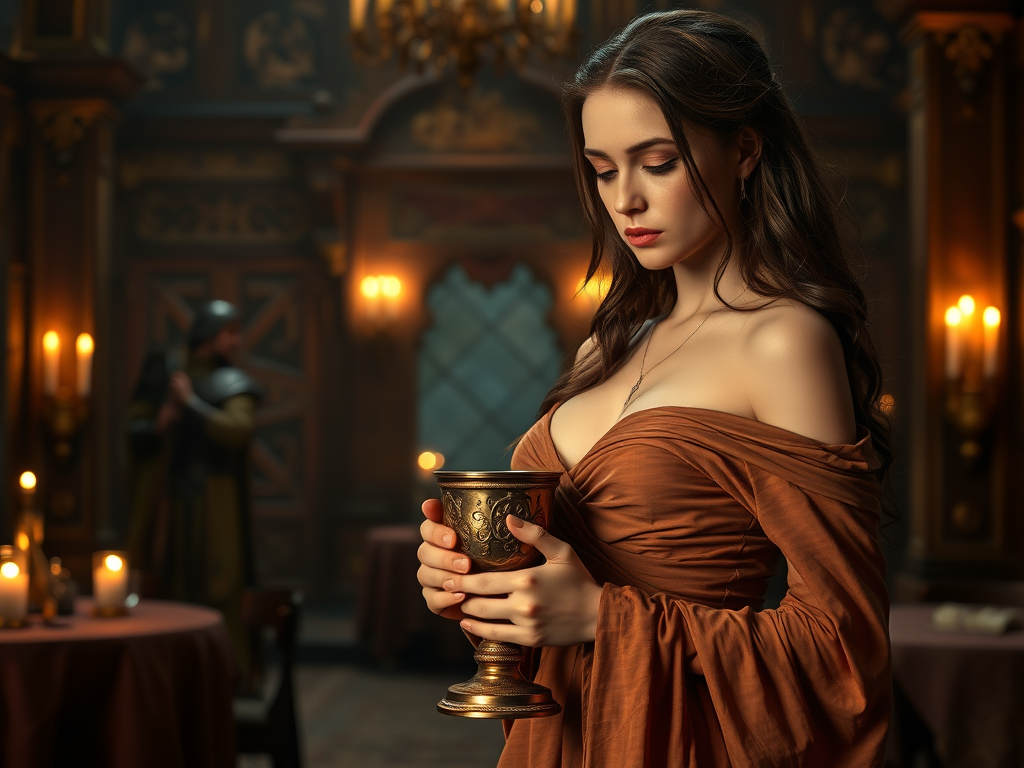
The scene of a slave kneeling gracefully with a cup of wine epitomizes the joy and dignity of service in Gorean philosophy. By examining this iconic ritual, we will discuss the deeper dynamic it illustrates, how Goreans adapt such practices in real life, and why Gor is a full-time philosophy – not a casual BDSM scene. We’ll also touch on how Goreans handle a lifestyle where a man might have multiple partners under his care, and a woman devotes herself to one man, “Natural Order” style.
Importantly, while the Gorean novels are fantasy, the values behind this ritual (honor, devotion, beauty in service) resonate strongly with real-life Goreans. Let’s dive into the scene and its meaning, demystifying why serving wine is so much more than a chore – it’s an expression of love, loyalty, and chosen roles. (For a broader look at core Gorean values, see Series 2.d – Understanding Gorean Natural Order: Philosophy and Modern Life, and for a prior discussion on the joy of service, see Series 3.c.)
An Iconic Gorean Scene: Serving Wine as a Ritual of Devotion
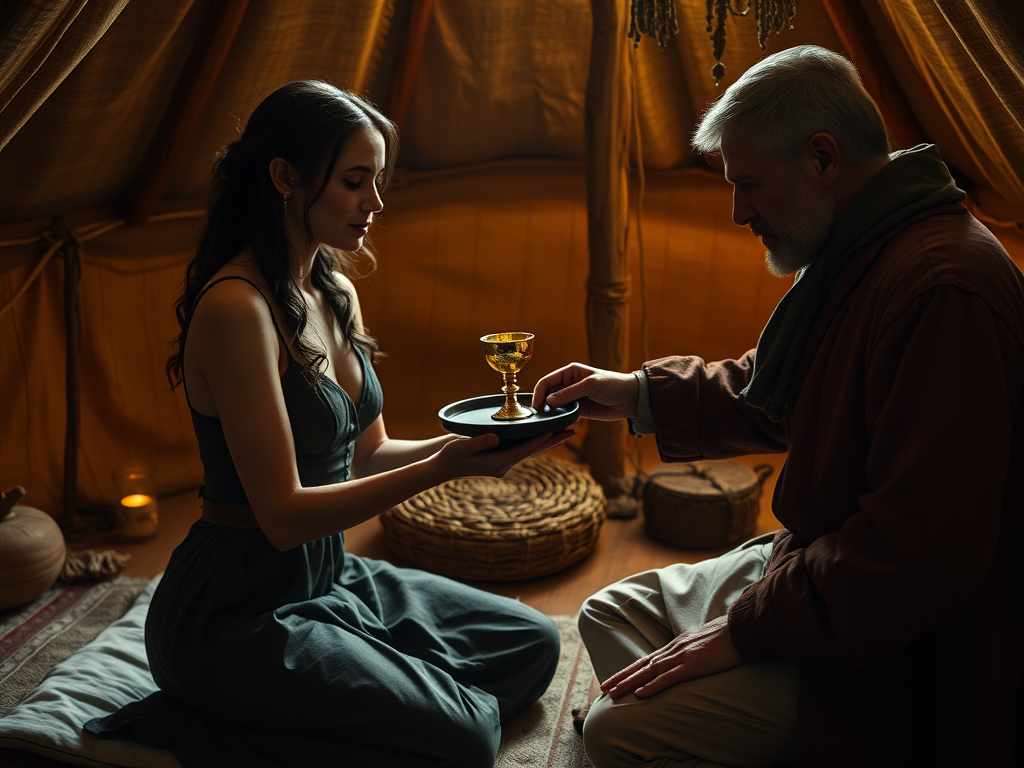
Imagine a grand hall on Gor after a feast. A beautiful slave girl has just finished a graceful dance for the gathered warriors. At the end of her dance, she is given a cup of wine, which she carries to a young man. She kneels before him in the position of a Pleasure Slave – back straight, head bowed, arms extended – and reverently proffers the wine. The man takes the cup and drinks while she remains deferentially posed. In that moment, the exchange is far more than performer-and-spectator or server-and-drinker; it is an intimate ritual. The kneeling girl offers refreshment as if offering her very self – a wordless symbol of submission and pleasure to serve.
Such scenes occur often in the Gor novels, each time highlighting different nuances of the master-slave dynamic. In Nomads of Gor, for example, we meet Aphris of Turia – once a proud, high-born free woman – who finds herself in a situation where she must serve a warrior named Kamchak. Aphris, in an act both humiliating and profound, fetches a bottle of fine Ka-la-na wine from Ar and brings a pouring vessel (crater). “May I serve you?” she asks, now seeking permission to serve the man she once defied.
Under Kamchak’s keen eye (he even watches to be sure she doesn’t secretly poison the wine), Aphris breaks the bottle’s seal, then kneels before him “in the position of the Pleasure Slave”, head down and arms extended, offering him the filled wine crater. In that pose, her former arrogance is gone – she embodies submission, yet there is dignity in her careful, elegant movements. The narrative notes that Kamchak’s eyes glint with approval. By pouring and presenting the wine in this ritualistic manner, Aphris demonstrates a deep change in herself; she has gone from a haughty beauty to a willing servant, and the very act of serving wine is the proof.
Gorean literature spares no detail in describing the grace and care a trained kajira puts into serving. In one scene, a Master commands, “Serve me wine.” The slave – who has been trained in proper service protocol – does not merely slosh wine into a cup and hand it over. Instead, she approaches the task with almost ceremonial precision. In Captive of Gor, a slave girl in a warlord’s tent takes a bottle of vintage Ka-la-na and pours a portion into a small copper bowl. She sets this bowl over a fire to warm (since Goreans often warm their red wine). After a short time, she tests the bowl’s heat against her cheek, ensuring it’s warm but not scalding. Only then does she pour the warm wine into a beautiful serving goblet (a black, red-trimmed wine crater designated for masters).
With a final deep breath to steady herself, she rises and approaches her Master. She then drops gracefully to her knees before him. With both hands, arms extended, head bowed in respect, she holds out the wine-filled crater and says softly, “I offer you wine, Master.” The Master takes the cup. The girl watches anxiously as he sips. When he smiles in approval, her heart leaps – she nearly faints with relief and joy, thankful that she has pleased him and will not face his discipline. This entire sequence shows how a Gorean slave finds purpose in perfecting even a simple service; every motion is done “in service” to honor her owner.
Another striking detail from the books is the custom of a slave kissing the rim of the drinking vessel before handing it to the Master. This kiss is a silent, symbolic gesture – the girl’s way of physically showing that the cup (and by extension, she herself) is offered with love and submission. In Slave Girl of Gor, a newly-enslaved woman initially forgets this detail in her nervousness. Trembling, she fills her captor’s goblet with paga (ale) and extends it to him, but he does not take it. At first she is confused – until she realizes her mistake. “I had, in my confusion and distress, forgotten to place my lips upon the goblet in subservience,” she thinks.
Chastened, she swiftly presses her lips to the metal cup in a quick token kiss. Then, overcome by the emotion of the moment, she boldly kisses it again – lingeringly, lovingly, her eyes closed, as if kissing her Master’s lips by proxy. “I had never kissed a boy on Earth with the helplessness and passion that I bestowed upon the mere goblet of my Gorean captor,” she reflects. “It was as though, with the cup, I was giving myself to him.” When she finally offers the goblet up after this display, her Master accepts it – and in doing so, accepts her devotion. This scene has become almost legendary in the Gorean community for illustrating the total surrender of self a kajira feels in serving: the act of offering the drink is an act of love.
There are countless variations of the wine-serving ritual in the saga, each reinforcing the same message. A trained slave may be ordered to serve any guest present, not just her own master, and she must do so with equal grace. For instance, in Assassin of Gor, a White Silk (virginal) slave named Lana makes a misstep by first offering wine to a stranger (a guest) before her own Master at a banquet – a breach of protocol that earns her a harsh rebuke. “How is it that you first serve wine to a strange man at the table of your master?” scolds Ho-Tu, the House’s Slave Master . Chastened and frightened, Lana tries again. This time she approaches the guest properly – delicately, head down, body posed in a flattering way – and whispers, “Wine, Master?” in a voice that is essentially an invitation.
On Gor, at formal feasts, it’s customary for a host to extend one of his slave girls to serve (and companion) an honored guest for the evening . Each eligible kajira will at some point approach the guest and offer wine. By accepting a cup from a particular girl, the guest is signaling that he chooses her for his pleasure that night . So when Lana offers “Wine, Master?” she is really saying, without saying it, “Do you find me pleasing? May I serve not just this drink, but you?” The guest’s answer – “Yes, I will have wine” – is accompanied by a meeting of eyes and a knowing smile . Lana pours for him, bowing her head and backing away shyly after he takes the cup. In that gentle exchange, we see the joy and dignity of service shine through. The girl is overjoyed to have been chosen; the act of serving wine was both a test of her obedience and an honor she hoped to earn.
It’s worth noting that even those new to bondage in Gor quickly learn that service is an honor, not a humiliation. In Hunters of Gor, a proud woman named Verna watches one of her captive girls pour wine for Marlenus of Ar (a powerful male) after being enslaved. “She poured it differently than she had before. She knelt, her head down… I could see it in her shoulders. She, a slave girl, poured wine for masters. That she was owned was revealed, beautifully, in her serving.”
In other words, once a woman accepted her collar, even something as simple as pouring a drink was transformed – her posture, her attitude, the energy she put into the task all proclaimed her new status with a kind of pride. The ritual of serving wine crystallizes this transformation in a single moment. It’s a dance of submission performed in public, yet done with such beauty and respect that it ennobles both the server and the served. The Master’s dominance and the kajira’s surrender complement each other in the flow of the ritual. When done correctly, both feel a deep satisfaction: he in being respectfully served, and she in finding purpose and joy through service.
The Philosophy Behind the Pour: Joy and Dignity in Service
Why do Goreans put so much emphasis on a seemingly mundane act like handing someone a drink? Because for Goreans, service is a language of devotion. It’s not viewed as menial labor or “just doing chores” – it is a heartfelt expression of love, loyalty, and fulfillment in one’s role. A kajira on Gor exists to serve her Master’s pleasure and comfort, yes, but this is not portrayed as degrading drudgery. Rather, it’s depicted as the natural joy of the submissive female to please the man she adores. The books repeatedly illustrate that a slave derives deep emotional satisfaction from bringing happiness to her Master through her service. When her Master is pleased, she is proud; when he is displeased, she is distraught (not merely from fear of punishment, but from genuine regret at having failed in her purpose).
This mindset is a defining element of Gorean philosophy. It might sound counterintuitive to outsiders – how can serving someone be joyful? The answer lies in Gorean notions of Natural Order and personal purpose. Gor’s ethos holds that being true to one’s nature brings fulfillment. Men on Gor are generally dominant, protective, and desire to lead; women (at least the ones who end up as slaves) are naturally submissive, service-oriented, and desire to yield – when those two halves meet, both find balance. A Gorean slave finds dignity in service because she is actualizing what she feels to be her rightful place in life, just as a Gorean Master finds dignity in protecting and guiding those in his care. It’s a consensual power exchange writ large as a lifestyle.
Modern Gorean practitioners echo this sentiment. They often describe service as “the kajira’s heart song” – an act that, when done consensually, feels right and affirming. In fact, as we’ve discussed before, many who live the lifestyle say that submitting or dominating felt like coming home. The blog previously noted that Gorean “Natural Order” means if you are a man who feels meant to lead and protect, or a woman who feels happiest serving and yielding, you shouldn’t be shamed for it – that’s your nature, and you can live it proudly . This concept is descriptive (for those who resonate with it), not prescriptive for all humanity . In other words, Goreans believe some people are naturally built for these roles, and when they embrace them, it’s beautiful – as illustrated when a slave’s pride shines through in how beautifully she pours wine for her Master.
The dignity of service in Gor is also reinforced by how masters are expected to cherish good service. A true Gorean Master does not take a well-trained, devoted slave’s service for granted or treat it with scorn. On the contrary, in the books, we often see Masters compliment a girl who serves exquisitely or reward her with a smile, a kind word, or a gentle touch. That positive reinforcement is everything to the slave – it validates her efforts and makes her glow with pride.
Consider the scene above where the Master sips the wine and smiles: that smile was the slave’s reward, and to her it was worth more than gold. John Norman (the author of Gor) frequently portrays the psychology of the slave as finding her highest happiness in such moments. When a kajira kneels and presses the cup to her bosom before offering it, or kisses the cup before handing it over, she’s effectively saying, “I give you my whole self along with this drink.” When the Master accepts it graciously, he is saying, “I receive your gift, and I acknowledge you.” This completes a subtle circuit of intimacy and trust between them.
It’s important to demystify a potential misunderstanding: Gorean slaves are not brainwashed robots or miserable drudges. They feel intense emotions and take personal pride in their skills and service. We saw this with the girl who feared she was “not even a good slave” when she nearly spilled the paga – her anxiety wasn’t just fear of punishment, but fear of letting down the man she had already come to love . When she redeemed herself by the beautiful gesture of kissing the goblet, it was a triumphant reclaiming of her dignity as a slave: “See, I remember my duty, and I give my all to it.”
This emotional dimension is why Gorean slaves often describe service as blissful or meaningful. One might recall the saying: “Slavery, done willingly, is a thousand times more fulfilling than freedom accepted resentfully.” While hyperbolic, it captures the Gorean belief that a woman who chooses (in real life) to submit to a worthy man can find tremendous joy in that choice, even in the daily acts of cooking, cleaning, or serving him a drink. It resonates with some people’s innermost desires – to devote themselves completely to someone they adore, or to take care of someone as their prized possession. In Gor, these desires are not only validated but celebrated.
Modern Gorean lifestyle couples often incorporate a version of the wine-serving ritual in their own homes – not as forced theater, but as a mutually cherished routine. For instance, a wife or girlfriend (who consensually identifies as a kajira to her partner) might each evening kneel and serve her companion a glass of wine or tea in a special way. She may have her own elegant style of presenting it – perhaps using a specific graceful pose they both enjoy – and he, in turn, might have a ritual of acknowledging her (maybe taking the drink and then kissing her forehead or saying, “You serve beautifully, my love”).
These kinds of private rituals reinforce their bonds. Far from feeling oppressed, the submissive partner feels seen and valued for her gift of service, and the dominant partner feels honored and satisfied. It’s a positive feedback loop that outsiders may not “get,” but those within the dynamic thrive on. (Many readers who follow our blog know this from personal experience or from witnessing Gorean couples interact – the radiance of a content kajira serving her Master is hard to fake.)
In Gor’s fiction, a slave’s entire day is structured around service – from warming his bath water, to cooking his meals, to laying out his clothes, and yes, to pouring his wines. The consistency of these acts is what makes the Gorean lifestyle so different from a casual BDSM scene. Which brings us to an essential point: Gorean life is a life, not a role-play.
Gor vs. BDSM: A Lifestyle of 24/7 Philosophy, Not Occasional Play

At a glance, someone might see a kneeling woman offering a cup and think, “Ah, this is just a kinky BDSM tea ceremony.” But Goreans assert that Gor is not BDSM – at least, not in the way people normally understand BDSM. Yes, both involve power exchange, and you’ll find masters and slaves in both Gorean circles and BDSM dungeons. However, the intent and scope are vastly different. BDSM is often regarded as a bedroom activity or a set of erotic role-playing scenarios – something people do for a few hours to spice things up, then go back to egalitarian life when the scene ends.
Gor, by contrast, is an entire philosophical worldview and way of life. One Gorean writer, Ubar Luther, put it succinctly: “Gor is not simply a subset of BDSM or D/S. Though there are some similarities…, the differences far outweigh [the similarities]. Gor encompasses a vast array of additional matters that have nothing to do with BDSM or D/S.” In other words, Gor goes beyond the bedroom – it’s about living according to certain principles (honor, order, responsibility, natural roles) every day, in all aspects of life.
So when a Gorean slave serves her master wine, it’s not a scripted “session” – it’s just Tuesday evening in their household. The dynamic doesn’t turn off when the wine is drunk. She remains in her submissive role and he in his dominant role seamlessly, whether they’re in private or public (within the bounds of what’s socially acceptable in public, of course – a Gorean couple in public might be subtler, but the hierarchy between them remains).
This is why we say the Gorean lifestyle cannot be partial or occasional. A person who identifies as Gorean embraces those values full-time. It’s integrated into daily routines and relationships. As one series article explained, “Gor isn’t a costume – Gor is a structure of living.” You don’t play a master or slave on weekends; you are one, continuously aligning to that identity in how you act and even think.
This doesn’t mean Goreans ignore consent or safety – quite the opposite. In fact, Goreans often stress that because their power exchange is so deep and continuous, it requires even more awareness and ethical grounding than a casual BDSM scene. We discussed this in Series 3.b on Emotional Safety: “Embarking on a Gorean-inspired relationship is not a free-for-all of dominance; it’s a deliberate dance built on trust, clarity, and care. In fact, the deeper the power-exchange goes, the more important it is to ground it in consent, open communication, and proper aftercare.” Gorean or not, Safe, Sane, Consensual still applies. The difference is that Goreans are trying to live a consistent D/s polarity within a real relationship (often a loving marriage or partnership), not just during erotic play. This approach actually parallels what some in the BDSM community call “24/7 lifestyle D/s,” but Goreans live it with their unique lore and philosophy from Norman’s books.
To illustrate the contrast: In a BDSM context, a submissive might perform a formal “wine service” as a one-time scene in a dungeon or at a fetish party, possibly in costume and following a high-protocol script, and then once the scene is over, that formality is dropped. In a Gorean home, a similar ritual might happen nightly at dinner, because it’s simply their way of maintaining the respectful dynamic between Master and kajira. The first scenario is essentially entertainment or erotic roleplay; the second is an expression of genuine hierarchy and affection embedded in their relationship. Neither is inherently better or worse – but they are different in tone and intention.
Goreans also broaden the scope beyond personal sexuality. The philosophy entails ideas about honor, duty, courage, self-improvement, connection to nature, community, and more – elements not typically part of BDSM. John Norman was a philosophy professor, and through Gor he explores what he imagines as a more “natural” way humans might organize society and relations if stripped of certain modern norms. Thus, Gor has its own codes (Warriors have their codes of honor, for example), its emphasis on honesty (a Gorean’s word is like law, as noted in Series 2.9), on facing challenges, etc. Slavery is just one facet (albeit the most sensational) of a much broader tableau.
In the Gorean community, you will meet people who focus on the philosophical side – discussing evolution, societal structures, the Home Stone concept of home/family loyalty – as much as, if not more than, the erotic side. This again sets them apart from a typical BDSM crowd where the focus is usually on the play and fetish aspects. One could say BDSM is an activity, whereas Gor is an identity and lifestyle (with activities flowing from it).
As Ubar Luther noted, the general public often mistakenly lumps Gor in with BDSM because of the master/slave imagery, but those who study it realize Gor is its own beast . The lifestyle has diverse practitioners: some who do elaborate role-play online as if living on Gor, some who approach it more intellectually (weaving Norman’s ideas into self-help or relationships), and some who are lifestylers living as master and slave in the real world. What unites them is a shared acceptance of Gorean philosophy to whatever degree suits them.
For our purposes, focusing on real-life lifestylers: A Gorean couple might look, on the surface, not too different from a traditional patriarchal couple or a Master/slave BDSM couple. But mentally, they see themselves through the Gorean lens. The Master might hold himself to a standard of Caste-like responsibility (even if Castes aren’t literal on Earth, he may value being excellent at his profession as part of being Gorean) and personal honor.
The slave might pride herself on being utterly feminine and pleasing “in the modality of the female,” as Norman would phrase it, which includes domestic service as well as sensuality. Both often feel that Gorean ethos gives deeper meaning to their roles – it’s not just “I like being dom and sub,” but “I believe men should lead and women thrive when they yield, and we’re living according to that belief.” They might even incorporate rituals described in the books (like wine serving, ceremonial recitation of “I am your slave,” etc.) to reinforce that identity.
Another key philosophical difference: Choice. In the fictional world of Gor, slaves have no choice – they are owned as property in a very literal sense. But obviously in real life, consent is the foundation. Gorean lifestylers acknowledge that the only ethical way to live this out on Earth is for all parties to agree to it. We’ve emphasized before (and it bears repeating) that a Gorean-style relationship in reality is only valid if it’s voluntary on all sides . The novels give the fantasy of “no choice” because that heightens the drama, but actual people always have a choice; as we often say, “slave by choice” is the operative concept.
In fact, Norman paradoxically frames absolute submission as a woman’s ultimate choice – the idea that a woman chooses to surrender as the fullest expression of herself . Whether one agrees with that or not, it underscores that will and consent are crucial even in embracing a seemingly traditional role. A real-life kajira is not truly property under law – she’s a consenting adult who chooses to live as if she were her partner’s property. It’s an important distinction that responsible Gorean lifestylers keep in mind to avoid crossing into abuse.
So, while a Gorean Master might not use a safeword (since they don’t consider their life a “scene” to safeword out of), he absolutely has ongoing, informed consent from his partner for the overall dynamic. If that consent were ever withdrawn, the relationship would fundamentally change (or end). This is similar to any 24/7 Master/slave arrangement in the BDSM world – you consensually negotiate a power dynamic that stays in effect long-term, but the submissive always retains the ultimate right to revoke consent (even if, within the role, she behaves as if she has no rights).
Good Gorean couples communicate extensively about limits, desires, and emotional well-being, just as any healthy couple should. In fact, many Gorean community leaders actively educate newcomers to avoid abusive fakes who might misuse Gorean rhetoric. They stress red flags, like any man who says “I’m a Gorean Master, you must obey me because the books say women are slaves” to a stranger – that’s nonsense and a sign of a predator. Gorean relationships, like BDSM ones, require mutual respect and trust. Without those, you have toxicity, not Gor.
From Page to Practice: Adapting the Wine Ritual in Real Life

Now, given that understanding, how do modern Goreans practically express something like the wine-serving ritual in a healthy way? It’s all well and good to read about voluptuous slave girls trembling with passion as they serve Ka-la-na, but how does a 21st-century couple make use of this idea without it becoming either corny play-acting or, worse, crossing someone’s comfort boundaries? Here are some insights and adaptations:
- Set the Stage Together: Communication is key. A couple interested in Gorean dynamics should discuss which rituals excite them and why. If the idea of a formal serving ritual appeals, talk about what it will involve. For example, the submissive might wear something special (or be nude, if in private and comfortable), assume a certain graceful posture, and use specific words (“Your wine, Master,” etc.). The dominant should reciprocate with appreciative words or gestures. Designing the ritual together ensures it’s consensual and meaningful for both. Maybe the Master enjoys the aesthetic of his lady kneeling; maybe the kajira enjoys the feeling of focusing completely on a task of pleasing him. Include those elements. The goal is to create a moment that both find fulfilling.
- Keep it Safe and Comfortable: In the books, a slave may be in bondage or an uncomfortable position for dramatic effect. In real life, ensure the position chosen is physically safe. For instance, a common Gorean pose is nadu (kneeling with thighs open, back straight). Many women find this elegant and not too uncomfortable for short periods – it can be used while serving. But if one has bad knees, you adjust (maybe kneel on a cushion, or do a standing bow instead). If hot liquids are involved (say, tea or coffee analogous to black wine), be careful – no one wants real burns from a fantasy! A modern kajira can certainly warm her master’s drink as described in the books, but she should test temperature cautiously (Norman’s detail of testing against the cheek is actually a good safety tip!). Always remember that the real beverage is less important than the attitude. If spilling is a concern, practice with water until confident. A caring Master would rather have a sincere but imperfect service than see his partner anxious to the point of shaking. Gorean service is about love, not perfectionism.
- Emotional Safety and Aftercare: Yes, aftercare – a term from BDSM, but applicable here too. If either partner finds the ritual emotionally intense (and it can be, as that Slave Girl of Gor scene shows!), make time afterwards to reconnect in a relaxed, loving way. Maybe after the Master finishes the drink, he pulls his slave into his arms and thanks her, or they cuddle. The novels rarely show explicit aftercare, but remember, those are often action-adventures where the emotional processing isn’t on the page. In real life, do check in with each other. A simple “How did that feel for you?” goes a long way. Ideally, it felt erotic and bonding. But if something felt off (perhaps the slave felt self-conscious, or the Master felt awkward maintaining a stern facade), talk about it and adjust next time. The ritual should strengthen your connection, not create distance.
- Consistency with Flexibility: If you adopt a ritual like nightly wine service, consistency helps it become a cherished tradition. However, life is life – sometimes you’re too tired, or kids are around, or company is over. A Gorean lifestyle doesn’t mean you must perform a formal serve no matter what. Adapt to circumstances. Maybe when alone you do the full ritual; in subtle public settings, the slave might simply pour quietly and give a knowing glance instead of kneeling – a private signal of the dynamic. Goreans are not interested in violating public decency or local laws (remember “when in Rome, do as the Romans do” – Goreans are mindful to blend in to avoid trouble ). So the ritual might be symbolic in those times (e.g., she always hands him his drink first at a restaurant, with a subtle “Tal, Master” under her breath that only he hears). The understanding between them is what counts.
- Training and Mastery: Many in the Gorean lifestyle enjoy the training aspect – the Master teaching the slave how he likes things done. The wine ritual is a perfect example. A Master might spend time showing his kajira the exact way to hold a goblet, how low to bow her head, how to time her words, etc. This can be a very erotic and bonding experience in itself. It’s essentially a loving form of instruction and obedience practice. The slave learns to be attuned to his preferences; the Master learns to be patient and clear in his expectations. Over time, as the kajira’s skill grows, both will take pride in how polished and “Gorean” their private ceremony looks and feels. It becomes their thing. If mistakes happen, a Gorean Master doesn’t fly into a rage – ideally, he corrects calmly (unless they both enjoy a bit of theatrical discipline as kink). The point is to eventually achieve that near wordless perfection where she knows just how he likes his wine and he can trust it will be done beautifully. This deepens trust on both sides.
- Remember the Romance: Gorean relationships are intense, but they are also deeply romantic in a traditional sense. The wine-serving scene, at its heart, is romantic: a woman expressing devotion; a man showing acceptance and gentle appreciation. Focus on that feeling when you do it. It shouldn’t feel like a cold obligation or a meaningless gesture. Small touches – like maintaining eye contact for a moment as he takes the cup, or him brushing her cheek after – keep the warmth in it. Some couples even incorporate sayings: The slave might whisper “La kajira” (“I am a slave girl”) as she offers the cup, reaffirming her identity in a loving way, and the Master might respond with something like “You are mine” as he accepts – whatever words give them butterflies. Make it yours, make it affectionate.
By adapting the spirit of the Gorean ritual to modern life, couples find that these acts can create a powerful anchor for their dynamic. One real-life kajira shared that each time she kneels with her husband’s evening drink, “my love for him just overflows – it’s like a meditation on our roles.” Another Gorean Master wrote that the first sip of wine his slave offers each day “tastes like loyalty, if loyalty had a flavor.” These poetic sentiments show how ritual can enrich a relationship when approached in a consensual, mindful manner. The actual wine or beverage is irrelevant – it could be fine mead or a can of soda – it’s the intent behind the serving that carries weight.
And importantly, no one is perfect 100% of the time. There will be days your pour is clumsy or the Master is grumpy and barely notices the nice job you did – we’re all human. Gorean philosophy isn’t about play-acting flawless characters; it’s about striving for an ideal but also showing forgiveness and flexibility. A kajira can still feel joy in service even if her Master sometimes just says a curt “thanks” and not much more – because she knows, in the larger picture, that he values her deeply. Likewise, a Master might usually hold high standards but occasionally chuckle if his beloved slave accidentally tracks in mud while kneeling – he’s allowed to be amused and loving, not stern 24/7. The genuine affection and understanding between them is what makes the dynamic stable.
Natural Order in Action: One Master, Multiple Kajirae – and Why It “Feels Natural”
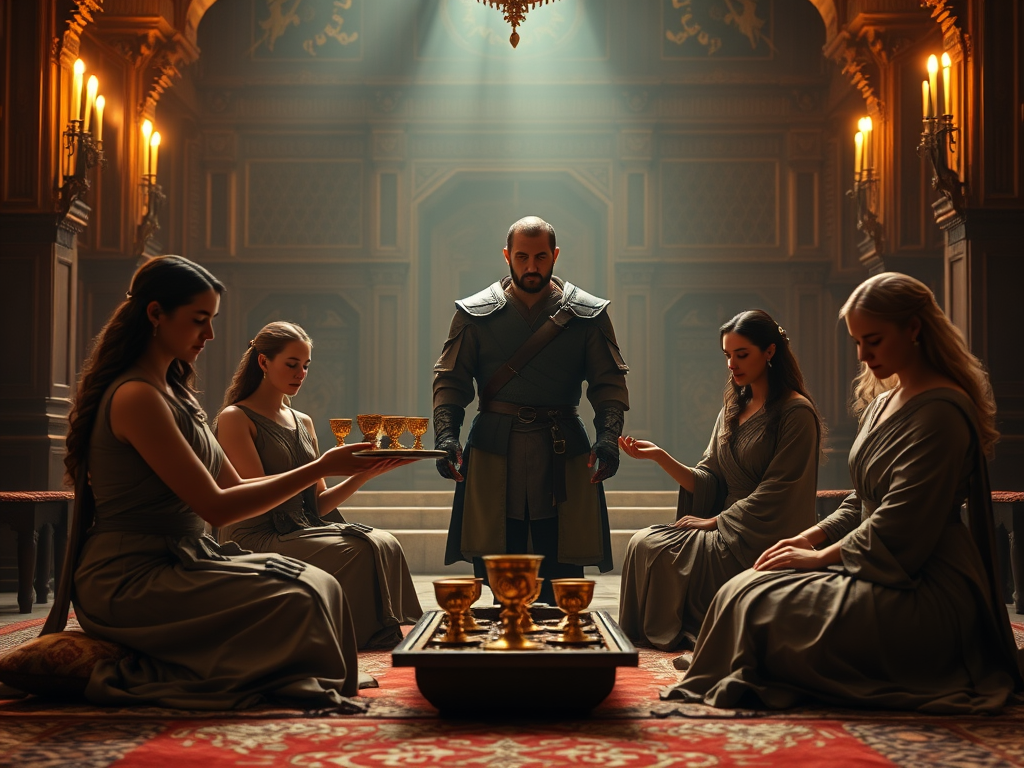
We cannot discuss the ritual of serving wine without touching on a related aspect that often raises eyebrows: in many Gorean scenes, one man is being served by multiple women. At that banquet in Assassin of Gor, for instance, there were fifteen slave girls present, all eager to serve the men . In the books, it’s common for a wealthy or powerful Gorean man to own a harem of slaves, and even free companions (wives) accept that their men might have additional slave concubines. This reflects what Goreans call the “natural order” or complementarity of the sexes: the male’s instinct to lead, spread his line, and command multiple females, and the female’s instinct to devote herself to a worthy male (and, if necessary, share him).
To many modern people, especially given our monogamy-centered culture, this idea sounds provocative or even offensive. But Goreans argue that history and biology are on their side when it comes to polygyny (one man, multiple women) being a natural, if not predominant, pattern for humanity. Anthropological research does show some fascinating data: about 85% of pre-industrial human societies permitted polygynous marriage (i.e. a man could have more than one wife).
In other words, before modern norms enforcing strict monogamy took over in many places, the vast majority of cultures accepted plural wives for those men who could afford to support them. Monogamy as the near-universal standard is actually a relatively recent development in human history (roughly in the last 10,000 years, coinciding with agriculture and more complex societies).
Our Stone Age ancestors, living in nomadic or tribal settings, likely practiced a mix of mating strategies – some pair-bonds, but also a lot of polygyny among high-status males. Biologists even characterize humans as “mildly polygynous” by nature, meaning that while we’re not as extremely polygynous as, say, gorillas (where one alpha male monopolizes many females), we’re also not truly monogamous like certain bird species. There are physical and social indicators that prehistoric males often competed for mates and that successful males had multiple female partners, whereas many less successful males had none .
Genetic evidence is especially striking: DNA studies suggest that throughout human history, far more women than men have reproduced. One genetic analysis found that “overall, more women reproduced than men” – meaning many women shared a smaller pool of men as fathers of their children . The researchers explained it bluntly: “not all men are able to afford wives, or sometimes a few men will have many wives.” In many societies, a minority of men (the most desirable or powerful) fathered children with multiple women, while a significant number of low-status men left no progeny .
This is classic polygyny at work, leaving a deep imprint in our gene pool. It implies that, from an evolutionary standpoint, men who could attract or acquire multiple women did so, and women often opted to be the second or third wife/partner of an high-quality man rather than the only wife of a lesser man. This is sometimes called the “female choice” in polygyny – women are not mindless chattel in this equation historically; often, they preferred sharing a strong provider to having a weak provider all to themselves.
Evolutionary psychology builds on this: human males, with their relatively limitless reproductive potential (a man can biologically father dozens of children in a year, whereas a woman can bear one child in that time), often have a drive to mate with multiple partners to spread genes. Females, with their high investment in each offspring (pregnancy, nursing, etc.), tend to be choosier and seek a mate of high status, resources, or genetic quality – even if that means he might have other mates.
In raw terms, a woman might rationally prefer being the cherished second wife of a rich, strong man than the only wife of a poor, weak man. Thus, women’s innate inclination might be to focus devotion on one strong partner, even if he isn’t exclusively hers (provided her needs and her children’s needs are met), while men have an innate inclination to seek multiple partners once they have resources/power .
Sound familiar? It’s basically the Gorean model in scientific terms. A direct parallel is drawn in the text: “men have an innate drive to seek multiple partners, and women have an innate inclination to focus their devotion on one strong partner – even if that man might not be exclusively hers.” This is exactly how Gorean “Natural Order” is structured. The Gorean Master expects to have several women serving him (if he has the means and merit), and the Gorean kajira is expected to be utterly devoted to her one Master (setting aside jealousy, trusting in his protection and care).
Far from being some outlandish sci-fi kink fantasy, this setup echoes a pattern we see repeatedly in human history and across cultures . Consider historical examples: ancient kings and emperors commonly had harems; polygamy is recorded in the Bible and practiced in many traditional societies; even in ostensibly monogamous European societies, powerful men often kept mistresses or serially married multiple young women over their lives. All these point to one thing: “there is nothing bizarre or perverted about one man having multiple women in his life; it has been common and ‘normal’ throughout history.”
That said, just because something was common doesn’t mean it’s easy or without challenges – especially in a modern context. Jealousy is a human emotion that certainly exists on Gor (slave girls in the books frequently struggle with jealousy of each other) and it certainly exists in real-life poly-style relationships. The difference is, in the Gorean ideal, jealousy is something a slave girl is taught to overcome as part of her submission. In the books, a kajira who shows open jealousy or attempts to undermine a fellow slave might be punished.
She is reminded that she is a slave and must gracefully accept her Master’s right to own others; her focus should be on being the best she can be, not on resentment. Of course, fiction can will away a lot of messy feelings or have them resolved via a firm whipping – real life is more complex. In a consensual modern arrangement where, say, a husband has two consenting partners (perhaps one is his legal wife and the other an agreed-upon secondary partner or slave), you cannot simply whip away feelings of jealousy or insecurity. You have to manage them with communication, empathy, and fairness.
The good news is, multiple-adult relationships can work – many people (especially in polyamorous or swinger communities) have created happy triads, harems, and other configurations. Goreans specifically tend toward a polygynous model (one Master, several women who are either slaves or perhaps one First Wife and several slave-girls). We ourselves see this dynamic in our community – there are Gorean households with one Master and two or more kajirae living in harmony. How do they do it? A few key ways, which any aspiring Gorean dominant with multiple submissives should heed:
- Strong Leadership with Fairness: The Master must be emotionally intelligent and fair in his dealings. He should give each woman attention and make each feel valued for her unique contributions. In practical terms, this might mean scheduling quality time with each, not always favoring one over others in a way that breeds resentment (unless one is the “First Girl” in the pecking order, but even then a wise Master shows care to all). The Master sets the tone: if he acts like the women are interchangeable toys, they will feel insecure and jealousy will rage. If he instead fosters a sense of family or team – “you are all mine, and I care for each of you” – then the women can bond and support each other rather than compete viciously.
- Open Communication & Reassurance: In any non-monogamous setup, transparency and reassurance are vital. The Master should encourage his partners to voice concerns or feelings privately to him without fear. And he should actively reassure them of their place. As one poly relationship guide suggests, “assure [your partners] of your love and that despite constraints of physical together time, your emotional commitment to them is full time and unchanged… Reassure them when they need it; it’s a chance to show your love.” In a Gorean context, a Master might say to a jealous kajira, “You are mine and I cherish you. Yes, I have another, but that does not diminish your value to me.” Simple affirmations can do wonders. Also, ensure each woman knows what her strengths are – maybe one is the best at cooking, another at singing to him, another at intellectual conversation – so she can feel proud rather than thinking she’s in competition on every metric.
- Define Roles and Hierarchy: Goreans often establish a clear hierarchy among multiple slaves to reduce conflict. For example, a “First Girl” (senior slave) may be appointed – she helps keep the others in line, and in return enjoys a bit of extra privilege or responsibility. The others know to respect her position. This can channel rivalry into a productive avenue: if a lower girl is jealous, her avenue to “rise” is by improving herself, not by tearing down her sister. The Master can use mild competition positively (“who can decorate the serving tray more beautifully tonight?”) but should never tolerate malicious sabotage or disrespect between his women. They are all on the same team – his team – and he should remind them of that. Also, each needs clearly defined duties so they aren’t all jostling for the same task. One might be in charge of pouring wine, another of fetching his slippers – then each has a sphere where she shines.
- Emphasize Sisterhood (Chain-Sisters): Gorean slaves owned by the same Master often refer to each other as “chain-sisters.” A good Master cultivates camaraderie among his slaves. He might have them work together on projects (like two girls performing a tandem dance, or collaborating to prepare a feast). Shared positive experiences build friendship. If the women genuinely like or at least respect each other, jealousy decreases. Many polygamous families in real life report that the wives became close friends – almost like sisters – and provided support for one another. In a Gorean household, while the dynamic is different (one is not a legal wife but a slave), friendship can absolutely blossom. The Master can encourage this by never playing them against each other in a cruel way and by praising teamwork.
- Internalize the Philosophy: Ultimately, the women in a Gorean multi-partner setting need to truly believe in the lifestyle’s tenets to find peace. A kajira who understands and accepts Natural Order will remind herself that “He is Master; it is natural he may have many. I am slave; it is natural I am devoted to him.” This doesn’t erase twinges of envy, but it frames them. In the books, slaves often have to undergo a personal growth where they conquer their ego and jealousy, learning to delight in their Master’s happiness even if it’s another girl currently pleasing him. In real life, that level of selflessness is challenging, but it’s a noble ideal to work towards. Masters can help by being consistent and not showing favoritism whimsically – if the women know that the Master’s love is abundant and each has her secure spot, it’s easier for them to relax and even take joy in watching another sister please him (some get vicarious pleasure from it, sharing in the happiness rather than feeling threatened).
The trend today is that such alternative arrangements, while not mainstream, are more visible and accepted than before. Consensual non-monogamy – whether open relationships, polyamory, or polygamy – is quietly on the rise. Surveys in the US and elsewhere suggest about 1 in 5 people have tried some form of consensual non-monogamous relationship in their lifetime, and around 4–5% of the population is currently in one . That’s millions of people.
And interestingly, many of these modern arrangements echo the polygynous style (one man with multiple women) – not because of sexism, but often because it naturally emerges from common desires. Even in the broader polyamory scene (which is usually egalitarian), there are plenty of “vee” relationships (one person with two partners) where that one person is male and the two partners are female. Society is slowly acknowledging that monogamy isn’t one-size-fits-all, and that for some, multiple partners works better . The Gorean community is a specific subculture within that broader phenomenon, one that adds a distinctive power-exchange flavor and traditional male-led household structure to the mix.
We should note that ethical non-monogamy requires all parties’ consent. In Gorean terms, a Free Companion (wife) must consent if her companion takes on a slave-girl as a lover, otherwise he’s just cheating under another name (not honorable!). And any new slave or partner introduced should know the arrangement upfront. Honesty is crucial – deceit is anti-thetical to Gorean honor. Many Gorean men actually remain monogamous in real life despite the ideal, either because they don’t have the opportunity or they choose to focus on one relationship. But the concept that it’s “natural” for a man to have more than one woman is generally accepted in the community, and if the chance arises and all agree, it’s embraced without guilt.
For the female Gorean (slave or free companion), it’s often emphasized that jealousy is a sign of not fully embracing your role. That may be a bit harsh – jealousy is natural – but the idea is to encourage a mindset shift. Rather than seeing a second woman as a threat, a Gorean woman tries to see her as an expansion of the household, someone who brings additional skills or companionship to the group (and who may take pressure off her in serving the Master, even!).
It’s a very different perspective from modern Disney-style romance where one True Love supplies 100% of everything. Goreans are more pragmatic and, they’d say, realistic about human nature. They might argue that many monogamous men secretly or eventually take lovers or second wives (historically), so why not approach it honestly and within a value system that makes it harmonious? Whether one agrees or not, it’s a viewpoint rooted in both their read of history and their personal inclinations.
Of course, the Master must also manage his own feelings. He may not feel “jealousy” in the same way if his women are only his, but he must guard against favoritism or neglect. And if his slave shows jealousy, he shouldn’t react with scorn or anger alone; he should also show leadership by addressing the underlying need. Maybe one girl feels insecure that he doesn’t spend time with her lately – the fix might be as simple as a planned day out with just her.
Assure, then reassure, as the poly advice goes: “Assure them of your love… Reassure them when they need it… Console them when they miss you.” These compassionate actions do not make a Master “weak”; on the contrary, they show he is in full command of his household’s emotional well-being. A Gorean Master takes responsibility for the happiness and health of those under him (just as a patriarch in olden days would tend to the welfare of his family, servants, etc.). This sense of responsibility is evident in the books too – masters often discipline jealousy not just to be cruel, but to restore order and peace in the harem, which ultimately is for everyone’s good.
Finally, it’s worth reinforcing: while Gor allows a man many slaves, it absolutely expects monogamy from the women. A slave must be totally devoted to her one Master. In fact, in Gorean law, if a slave girl even looks at another man without permission, it’s a punishable offense. Now in real life, obviously a slave isn’t a legal property, but the spirit remains: a committed kajira chooses to make her Master the center of her world. This one-sided exclusivity rubs some people the wrong way (“so he can play with many, but she can only have him?”), but Goreans would argue it’s a natural asymmetry – again citing biology (women invest more, are choosier, etc., so they select one mate; men can spread, so they don’t stick to one).
And critically, the women involved agree to this. A female who wants multiple partners for herself probably wouldn’t be happy in Gor; Gorean lifestyle is more appealing to those women who want that one heroic figure to serve and aren’t interested in other men anyway. It’s a personality thing. When everyone’s inclinations align (the man comfortable with multiple partners, the women content with one man), these arrangements can actually be quite stable and loving. There are Gorean families (and poly families in general) that last decades, raise children, etc., debunking the myth that such setups are inherently doomed.
Conclusion: Service as the Heart of Gor’s Lifestyle

The ritual of serving wine distills many of the themes we’ve discussed across this blog series: honor, trust, beauty in traditional roles, and the idea that fulfilling one’s nature brings satisfaction. It’s a scene that the Gorean community holds up as iconic because in that simple interaction – a woman kneeling with a cup, a man accepting it with a look – you see a entire philosophy at play. The kajira demonstrates submission, love, excellence in service; the Master demonstrates command, appreciation, magnanimity in receiving it. Both demonstrate choice – she chooses to serve with joy, he chooses to lead and care for her (and perhaps others) with fairness.
For newcomers reading this, it’s crucial to understand that everything is consensual despite the unequal roles. The slave wants to be there, serving that wine; the master earns that devotion by being the kind of man she can trust and idolize. When those elements click, the act isn’t degrading at all – it’s uplifting. One might even liken it to a dance or a religious ritual, something almost sacred to the participants. Indeed, many Gorean couples describe their dynamic in spiritual terms: the slave finds freedom in surrender, the master finds purpose in responsibility. The wine serve is simply one of the clearest outward expressions of that inner bond.
If you find yourself drawn to these ideas, you’re not alone – and you’re not strange. As we’ve shown, aspects of the Gorean lifestyle echo age-old human practices and desires. There’s no “right way” that fits everyone, but for those who resonate with it, living with a Gorean ethos can feel deeply authentic. Whether it’s incorporating small rituals like this into your love life or fully embracing a 24/7 consensual power exchange, the key is to do it with open eyes and open hearts. Communication, consent, and ethical behavior are what separate a beautiful Gorean relationship from a toxic situation.
For many, Gor offers a framework to explore male dominance and female submission beyond the bedroom, anchored in values and continuous commitment. It’s definitely not politically correct or mainstream – but that’s part of why it speaks to some, offering an alternative to modern egalitarian norms that, for them, is more satisfying. As we demystify these concepts, it becomes clear Gor isn’t about hate or oppression; it’s about mutual fulfillment through complementary roles. The wine ceremony exemplifies how something as ordinary as serving a drink can be elevated into a meaningful exchange of honor and devotion when viewed through the Gorean lens.
In closing, the ritual of serving wine has indeed shaped the Gorean community by giving them a tangible practice to rally around. Attend any Gorean gathering (online or in person), and sooner or later you’ll witness a version of this serve – each slightly unique, but all done with that recognizable mix of pride and reverence. It inspires newcomers and reaffirms veterans. It reminds everyone that “slave” is not an insult in this context, but a cherished role, and “master” is not a tyrant, but a beloved leader.
Next in this series, we will continue examining scenes from Gor that have influenced how lifestylers live and love. From legendary love stories to tests of loyalty, each has lessons to impart. We hope this deep dive into the “Joy and Dignity of Service” encourages you to explore further. If this topic intrigued you, consider reading Series 3.12 – The Joy of Service in Gorean Life which delves even further into how service functions as a “language of devotion” in Gorean relationships, or Series 2.6 – Freedom, Choice, and Voluntary Surrender to understand the paradox of finding freedom in chains.
Thank you for reading, and Tal (greetings) until next time! Serve with joy, lead with honor, and drink deeply of life – that’s the Gorean way.
Sources & References:
- Norman, John. Outlaw of Gor. (Quote on dance ending with wine serve) .
- Norman, John. Nomads of Gor. (Aphris of Turia serving Kamchak) .
- Norman, John. Assassin of Gor. (Lana’s corrected wine offering and guest selection ritual) .
- Norman, John. Captive of Gor. (Detailed wine warming and serving ceremony by a slave) .
- Norman, John. Hunters of Gor. (Owned status revealed beautifully in how a slave pours wine) .
- Norman, John. Slave Girl of Gor. (Slave passionately kissing the goblet in subservience) .
- Gorean Lifestyle Blog – GOR vs BDSM (by Ubar Luther) – on differences between Gorean lifestyle and BDSM .
- Gorean Lifestyle Blog – Series 3.b: Emotional Safety in Gorean Dynamics – on grounding power exchange in consent and care .
- Gorean Lifestyle Blog – Demystifying Natural Order – explaining Gor’s natural order as embracing one’s nature, not enforcing a universal rule .
- Polyamory resource (UK) – advice on handling jealousy by assuring love and commitment despite time constraints .
I wish you well!
©2026 – Written by Azrael Phoenix
- Follow on Facebook: GorByPhoenix
You can read the full set of articles of this Series here:
- Series 1 – Start Here: Understanding the Gorean Lifestyle
- Series 2 – The Philosophy: Values Behind the Gorean Lifestyle
- 2.a – Honor, Responsibility and Discipline: The Core of Gorean Philosophy
- 2.b – Freedom, Choice and Voluntary Surrender: A Paradox at the Heart of Gor
- 2.c – Strength and Vulnerability: The Gorean View of Masculinity and Femininity
- 2.d – Understanding Gorean Natural Order: Philosophy and Modern Life
- 2.e – Aligning Words and Actions in Gorean Life
- Series 3 – Practicing a Gorean-Inspired Lifestyle (Safely & Ethically)
- Series 4 – Reading Gor: Guides, Themes, and Character Studies
- 4.a – Where to Start with the Books of Gor
- Part 1 – A Reading Guide for Newcomers
- Part 2 – Saga in Stages: Phases of the Gorean Journey
- Stage 1 – The Early Adventures (Books 1–6): From Earthman to Gorean Warrior
- Stage 2 – Broadening Horizons & Deeper Themes (Books 7–13): New Perspectives on Gor
- Stage 3 – The Jason Marshall Trilogy (Books 14–16): A New Tale of Submission and Identity
- Stage 4 – War and Upheaval (Books 17–25): The Epic Gorean War and Turning Point
- Stage 5 – The Saga Resumes (Books 26–33): New Century, New Faces, and the Gorean Renaissance
- Stage 6 – Climactic Conclusions (Books 34–38): A New Resolve and the Future of Gor
- Part 3 – The Philosophy Behind the Fantasy: How Gor Evolved (and Why It’s Not Just “Erotic Pulp”)
- Part 4 – Major Pivotal Books & Moments in the Saga
- Part 5 – Where to Find the Gor Books (Legally and Easily)
- Part 6 – Confronting the Controversies: Misconceptions and Reality-Checks
- 4.b – 10 Scenes That Shaped the Gorean Lifestyle Community (and Why)
- Part 1 – The Home Stone of Port Kar – Loyalty and Belonging in Action
- Part 2 – The Fall of Tharna – When Natural Order Overturns a Matriarchy
- Part 3 – From Proud Beauty to Serving Slave – Aphris of Turia’s Surrender
- Part 4 – “La Kajira” — An Earth Woman’s First Surrender of Self
- Part 5 – The Ritual of Serving Wine – The Joy and Dignity of Service
- 4.a – Where to Start with the Books of Gor
Series 4.b – 10 Scenes That Shaped the Gorean Lifestyle Community (and Why) – Part 4: “La Kajira” — An Earth Woman’s First Surrender of Self

There are “big” Gorean moments—raids, battles, city politics, the clash of castes and cultures. And then there are moments that are almost quiet, almost ordinary… until you realize they are psychologically irreversible.
For me, “La Kajira” is one of those irreversible scenes.
It’s not a love scene. It’s not even, in the narrow sense, a “submission scene.” It is a language lesson—a single phrase forced through clenched pride. And yet it functions like a blade: it cuts through identity, through denial, through the protective fiction that a person can remain who they were, even after the world has changed the rules.
This is why the community remembers it. This is why people quote it. This is why “La Kajira” became more than text—it became symbol.
(A brief note for modern readers: the novels contain captivity and coercion as part of their fictional world. Any real-life adoption of power exchange must be adult, legal, informed, and consensual.)
1) Setting the scene: when an Earth identity meets Gorean reality

Nomads of Gor is the fourth novel in John Norman’s saga, first published in 1969.
Tarl Cabot is among the Wagon Peoples (the Tuchuks), living close enough to their world that Gor is no longer “a place he visits,” but a reality he must navigate daily.
Into that reality is thrown Elizabeth Cardwell—an Earth woman, intelligent and modern, who doesn’t arrive with cultural fluency or psychological readiness. She is not “raised Gorean.” She is not even fluent in Gorean speech. She is raw material—what the Wagon Peoples would call untrained.
And then comes the order.
In the scene as preserved in multiple compiled reference pages, Kamchak’s instruction is direct: “Teach her ‘La Kajira’.”
That line matters because it tells you what the culture considers foundational. Not etiquette. Not history. Not polite greetings.
A single identity phrase.
A label.
A declaration.
2) The “La Kajira” moment: a two-word threshold

The power of the scene is in its restraint.
Elizabeth protests. She hesitates. The Earth self tries to maintain jurisdiction. But the demand is not for argument—it is for speech.
Tarl’s insistence is famously simple: “Say ‘La Kajira’.”
And when she finally does—when she forms the words and releases them into the air—the internal line is crossed. The translation that follows is the psychological payload:
“It means… ‘I am a slave girl.’”
If you’ve ever watched someone resist a truth until the moment they finally say it out loud, you know the feeling: the moment language stops being theory and becomes reality.
This is why the scene stays with readers.
Not because the words are “sexy.”
Because the words are final.
3) What this illustrates in Gorean philosophy: identity precedes behavior

In a purely behavioral reading, Elizabeth merely repeated a phrase under pressure.
But Norman’s repeated pattern (especially across “Earth woman” arcs) is that the deepest transformation is not a change of clothing, or location, or even rules—it is a change of self-definition.
That’s why the community latched onto this moment as a template: it frames submission not as a single act, but as an identity adoption—a new inner posture from which a thousand small acts will later follow.
Even the language notes associated with Nomads emphasize how central terminology is. For instance, within the same cluster of references, the text underscores that “kajira” is not a rare poetic term but a common cultural designation: “Kajira is perhaps the most common expression for a female slave.”
In other words: this is not “special scene language.”
This is everyday Gorean reality—named.
4) Why a simple utterance carries so much weight: the psychology of speaking identity

When I step back from the fiction and look at the mechanics, “La Kajira” hits multiple deep psychological triggers:
A) Speech as action (not description)
Philosophers of language often point out that some utterances don’t merely describe reality—they perform it. That’s the heart of speech act theory: saying something can be doing something, especially in a social context where words carry recognized force.
Elizabeth is not merely pronouncing syllables. In the scene’s logic, she is participating—however unwillingly—in a ritual of reclassification.
B) Cognitive dissonance: behavior pushes belief
If you do something that conflicts with your self-image, you feel psychological tension—and people often resolve that tension by shifting beliefs or identity. That’s one of the core ideas behind cognitive dissonance research.
When Elizabeth says, “I am a slave girl,” her mind must either:
- reject the words (and intensify internal conflict), or
- accept the words (and reduce internal conflict).
The scene is powerful because it suggests the second pathway has begun.
C) Self-perception: “I did it, therefore I must be…”
Relatedly, self-perception theory proposes that people infer attitudes and identity partly by observing their own behavior—especially when feelings are conflicted.
A reader may not consciously cite Bem while reading Norman—but the mechanism is there:
“I said it. I obeyed. So what does that make me?”
D) Identity language changes choices
Modern behavioral research shows that identity-framed language can strengthen commitment (“I don’t…” vs “I can’t…”), because it shifts the statement from temporary circumstance to self-definition.
That’s “La Kajira” in a nutshell: the phrase compresses a whole trajectory into two words.
5) Why the community adopted it: “La Kajira” as symbol, shorthand, and threshold

If you spend any time in Gorean circles—especially 24/7-oriented ones—you see how certain phrases become cultural keys.
“La Kajira” became one of those keys because it functions on three levels at once:
- A literary reference: “I know the scene, I understand the pivot.”
- A personal mirror: “I recognize that internal threshold in myself.”
- A shorthand for commitment: “Not a mood. Not a bedroom costume. A chosen identity.”
You can even see the phrase circulating as a recognizable emblem in community-adjacent spaces (quotes, mottos, merchandise), which is one small indicator of how it moved from page to culture.
But here is where I want to be very precise:
In the novels, the threshold is coerced.
In healthy real life, the threshold—if it exists at all—must be chosen.
And that distinction is everything.
6) “Gor isn’t BDSM”—and still, modern adults need modern safety

I often say (and I stand by it): Gorean lifestyle, as I practice and write about it, is not “a BDSM activity.” It’s a philosophical framework that shapes daily life: discipline, responsibility, integrity, household structure, and identity. It doesn’t fit neatly into “we do this on weekends.” It’s closer to a lived code.
That said, real people live in real societies—with real laws, real trauma histories, real mental health needs, and real consequences. So even if I don’t reduce Gor to “a kink,” I still consider consent and communication non-negotiable in any ethical relationship dynamic. Frameworks like SSC or more modern risk-awareness models exist for a reason: they’re a social technology for safety.
This is not “importing BDSM into Gor.”
It’s refusing to confuse fantasy coercion with real-world ethics.
7) Healthier real-life expressions of the “La Kajira” threshold
Nobody today needs to recreate Elizabeth Cardwell’s fear to access the meaning of the moment.
If a couple (or household) is consensually exploring a Gorean-inspired structure, there are healthier translations of the same psychological principle—naming chosen identity—without coercion.
Here are approaches I’ve seen work in real life, and that align with the spirit of the scene while keeping ethics intact:
A) Replace forced confession with chosen vow
Instead of “Say you are a slave,” use language that preserves agency:
- “I choose to serve.”
- “I choose to belong.”
- “I choose this structure.”
The point is not humiliation; it’s clarity.
B) Make the threshold reversible in early stages
In early phases, treat identity phrases like provisional commitments:
- “For the next 30 days, I will live as your kajira in agreed ways.”
- “At day 30, we review what worked and what didn’t.”
This prevents the identity claim from becoming a trap.
C) Use “ritual” without “pressure”
People underestimate how powerful simple rituals are:
- a kneeling moment
- a daily greeting
- a written line in a journal (“Today I served in these ways…”)
Ritual is how philosophy becomes behavior—without needing theatrics.
D) Build “permission to correct course”
One of the healthiest modern adaptations is an explicit rule like:
“Either of us can call a pause to talk—without punishment—for emotional safety or boundary adjustment.”
That single agreement preserves structure and prevents harm.
8) What “La Kajira” teaches the Master, too: firmness is not cruelty

Tarl’s role in the scene is not “romance.” It’s leadership under a cultural mandate.
In real-life translation, the lesson for a Dominant is not “be harsh.” It’s:
- be clear
- be consistent
- carry responsibility for outcomes
A strong structure is not built by moods. It’s built by follow-through.
But the modern line that cannot be crossed is this: firmness must never become coercive control, isolation, or degradation disguised as “philosophy.” In real life, honor is proven in how power is handled—especially when it would be easy to abuse it.
9) A careful word on “Natural Order,” jealousy, and relationship structures

The Gorean books often portray relationship structures that many modern people find provocative—sometimes one-to-one devotion, sometimes multi-partner households, often with asymmetries that conflict with contemporary norms.
In real life, there is no single “natural” template that ethically overrides consent. Human societies have expressed a range of mating systems historically (including forms of polygyny in some cultures), but anthropology also shows that social systems vary widely—and that “what exists” does not automatically mean “what is right for you.”
What is true—and well supported—is that consensual non-monogamy exists at non-trivial rates, and many people explore it successfully when agreements are explicit and ethical.
If someone chooses a multi-partner structure, jealousy isn’t a moral failure—it’s data. The healthiest households I’ve seen treat jealousy as:
- a signal (needs attention)
- not a weapon (not used to punish)
- not a verdict (“this can never work”)
Practical tools that consistently matter:
- clear agreements (time, intimacy, visibility, privacy)
- reassurance routines (especially for newcomers)
- regular check-ins that are not crisis-driven
- and the right to renegotiate without shame
If you want a Gorean framing: discipline is not only sexual discipline—it’s emotional discipline. It’s learning to name what you feel without turning it into chaos.
10) Why this scene shaped Gorean lifestyle culture—my conclusion
I think “La Kajira” shaped the community because it captures, in a single breath, what many people spend years circling:
- the collapse of a public mask
- the terror of truth
- the relief of clarity
- and the beginning of alignment between inner desire and outward structure
It is the moment identity becomes spoken.
And in Gorean philosophy, what is spoken—what is claimed—demands to be lived.
That is why, decades later, two simple words still echo.
I wish you well!
©2026 – Written by Azrael Phoenix
- Follow on Facebook: GorByPhoenix
You can read the full set of articles of this Series here:
- Series 1 – Start Here: Understanding the Gorean Lifestyle
- Series 2 – The Philosophy: Values Behind the Gorean Lifestyle
- 2.a – Honor, Responsibility and Discipline: The Core of Gorean Philosophy
- 2.b – Freedom, Choice and Voluntary Surrender: A Paradox at the Heart of Gor
- 2.c – Strength and Vulnerability: The Gorean View of Masculinity and Femininity
- 2.d – Understanding Gorean Natural Order: Philosophy and Modern Life
- 2.e – Aligning Words and Actions in Gorean Life
- Series 3 – Practicing a Gorean-Inspired Lifestyle (Safely & Ethically)
- Series 4 – Reading Gor: Guides, Themes, and Character Studies
- 4.a – Where to Start with the Books of Gor
- Part 1 – A Reading Guide for Newcomers
- Part 2 – Saga in Stages: Phases of the Gorean Journey
- Stage 1 – The Early Adventures (Books 1–6): From Earthman to Gorean Warrior
- Stage 2 – Broadening Horizons & Deeper Themes (Books 7–13): New Perspectives on Gor
- Stage 3 – The Jason Marshall Trilogy (Books 14–16): A New Tale of Submission and Identity
- Stage 4 – War and Upheaval (Books 17–25): The Epic Gorean War and Turning Point
- Stage 5 – The Saga Resumes (Books 26–33): New Century, New Faces, and the Gorean Renaissance
- Stage 6 – Climactic Conclusions (Books 34–38): A New Resolve and the Future of Gor
- Part 3 – The Philosophy Behind the Fantasy: How Gor Evolved (and Why It’s Not Just “Erotic Pulp”)
- Part 4 – Major Pivotal Books & Moments in the Saga
- Part 5 – Where to Find the Gor Books (Legally and Easily)
- Part 6 – Confronting the Controversies: Misconceptions and Reality-Checks
- 4.b – 10 Scenes That Shaped the Gorean Lifestyle Community (and Why)
- Part 1 – The Home Stone of Port Kar – Loyalty and Belonging in Action
- Part 2 – The Fall of Tharna – When Natural Order Overturns a Matriarchy
- Part 3 – From Proud Beauty to Serving Slave – Aphris of Turia’s Surrender
- Part 4: “La Kajira” — An Earth Woman’s First Surrender of Self
- 4.a – Where to Start with the Books of Gor
Series 4.b – 10 Scenes That Shaped the Gorean Lifestyle Community (and Why) – Part 3 – From Proud Beauty to Serving Slave – Aphris of Turia’s Surrender

From Proud Beauty to Serving Slave – Aphris of Turia’s Surrender
Introduction
I remember the first time I read about Aphris of Turia – the transformation of this proud Gorean beauty into a devoted slave utterly captivated me. Her journey, from an aristocratic free woman luxuriating in pride to a woman who willingly submits herself at the feet of a man, epitomizes the dramatic “natural order” transformations in John Norman’s Gor series. In this third part of our series, I will delve deeply into Aphris’s surrender and draw parallels to other female characters in Gor who undergo similar upheavals in identity. Along the way, I’ll connect these fictional arcs to Gorean philosophy and even real-world perspectives: is it so unnatural for a woman to devote herself to one man, and for a man to have multiple devoted women? As we’ll see, Gorean literature unabashedly argues that such arrangements are rooted in nature – and modern science and history provide intriguing support for that claim. I write this as an individual deeply fascinated by Gorean lifestyle dynamics, hoping to demystify the “Natural Order” mindset and show that a chosen life of male dominance and female submission can be not only normal, but profoundly fulfilling for those who embrace it.
The Pride of Turia: Aphris’s Arrogant Beginnings
Aphris of Turia is introduced in Nomads of Gor as nothing less than the prized jewel of her city. She is the richest heiress of Turia and vaunted as its most beautiful woman . When we first meet her at a banquet, Aphris makes a grand, calculated entrance to ensure every eye is drawn to her splendid figure. Clad in opulent robes of pure white trimmed in gold, her face demurely veiled, she descends the stairs with regal deliberation – the very picture of haughty nobility . Despite the required modesty of a high-caste free woman, Aphris exudes vanity: she knows her beauty and status command attention. In true Turian fashion, she assumes the position of a Gorean Free Woman at the table, kneeling with back straight and head held high, a posture of dignified reserve . Every detail of her appearance and bearing proclaims pride, confidence, untouchability.
We soon learn just how prideful Aphris is. Kamchak of the Tuchuks (one of the Wagon Peoples of the plains) recalls an incident two years prior when he tried to court Aphris by gifting her an extravagant five-stranded diamond necklace. The young lady’s response? She spurned the gift and publicly insulted him. She claimed to have tossed the diamonds to one of her slaves, and she denounced Kamchak as a “Tuchuk sleen” (a harsh slur) for daring to present a present to her, the lofty Aphris . In Gorean culture, a free woman – especially one of Aphris’s wealth and station – might see a gift from a mere nomad as an affront. Aphris’s vanity was so great that she could not imagine lowering herself to accept anything from a man she deemed beneath her. This little backstory sets the stage: Aphris is spoiled, willful, and fiercely proud. She considers herself Kamchak’s social superior and treats him with open contempt. It’s precisely this arrogance that sows the seeds of her eventual fall.
Tricked and Collared at the Banquet

At Saphrar’s banquet in Turia, Aphris’s pride meets Kamchak’s cunning. The wily Tuchuk has not forgotten the insult of the diamond necklace. He arrives at the feast with a small mysterious box at his side. Aphris, curious as any woman, cannot let the box pass unnoticed. What treasure might it contain? Kamchak goads her interest, suggesting it holds a “trinket” she probably wouldn’t like. The more he demurs, the more her curiosity burns . Finally, when Kamchak hints the gift was meant for her, Aphris demands it. He only agrees on the condition that he be allowed to place it on her himself – a seemingly gallant gesture. So blinded by vanity and greed is Aphris that she consents without a second thought .
What follows is one of the most iconic “gotcha” moments in the saga. Aphris kneels before Kamchak, spine rigid and chin delicately lifted, prepared to receive what she assumes is some magnificent necklace . In that instant, Kamchak springs his trap:
What happened then was done very swiftly. Kamchak lifted from the box an object indeed intended to grace the throat of a girl. But it was a round metal ring, a Turian collar, the collar of a slave. There was a firm snap of the heavy lock in the back of the collar and the throat of Aphris of Turia had been encircled with slave steel!
The effect is instant and electrifying. Aphris, the exalted free lady of Turia, is collared – literally locked into the status of a slave. Gasps and cries fill the hall as Kamchak, not done with his audacity, then rips away her veil (exposing her face, a grave offense to a high-caste woman) and even steals a bold kiss from her startled lips . In a single breathless moment, Aphris’s untouchable dignity is shattered. Kamchak caps it off by flinging the furious woman over the low banquet table, sending her tumbling to the floor in a heap of silk and indignation .
The hall erupts in chaos. Aphris’s reaction is one of sheer outrage and panic. She scrambles to her knees, clawing in vain at the locked collar on her throat, as if she could physically tear it off with her gloved fingers . “Sleen! Sleen! Sleen!” she screams at Kamchak in helpless fury . Never has she suffered such humiliation. The sight of this proud woman on her knees, veil torn away, a slave collar fastened on her neck, is shocking to all – and deeply symbolic. Aphris’s pride has literally been collared.
Kamchak, meanwhile, is cool and mocking. He studies her and delivers a devastating remark: “Beneath your robes of white and gold, I smelled the body of a slave girl.” This statement cuts to the core of Gorean philosophy – the idea that no matter the outer trappings of modesty and pride, a woman’s slave nature can be sensed by a strong man. Kamchak implies that Aphris’s haughty exterior was hiding a natural submissiveness all along. (At this, Aphris only howls louder for someone – anyone – to kill the “Tuchuk sleen” who has done this to her.)
It’s worth noting how Aphris comports herself even amid the mortification of this moment. When she rises, veil torn and hair disarrayed, she still stands proudly. After Turian officials intervene and order the collar removed (Kamchak shrugs that he “forgot” the key, delaying them), Aphris gathers the shreds of dignity she can and walks away regally, head high. As she departs, Kamchak can’t resist commenting loudly, “To see her walk, one would hardly suspect that she wears the collar of a slave.” Aphris spins in rage, flashing eyes full of tears, and Kamchak only chuckles: “I meant only, little Aphris, that you wear your collar well.” . In other words, even in indignity, she has the poise of a natural slave – another twist of the verbal knife. Aphris’s response is to cry out in frustration and flee, hands jerking at the hated band of steel fastened about her throat .
This banquet scene is a masterful turning point. In Gorean terms, Aphris has been shown her place. All her wealth and station could not stop a man determined to prove her a “mere” woman who can be bound. The psychological impact on her is enormous: for the first time, Aphris experiences the helplessness of the collar. The proud “free companion” side of her is in agony – but another side (the latent “slave girl” within, as Kamchak suggests) has been awakened. Aphris’s story will hinge on which side ultimately triumphs.
Pride on the Line: The Love War Challenge

Humiliated as she is, Aphris’s pride does not allow her to simply slink away and lick her wounds. Instead, she does something drastic: she stakes her very freedom on a challenge of honor. When Kamchak faces an uproar at the banquet (angry Turian men calling for his blood), he invokes his right as an ambassador to avoid immediate retribution. But Turia’s champion warrior, Kamras, spits with rage and challenges Kamchak to a formal duel. Kamchak, surprisingly, refuses to fight – asking coolly, “Why should I fight? What is to be gained?” . It’s a calculated bait. The implication is he has nothing to win by dueling… unless something or someone valuable is put at stake.
That’s when Aphris, still collared and livid, makes a fateful move. In front of the whole assembly she cries out: “Yes! If you will meet Kamras, Champion of Turia, I, Aphris of Turia, will stand at the stake in Love War!” . This is essentially a declaration that she herself will be the prize of the contest. It’s an incredibly rash offer – effectively saying, “Fight him, and if you win, I’ll be your spoil.” Aphris is so enraged and desperate to salvage her honor that she volunteers to risk becoming Kamchak’s slave permanently by the rules of the Love War games.
Kamchak’s eyes light up at her outburst – exactly as he planned. With a satisfied grin he answers, “I will fight,” sealing the agreement . In that moment, Aphris’s own pride ensnares her. As observers note, the “wily Tuchuk” used Aphris’s pride against her, maneuvering her into offering herself by her own will . Even Saphrar, her guardian, realizes he’s been outfoxed. Though Saphrar initially tries to forbid her from standing in the Love War (hoping the scandal will blow over in time), Aphris begs him with tears to let her do it: “Unless you permit this, my honor will be forever stained.” . She cannot bear the thought of Turian society laughing at her as the woman who let a barbarian get away with collaring and kissing her. In Aphris’s culture, reputation is everything – and Kamchak’s trick made a mockery of hers. So she would sooner bet her very freedom on a duel’s outcome than live with that humiliation.
Finally, with Kamras’s insistence as well, Saphrar relents and permits Aphris to stand as a Love War stake . The terms are set: at the upcoming games, Kamras (Turia’s finest swordsman) will defend Aphris’s stake against Kamchak (the barbarian outsider). The winner takes the loser’s staked woman as slave. Aphris, by all expectation, should be quite safe – Kamras has never lost a duel, and the men of the Wagon Peoples are not even trained in swords. Indeed, when the rosters are announced at the start of the games, Aphris is assigned to the First Stake, meaning she is officially ranked the most beautiful woman on the Turian side . (One judge calls out, “First Stake – Aphris of Turia!” to great fanfare .) Her champion Kamras will face Kamchak in the grand duel, confident in victory. The Turian crowd delights in this scenario, certain that the “Tuchuk sleen” will get his comeuppance and that Aphris will be avenged .
Yet there is an unintended consequence already in motion: by agreeing to “stand at the stake,” Aphris has tacitly accepted the possibility that she could become Kamchak’s slave. She has effectively consented to the legitimacy of the Love War’s outcome. In Gorean culture, that’s binding: if Kamchak wins, Aphris’s fate as a slave will be sanctioned by the very codes of honor she invoked. This mixture of pride and honor culture propels Aphris toward her own surrender as inexorably as gravity. It’s both ironic and poetic that her desperate attempt to reclaim honor only ensnares her deeper in eventual slavery.
Conquest and Surrender: Aphris Becomes a Slave
The Love War duel itself is thrilling. As expected, Kamras is a master of the blade while Kamchak initially feigns clumsy ineptitude with a sword (the Wagon Peoples prefer bows, lassos, and bolas in war). But it turns out Kamchak had a few secrets up his sleeve. He expertly tires Kamras out in a prolonged bout, then suddenly reveals he can handle a sword with deadly skill – he had in fact once served in Ar’s army and earned the rank of First Sword there in his youth . In a final flourish, Kamchak defeats Kamras. The “unbeatable” champion collapses from blood loss and exhaustion, and Turia’s hopes collapse with him . The outcome no one expected comes to pass: Kamchak wins Aphris of Turia. In full view of thousands at the Plains of a Thousand Stakes, the proud daughter of Turia becomes by law the property of a Tuchuk warrior.
Kamchak does not dally. Victorious, he carries Aphris off to his wagon as a slave . Imagine Aphris’s state of mind in this moment. One day ago she was a cosseted debutante with unimaginable wealth; now a fierce man throws her over his shoulder as chattel. All her riches, by Gorean law, are immediately signed over to her guardian Saphrar . She has lost everything but the clothes on her back – and likely she’ll lose those soon enough too, as Gorean slaves are not permitted the modest garments of free women. It’s a stunning reversal of fortune.
Initially, Aphris is surely in psychological shock and fury. Norman doesn’t detail every moment of her transport, but we know she ends up clad in the scant garb of a slave and kept in Kamchak’s wagon under his watch. The next phase of Aphris’s journey is the gradual softening of her will – the emotional transformation to match her new collar. The books tell us that in the days following, Aphris’s hatred begins to ebb and new feelings confuse her. She starts exhibiting the behavior of an “adoring slave,” her emotions swinging from defiance to longing . In short, Aphris falls in love with her captor. Kamchak, for all his bluffness, is a charismatic and powerful man, and we see even his stern heart warms with affection for the beautiful prize he has won . Despite teasing Tarl Cabot about having feelings for his own slave, Kamchak himself is clearly smitten with Aphris. The proud rider of the plains finds that possessing Aphris completely – owning her – is intensely satisfying to his male soul.
John Norman frequently describes this dynamic: when a woman who has long suppressed her submissive nature is finally conquered by a worthy man, she often discovers a deep fulfillment in surrender. Aphris’s storyline bears this out. Kamchak’s earlier taunt that he smelled “the body of a slave girl” beneath her silks was prescient – once Aphris’s pride is stripped away, her true needs as a woman surface. The Gorean view is that only in total submission can a woman experience love and passion to the fullest. As one quote from Hunters of Gor puts it: “The Goreans claim that in each woman there is a free companion, proud and beautiful… and in each, too, a slave girl. The companion seeks for her companion; the slave girl for her master. It is further said, that on the couch, the Gorean girl, whether slave or free… begs for a master.” . This is exactly Aphris’s arc – her “free companion” persona (noble, independent) gives way in intimacy to the primal “slave girl” within who begs for her master.
We see the culmination of Aphris’s transformation during the grand finale in Turia. After some wartime adventures (a Turian coup and a siege, during which Aphris is briefly stolen by another tribe and heroically bought back by Kamchak ), Kamchak becomes Ubar of all the Wagon Peoples. In the euphoria of victory, he offers Aphris her freedom. This is a crucial moment: Kamchak essentially says, “You are free. You may return home if you wish.” He gives her the choice he had promised – to release her from bondage now that honor is satisfied. How does Aphris respond?
Aphris refuses freedom. She kneels before him, lowers her head to his boot, and says, “No… I am Kamchak of the Tuchuks’.” She then timidly looks up, eyes filled with tears, and pleads, “Please, Master.” In that simple, trembling request is contained all the love and surrender in her heart. Aphris is effectively saying: I belong with you. I belong to you. When Kamchak, puzzled, asks why she would choose to stay a slave, Aphris actually smiles and answers with gentle humor: “I have grown fond of the smell of bosk.” (Bosk are the cattle-like animals the Wagon Peoples herd – their nomadic life literally smells of bosk and campfires. Aphris is saying she’s come to prefer the life she’s found with him over her old life of perfumes and city luxury.) This line always warms my heart – it shows Aphris not only accepts her new life, she cherishes it, earthy smells and all. It’s her way of telling Kamchak that she loves him and the world he’s shown her.
Kamchak’s response is as grand as it is moving. His face stern (though his voice is near breaking), he takes her by the hand and pulls her up onto his kaiila saddle. In front of all assembled, he declares: “This woman is called Aphris – know her – she is Ubara of the Tuchuks, she is Ubara Sana, of my heart Ubara Sana!” . “Ubara” is the word for the wife of a Ubar (a queen, in effect), and Ubara Sana translates roughly to “Little Ubara” or beloved Ubara. Kamchak is proclaiming that Aphris is his free companion (wife) and his queen, precious to his heart . In lifting her from slavery to companionship, he shows the highest form of love a Gorean man can give – yet notably, he only does this after she demonstrates absolute devotion. Aphris had to first embrace her role as “slave of the heart,” proving her willingness to belong to him utterly, before he raises her to stand by his side.
So the proud beauty of Turia surrenders, utterly and willingly. She remains monogamously devoted to Kamchak (indeed, she begs not to be sent away from him), and he, though Ubar, presumably will have other slaves but treasures Aphris as a first companion. They ride off together, Free Companions by choice, but only after experiencing the deep truths of the master-slave bond. Aphris’s story thus ends not tragically, but triumphantly: she finds her place in the “natural order” and gains both love and a grand role (Ubara of the united tribes). It’s a powerful affirmation of Gorean ideas about gender – ideas that, while fantastical in the novels, resonate with some real-world historical patterns and primal psychological leanings.
Other Proud Women of Gor Who Yielded

Aphris’s surrender is dramatic, but it’s far from unique in the Gorean chronicles. John Norman crafted many female characters who begin as proud, independent (even haughty) women and who eventually find fulfillment in submission. Let’s look at a few notable parallels:
- Sheila of Coroba (Guardsman of Gor) – Introduced as an arrogant, politically scheming noblewoman, Sheila is captured and put under the dominance of a mercenary captain. Initially she fights her captor with every fiber of her being. But as with Aphris, her resistance erodes under the steady assertion of her master’s will and desire. In an emotionally charged climax, Sheila not only submits – she begs for more. “You will be strong with me, will you not? You will make me do, and be, uncompromisingly, and as a slave, what you want, will you not?” she asks, desperate to be fully mastered . Finally, overcome by need, Sheila tearfully cries out: “Train me!… Train me, piteously, mercilessly, to your standards and pleasure!” . When her captor agrees, Sheila’s response is the tremulous, “Yes, Master,” spoken with relief and joy . This once-proud woman explicitly pleads to be made into the most perfect slave possible for her man. I found this scene incredibly telling – it lays bare the secret yearning that Gorean philosophy attributes to all women: to be so deeply claimed that there is nothing of themselves left unrealized. Sheila’s surrender is as complete as it is voluntary. By the novel’s end, she even says, “I am a slave, and I love it.” Her transformation closely mirrors Aphris’s, proving the point that under the right (or one might say wrong from a modern view!) circumstances, a proud female on Gor often chooses loving enslavement over freedom.
- Tarna (Raiders of Gor) – Tarna is a beautiful, proud deputy of the pirate Vosk League in Port Kar. Skilled with weapons and accustomed to giving men orders, Tarna meets her match when she is captured by Marlenus of Ar. In a pivotal scene, Marlenus forces Tarna to her knees at sword-point and orders her to submit. Tarna’s pride resists – she insists she is a free woman – but faced with the undeniable mastery of Marlenus, she eventually breaks. Not only does Tarna submit, she does so publicly, acknowledging herself a slave. Similar to Aphris’s humiliation at the banquet, Tarna’s moment of surrender strips away her former arrogance. While the exact quotes are lengthy, the gist is that Tarna, trembling and disarmed, is compelled to say the words “I am your slave girl” in front of onlookers, cementing her change in status. The proud warrior-woman is thus tamed, and we’re told she later serves devotedly at Marlenus’s feet. Tarna’s fall underscores a pattern: the stronger the woman’s initial pride, the more profound her submission once it’s awakened. Gor revels in these poetic ironies.
- Telima (Raiders of Gor) – Telima provides an interesting variant. She begins as a fierce marsh pirate (a so-called “panther girl” who had once enslaved Tarl Cabot himself!). Tarl turns the tables and makes Telima his slave, though later he frees her and she lives as a free companion for a time. However, circumstances force Telima back into captivity in Raiders of Gor, along with two other free women. At one point all three women, including Telima, are confronted by their master and they break down, openly admitting their slavery. “We acknowledge ourselves your slave girls!” Telima screams on behalf of them all. “If we do not please you, beat us or slay us!” (Raiders of Gor, p.244) . This dramatic declaration highlights how completely these once-independent women have been mastered; they are literally offering their lives to please the man who owns them. Telima’s journey (from masterful huntress to begging kajira) shows even a woman who once lived free and wild outside civilization can eventually embrace loving service to a man. In Telima’s case, she actually falls for Tarl and by the end of Raiders voluntarily remains his love slave.
- Elinor Brinton (Captive of Gor) – Elinor isn’t Gorean aristocracy but rather a wealthy, snooty Earth woman abducted to Gor. Initially, she is horrified by the very idea of slavery and considers herself far above any man on Gor. But after much tribulation in captivity, Elinor undergoes a profound internal change. She discovers in herself a need to submit and be found pleasing. By the end of her book, Elinor – once so prideful – begs to wear her master’s collar rather than be set free. Her famous realization encapsulates it: “I am a slave. Only a slave.” (Captive of Gor, p. ) She fully acknowledges that she’s happier and more herself in bondage than she ever was on Earth as a free woman. Her story, like many others, reinforces the Gorean assertion that “No woman knows truly what she is until she has worn the collar.” – in other words, only in submission does a woman discover the truth of her femininity. Elinor’s evolution from an entitled society girl to a passionate slave of Gor is another clear parallel to Aphris’s proud-to-submissive arc.
These examples (and there are more; e.g. Verna the panther girl, Lady Sabina of Ar, the former Tatrix of Tharna, etc.) all serve to illustrate Norman’s thematic point: in the Gorean universe, many women ultimately find their deepest fulfillment in yielding to male dominance. The initial “proud beauty” persona is often a mask of societal conditioning or personal fear, which is then stripped away to reveal the “natural slave” longing underneath. It’s a controversial idea, no doubt, but it’s presented in the novels as a kind of romantic freedom through surrender.
Notice also that these women, once they embrace submission, tend to become utterly devoted to one man. Aphris only wants Kamchak; Telima only wants Tarl; Sheila lives only for her captain; Elinor pines only for her chosen master. Gorean slaves may be bought and sold, but the narrative often focuses on the ideal of a love slave who, in her heart, is monogamously bonded to her one true Master. This resonates with the blog series’ subtle theme: that it feels natural for the woman to give all her love to a single man. The men, conversely, being masters, often can and do have multiple women – but usually one stands out as the special one (the Ubara or love slave) among them. This dynamic, interestingly, reflects a common pattern in human polygynous setups historically: the male may have several mates, but each female typically remains singularly attached to him. Let’s explore that “natural order” concept further, beyond the novels.
Gorean Philosophy: Nature’s Hierarchy of Male Mastery and Female Submission

To demystify Gor’s “Natural Order” mindset, we should examine the philosophy John Norman weaves through the books. In simple terms, Gor’s creed is that men and women are inherently different, with men naturally dominant and women naturally submissive. Far from seeing this as immoral, Goreans see it as beautiful and right. The fictional Goreans consider their ways closer to nature and truth than the societies of Earth, which they view as repressed and hypocritical.
One recurring idea in the books is that every woman has two aspects (as mentioned): the proud free self and the sensual slave self, and that ultimately the latter is deeper and more real. “Goreans, in their simplistic fashion, often contend, categorically, that man is naturally free and woman is naturally slave,” Norman writes. He admits it’s an oversimplification – Gorean free women do exist and command respect (indeed, “there is no higher person… than the Gorean free woman” ). However, Goreans believe every woman harbors a secret desire to meet her “natural master.” Norman continues: “Goreans do believe, however, that every woman has a natural master… She lives in terror that she might meet one in real life.” . That line encapsulates the paradox: A woman might fear the man strong enough to completely dominate her, yet something in her yearns for such a man.
In the world of Gor, many women do end up meeting a “natural master” – and when they do, the result is total surrender (after perhaps some requisite struggle to save face). We saw this with Aphris and Kamchak. Aphris deep down wanted a man strong enough to take absolute possession of her; her initial contempt for Kamchak turned to love precisely because he proved himself that man. There’s a telling Gorean proverb cited in the books: “Any woman who relishes a compliment is in her heart a slave girl.” – meaning that the desire to please a man and be validated by his approval is a sign of innate submissiveness. By this metric, nearly all women qualify, since who doesn’t enjoy being found beautiful by someone they admire? Gorean logic extends that to say, if a woman wants to be truly pleasing and fully possessed by a man, the most honest and natural state for her is literal slavery to him. In that state, “only a slave girl can truly belong to a man, can be truly his, in all ways, utterly, totally, completely his”.
This is admittedly extreme, but it’s the romanticized extreme the novels embrace. The Gorean slave isn’t depicted as a miserable chattel (unless with a cruel master, which Norman assures us is rare ); rather, she is exultant, living “a life wholly given over to love… a total life” with “no compromises” . In the Gorean view, the free woman’s life was full of compromises and pretense – the slave’s life is honest and complete. Aphris’s story reflects this: as a free woman she played societal roles (veiled, proper, aloof), but as a slave she could at last love openly, beg for her master’s touch, and experience her sexuality without restraint. It’s as though the collar unlocked her true self. We see her literally go from icy virgin noble to sensuous, affectionate lover once she’s owned. By the end, Aphris has never been happier, even though by Earth standards she’s lost her autonomy. This is exactly what Norman means when he has characters say things like: “In every woman there is a Free Companion… and a slave girl… and after she has tried all loves, she will beg for a master.” In the fictional context, being mastered by a worthy man is the pinnacle of a woman’s joy.
Goreans also argue that men need to be men – unencumbered by artificial notions of equality that, in their opinion, weaken natural male instincts. They revel in a hierarchy where men fight, lead, and dominate, and women yield, serve, and inspire devotion by their beauty and total love. This is not portrayed as exploitation but as a complementary fulfillment of each sex’s nature. One bold statement from Marauders of Gor contrasts Earth and Gor morals: “The Gorean morality… might be said to be a morality of masters. Guilt is almost unknown in Gorean morality… Many Earth moralities encourage resignation and accommodation; Gorean morality is bent more toward conquest and defiance… To these Earth moralities, the Gorean ethos might ask, ‘Why so soft?’” . Indeed, Gor is “hard” in its ethos – but the flipside is that it is, they claim, honest and natural. “In some respects the Goreans are, perhaps, cruel. Yet… in [Gor] men and women are alive… It is a world which I would not willingly surrender… in it there is good air.” . This quote from Slave Girl of Gor reflects the author’s suggestion that stripping away modern artificial constraints leads to a purer, more vital way of life (albeit a more dangerous one). Men are unapologetically masculine; women are joyously feminine.
It’s important to note that Gorean men adore women in their way. They are often fierce and strict with slaves, yes, but they also admire female beauty intensely (“the Gorean is extremely sensitive to beauty; it gladdens his heart” ) and they elevate the concept of the Free Companion (essentially a wife) to sacred status when it is earned. Gor isn’t about men hating women – it’s about men insisting women be fully women (feminine, desirable, yielding) and not trying to be men’s “equals” in ways they see as unnatural. A Gorean might say to an Earth woman: “On Earth, women try to be identical with men… Perhaps because there are few men.” – a barbed observation that much of feminism exists because Earth men have forgotten how to be strong males who inspire feminine surrender. In the presence of a true Gorean male, they claim, a woman wouldn’t want to be equal – she’d want to be his, utterly. That’s the natural order as they see it.
We can debate these ideas at length, but the takeaway for our purposes is that Aphris’s story is a perfect case study of Gorean “natural order” philosophy in action. A proud woman meets a powerful man; through conflict he masters her; in submission she finds love and freedom from her previous constraints; he in turn gains a loving companion devoted to making him happy. It’s portrayed as a win-win symbiosis, sanctioned by both biology and the universe’s will. Aphris goes from ornament of Turian society to cherished “Ubara of my heart” – but only after she becomes, for a time, a serving slave at Kamchak’s feet. Gor’s message is that there’s nothing shameful in this; on the contrary, it’s beautiful and natural.
Conclusion: Embracing the Natural Order – By Choice

Aphris of Turia’s surrender encapsulates so much of what the Gorean saga is about: the rediscovery of primal identities, the romance of absolute devotion, and the balance of power and love between men and women. From proud beauty to serving slave, Aphris finds where she belongs – at the side (and feet) of the man she loves, totally his. It’s a narrative that challenges modern egalitarian ideals, yes, but it appeals on a level of archetype and evolutionary memory that many readers (myself included) find undeniably intriguing and even stirring.
In writing about Aphris, and comparing her to others like Sheila, Tarna, Telima, and more, I notice a consistent message: when a woman chooses to yield to a worthy man, seeing it not as degradation but as coming home to her true nature, it can be a source of empowerment and joy, even if it requires effort from her part to control her conflicting instincts. Gorean philosophy calls this the “natural order” – and while we might not literally replicate Gor on Earth (no, I don’t advocate anyone kidnapping haughty debutantes and throwing collars on them! Consent is paramount in reality), we can take a kernel of wisdom from the stories. That kernel is an encouragement for individuals to discover what roles and dynamics genuinely fulfill them, free of societal guilt. If that means a woman naturally feels happiest being monogamous and utterly devoted to elevating one man – there is nothing wrong with that. In fact, many traditional and evolutionary psychologists would say that is a common female inclination. And if a man feels he naturally thrives having multiple female lovers or a very subservient partner, and can handle that responsibility with fairness and care, there’s nothing inherently evil in that either (provided no one is deceived or coerced).
The Gorean lifestyle, consensually applied, is one way some people pursue these tendencies. It’s extreme and not for everyone, but it works for some. And elements of it – male leadership, female submission, polygyny – have been part of human relations forever. Understanding this makes Gor less of a strange BDSM kink and more of a provocative exaggeration of real human mating strategies. Norman basically took timeless truths (“men like variety and control; women like security and strong men”) and spun a whole imaginative universe where those truths play out in grand operatic fashion.
As a reader and someone who enjoys exploring these ideas, I find nothing inherently “unnatural” about the Gorean natural order. Controversial, sure – it rubs against modern social norms. But looked at through the lenses of biology, history, and personal freedom, one can appreciate Gor’s perspective. Love, after all, can wear many faces. For Aphris, love meant submission. For Kamchak, love meant dominance (tempered by honor and affection). In the end they ride off together, both satisfied – she choosing to be owned, he respecting and adoring the treasure that is her surrender. “Amor vincit omnia,” the Latin phrase goes: Love conquers all. In Aphris’s case, love conquered her pride, and in Kamchak’s case, love conquered his loneliness.
If you’ve enjoyed this deep dive into Aphris of Turia’s saga, I encourage you to explore more of the Gor series and our blog’s other posts. Each character’s journey offers new angles on the Gorean lifestyle and philosophy. There is a rich trove of scientific and historical context we can connect to these stories – from discussions on pair-bonding and polygyny to dominance and submission psychology. In the next installments, we will continue examining other female characters’ paths (each with their own flavor of surrender) and peel back more layers of what John Norman called the “truths” of men and women. Whether you take Gor as literal inspiration, kinky allegory, or pure fantasy, it undeniably makes us reflect on what we truly want in our relationships. And if one message rings clear, it’s that there is no shame in embracing your nature – whatever that may be – and crafting your life and love in a way that feels authentically yours.
Tal (until next time)… and cheers to finding the beauty in your chosen surrender or dominance, should you seek it. Remember, as the Goreans say, freedom and fulfillment can take unexpected forms – sometimes even a steel collar and the words “Yes, Master” contain the sweetest liberation a woman can know. Aphris of Turia discovered that for herself, and her story continues to entice and inspire those of us drawn to the allure of the natural order on Gor.
I wish you well!
©2026 – Written by Azrael Phoenix
- Follow on Facebook: GorByPhoenix
You can read the full set of articles of this Series here:
- Series 1 – Start Here: Understanding the Gorean Lifestyle
- Series 2 – The Philosophy: Values Behind the Gorean Lifestyle
- 2.a – Honor, Responsibility and Discipline: The Core of Gorean Philosophy
- 2.b – Freedom, Choice and Voluntary Surrender: A Paradox at the Heart of Gor
- 2.c – Strength and Vulnerability: The Gorean View of Masculinity and Femininity
- 2.d – Understanding Gorean Natural Order: Philosophy and Modern Life
- 2.e – Aligning Words and Actions in Gorean Life
- Series 3 – Practicing a Gorean-Inspired Lifestyle (Safely & Ethically)
- Series 4 – Reading Gor: Guides, Themes, and Character Studies
- 4.a – Where to Start with the Books of Gor
- Part 1 – A Reading Guide for Newcomers
- Part 2 – Saga in Stages: Phases of the Gorean Journey
- Stage 1 – The Early Adventures (Books 1–6): From Earthman to Gorean Warrior
- Stage 2 – Broadening Horizons & Deeper Themes (Books 7–13): New Perspectives on Gor
- Stage 3 – The Jason Marshall Trilogy (Books 14–16): A New Tale of Submission and Identity
- Stage 4 – War and Upheaval (Books 17–25): The Epic Gorean War and Turning Point
- Stage 5 – The Saga Resumes (Books 26–33): New Century, New Faces, and the Gorean Renaissance
- Stage 6 – Climactic Conclusions (Books 34–38): A New Resolve and the Future of Gor
- Part 3 – The Philosophy Behind the Fantasy: How Gor Evolved (and Why It’s Not Just “Erotic Pulp”)
- Part 4 – Major Pivotal Books & Moments in the Saga
- Part 5 – Where to Find the Gor Books (Legally and Easily)
- Part 6 – Confronting the Controversies: Misconceptions and Reality-Checks
- 4.b – 10 Scenes That Shaped the Gorean Lifestyle Community (and Why)
- Part 1 – The Home Stone of Port Kar – Loyalty and Belonging in Action
- Part 2 – The Fall of Tharna – When Natural Order Overturns a Matriarchy
- 4.a – Where to Start with the Books of Gor
Series 4.b – 10 Scenes That Shaped the Gorean Lifestyle Community (and Why) – Part 2 – The Fall of Tharna – When Natural Order Overturns a Matriarchy
In John Norman’s Gor saga, few events illustrate the clash between imposed social order and “natural order” as starkly as the fall of Tharna. In Outlaw of Gor, the city of Tharna stands out as an anomaly on Gor – a matriarchal stronghold ruled by a queen (the Tatrix) and her all-female council. This was utterly contrary to the usual Gorean norms, where men hold power and women (whether free or enslaved) occupy clearly subordinate roles. Here in Tharna, women held privilege and power, enforcing a cold, authoritarian regime over the city’s men. By the end of the book, however, Tharna’s experiment in female rule collapses spectacularly.
The “natural order” – the Gorean ideal of male dominance and female submission – reasserts itself with full force, overturning the matriarchy. As someone who has studied both Gorean philosophy and real-world human behavior, I find the tale of Tharna’s fall deeply telling. In this article, I’ll recount the fall of Tharna and explore how it resonates with natural evolutionary tendencies and modern lifestyle choices. My goal is to demystify the “Natural Order” mindset and show that there is nothing inherently wrong – in fact, perhaps something very natural – in people choosing to live with the man as Dominant and the female as submissive. Along the way, I’ll draw links to science and history, and even offer thoughts on making such relationships work (minimizing jealousy and fostering harmony) in today’s world.
Tharna’s Matriarchy: A City Turned Upside-Down

From the moment Tarl Cabot (the saga’s male protagonist) enters Tharna, it’s clear this city is unlike any other on Gor. Tharna’s women walk freely in public, faces hidden behind silver masks, while men shuffle by in drab garments, careful never to even brush against them. In fact, physical contact between a man and a woman is literally a crime in Tharna – an offense punishable by harsh penalties. The usual Gorean customs – free women modestly confined to homes, veiled and speaking only to male relatives – are upended. Instead, in Tharna women command and men obey. Slavery of any kind has been outlawed in the city, so even the thought of a man owning a woman or a woman serving a man is anathema there.
At first glance, one might think Tharna’s female-led system is liberating for women. Even Tarl admits he initially felt a spark of approval that in at least one city women had such “privilege and opportunity”. But this matriarchy is no paradise – it is a dystopia. The ruling Tatrix (at the time, Lara’s usurper Dorna the Proud) and her cohorts impose oppressive and sadistic rule. The society is joyless and strained: the masked women of Tharna are described as beautiful but cold, and the men as sullen and downtrodden. We later learn that even the powerful women are internally miserable. They have tried to reject the natural order so completely that they deny their own biology and emotions. It’s hinted that many of Tharna’s women secretly yearn for the very dominance they have outlawed. Indeed, the author makes a point that Tatrix Lara’s notorious “hatred” of men stemmed from fear – fear of the powerful desire she actually felt to be dominated by a man. In other words, her loathing was rooted in the denial of her own nature, a nature that craved male mastery even as she ruled as a queen.
Overall, Tharna before the fall is painted as an unnatural social experiment – a matriarchy sustained by rigid laws, masks, and intimidation. No one is truly happy in Tharna, neither the men subjugated by women, nor the women themselves who live in constant denial of their natural urges. The stage is set for upheaval, because on Gor (as perhaps in nature), you can only suppress natural dynamics for so long before they erupt back to the surface.
Rebellion and the Fall of Tharna

The turning point comes in Outlaw of Gor when Tarl Cabot finds himself imprisoned in Tharna’s silver mines among male slaves. What follows is a dramatic slave rebellion that ignites a wider revolution. The men of Tharna finally rise up against female rule – a revolt “ripping the city apart” as they overthrow the Tatrix and her council. Tarl plays a catalytic role: initially captured and forced into the brutal gladiatorial “Amusements of Tharna,” he manages to escape and even kidnap Lara, the reigning Tatrix, using her as leverage to free other prisoners. In the chaos that ensues, Lara’s scheming second-in-command (Dorna the Proud) attempts to usurp power, but Tarl returns just in time with the real Tatrix (Lara, now humbled and changed) to set things right.
The imagery of Tharna’s fall is striking: men breaking their chains in the depths of the mines, arming themselves and flooding into the city; slaves and warriors uniting to topple the female oligarchy. Natural order asserts itself in a very literal sense – the physically stronger sex, long suppressed, rises and reclaims dominance. Recently “men have regained total control over Tharna through a male slave rebellion initiated by then-prisoner Tarl Cabot”. The all-female government is overthrown. Dorna flees for her life, and the reign of the masked women crumbles.
One fascinating aspect is that victory doesn’t simply mean replacing a female tyrant with a male tyrant. Tarl doesn’t install himself as ruler; instead, he actually restores Lara to the throne – but on new terms. The men initially balk at the idea of any woman ruling again (understandably, as they “were fighting against the rule of women”). However, they relent only after seeing that Lara is not the same woman who once enforced their subjugation. In captivity, Lara herself has undergone a profound transformation. She experienced a taste of life as a captive/slave (when she was temporarily enslaved during the turmoil) and emerged deeply changed – warmer, wiser, and openly respectful of men. Tarl persuades the rebels that this new Lara no longer “hates men” or views them as beasts, and thus she can be a just leader. In essence, Lara has embraced the natural order in her own soul – relinquishing the cold mask of female supremacy and acknowledging the rightful strength of men. Only with that understanding is she accepted back, and the civil war can end.
This resolution is key: it’s not about men versus women annihilating each other; it’s about realigning society with what Norman portrays as the natural balance. Lara’s internal surrender to her suppressed submissive nature symbolizes the return of harmony. And practically speaking, the outcome in Tharna is sweeping – nearly the entire female population of Tharna ends up enslaved by the men in the aftermath (shockingly, with Lara’s own approval). Those proud free women in silver masks are given a simple choice: accept a man’s authority or be collared. Lara decrees that all former free women of Tharna have six months to find a male companion (a Free Companion, essentially a husband) who is willing to claim them – otherwise, any woman remaining alone after half a year will be made a slave. This edict comes from the once proud Tatrix herself! It’s as though she’s saying that a woman unclaimed by a man belongs in a collar, for her own good.
Many women of Tharna do end up in bondage as a result, willingly or unwillingly entering the “natural” state of the Gorean female. By the end of the novel, Tharna has been utterly reshaped into a more “normal Gorean city” – in other words, a patriarchy. Men now rule openly (Lara retains the title of Tatrix but notably adds men to her high council, and her power is clearly curbed by male authority). The once vaunted masks are abolished. Relations between the sexes revert to what Goreans consider healthy: women either become dutiful companions to men or their devoted slaves, and men resume their role as leaders and protectors. In an epilogic note, Tarl reports that under Lara’s renewed (and male-advised) leadership, Tharna is implementing reforms and that “positive effects are already being felt throughout the city, and throughout all Gor”. It’s as if Gor itself heaved a sigh of relief at Tharna’s return to the fold of natural order.
Gorean Philosophy: Natural Order Restored
As a long-time reader of the Gorean saga and a student of its philosophy, I interpret the Fall of Tharna as John Norman’s grand illustration of his core belief: Nature will triumph over social artifice. In Norman’s worldview (often called the “Gorean philosophy” by fans), men and women are inherently different and happiest when fulfilling their natural roles – the man as master or leader, the woman as companion or slave (submissive).
Tharna tried to invert that, imposing a top-down matriarchy that flouted those instincts. The result? Misery, repression, and eventual violent correction. When they say “natural order” on Gor, they specifically mean male dominance and female submission as the way things are supposed to be. It’s a controversial idea, no doubt. But Norman doesn’t shy away – through Tharna’s story he essentially argues that a society run by women will either collapse under its own denial of nature or have to change course to survive.
One telling detail is Lara’s personal journey. She embodies the archetype of the proud, unfulfilled woman who secretly yearns for a strong man’s dominance. Her “fear of her desire to be dominated” is what fueled her extreme behavior against men. How familiar does that sound? In the Gorean mindset, many women who stridently seek power over men or profess to despise men are, deep down, at war with their own feminine submissive longing.
It’s almost a Freudian touch – the thing you hate is the thing you unconsciously want. Once Lara finally experiences true submission (briefly as a slave and then as Tarl’s obedient ally), that inner conflict in her dissolves. She becomes more content, compassionate, and whole. The implication is that women find their truest happiness in yielding to male dominance, not in wielding power themselves. The post-revolution Tharna, where women either have a male companion or are collared, is portrayed as a far more peaceful and joyous place than the old Tharna of masked mistresses. The “unnatural” experiment ended, and harmony returned.
Now, it’s crucial to note – and Norman always did through Tarl’s perspective – that this isn’t about men mindlessly subjugating women out of cruelty. The Gorean natural order is as much burden as privilege for men. A Gorean man must be strong, honorable, and worthy of the total power he wields. He is expected to cherish and protect his woman (or women), even as he commands them. In Tharna’s case, the men endured years of humiliation under female rule, but when they took power, they didn’t become wanton monsters.
Instead, under Tarl and Lara’s influence, they allowed a just settlement: Lara herself remained as figurehead (after learning her lesson), and only the women who refused any companionship were ultimately enslaved. One could argue even that was for their own good – in Gor’s philosophy, a woman without a man to belong to is thought to be deeply unhappy on some level. Better a collar at a strong man’s feet than lonely “freedom” in misery. It’s a provocative view, yet within the books it is often borne out by the narratives of countless slave-girls who discover joy once they stop fighting their nature.
As I recount Tharna’s fall, I am struck by how resonant it is with certain evolutionary and historical perspectives on gender. Norman was writing fantasy, but he peppered his work with pseudoscientific justifications for male dominance – many drawn from real anthropology, biology, and history (albeit selectively). Let’s step back and consider: Is there any factual basis to the idea that polygyny (one man, multiple women) and female monogamy (one woman bonded to one man) might be a “natural order” for humans? The answer is complex, but there are some intriguing links.
Evolutionary Echoes: Are We “Wired” for Male Dominance and Polygyny?

Modern science tells us that human mating systems have varied widely across cultures and history – yet certain patterns do emerge. Anthropology in particular reveals that monogamy (pairing one man and one woman exclusively) is actually somewhat unusual when you look at the broad sweep of human societies. One comprehensive cross-cultural analysis found that about 85% of pre-industrial societies permitted polygynous marriage (polygyny meaning a man can have multiple wives).
In other words, before modern era norms and laws imposed monogamy in many places, the vast majority of human cultures were flexible enough to allow a successful man to take two, three, or more wives. Monogamy as a strict norm became globally prevalent only relatively recently – roughly in the last 10,000 years, coinciding with the rise of agriculture and complex civilizations. Before that, in the more “natural” context of nomadic or tribal life, humans likely practiced a mix of mating strategies with a strong dose of polygyny. In fact, some biologists characterize humans as “mildly polygynous” by nature – not as extremely polygynous as, say, gorillas, but not purely monogamous either. We show physical and behavioral signs of a species where males competed for mates and often the highest-status males had disproportionate reproductive success.
Genetic evidence bears this out in a startling way: historically far more women than men have passed on their genes to future generations, implying that many women shared relatively few men as mates. One genetic study from the Max Planck Institute examined DNA from populations around the world and concluded “overall, more women reproduced than men” throughout human history.
Why would that be? The researchers explain: “not all men are able to afford wives, or sometimes a few men will have many wives”. In other words, in many societies a minority of men (the most successful, powerful, or desirable) fathered children with multiple women, while less successful men left no offspring at all. This kind of reproductive pattern is classic polygyny – and it has left its mark in our genes. It suggests that, in broad evolutionary terms, men who could attract multiple women did so, and women, rather than each having a unique one-to-one mate, often ended up sharing high-value men (whether as formal co-wives or as concubines, mistresses, etc.).
From an evolutionary psychology standpoint, this aligns with differences in male and female mating strategies. Females (who have high investment in pregnancy and child-rearing) tend to be choosy, often seeking a mate who is capable, resourceful, and dominant – even if that means he already has another mate. Males, by contrast, can increase their reproductive success by mating with multiple females (since, biologically, a man can potentially father many more children in a year than a woman can bear).
Thus, it’s argued that men have an innate drive to seek multiple partners, and women have an innate inclination to focus their devotion on one strong partner – even if that man might not be exclusively hers. I see a direct parallel here to the Gorean natural order: the Gorean male expects to have several women serving him (if he has the means), and the Gorean female is expected to be utterly devoted to her one man (whether as his Free Companion or his slave). Far from being a purely fictional kink, this setup echoes patterns that have appeared repeatedly in human history and even prehistory. Consider ancient harems of kings, polygamous marriages in biblical times.
Even in ostensibly monogamous societies, powerful men often had mistresses or concubines on the side (e.g., Emperor Louis XIV of France famously kept official mistresses who bore him many children). Serial monogamy (divorcing and remarrying younger women, as Henry VIII did) is another way male leaders have effectively monopolized multiple women over a lifetime. All these real-world examples point to one thing: there is nothing bizarre or perverted about one man having multiple women in his life; it has been common and “normal” throughout history.
Monogamy has its advantages too, of course – it became the dominant norm in modern times for various social and economic reasons (inheritance issues, egalitarian ideals, etc.). But biologically, polygyny remains a persistent underlying tendency. To put it simply, our species wouldn’t have the genetic patterns it does if we were truly strictly monogamous by nature.
I want to be clear: saying something is “natural” in an evolutionary sense doesn’t automatically make it morally right or right for everyone. However, it does suggest that those who choose to live in a male-dominant, polygynous arrangement are aligning with an ancient, evolution-tested pattern. There’s a certain resonance or ease that can come from that, which many people feel even if they can’t articulate it. I’ve spoken with women in the Gorean lifestyle who describe a profound feeling of “coming home” when they finally submit fully to one man’s authority. Likewise, men often describe a sense of groundedness and purpose when they embrace their role as protector/leader of their women. It’s as if these roles are part of our deep cultural DNA.
Modern Reflections: Polygyny and Devoted Women in Today’s World

One might ask: All this Gor talk and evolutionary history is fine, but what about now? Isn’t one-man-many-women an outdated practice? You may be surprised to learn that plural relationships and consensual power-exchange lifestyles are not only still around – they’re quietly on the rise. While society at large remains very much monogamy-centric (and gender-equality oriented), there’s a growing subculture exploring alternatives that look a lot like the Gorean model (minus the literal aliens and swords!).
Consider the phenomenon of consensual non-monogamy. Recent surveys in the United States found that about 1 in 5 people has engaged in some form of consensual non-monogamous relationship in their lifetime. That could include swinging, open relationships, polyamory, or polygamy. At any given time, an estimated 4–5% of the population is currently in an openly non-monogamous setup. These numbers are not negligible – that’s millions of people. And the interest in such relationships has been growing in the last decade.
Now, not all of these are polygyny per se (some are polyamory where women also have multiple partners, etc.), but the point is that monogamy is no longer a one-size-fits-all given. Society is slowly acknowledging that different arrangements can work for different people. Polygyny in particular continues in many parts of the world (from West Africa to segments of the Middle East and Asia), and even in the West we see it in certain communities (for example, fundamentalist Mormon groups practice plural marriage, and some African or Middle Eastern immigrant communities maintain polygynous families).
Moreover, a less formal type of polygyny is arguably at play in the dating world – it’s often observed that a relatively small percentage of the most attractive or wealthy men end up dating or sleeping with a large pool of women (thanks to dating apps and social media, the effect of a few men “cornering” the market has been commented on by researchers). It seems the Gorean-like dynamic of high-status men having multiple women is sneaking back into mainstream consciousness, albeit without the open social recognition it once had.
Additionally, the Dominant/submissive (D/s) lifestyle has gained notable visibility and interest – partially propelled by books/films like Fifty Shades of Grey, which, while not Gorean, tapped into similar fantasies of a powerful man and devoted woman. Thousands of couples today incorporate consensual power dynamics into their relationships, with some even identifying as 24/7 Master/slave couples. Within these circles, it’s not unheard of for a Master to have more than one slave or submissive.
It’s done ethically and with consent, but it mirrors that “harem” structure in a modern, negotiated way. I personally know several triads or quads where one male Dominant has two or three female submissives who love the arrangement – they often describe each other as “sister slaves” or “sister-wives”, supporting one another emotionally while serving the same man. Far from being constantly jealous or oppressed, many of these women report a strong sense of sisterhood and shared purpose. After all, they chose this life because it fulfills them.
One Psychology Today article even noted that polygyny can have upsides for women: co-wives may come to enjoy each other’s company, help each other with domestic duties and child-rearing, and the addition of younger wives can reduce the workload on the first wife while even enhancing her status in the family. This doesn’t mean it’s all sunshine and roses – but it undercuts the simplistic assumption that multiple women with one man is automatically a miserable scenario for the women. In fact, some women genuinely prefer to share a great man rather than have a mediocre man all to themselves.
In evolutionary terms, this makes sense too – better to be the second (or third) wife of a strong, resource-rich male than the only wife of a weak, incapable male (a dynamic observed in many polygynous cultures). We see echoes of this even in modern dating; for example, studies show wealthy or high-status men are much more likely to attract female interest, even if those men are known to be less faithful. It’s as if many women subconsciously would rather be one of many in a high-status man’s life than the sole focus of a low-status man.
Let’s not pretend jealousy never exists in such arrangements – it does. Jealousy is a natural human emotion, and even the most dedicated Gorean-style woman can feel its pangs when her Master brings a new girl into the household. However, jealousy can be managed and minimized. I often emphasize communication and emotional honesty as key. In Tharna’s fictional case, of course, the women were conquered and had to accept the new order. But in a willing polygynous or D/s relationship today, everyone must communicate their needs and feelings.
Modern research on polyamorous families has introduced the idea of “compersion,” which is essentially the opposite of jealousy – feeling happiness or joy at your partner’s happiness with someone else. Achieving compersion is challenging, but not impossible. A recent psychological study identified factors that help people feel positive rather than jealous in non-monogamous setups. Top among them were emotional closeness among all parties, clear, honest communication about the relationships, and a reduction in possessive mindset. In a polygynous marriage, this translates to fostering solidarity and friendship between co-wives.
If two women see each other as sisters or teammates rather than rivals, jealousy dwindles into the background. In my experience, a wise Dominant man will encourage bonding among his women – perhaps having them spend time together, work on projects jointly, or openly acknowledge each woman’s special place in his life so none feel insecure. It’s also crucial that he remains fair and attentive: showing favoritism or neglecting one partner is a sure way to ignite envy. Gorean masters in the books often handle this by establishing a clear hierarchy (e.g., a “First Girl” among slaves who has certain responsibilities) and making sure each woman knows what is expected and also what care she will receive. Structure and clarity go a long way in preventing jealousy.
Additionally, a devoted female in such a lifestyle can work on her mindset to reduce jealousy. This might involve building confidence in her value to her man and embracing the idea that his love/ownership isn’t a zero-sum game. One woman’s beauty or service doesn’t negate another’s. A practical tip I give is to focus on the positive aspects of having a sister-wife or co-submissive: she can be a friend and companion to you, someone who understands your world. You can learn from her strengths, and she can learn from yours.
When jealousy twinges arise, instead of letting them fester, talk about them with your partner in a respectful way (“Master, I find myself feeling insecure when I see you with her, can you help me with this?”). A good Dominant will reassure and guide his women through these feelings, not scold them for it. In the end, the goal is a harmonious household where, much like a well-run Gorean city, everyone knows their role and finds contentment in it.
It’s worth noting that studies of consensually non-monogamous folks find that they do experience jealousy (they’re human!), but they tend to report less distress about it and more strategies to cope. This is encouraging: it means jealousy doesn’t have to be the downfall of plural relationships. With openness, empathy, and maybe a dash of “compersion” practice, multiple adults can indeed love and serve together under one roof. I’ve seen it work beautifully – and ironically, those families sometimes have less drama than some monogamous couples I know, because they’ve had to develop stellar communication skills and intentional relationship practices.
Embracing the Natural Order – Nature Usually Wins

Looking back at Tharna’s rise and fall, I not only see an adventurous story – I see a mirror held up to some fundamental truths about sex and power. The Fall of Tharna shows a society course-correcting to what its members truly need: men reclaiming purpose and agency, women finding fulfillment in devotion and service. It’s an extreme, fictional scenario, but the underlying message hits a chord with me as a proponent of the Gorean philosophy (in its consensual modern form).
There is nothing evil or “wrong” about a man assuming his natural dominant role, nor about a woman yielding to her natural submissive role – if anything, it can be beautiful and enriching for both. This dynamic, when entered willingly and lived honorably, aligns with millennia of human experience and our very biology. Far from being some kind of twisted perversion, a polygynous or D/s lifestyle can be seen as a return to an ancient “tribal” model of family – one that our ancestors often lived and that our genes remember.
Of course, every individual and couple (or triad, etc.) is different. The Gorean path is not for everyone, just as monogamy is not for everyone. The wonderful thing about the times we live in is that more people are waking up to the idea that they can design their relationships in the way that brings them the most joy and authenticity – societal convention be damned. For some, that might be a strict 1-1 egalitarian marriage. For others, it might be a Master with his harem of adoring kajirae (slave-girls). Many will find themselves somewhere in between. The key is choice and consent, guided by a recognition of what truly makes you feel alive.
As an individual, I write about these topics not to pressure anyone into a lifestyle, but to shed light on an option that is often misunderstood. The “natural order” mindset – the idea that many women want to love one man with fierce singular loyalty, and many men want (and even deserve) to lead multiple women – is certainly counter-cultural today. It can be misinterpreted as misogyny or chauvinism by those who only see the surface. But I hope this analysis of Tharna helps demystify it. When done consensually, a male-led, polygynous relationship can be nurturing and deeply satisfying. It taps into something primal: the proud protective male and the adoring female(s) who revolve in his orbit, each completing the other.
The Fall of Tharna is just one scene in the rich tapestry of the Gor chronicles, but it’s a pivotal one. It invites us to question modern assumptions and at least consider that our “civilized” norms (like strict monogamous matriarchy – or even our more extreme experiments in gender role reversal) might not always align with the heart’s truth or nature’s design. Gor, in its pulp-fiction way, invites readers to explore those uncomfortable ideas. And perhaps that’s why the series and the subculture around it endure.
I encourage you, if this topic intrigues you, to continue exploring this blog series and the world of Gor in general. In upcoming posts, I’ll be delving into other dramatic moments and themes from the books – each offering a lens on topics like honor, instinct, master/slave dynamics, and more. Whether you’re simply a curious reader or someone seeking a more fulfilling relationship paradigm, the Gorean philosophy has nuggets of insight (and yes, titillation!) that are worth your time.
Tharna fell because it had to fall – natural order reasserted itself, and in the end, both men and women of Tharna were better for it. It’s a lesson in both story and symbolism. As I reflect on it, I find myself quietly affirming the path I’ve chosen in life – one that embraces my nature rather than fights it. After all, in the long run, nature usually wins. And when it comes to love, sex, and power, perhaps the happiest outcome is when we allow it to win – consciously, respectfully, and passionately in our own lives.
Tal (greetings/good fortune) to you, dear readers, and thank you for reading this deep dive into Scene 2 of our series. Stay tuned for more explorations of Gor’s wisdom and wonder in the next installment!
References
- Tharna | Gorean Wiki | Fandom
- Tharna | What Women Wore
- Outlaw of Gor | Gorean Wiki | Fandom
- Humans rank between meerkats and beavers in monogamy ‘league table’
- The Pros and Cons of Polygamy | Psychology Today
- Polygamy – an overview | ScienceDirect Topics
- News – Genetic Study Offers Evidence of Polygyny in Human History – Archaeology Magazine
- The Pros and Cons of Polygamy | Psychology Today
- Updated Estimate of Number of Non-Monogamous People in U.S. | Psychology Today
- Study identifies key factors boosting compersion in non-monogamous relationships
- What Is Compersion? Unpacking The Opposite Of Jealousy | mindbodygreen
I wish you well!
©2026 – Written by Azrael Phoenix
- Follow on Facebook: GorByPhoenix
You can read the full set of articles of this Series here:
- Series 1 – Start Here: Understanding the Gorean Lifestyle
- Series 2 – The Philosophy: Values Behind the Gorean Lifestyle
- 2.a – Honor, Responsibility and Discipline: The Core of Gorean Philosophy
- 2.b – Freedom, Choice and Voluntary Surrender: A Paradox at the Heart of Gor
- 2.c – Strength and Vulnerability: The Gorean View of Masculinity and Femininity
- 2.d – Understanding Gorean Natural Order: Philosophy and Modern Life
- 2.e – Aligning Words and Actions in Gorean Life
- Series 3 – Practicing a Gorean-Inspired Lifestyle (Safely & Ethically)
- Series 4 – Reading Gor: Guides, Themes, and Character Studies
- 4.a – Where to Start with the Books of Gor
- Part 1 – A Reading Guide for Newcomers
- Part 2 – Saga in Stages: Phases of the Gorean Journey
- Stage 1 – The Early Adventures (Books 1–6): From Earthman to Gorean Warrior
- Stage 2 – Broadening Horizons & Deeper Themes (Books 7–13): New Perspectives on Gor
- Stage 3 – The Jason Marshall Trilogy (Books 14–16): A New Tale of Submission and Identity
- Stage 4 – War and Upheaval (Books 17–25): The Epic Gorean War and Turning Point
- Stage 5 – The Saga Resumes (Books 26–33): New Century, New Faces, and the Gorean Renaissance
- Stage 6 – Climactic Conclusions (Books 34–38): A New Resolve and the Future of Gor
- Part 3 – The Philosophy Behind the Fantasy: How Gor Evolved (and Why It’s Not Just “Erotic Pulp”)
- Part 4 – Major Pivotal Books & Moments in the Saga
- Part 5 – Where to Find the Gor Books (Legally and Easily)
- Part 6 – Confronting the Controversies: Misconceptions and Reality-Checks
- 4.b – 10 Scenes That Shaped the Gorean Lifestyle Community (and Why)
- Part 1 – The Home Stone of Port Kar – Loyalty and Belonging in Action
- Part 2 – The Fall of Tharna – When Natural Order Overturns a Matriarchy
- 4.a – Where to Start with the Books of Gor
Series 4.b – 10 Scenes That Shaped the Gorean Lifestyle Community (and Why) – Part 1 – The Home Stone of Port Kar – Loyalty and Belonging in Action
In this special set of articles, I’ll dive into ten memorable scenes from John Norman’s Gor novels that have profoundly influenced the Gorean lifestyle community (and me personally). Each scene is described without explicit detail, focusing on the philosophy or dynamic it illustrates. I’ll also explore how those intense fictional moments translate into real-life practices – offering healthier, consensual ways to express similar dynamics today.
Throughout these articles, we reinforce a key theme: Gor is not BDSM. Gorean Lifestyle is a holistic philosophy woven into daily life – something you live continuously, not just a role-play you dip into occasionally . By examining these scenes, we demystify the Gorean “Natural Order” mindset and show why many find it a natural, even evolutionary, way to live.
The Pivotal Moment in Raiders of Gor
I still remember the jolt of emotion I felt reading the scene in Raiders of Gor when Port Kar – infamous as the only city on Gor without a Home Stone – finally claimed one. In that pivotal chapter, with enemy fleets approaching and morale in ruins, Tarl Cabot (alias Bosk of Port Kar) stood among dispirited captains and did the unthinkable. “She has no Home Stone,” one man said of Port Kar . And it was true: “Port Kar, of all the cities on Gor, was the only one that had no Home Stone. I did not know if men did not love her because she had no Home Stone, or that she had no Home Stone because men did not love her.” Without a Home Stone, the men had no united cause, no symbol of honor to defend, and one officer even suggested the city be abandoned to its foes . It was a dark moment of despair and cynicism.
But then everything changed. I was riveted as Bosk turned the question around: “How many of you think that Port Kar has no Home Stone?” he asked the room . The men were confused – everyone “knew” Port Kar had none – until Bosk’s friend, Tab, ventured softly that “she might have one.” How could that be? Bosk guided them to the answer: “How does a city obtain a Home Stone?” he prompted. “Men decide that she shall have one,” Tab answered . In that simple exchange, the heart of the matter is laid bare: a Home Stone exists because people will it so, by their collective choice and belief.
What followed gave me goosebumps. Bosk summoned a young slave boy named Fish and ordered him: “Go outside and find a rock, and bring it to me.” When the boy returned with a common gray stone “somewhat bigger than my fist,” Bosk carved into it the block-letter initials of Port Kar . Holding the rock up, he asked, “What have I here?” Quietly, Tab spoke the words: “The Home Stone of Port Kar.” In that electrifying moment, a city’s soul was born out of nothing more than will and a piece of rock. Bosk turned to the man who had urged flight and challenged him: “Now, shall we fly?” The man gazed at the simple stone, perhaps feeling its weight of meaning for the first time in his life. “I have never had a Home Stone before,” he whispered. Would he still flee? “Not if we have a Home Stone,” he said .
I still get chills rereading the climax of that scene. Bosk raised the stone high: “Do we have a Home Stone?” he asked the assembly. The first answer rang out from the least expected source: “I will accept it as my Home Stone,” declared Fish – a lowly slave boy . No one mocked him. “The first to accept the Home Stone of Port Kar was only a boy, and a slave. But he had spoken as a Ubar.” In Gorean culture, the Ubar is the paramount leader, one who can unite men. In that instant, a child and slave showed the heart of a leader by being the first to swear loyalty to the new Home Stone. It was as if the honor of belonging to a Home Stone elevated even the lowliest person to nobility. Immediately, Bosk’s mighty allies – Thurnock, Clitus, Tab – all shouted “And I!” one after another, pledging themselves to Port Kar’s Home Stone . The room erupted in joy. More than a hundred weapons flashed from their sheaths to salute the stone. Weathered sea-thieves wept openly, brandishing swords in triumph. “There was joy in that room then such as I had never before seen… there was a belonging, and a victory, and a meaningfulness… and, in that instant, love.” The grim, maligned city of Port Kar had found its soul. Against all odds, a mere rock and the idea behind it ignited loyalty, honor, and hope where before there had been only cynicism and selfish survival. The next day, united under their new Home Stone, the men of Port Kar – every captain, mercenary, dockhand and slave – flung themselves at the invading fleets of Cos and Tyros and drove them back in a stunning victory . The Home Stone had transformed a den of pirates into an army of heroes.
The Symbolic Power of the Home Stone in Gorean Society
This scene is powerful not just as storytelling, but as an illustration of what a Home Stone means in Gorean society. On Gor, the Home Stone is far more than a rock; it embodies the heart, honor, and identity of a community. As one saying goes, “A palace without a Home Stone is a hovel; a hovel with a Home Stone is a palace.” (Slave Girl of Gor, p.142) . In other words, wealth or walls mean nothing without the spirit and unity that a Home Stone represents. The love Goreans have for their city is “invested in the Home Stone, that in many respects is the very soul of a city.” It is the tangible symbol of their sovereign community and its shared values. To possess a Home Stone is to be part of something larger than oneself – a people, a history, a destiny.
No wonder, then, that talking about Home Stones is considered almost sacred on Gor. “There is a saying on Gor… that one who speaks of Home Stones should stand, for matters of honor are involved.” (Tarnsman of Gor, p.27) . One does not speak of such things lightly. A Home Stone is a point of honor and home. It is said that “the sharing of a Home Stone is no light thing in a Gorean city.” (Slave Girl of Gor, p.394) – to share a Home Stone with someone means you are Ours, bound together as fellow citizens or housemates. This is why the men of Port Kar felt such triumph and love when they finally had their own Home Stone. In accepting that stone, they were not just agreeing to hold a bit of carved rock – they were accepting each other. They became brothers in a way they never were before. The pirate captains, the thieves, the fishermen, even the bond servants – all became one people of Port Kar in that moment, because now they shared a common heart. The Home Stone dissolved prior divisions: caste rivalries, personal grudges, even the barrier between free and slave momentarily vanished. As I read it, I realized that by Gorean belief a Home Stone’s power “unites such people and they will support and protect all those who share it.” The men of Port Kar had found something worth dying for besides gold: honor.
What strikes me most is how consciously created this symbol was. Port Kar didn’t stumble upon an ancient mystical stone or receive one from the Priest-Kings – Bosk and his men simply decided to have one. A Home Stone, in the end, is a matter of choice and commitment. “Men decide that she shall have one,” as Tab said . The scene beautifully illustrates a kind of social contract: the value of the symbol comes from the faith and honor people invest in it. Bosk even emphasizes this principle when his companion Telima incredulously says people are shouting that Port Kar has a Home Stone (when “everyone knows” it has none). He answers her, “If men will that there be a Home Stone in Port Kar… then in Port Kar there will be a Home Stone.” . This line is philosophical: reality on Gor is partly a matter of will. The Home Stone became real the moment people willed it into being and behaved as if it were real – a very existential notion.
Loyalty, Honor, and Identity Forged in Stone
The philosophical implications of this scene run deep, touching on loyalty, honor, civic identity, and even personal transformation. Loyalty is perhaps the most obvious theme: once the Home Stone existed, the men’s loyalty to Port Kar was ignited like a flame. Men who mere minutes before were ready to abandon the city were suddenly willing to lay down their lives for it. The symbol gave shape to an loyalty that had lain dormant. This resonates with a truth I’ve observed in life: people need something larger than themselves to believe in. Psychology recognizes that belonging to a group or cause fulfills a fundamental human motivation . When people feel they belong, it profoundly affects their emotions and behavior. In Port Kar’s case, the collective decision to embrace a Home Stone satisfied that deep need to belong to a community – turning a mob of individuals into a unified force. Modern social psychology research even confirms that having a shared symbol (like a flag or logo) makes a group feel more “real” and united to its members . The Home Stone served exactly that function: it made “Port Kar” tangible and real in the hearts of her people, perhaps for the first time ever. It’s no coincidence that in the throes of accepting the Home Stone, those hardened seamen felt “a belonging… and a meaningfulness” that they had never known before . The symbol unlocked a powerful group cohesion.
Closely tied to loyalty is honor. Gor is a world where personal honor is paramount, yet honor is usually conceptualized in terms of codes (like the Warrior’s Codes) or personal reputation. The Home Stone scene adds another dimension: honor as a shared, civic value. Defending one’s Home Stone is the highest honor a Gorean could ask for. Indeed, the Codes of the Warrior all but demand that a warrior defend his city’s Home Stone to the death. Before that night, Port Kar’s mercenaries had a reputation as honorless – they fought for coin or pleasure, not principle. But with a Home Stone, suddenly they had an honorable cause. One might say Bosk restored honor to Port Kar by giving its men something honorable to defend. The man who had never had a Home Stone before spoke for perhaps many of them when he said those words with wonder. It is very poignant: a veteran killer, who likely scoffed at honor, admitting in awe that now he has honor – because now he has something pure to fight for beyond himself. Gorean philosophy often emphasizes that meaning and honor derive from what one is willing to serve or protect beyond one’s selfish needs. The Home Stone epitomizes that principle. As one Gorean proverb puts it, “The loyalty and pride in your Home Stone seems to release the floodgates of hidden strengths.” Even a peasant or a pirate becomes formidable when fighting for his Home Stone. I felt this viscerally as those men brandished their swords and wept with fierce pride around that simple rock.
The scene also speaks to civic identity. Port Kar went from “that city of thieves” to our city literally overnight. A shared symbol can transform how people see themselves in relation to their community. Sociologists like Émile Durkheim long ago noted that common rituals and symbols help forge social unity . By participating in that impromptu oath-taking (it was effectively a citizenship ceremony happening organically), each man of Port Kar reforged his identity as a citizen not just a lone rogue. The Home Stone became the locus of a new civic identity that transcended the factions and even the multiple Ubarates that had split Port Kar’s governance. In fact, following this victory, Port Kar abolished its competing Ubars and was governed by its Council of Captains – unified, at last, under one flag (or rather, one stone) . It’s a reminder of how a society can reinvent itself by rallying around a new symbol and narrative. Anthropologists talk about “imagined communities” – groups of people who unite around shared stories, symbols, and memories even if they’ll never all meet. The Home Stone allowed Port Kar to imagine itself as a true city with a common heart. That shared narrative – “we are of Port Kar, we now have a Home Stone!” – gave every man from pirate prince to galley slave a point of common pride. It unified them as a community and galvanized collective action.
Finally, there is the thread of personal transformation. This runs quietly through the scene and the broader novel. Consider Tarl Cabot himself: earlier in the story he had betrayed his own Warrior’s code and lived as a despairing exile, “a man who had lost his honor.” In Port Kar he even took a cynical alias (“Bosk”) and wallowed in the city’s brutality, feeling that “There was nothing of worth in Port Kar, nor in all the worlds of all the suns.” Yet in choosing to give Port Kar a Home Stone instead of giving up, Tarl redeems himself. He steps back into honor and leadership. The label of Ubar – which he initially recoiled from – becomes something he earns not by crown or decree but by action. By risking himself to create hope for others, he transforms back into the honorable warrior he once was. And he transforms others: the slave boy Fish, who speaks as a Ubar in that moment, goes through his own metamorphosis from property to patriot (we later learn Fish was in fact the son of a former Ubar, living in disguise – making his acceptance of the Home Stone even more poignant). The men in that room, too, are transformed – fear melts into courage, despair into determination. Even absent characters are changed: I imagine how Telima, listening from afar, must have felt when she heard the roar of allegiance echo through Port Kar. Earlier that night she had clung to Tarl, begging him to flee: “Will you not fly?” she had pleaded, in tears . She feared for his life, knowing the treachery of Port Kar. But Tarl’s decision to stand his ground for the Home Stone likely transformed Telima as well – forcing her to confront her own cynical hatred of the city. In subsequent books, we see Gorean free women and slaves alike derive pride and identity from their city’s Home Stone; I suspect Telima, in spite of herself, felt a stirring of respect and pride then. Indeed, Port Kar’s Home Stone was born out of masculine will and honor, but its effects would embrace all – male and female, free and slave. When a man finds something noble to lead and protect, the people in his care also find purpose and belonging.
Universal Lessons: The Need for Belonging and Shared Symbols
One reason this scene resonates so deeply, even outside the context of Gor, is that it taps into a universal human truth: we all crave belonging, and we uplift symbols to represent that belonging. Psychology and sociology both affirm this. In their classic work on the “need to belong,” Baumeister and Leary concluded that the human desire for strong, positive group affiliations is “a powerful, fundamental, and extremely pervasive motivation.” When people lack belonging, they suffer; when they find it, they thrive. I see this in the men of Port Kar – once they felt connected to each other through the Home Stone, they were alive with passion and courage. Modern research on group psychology has even shown that simply having a symbol can make a random collection of individuals perceive themselves more strongly as a real group . In one study, groups that adopted a flag or logo were seen as more unified and even more formidable . The Port Kar story could be a case study in this effect: as soon as Bosk held up that inscribed stone, the psychological entitativity (group unity) of those men skyrocketed. They truly became one entity – the People of Port Kar – in their own eyes and thus gained the strength to act as one. Anthropologists similarly note that communal rituals and symbols (be it a totem pole, a flag-raising, or a shared Home Stone) have the power to knit individuals into a cohesive tribe . Durkheim’s insight over a century ago was that when a community venerates a symbol together, they are really venerating their own unity. The Home Stone of Port Kar is a fictional example, but it rings true with what we know about human nature. We give meaning to bits of cloth or stone and rally around them because doing so fulfills a deep social and spiritual need. We need that sense of “this is ours; we stand together.”
I believe this is why that Home Stone scene can nearly bring a tear to my eye – it speaks to the longing in each of us to find our own tribe, our own guiding symbol. For some, it’s a national flag or a community tradition. For Goreans, it’s the Home Stone, the very concept of home made concrete. Even here on Earth, we have analogues: consider how people feel about their country’s flag. A Gorean would say the flag is but a pale shadow; on Gor, if someone were to burn a city’s Home Stone it would be an act deserving of death . That is how sacred the symbol of belonging is. While we may not share that extremity on Earth, we can recognize the sentiment. Humans everywhere uphold symbols – whether a crucifix, a wedding ring, a team jersey – that stand for their group loyalty and identity. We invest these objects with emotion and meaning, much as the men of Port Kar did with their stone, and in return those symbols inspire us, comfort us, and challenge us to be better members of our communities.
Living the Home Stone in Modern Gorean Life
As a Gorean lifestyle practitioner in the modern world, I often reflect on Port Kar’s Home Stone when considering how to bring Gorean principles into daily life. Obviously, we are not defending walled cities from invaders here on Earth. But the symbolic and philosophical lessons of the Home Stone are remarkably applicable to our homes and relationships. For those of us who embrace the Gorean ethos, establishing a “Home Stone” in one’s household can be a deeply meaningful act. This doesn’t necessarily mean literally placing a rock in your living room (though some do choose a physical token – a stone or sculpture – to represent their Home Stone). It’s about creating a shared sense of home, honor, and purpose within the family or household circle.
In my own home, we actually instituted a Home Stone ritual after being inspired by Port Kar’s story. I selected a small smooth stone from a river near our house – nothing fancy, but that was the point. My partner and I sat down and discussed what our home and partnership stood for. We talked about our values (trust, loyalty, growth) and in a simple yet intimate ritual, I carved our initials into that stone. We pledged, hand over heart, that this stone would be our Home Stone, symbolizing the life we build together. It felt momentous, and indeed it has had a lasting impact. That stone sits in a central place in our living area. Every so often, if we face a tough decision or conflict, one of us will literally pick it up and say, “This is our Home Stone – remember what we stand for.” It’s amazing how a small object can diffuse an argument or strengthen resolve; it reminds us that our bond and common values come first. In a way, it’s our equivalent of a family flag or crest, but far more personal.
I know other Gorean households that have their own Home Stone practices. Some hold a yearly Home Stone ceremony where each member of the household (even the children, even any collared slaves in the house) reaffirms their fidelity to what the Home Stone represents. It might be as simple as touching the stone and saying “I keep faith” or as formal as reciting an oath. What matters is the renewal of shared identity. As the Port Kar scene showed, such rituals can unite and emotionally recharge everyone involved. I’ve seen a household of dear friends establish a Home Stone when they formed a new household. In a moving private ceremony, the head of house (a stern yet kind man I greatly respect) produced a beautiful polished stone he had prepared, and one by one the members of the house (his free companion, two household slaves, and even a close ally who is often at their home) laid their hands on it and spoke their pledge to uphold that household’s honor and welfare. There were tears of joy, even laughter, and a tangible sense of “this is who we are now.” It reminded me so much of that night in Port Kar – minus the swords!
The concept of the Home Stone also helps us modern Goreans clarify our values and roles. In Gor, the Home Stone often symbolizes the Natural Order of society – every person has a place and a duty around it. I’ve written before about Gor’s Natural Order and how it typically envisions the male as leader and protector, and the female as devoted supporter and nurturer of the home (whether Free Companion or kajira) – roles that complement each other in harmony. The Home Stone in a household can crystallize this dynamic in a positive way.
For Gorean couples or communities today, a Home Stone can be any symbol you jointly embrace: it might be an actual stone, a flag with a family emblem, or even a specific ritual spot in your home (a hearth, a fire bowl, etc.) where you gather to re-affirm your unity. The key is that everyone involved chooses it and honors it. It’s not coercive or dogmatic – it’s voluntary and heartfelt, or it’s meaningless. When done right, it serves as a constant beacon of shared values. It helps keep petty squabbles and individual ego trips in perspective, because you can always point to the Home Stone (literally or figuratively) and say, “This is what we serve.” In a Gorean household, that might translate to the family words or motto – perhaps an ideal like “Courage” or “Freedom” etched into the stone – something that, when times get tough, everyone can rally around. And yes, for those of us who structure our households around a dominant male and a submissive female, the Home Stone naturally reinforces that hierarchy of honor. The male, as holder of the Home Stone, carries the mantle of Ubar of the house – not a tyrant, but a servant-leader whose charge is the welfare and glory of those under the roof. The female, by pledging herself to that Home Stone, expresses her faith in his leadership and finds pride in her devotion. It’s a far cry from empty chauvinism; it’s a two-way street of responsibility and trust. Like in Port Kar, each person in the household, from the strongest warrior to the humblest kajira, draws purpose from the Home Stone and in return gives it their loyalty. I find that profoundly beautiful.
Conclusion: A Stone That Still Inspires
The saga of Port Kar’s Home Stone in Raiders of Gor is more than just a thrilling episode in a novel – it’s a lesson in human nature and a source of inspiration for living. I often encourage fellow readers (especially those exploring the Gorean lifestyle) to revisit that chapter and really absorb its message. It shows how loyalty, honor, and identity are forged when we choose to affirm a common bond. It shows that even the most jaded souls can find redemption in loyalty to a higher value. And it shows the natural satisfaction that comes when a man steps into leadership and a community (or a family) comes together in trust under him. John Norman’s writing might be called “fantasy,” but the Home Stone of Port Kar feels very real to me. It reminds me why I gravitated to Gor’s philosophy in the first place – the emphasis on belonging, on purposeful hierarchy, and on symbols that carry deep meaning.
I hope this reflection on Port Kar’s defining moment has been both informative and stirring. I wrote it to stand alone for anyone curious about Gorean concepts, but it’s also part of a larger journey. If you found value here, you might enjoy exploring related topics I’ve written about – such as the Gorean Caste System (another way society on Gor creates identity and order), the Gorean view of Natural Order between the sexes, or even practical tips on structuring a Gorean household in the modern world. All these aspects intertwine to paint a fuller picture of what it means to live by Gorean principles.
In the end, the Home Stone scene teaches a timeless lesson: we become what we choose to honor. In Port Kar, a rough crowd chose to honor a stone – and in doing so, they became a proud people. In my own life, I choose to honor the Home Stone I have set, and it continues to shape me into a better man and a better leader. Like those weathered seamen crying tears of belonging, I have found that it is in giving ourselves to something greater – a Home Stone, a home, a principle – that we truly find ourselves. And that, dear reader, is a realization as worth fighting for as any treasure on Gor.
I wish you well!
©2026 – Written by Azrael Phoenix
- Follow on Facebook: GorByPhoenix
You can read the full set of articles of this Series here:
- Series 1 – Start Here: Understanding the Gorean Lifestyle
- Series 2 – The Philosophy: Values Behind the Gorean Lifestyle
- 2.a – Honor, Responsibility and Discipline: The Core of Gorean Philosophy
- 2.b – Freedom, Choice and Voluntary Surrender: A Paradox at the Heart of Gor
- 2.c – Strength and Vulnerability: The Gorean View of Masculinity and Femininity
- 2.d – Understanding Gorean Natural Order: Philosophy and Modern Life
- 2.e – Aligning Words and Actions in Gorean Life
- Series 3 – Practicing a Gorean-Inspired Lifestyle (Safely & Ethically)
- Series 4 – Reading Gor: Guides, Themes, and Character Studies
- 4.a – Where to Start with the Books of Gor
- Part 1 – A Reading Guide for Newcomers
- Part 2 – Saga in Stages: Phases of the Gorean Journey
- Stage 1 – The Early Adventures (Books 1–6): From Earthman to Gorean Warrior
- Stage 2 – Broadening Horizons & Deeper Themes (Books 7–13): New Perspectives on Gor
- Stage 3 – The Jason Marshall Trilogy (Books 14–16): A New Tale of Submission and Identity
- Stage 4 – War and Upheaval (Books 17–25): The Epic Gorean War and Turning Point
- Stage 5 – The Saga Resumes (Books 26–33): New Century, New Faces, and the Gorean Renaissance
- Stage 6 – Climactic Conclusions (Books 34–38): A New Resolve and the Future of Gor
- Part 3 – The Philosophy Behind the Fantasy: How Gor Evolved (and Why It’s Not Just “Erotic Pulp”)
- Part 4 – Major Pivotal Books & Moments in the Saga
- Part 5 – Where to Find the Gor Books (Legally and Easily)
- Part 6 – Confronting the Controversies: Misconceptions and Reality-Checks
- 4.b – 10 Scenes That Shaped the Gorean Lifestyle Community (and Why)
- 4.a – Where to Start with the Books of Gor
Series 4.a – Where to Start with the Books of Gor – Part 6: Confronting the Controversies: Misconceptions and Reality-Checks

No guide to Gor would be complete without addressing the elephants in the room… The series is deeply controversial and has been for decades. By now you’ve gathered why: Gor depicts women as natural slaves and men as rightful masters in often explicit detail. Critics have not been shy in lambasting this as everything from misogynistic trash to dangerous incitement. Before you dive in or as you read, it’s helpful to separate myth from fact and understand how fans reconcile the fiction with reality.
Common Criticisms vs. What Fans/Context Say:
- “It’s just misogynistic porn!” – It’s true the novels sexualize the submission of women and contain a lot of BDSM fantasy. Critics like the Encyclopedia of Fantasy and authors like Moorcock have used words like “sadomasochistic pornography” . However, context matters. First, the books were written as provocative thought experiments by a philosophy professor – they are layered with social commentary (you’ll find pages of dialogue about evolution, honor, etc., which porn typically lacks!). Second, Norman’s intent was not to write throwaway titillation; he was challenging prevailing norms by proposing an extreme counter-model. One can disagree strongly with his model (many do) and still recognize that ideas are being explored. Fans often argue that calling it “porn” is an oversimplification – there are long stretches of complex plotting and world-building without any sexual content, and when sex or Master/slave scenes occur, they usually serve to illustrate a philosophical point or character development. As a new reader, you’ll probably still find some scenes gratuitous (they are meant to arouse on some level), but don’t be surprised to also find yourself pondering questions of human nature amid the more lurid parts.
- “Gor glorifies abuse and non-consent.” – On the surface, yes, Gor’s fictional society is non-consensual: slaves are taken by force, without choice. This is fantasy. Importantly, the books do not advocate doing this in the real world – quite the opposite, the author and the subculture repeatedly stress the difference between fiction and reality . A responsible Gorean lifestyler will tell you “consent is the bedrock; without it, you’re just a criminal, not a Master” . The novels portray a world where laws and morals differ – just as a grimdark fantasy might portray a world of constant war and murder without endorsing murder. Norman’s goal was partly to examine power in a setting unrestrained by modern ethics. That said, the depictions can be disturbing (kidnapping, conditioning, etc.). If those bother you, it’s valid to criticize the books. But it’s a leap to assume a reader of Gor or even a fan wants that for real. Many fans find the consensual version of such power exchange alluring and use the books as imaginative fodder, not as an exact script . As a newcomer, understand that enjoying the fantasy does not equate to endorsing actual slavery or abuse. The blog you’re reading here consistently emphasizes informed consent, adult choice, and mutual respect as non-negotiable in any Gorean-style arrangement in reality . The books are triggering for some, healing or thrilling for others – your mileage may vary, and that’s okay.
- “Gor says all women should be slaves – that’s hateful.” – This is a nuanced one. In the fictional setting, yes, Norman posits that the vast majority of women would be happier as slaves if societal veneer were stripped away . But he also includes free women characters (especially early on) who are respected. It’s more accurate to say Gor’s message is “all women are naturally submissive or at least crave male dominance, though not all will end up in a literal collar.” Modern practitioners interpret “slave” broadly – some women in the community identify as Kajira (slave) and live with a collar and full submission; others identify as Free Companions who are equals in public but privately defer to their companion. The key is voluntariness. Norman himself, in interviews, clarified he doesn’t think all real women should be collared; rather, he despised enforced egalitarianism. He felt society shouldn’t shame a woman who wants to be ultra-feminine or submissive, nor a man who wants to be overtly chivalric or dominant. In Gor’s world, he pushes it to an extreme to examine it. Certainly, this is ideologically opposite to feminist theory. As a reader, you can find it antiquated or offensive – many do – but within the story, remember it’s fantasy wish-fulfillment and allegory. The text even acknowledges not everyone fits the stereotype (“there are dominant women, submissive men, and everything in between” in real life, as one passage puts it ). The series’ core philosophy, when charitably viewed, is about embracing one’s authentic self – if a woman truly yearns to surrender to a worthy man, Gor says she should, proudly. If a man truly desires to lead and protect a woman, he should, honorably. It’s a romanticized ideal of complementarity. The controversy arises because Norman wraps that ideal in non-consensual trappings and absolutist language in the novels (for dramatic effect). When reading, it helps to separate “All women on Gor end up as slaves or in submission” (a world-building choice) from “All women on Earth should be slaves” (not a direct claim the books explicitly make – they imply many women are unfulfilled under Earth’s norms, but they don’t suggest launching slaving raids on Earth; the slavers in the story are aliens and Gorean renegades, after all!).
- “It’s a cult or encourages cult-like behavior.” – Because there have been real-life groups living as Goreans, sometimes in problematic ways (a few cases of abusive groups masquerading as Gorean “households” did hit news in the past), some worry the books recruit people into a dangerous lifestyle. The truth: Gorean lifestyle communities exist, but they are generally small, private, and comprised of consenting adults who adopt roles and rituals from the books in varying degrees. Like any BDSM or poly lifestyle, they can be healthy or unhealthy depending on the individuals. The books themselves are fiction and don’t contain any mystical doctrine or commands to the reader, so calling them a “cult manual” is a stretch. Modern Goreans often interact with the broader BDSM community and follow the same safety principles (Safe, Sane, Consensual, etc.) . The blog (House of Phoenix) and others work to educate newcomers about red flags – e.g., if someone online says “I’m a Gorean Master, you must obey me because the books say women are slaves,” that person is misusing Gor to justify abuse and should be avoided . In the novels, cult-like groups (e.g., the Kurii’s followers) are usually the villains, interestingly. The message is supposed to be about voluntary embracing of a role that feels right, not brainwashing. If you approach the series as philosophy-in-fiction, you can glean insights or at least interesting arguments without fearing it’s going to “convert” you unless you actively want to experiment with that lifestyle. Remember, reading about a fictional slave world doesn’t make you or anyone a mindless follower – readers can think critically and do. Many female readers of Gor actually enjoy the books while fully aware it’s fantasy, sometimes even because it’s taboo and doesn’t reflect their real-life desires (escapism is complex!). Many male readers take it as heroic fantasy with a BDSM edge, not a literal blueprint for how to treat every woman. The bottom line: don’t believe the extreme hype. Gor is neither pure evil nor pure gospel; it’s an exploration, and you’re free to take it, leave it, or remix it.
To any new reader concerned about how to reconcile liking parts of Gor with their moral compass, here’s some guidance: It’s possible – indeed common – to enjoy the Gor series as a provocative fantasy and still champion equality and respect in real life. These aren’t mutually exclusive. Liking the dynamic of a confident, protective man and a devoted, surrendering woman (which Gor cranks to 100) doesn’t mean you think less of women or want to strip anyone’s rights away. It might simply mean that power exchange presses certain emotional or sensual buttons for you. The key difference is choice. As this blog has stressed, a Gorean-style relationship in the real world is only ethical when chosen by all parties with full consent . The books give the fantasy of “no choice” because that heightens the drama and removes the ambiguity – but actual people always have a choice. Indeed, Norman’s own philosophical paradox is that he frames the most total submission as in some sense a woman’s ultimate choice of self-fulfillment . It’s a paradox and perhaps a rationalization, but it’s how many fans mentally separate the romance of it from real oppression.
So, if you decide to read Gor, do so with eyes open. You’ll encounter things that are objectionable – even fans agree some content is uncomfortable. But you’ll also find nuggets of wisdom or at least food for thought about honor, discipline, desire, and human nature. We encourage you to discuss what you read, question it, maybe even debate with fellow readers or within yourself: Is there any truth to the “natural order” idea, or is it just elaborate kink? What does the appeal of Gor say about society’s unspoken wants or discontents? Many intelligent discussions have arisen from these books (and yes, many flame wars too!). By grappling with the controversies instead of avoiding them, you might clarify your own values. And even if you conclude “Nah, I reject Norman’s view entirely,” you’ll have journeyed through a legendary piece of alternative sci-fi history and seen firsthand what the fuss was about.
Demystifying “Natural Order”: Perhaps the most central controversy is the claim that Gor’s ethos is just misogyny dressed up. We touched on this earlier via the blog’s explanation . To put it succinctly: Gorean “Natural Order” says if you are a man who feels meant to lead and protect, or a woman who feels happiest serving and yielding, you shouldn’t be shamed – that’s your nature and you can live it proudly . It does not say all men must dominate all women in all circumstances universally (though careless readings can take it that way). It’s descriptive for those who resonate with it, not prescriptive for everyone . The books exaggerate to make a point, but thoughtful readers understand nuance. As a newcomer, you might find you resonate with none, part, or all of that concept. Any reaction is fine. The goal here isn’t to convert you to a Gorean worldview; it’s to present it so you can examine it. If nothing else, reading Gor might make you appreciate how far society has come in terms of egalitarian values – or conversely, it might make you question if some modern norms ignore biological inclinations. It often does both for people.
In closing, tackling Gor is a bit like a journey to the wilds of Counter-Earth itself: you’ll see wonder, beauty, barbarism, and philosophy entwined. Nothing is quite politically correct in Gor, but that’s part of its raw power as a narrative setting. As this blog has shown in earlier series entries, one can draw positive, consensual lessons from Gor – about living with integrity, aligning words and actions, embracing clear roles in relationships, etc. – without endorsing the problematic extremes . The books themselves even encourage critical thinking; many characters question Gorean customs, only to reach their own conclusions. You are encouraged to do the same.
Happy reading, and remember: “We can critique the source while still finding value in what it awakens in us.” Gor, for all its fiction, ultimately asks each person to confront who they are and what they desire – and that introspection, approached ethically, is a treasure more valuable than gold on both Gor and Earth.
Sources & Further Exploration:
To ground the points made in this guide, here are references to relevant materials:
- Norman, John. Gorean Saga Novels 1–38. (1966–2024). – The primary texts themselves; each book mentioned above is by John Norman. Key thematic quotes and plot points were drawn from these novels.
- Wikipedia, “Gor – Plotlines” – overview of series plot arcs (mentions Ar/Cos conflict and Priest-Kings vs Kurii) .
- Wikipedia, “Gor – Reception” – summary of critical reception (notes from Encyclopedia of Fantasy and Moorcock’s quote) .
- Essay “The Rule Books of Gor?” by Ubar Luther (House of Runo, 2019) – provides historical groupings and notes on intensity changes (e.g., compares Captive vs Dancer content harshness) , and speculation on style changes post-2001 .
- Henrich, J. “The Puzzle of Monogamous Marriage,” Philosophical Transactions of the Royal Society B (2012) – notes anthropological stat that ~85% of societies permitted polygyny . Used to support the point on naturalness of polygyny in historical context.
By exploring these sources and, of course, the novels themselves, you’ll be well-equipped to understand and evaluate the Gor phenomenon. Whether you end up loving the saga, loathing it, or simply learning from it, you’ll have experienced a truly unique piece of speculative fiction – one that continues to spark debate and soul-searching long after the final page is turned. Enjoy your journey on Gor, and Tal! (That’s Gorean for “greetings” – or in this case, farewell and good fortune).
I wish you well!
©2026 – Written by Azrael Phoenix
- Follow on Facebook: GorByPhoenix
You can read the full set of articles of this Series here:
- Series 1 – Start Here: Understanding the Gorean Lifestyle
- Series 2 – The Philosophy: Values Behind the Gorean Lifestyle
- 2.a – Honor, Responsibility and Discipline: The Core of Gorean Philosophy
- 2.b – Freedom, Choice and Voluntary Surrender: A Paradox at the Heart of Gor
- 2.c – Strength and Vulnerability: The Gorean View of Masculinity and Femininity
- 2.d – Understanding Gorean Natural Order: Philosophy and Modern Life
- 2.e – Aligning Words and Actions in Gorean Life
- Series 3 – Practicing a Gorean-Inspired Lifestyle (Safely & Ethically)
- Series 4 – Reading Gor: Guides, Themes, and Character Studies
- 4.a – Where to Start with the Books of Gor
- Part 1 – A Reading Guide for Newcomers
- Part 2 – Saga in Stages: Phases of the Gorean Journey
- Stage 1 – The Early Adventures (Books 1–6): From Earthman to Gorean Warrior
- Stage 2 – Broadening Horizons & Deeper Themes (Books 7–13): New Perspectives on Gor
- Stage 3 – The Jason Marshall Trilogy (Books 14–16): A New Tale of Submission and Identity
- Stage 4 – War and Upheaval (Books 17–25): The Epic Gorean War and Turning Point
- Stage 5 – The Saga Resumes (Books 26–33): New Century, New Faces, and the Gorean Renaissance
- Stage 6 – Climactic Conclusions (Books 34–38): A New Resolve and the Future of Gor
- Part 3 – The Philosophy Behind the Fantasy: How Gor Evolved (and Why It’s Not Just “Erotic Pulp”)
- Part 4 – Major Pivotal Books & Moments in the Saga
- Part 5 – Where to Find the Gor Books (Legally and Easily)
- Part 6 – Confronting the Controversies: Misconceptions and Reality-Checks
- 4.a – Where to Start with the Books of Gor
Series 4.a – Where to Start with the Books of Gor – Part 5: Where to Find the Gor Books (Legally and Easily)

Embarking on this 38-volume journey means you’ll need access to the books. Fortunately, despite the series’ rocky publication history, today all Gor novels are available in print and digital formats – no need to scour used bookstores unless you want collectible old editions.
- E-Books: The entire Gorean Saga has been released as e-books, originally through the E-Reads company and now via Open Road Media (a publisher that specializes in digital reprints of genre classics). You can find the Kindle editions on Amazon, for example, often labeled as “Open Road Media Sci-Fi & Fantasy” editions . Other e-book retailers (Kobo, Barnes & Noble for Nook, Apple Books, etc.) also carry them. The e-books were released around 2014 in a wave, coinciding with the series’ 40th anniversary and rebranding as the “Gorean Saga” for new audiences . They are usually reasonably priced and contain the full unabridged texts.
- Print Books: If you prefer physical copies, Trade paperback editions of the later books (26–38) can be bought new (publishers like Dark Horse or Open Road have printed them via IPG – Independent Publishers Group ). For Books 1–25, you might find older paperback prints from Ballantine/DAW in used condition, but there are also print-on-demand versions available. Some online retailers list new paperback editions of the classics via Open Road as well. Check the ISBN and publisher listing to see if it’s an official release. You can also check used book sites like AbeBooks – they often have affordable copies of the 1970s–80s paperbacks (with the iconic Boris Vallejo or Gino D’Achille cover art, if you’re into vintage covers). Just note that anything labeled “DAW first edition” after book 13 isn’t rare – DAW printed only one run for many of those books due to low sales back then , meaning “first edition” is just the edition.
- Audiobooks: Good news for audio lovers – a number of Gor books have been produced as audiobooks, available on Audible and other platforms . The narration is often by Ralph Lister or similar voice actors who bring a deep, formal tone that fits the material. As of now, not every single book has audio, but many of the early entries (Tarnsman through Marauders, for example) and several later ones do. Audible has listings for recent releases as well, like Warriors of Gor (Book 37) . If you enjoy audiobooks, you might try listening to Book 1 – the descriptive language and dialog can be quite engaging in spoken form (though be prepared to occasionally blush if listening in public, given some content!).
- Libraries: Some libraries (especially in the US) might have Gor novels in their ebook collections via OverDrive/Libby, since Open Road Media distributes to libraries. For instance, OverDrive shows the Gorean Saga as a series with 39 entries . You can check your local library’s digital catalog. Physical copies in libraries are rarer (due to past controversies, many libraries did not stock them), but inter-library loan could surprise you.
- Official Website and Fan Sites: There is an official Gorean Chronicles website (gorchronicles.com) which sometimes posts news on releases . They once announced when the ebooks launched. While you can’t buy directly there, it’s a resource for confirming ISBNs or release order. Fan sites like Gorean Living or The Gorean Cave provide tons of quotes and references (like a concordance), but they do not offer full texts – you’ll still need the books themselves. Avoid any shady “PDF download of Gor” sites – not only is that illegal, but also many such files are incomplete or poorly scanned. Since the series is commercially available again, supporting the official releases helps ensure the saga stays accessible.
A tip: if you plan to read many of the books, consider getting a couple in omnibus form if available (sometimes Books 1–3 are sold in a single volume). Also, Goodreads and book series blogs often have the reading order listed, so you can keep track of which book is next (the numbering can get confusing since the later ones use titles not numbers on the cover). I’ve listed them here in order, so refer back if needed.
Lastly, immersing yourself in Gor can be more fun with community – there are discussion groups on platforms like Reddit (r/Gor or r/Gorean subforums) where people share their thoughts, Discord servers, Second Life or Facebook groups for Gorean fans. They can point you to where they bought their copies or just provide moral support as you venture into some of the more extreme content.
I wish you well!
©2026 – Written by Azrael Phoenix
- Follow on Facebook: GorByPhoenix
You can read the full set of articles of this Series here:
- Series 1 – Start Here: Understanding the Gorean Lifestyle
- Series 2 – The Philosophy: Values Behind the Gorean Lifestyle
- 2.5 – Honor, Responsibility and Discipline: The Core of Gorean Philosophy
- 2.6 – Freedom, Choice and Voluntary Surrender: A Paradox at the Heart of Gor
- 2.7 – Strength and Vulnerability: The Gorean View of Masculinity and Femininity
- 2.8 – Understanding Gorean Natural Order: Philosophy and Modern Life
- 2.9 – Aligning Words and Actions in Gorean Life
- Series 3 – Practicing a Gorean-Inspired Lifestyle (Safely & Ethically)
- Series 4 – Reading Gor: Guides, Themes, and Character Studies
- 4.15 – Where to Start with the Books of Gor
- Part 1 – A Reading Guide for Newcomers
- Part 2 – Saga in Stages: Phases of the Gorean Journey
- Stage 1 – The Early Adventures (Books 1–6): From Earthman to Gorean Warrior
- Stage 2 – Broadening Horizons & Deeper Themes (Books 7–13): New Perspectives on Gor
- Stage 3 – The Jason Marshall Trilogy (Books 14–16): A New Tale of Submission and Identity
- Stage 4 – War and Upheaval (Books 17–25): The Epic Gorean War and Turning Point
- Stage 5 – The Saga Resumes (Books 26–33): New Century, New Faces, and the Gorean Renaissance
- Stage 6 – Climactic Conclusions (Books 34–38): A New Resolve and the Future of Gor
- Part 3 – The Philosophy Behind the Fantasy: How Gor Evolved (and Why It’s Not Just “Erotic Pulp”)
- Part 4 – Major Pivotal Books & Moments in the Saga
- Part 5 – Where to Find the Gor Books (Legally and Easily)
- Part 6 – Confronting the Controversies: Misconceptions and Reality-Checks
- 4.15 – Where to Start with the Books of Gor
Series 4.a – Where to Start with the Books of Gor – Part 4: Major Pivotal Books & Moments in the Saga

Throughout the guide provided in the previous posts, we’ve hinted at some of the key pivotal books and scenes. To recap, here are a few milestones to note (as a light checklist for newcomers who like to know when something big is coming):
- Book 1: Tarnsman of Gor – The beginning of it all: Tarl’s first adventure, first love (Talena), first exposure to Gor’s harsh justice. The ending sets the stage for his growth and the Priest-Kings’ intrigue.
- Book 3: Priest-Kings of Gor – Huge lore dump: introduction of the Priest-Kings and the Nest War. Gor’s sci-fi underpinnings become clear here; also the Kurii are first mentioned as looming threats.
- Book 7: Captive of Gor – First full novel from a slave girl’s perspective. Marks the series’ shift to emphasizing the master/slave dynamic in a detailed way. A newcomer’s first real taste of Norman’s erotic philosophy at length.
- Book 9: Marauders of Gor – Tarl’s “I am Gorean” moment . Also notable for rich depiction of Torvaldsland. Seen by many as the point where Tarl fully commits to Gorean life (no longer thinking of returning to Earth).
- Book 11: Slave Girl of Gor – Possibly the most graphic of the early era slave POV books. Notable for a plot twist involving Kurii and a slave’s role in it. It’s a litmus test: if you handle this book, you can handle Gor’s extremes.
- Book 13: Explorers of Gor – Besides concluding the initial wanderer phase, it reveals a Kurii atrocity (not to spoil, but it involves devastation in the jungle) that raises the stakes. Also introduces the Callerna (spies for Priest-Kings) which are key later.
- Book 14–16: Jason Marshall Trilogy – The entire trilogy is pivotal as a unit. Specifically, the climax of Book 16 (Guardsman) where Jason finds Beverly and the nature of their reunion (she at his feet) hammers home Gorean gender philosophy in a dramatic personal way.
- Book 17–18: Savages/Blood Brothers – Not only great stories, but pivotal for showing Kurii arming natives – a clear sign the final conflict is starting. Also Tarl’s relationship with the Red Savages is heartfelt and has a bittersweet end that fuels his determination.
- Book 19–21: (Kajira, Players, Mercenaries) – Book 19’s perspective during war preparations is unique; Book 21 (Mercenaries) ends on a cliffhanger with Ar’s dire situation. These build tension toward the finale.
- Book 22: Dancer of Gor – Pivotal for being the last “slave narrative” before the war’s climax. Doreen’s internal surrender and external events in Ar’s vicinity set up Book 23.
- Book 25: Magicians of Gor – A major climax resolving the Ar-Cos war and exposing the “magicians” (which I’ll avoid detailing to preserve intrigue). The final chapters here change the political landscape of Gor significantly and could have served as an ending to the series (had it not continued).
- Book 26: Witness of Gor – Pivotal for kicking off the second saga, and especially for its format (a slave “diary” of huge events). Contains courtroom scenes and revelations about post-war Ar.
- Book 28: Kur of Gor – A deep dive into Kurii society. The confrontation and alliance dynamics among Kur factions here are crucial for understanding the enemy’s state. Ends with momentum toward a new Kurii offensive.
- Book 33: Rebels of Gor – Sets the stage for the “final battles.” By the end of this, Gor is again on the brink of wide conflict due to widespread rebellions (and hints of Kur involvement). It’s the springboard into the last act.
- Book 36–37: Avengers/Warriors of Gor – These together have multiple pivotal moments: the return of a certain nemesis from way back, the rallying of various Gorean forces, a showdown that ties back to Earth involvement, and more. Essentially, the series’ largest-scale conflict since Book 25 occurs here, but now with decades of lore to draw on (so in some ways even bigger in scope).
- Book 38: Treasure of Gor – While more introspective, it’s pivotal as a capstone. The resolution of the “treasure” hunt holds symbolic weight for Tarl’s personal journey and Gor’s future direction (we won’t reveal what the treasure is – that’s a treat for the reader to discover).
These highlights don’t cover every twist or character arc (there are many side characters with compelling stories, like Marcus and Phoebe’s love story in the war arc, or the tragedy of Tarna the panther girl, etc.), but they give you signposts in the saga. Many readers, after finishing the series, often revisit these pivotal books to relive their favorite moments or to better grasp the philosophical turning points.
I wish you well!
©2026 – Written by Azrael Phoenix
- Follow on Facebook: GorByPhoenix
You can read the full set of articles of this Series here:
- Series 1 – Start Here: Understanding the Gorean Lifestyle
- Series 2 – The Philosophy: Values Behind the Gorean Lifestyle
- 2.5 – Honor, Responsibility and Discipline: The Core of Gorean Philosophy
- 2.6 – Freedom, Choice and Voluntary Surrender: A Paradox at the Heart of Gor
- 2.7 – Strength and Vulnerability: The Gorean View of Masculinity and Femininity
- 2.8 – Understanding Gorean Natural Order: Philosophy and Modern Life
- 2.9 – Aligning Words and Actions in Gorean Life
- Series 3 – Practicing a Gorean-Inspired Lifestyle (Safely & Ethically)
- Series 4 – Reading Gor: Guides, Themes, and Character Studies
- 4.15 – Where to Start with the Books of Gor
- Part 1 – A Reading Guide for Newcomers
- Part 2 – Saga in Stages: Phases of the Gorean Journey
- Stage 1 – The Early Adventures (Books 1–6): From Earthman to Gorean Warrior
- Stage 2 – Broadening Horizons & Deeper Themes (Books 7–13): New Perspectives on Gor
- Stage 3 – The Jason Marshall Trilogy (Books 14–16): A New Tale of Submission and Identity
- Stage 4 – War and Upheaval (Books 17–25): The Epic Gorean War and Turning Point
- Stage 5 – The Saga Resumes (Books 26–33): New Century, New Faces, and the Gorean Renaissance
- Stage 6 – Climactic Conclusions (Books 34–38): A New Resolve and the Future of Gor
- Part 3 – The Philosophy Behind the Fantasy: How Gor Evolved (and Why It’s Not Just “Erotic Pulp”)
- Part 4 – Major Pivotal Books & Moments in the Saga
- Part 5 – Where to Find the Gor Books (Legally and Easily)
- Part 6 – Confronting the Controversies: Misconceptions and Reality-Checks
- 4.15 – Where to Start with the Books of Gor
Series 4.a – Where to Start with the Books of Gor – Part 3: The Philosophy Behind the Fantasy: How Gor Evolved (and Why It’s Not Just “Erotic Pulp”)

When evaluating the Gor books, especially as a newcomer, it’s crucial to understand how the series’ tone and intent evolved over time, in tandem with both the author’s growth and the changing social climate. What began as a relatively straightforward adventure series took on an increasingly philosophical (some would say polemical) bent. Let’s break down the major philosophical stages of Gor and how they mirrored or reacted to the “society mindset” of their times:
- 1960s – Pulp Beginnings with a Twist: The first Gor novel came out in 1966, at the tail end of the pulp sci-fi/fantasy era. In many ways, Tarnsman of Gor reads like a classic adventure of its decade – a bit campy, action-packed, with a John Carter-like hero and a damsel. Norman, a philosophy professor by trade, initially wove in only light philosophical commentary (e.g., musings on honor or the simplicity of Gor’s life versus Earth’s complexities). Notably, the sexual politics were present but subdued; there’s a free woman love interest and a minor slave girl, but nothing overtly shocking by today’s standards. However, even in Book 2 or 3, one catches glimmers of a “counter-counterculture” stance: as the real 1960s were embracing sexual revolution and nascent feminism, Norman’s Gor quietly suggested that perhaps traditional gender roles were deeply satisfying. Back then, this wasn’t taken too seriously – the books were mostly seen as Burroughs-style romps with some risqué spice.
- 1970s – Philosophy Emerges, Controversy Grows: As the series entered the 1970s, Norman’s voice became bolder. This was the era of second-wave feminism, women’s lib, and a lot of social experimentation. In response (or perhaps in provocation), the Gorean novels doubled down on the idea of “Natural Order.” By the mid-to-late ’70s (Books 7–14), Norman was explicitly arguing that men and women are fundamentally different by nature – men being dominant, women being submissive – and that modern egalitarianism was suppressing these truths . His protagonists would often critique Earth culture as soft, decadent, or hypocritical, while extolling Gor’s harsh but clear-cut way of life. It’s no coincidence that during this period the books greatly expanded their focus on female slavery – Norman was using Gor as a thought experiment to say, “what if women were freed from modern constraints and had to submit – might many discover it fulfills them?” The content also got more graphic in terms of BDSM and humiliation scenes, which caught the ire of some critics. Indeed, mainstream fantasy and sci-fi readers started to react: some were appalled (seeing the books as misogynistic porn), while others became ardent fans of the provocative ideas. By the end of the ’70s, the Gor series was notorious. The Encyclopedia of Fantasy later noted that while the first books were decent ERB pastiches, the later volumes “degenerate into extremely sexist, sadomasochistic pornography… causing widespread offence” . This was a common view in literary circles – Gor was seen as going off the deep end in pursuit of its kink and message.
- 1980s – Pushback and the End of the Classic Era: The early ’80s saw Norman continue his saga (the Jason Marshall books, then the big war arc) with no tone-down in sight. If anything, the philosophy became even more didactic. Entire chapters might be devoted to a Gorean master explaining why Gorean society is more honest about male dominance than Earth’s, or a newly enslaved woman reflecting on how confused she was by “false freedoms” on Earth and how alive she feels now (despite or due to her chains). Such content was polarizing. Importantly, publishers started getting cold feet. DAW Books, which published Gor through the ’70s and ’80s, decided to cut the series after Magicians of Gor (1988), citing low sales – though Norman publicly argued it was blacklisting due to feminist pressure . The late ’80s were indeed a time when explicit content in genre fiction got more scrutiny (and Gor’s ideology didn’t win it any favors among progressive voices). Famed sci-fi author Michael Moorcock even quipped that Gor novels should be put on the top shelf away from minors, saying he wasn’t for censorship but supported marginalizing “stuff that works to objectify women” . By 1988, Gor was effectively pushed out of the mainstream – it went out of print, and Norman couldn’t get a publisher for sequels. Interestingly, this period also saw the rise of the Gorean subculture: fans, via early internet forums and gatherings, kept the spirit alive (some literally living as Goreans behind closed doors) . They didn’t see the books as pornographic abuse manuals; they saw a kernel of truth that resonated with their personal identities (e.g., men who felt happiest leading, women who felt happiest yielding). This fan support would be crucial for Gor’s later revival.
- 2000s – Revival in a Changed World: Come 2001, Gor returned via small press and then e-books. Society had changed: BDSM themes were somewhat more mainstream (the mid-’90s had shows like Xena, and by 2010s we’d have 50 Shades of Grey making dominance/submission a water-cooler topic). However, Gor was still extreme in its unilateral male-dom fantasy. The new novels (Books 26+) reflect an older Norman reasserting his views for a new generation, sometimes even more directly. The writing style shifts a bit – some fans noticed subtle differences in tone or even wondered if a ghostwriter was involved – but the core philosophy remains intact, if not sharpened. Norman, having seen the backlash, now had nothing to lose and a dedicated niche audience to gain. He used more metafictional commentary, through characters, to answer critics indirectly. For example, a Gorean character might remark how on Earth “political correctness” forbids acknowledging natural instincts, but on Gor they do so freely . Also, the later books put an emphasis on consensualism in the subculture in subtle ways: they make it clear that while Gor in fiction has non-consensual slavery, real-life Goreans practice these roles only with consenting adults. This mirrors the fan community’s stance that “Gor is not about actual abuse; it’s about chosen power exchange” . In essence, by the 2000s Norman was writing for the fans who got it. He left certain provocations in (to stay true to the fictional world) but also gave nods to the idea that modern people would adapt Gor ethically, not literally .
- 2020s – A Legacy in Context: In the most recent books, we see a reflective quality as mentioned. Norman is tying together 50+ years of storytelling, effectively saying, “This was my vision of a natural order, take it or leave it.” By now, the series exists somewhat outside the mainstream – it’s a known phenomenon (scholars of sci-fi note it for its unique longevity and subculture impact), but it’s rarely discussed in polite literary society except perhaps as a curious footnote of BDSM/fantasy crossover. Yet, ironically, the wider world has shifted on some axes closer to Gor’s discussion points. For instance, polyamory is openly practiced by more people now; a 2023 study found a sizable percentage of adults are open to non-monogamous relationships . The idea that not all women want the careerist independent life – that some choose submission in relationships – is increasingly visible in discussions around kink and lifestyle choices. While Gor is far more rigid and role-essentialist than most real-world dynamics, readers today might not be as shocked by the concept of a consensual Master/slave relationship as readers in the 1970s were. Thus, new readers might approach Gor with a nuanced view: “It’s an extreme fantasy, but it touches on desires that do exist for some people.” And indeed, Norman’s later books and interviews emphasize that he’s exploring a fantasy of “complementary” roles, not advocating literal enslavement under modern law . His point (stated through characters) is that if a man and woman truly fit the dominant/submissive polarity, choosing to live that way is nothing to apologize for – it’s their natural path, and it can be beautiful and meaningful for them . In the 2020s, with the rise of the BDSM community’s visibility and concepts like “submissive as empowerment,” Gor finds itself oddly aligned in message (consent is key, roles can be chosen for fulfillment) even as it remains radical in execution.
To sum up this evolution: Gor started as adventure fiction with a hint of patriarchal traditionalism, grew into an explicit philosophical rebellion against feminism, was then tempered by exile and rebirth into a cult favorite that actually contributed to the BDSM subculture. John Norman often said he was influenced by Nietzsche and Freud – you see Nietzschean master-morality in his heroes and Freudian sexual undercurrent in his portrayal of women’s “secret wishes.” Over time he made those undercurrents overt. The books themselves acknowledge they are “intentionally provocative… pushing gender roles to a dramatic limit” . Modern Goreans (and readers) are urged to take what’s useful and inspiring (honor, directness, purposeful relationships) and leave behind what is incompatible with modern ethics (coercion, inequality of human worth) . As I’ve stated previously: “We take the parts that speak to our values…and we leave behind what cannot coexist with modern consent, law and basic respect.” That means you can enjoy Gor as an intense fantasy that resonates with certain primal ideas, without thinking it’s a literal model to implement verbatim in real life (no, you cannot actually kidnap someone and claim Gorean philosophy – that’s abuse, period!).
I wish you well!
©2026 – Written by Azrael Phoenix
- Follow on Facebook: GorByPhoenix
You can read the full set of articles of this Series here:
- Series 1 – Start Here: Understanding the Gorean Lifestyle
- Series 2 – The Philosophy: Values Behind the Gorean Lifestyle
- 2.a – Honor, Responsibility and Discipline: The Core of Gorean Philosophy
- 2.b – Freedom, Choice and Voluntary Surrender: A Paradox at the Heart of Gor
- 2.c – Strength and Vulnerability: The Gorean View of Masculinity and Femininity
- 2.d – Understanding Gorean Natural Order: Philosophy and Modern Life
- 2.e – Aligning Words and Actions in Gorean Life
- Series 3 – Practicing a Gorean-Inspired Lifestyle (Safely & Ethically)
- Series 4 – Reading Gor: Guides, Themes, and Character Studies
- 4.a – Where to Start with the Books of Gor
- Part 1 – A Reading Guide for Newcomers
- Part 2 – Saga in Stages: Phases of the Gorean Journey
- Stage 1 – The Early Adventures (Books 1–6): From Earthman to Gorean Warrior
- Stage 2 – Broadening Horizons & Deeper Themes (Books 7–13): New Perspectives on Gor
- Stage 3 – The Jason Marshall Trilogy (Books 14–16): A New Tale of Submission and Identity
- Stage 4 – War and Upheaval (Books 17–25): The Epic Gorean War and Turning Point
- Stage 5 – The Saga Resumes (Books 26–33): New Century, New Faces, and the Gorean Renaissance
- Stage 6 – Climactic Conclusions (Books 34–38): A New Resolve and the Future of Gor
- Part 3 – The Philosophy Behind the Fantasy: How Gor Evolved (and Why It’s Not Just “Erotic Pulp”)
- Part 4 – Major Pivotal Books & Moments in the Saga
- Part 5 – Where to Find the Gor Books (Legally and Easily)
- Part 6 – Confronting the Controversies: Misconceptions and Reality-Checks
- 4.a – Where to Start with the Books of Gor
Series 4.a – Where to Start with the Books of Gor – Part 2: Saga in Stages: Phases of the Gorean Journey – Stage 6

Though the Gorean saga is one long continuum, it’s helpful to break it into phases, each with its own focus and feel. Here’s a roadmap of the journey, with light spoilers (I won’t ruin major twists, only set the stage):
6. Climactic Conclusions (Books 34–38): A New Resolve and the Future of Gor
Key books: Plunder of Gor (34), Quarry of Gor (35), Avengers of Gor (36), Warriors of Gor (37), Treasure of Gor (38).
The latest books (2016 onwards) bring the saga to its most recent chapters. Without giving away too much (these are newer and many newcomers won’t have read them yet), here is what you can expect:
Plunder of Gor (34) returns to the aftermath of the rebellions – with war chaos comes opportunists. The novel follows Tarl and others dealing with piracy and raiding along Gor’s coasts during the instability . It examines the fine line between a “hero” and a “pirate” when law breaks down. Philosophically, it reiterates that strength must be guided by honor – when even honorable men turn to plunder, something must realign their moral compass.
Quarry of Gor (35) is a more intimate story: it centers on the pursuit of a dangerous fugitive (the “quarry”) across Gor . Tarl and others are hunting someone whose crimes strike at the heart of Gorean law and tradition. Along this chase, issues of justice vs. vengeance are explored. For example, if a traitor to the Home Stone flees, is it honorable to kill him out of hand, or must Gorean law give him a trial? The book asks such questions, reflecting a mature Gor that’s grappling with rebuilding civilization post-war.
Avengers of Gor (36) and Warriors of Gor (37) form a powerful duo that essentially weave together many plot threads from the entire series. In these, old enemies resurface, and unresolved vendettas are addressed . Tarl finds himself leading/coordinating groups of warriors from various alliances to finally settle scores that in some cases date back to the very first books. The term “Avengers” implies Gor is settling accounts; “Warriors” implies a final test of the warrior’s code. Indeed, Warriors of Gor (2022) reads like a grand reunion and reckoning – characters from early books reappear, the Priest-Kings’ stance towards Gor is clarified, and the outcome may determine the fate of both Gor and Earth (the Kurii threat to Earth itself is addressed again, which hadn’t been a focus since very early in the saga).
Finally, Treasure of Gor (38), published in 2024, is the latest at the time of writing. As the title suggests, it’s about a search for an extraordinary treasure (material and metaphorical) . Many factions race for it, and Tarl is in the thick of this perilous hunt. Without spoiling, the “treasure” ends up being more than just gold or jewels – it’s something that challenges characters to consider what truly matters in life on Gor. After decades of slavery, war, love, and loss, Treasure of Gor carries a reflective tone: what is the real treasure Tarl Cabot has gained from his life on Gor? Long-time fans have noted it provides a satisfying thematic bookend, emphasizing that after all the conquest and submission, the core values of honor, loyalty, and purpose are Gor’s greatest riches.
For a newcomer, reaching the end of the current series is a monumental undertaking – congratulations are in order if you do! As you close Book 38, you will have essentially traversed an entire saga of a man and a world in parallel transformation. You’ll have seen Gor born as a niche pulp world and evolve into a fully realized universe with its own history and mythology.
It’s worth noting that John Norman, now in his 90s, may or may not continue the saga beyond this point. But in many ways, Warriors of Gor and Treasure of Gor feel like a deliberate tying of bows, bringing the philosophy full circle. The series began with a man torn between Earth and Gor; it ends with Gor’s way of life tested and reaffirmed. Norman even more explicitly reinforces his controversial messages in the finale: for instance, dialogues in the final books outright claim that modern Earth’s attempts at gender neutrality have left people unfulfilled, whereas Gor’s approach yields clear purpose and joy (for those who conform to it).
One more thematic note on the late books: They frequently reference how common it has become on Gor for a single man to have multiple women in his household, whether free companions and consorts or a cadre of slaves. While earlier in the series this was present but not heavily discussed (Tarl himself historically had one true love at a time and maybe a few slaves in passing), the later books – perhaps reflecting the Gorean subculture’s real practices – speak to the idea that a strong man naturally accumulates a harem of devoted women. Norman doubles down on defending polygyny as natural. He cites (through characters) quasi-anthropological reasoning: that in many cultures on Earth, polygynous marriage was common (indeed, about 85% of societies have permitted men multiple wives historically) , and that biologically men can spread seed widely while women are more selective . The books suggest that a Gorean man having multiple women under his care is not only normal but deeply fulfilling for all involved – provided it’s in the open and structured by honor. A Gorean Master takes on multiple partners responsibly, ensuring each woman knows her place and value. In turn, each woman devotes herself to him exclusively, finding pride and sisterhood rather than jealousy. The series even portrays moments of female slaves feeling compersion (joy at their master’s joy with another), something the Gorean lifestyle community also emphasizes in practice .
We highlight this because it’s a theme readers will encounter especially in the latter part of the saga, and it can raise eyebrows. In our modern world, multiple-partner relationships (polyamory, polygamy) are getting more visibility, but Gorean dynamics are a very specific, male-led variant. If you’re reading these books and finding the concept intriguing, know that the Gorean subculture has indeed developed ways to make such arrangements work consensually. Serving together and sharing pride in a household can create genuine sisterhood instead of envy – especially when each kajira has a clear role and assurance of her Master’s love . For example, Gorean households often designate a “first girl” slave who helps lead and train others ; each woman might get individual attention or days with the Master, as well as joint service times, to balance emotional needs . Jealousy, when it arises (as it naturally can in any human heart), is openly acknowledged and addressed – not punished or ignored . Masters are encouraged (in the lifestyle, and implied in the books) to listen to their slaves’ insecurities and reassure them, showing that caring leadership isn’t just stern but also compassionate . The end result, as Norman would have it, is a harmonious unit where each woman’s monogamous devotion to her one Master is matched by the Master’s polygnous love for all his women, each in their own way . It’s certainly idealized in the novels – real life can be messier – but the underlying notion is that such natural hierarchies can be immensely rewarding if managed with honesty and discipline.
I wish you well!
©2026 – Written by Azrael Phoenix
- Follow on Facebook: GorByPhoenix
You can read the full set of articles of this Series here:
- Series 1 – Start Here: Understanding the Gorean Lifestyle
- Series 2 – The Philosophy: Values Behind the Gorean Lifestyle
- 2.a – Honor, Responsibility and Discipline: The Core of Gorean Philosophy
- 2.b – Freedom, Choice and Voluntary Surrender: A Paradox at the Heart of Gor
- 2.c – Strength and Vulnerability: The Gorean View of Masculinity and Femininity
- 2.d – Understanding Gorean Natural Order: Philosophy and Modern Life
- 2.e – Aligning Words and Actions in Gorean Life
- Series 3 – Practicing a Gorean-Inspired Lifestyle (Safely & Ethically)
- Series 4 – Reading Gor: Guides, Themes, and Character Studies
- 4.a – Where to Start with the Books of Gor
- Part 1 – A Reading Guide for Newcomers
- Part 2 – Saga in Stages: Phases of the Gorean Journey
- Stage 1 – The Early Adventures (Books 1–6): From Earthman to Gorean Warrior
- Stage 2 – Broadening Horizons & Deeper Themes (Books 7–13): New Perspectives on Gor
- Stage 3 – The Jason Marshall Trilogy (Books 14–16): A New Tale of Submission and Identity
- Stage 4 – War and Upheaval (Books 17–25): The Epic Gorean War and Turning Point
- Stage 5 – The Saga Resumes (Books 26–33): New Century, New Faces, and the Gorean Renaissance
- Stage 6 – Climactic Conclusions (Books 34–38): A New Resolve and the Future of Gor
- Part 3 – The Philosophy Behind the Fantasy: How Gor Evolved (and Why It’s Not Just “Erotic Pulp”)
- Part 4 – Major Pivotal Books & Moments in the Saga
- Part 5 – Where to Find the Gor Books (Legally and Easily)
- Part 6 – Confronting the Controversies: Misconceptions and Reality-Checks
- 4.a – Where to Start with the Books of Gor
Series 4.a – Where to Start with the Books of Gor – Part 2: Saga in Stages: Phases of the Gorean Journey – Stage 5

Though the Gorean saga is one long continuum, it’s helpful to break it into phases, each with its own focus and feel. Here’s a roadmap of the journey, with light spoilers (I won’t ruin major twists, only set the stage):
5. The Saga Resumes (Books 26–33): New Century, New Faces, and the Gorean Renaissance
Key books: Witness of Gor (26), Prize of Gor (27), Kur of Gor (28), Swordsmen of Gor (29), Mariners of Gor (30), Conspirators of Gor (31), Smugglers of Gor (32), Rebels of Gor (33).
After Magicians of Gor, there was a 13-year gap in publication. The series was effectively on hiatus from 1988 until 2001, in part due to controversies and publishing hurdles (Norman’s original publisher dropped the series, allegedly under pressure from the growing anti-sexist sentiment in sci-fi circles ). But the turn of the millennium saw Gor’s comeback, fueled by e-books and a dedicated fanbase. When Norman returned to Gor with Witness of Gor in 2001, both he and the world had changed – yet Gor remained Gor.
Books 26–33 can be seen as a “second series” or Gorean revival. They introduce new lead characters and pick up unresolved threads from before, while also reflecting the fact that Norman was writing in the 2000s now, not the 1960s–80s. One thing you’ll notice is that these books are often longer and even more detail-heavy. Norman had decades of ideas stored up, and he indulges in expanded world descriptions, cultural tidbits, and yes, extended philosophical asides. Some readers find the pace slower here, but others enjoy revisiting Gor with fresh storylines.
Witness of Gor (Book 26) is a bold opener for this era: it’s narrated by Janice, an Earth woman who is brought to Gor and made a slave, but uniquely, she is used as a political pawn and a witness to events (hence the title). The narrative is structured around her diary/testimony regarding a contentious legal and diplomatic situation in Gor. Through Janice, we observe the aftermath of the great war – there are still power struggles in Ar’s shadows, and not all Kurii plots were stamped out. Witness reads almost like a courtroom drama mixed with a psychological study of a woman in chains; it’s very detailed on Gorean law and city life . As a newcomer, you might find it a dense read, but it significantly expands on how Gorean society functions post-war.
Prize of Gor (27) continues the focus on new characters – this time Ellen, a young Earth woman who, as the title suggests, is treated as a coveted “prize” or object in Gor’s slave trade . Ellen’s story is reminiscent of the earlier slave-girl books but with a twist: she passes through multiple owners of high station, giving us a tour of Gorean elites and their private vices. It’s a dark Cinderella tale in a way – Ellen learns how a mere slave can influence or be witness to great events among the free. Thematically, Norman uses her to reinforce that even a woman of Earth with modern notions can discover her “slave heart” once on Gor. By Book 27, one might notice Norman’s language becomes even more explicit in erotic content; with the shackles of 1980s censorship gone, these later books don’t hold back describing slave arousal and masterful dominance in detail.
Then comes a unique entry: Kur of Gor (Book 28). As the name implies, it’s about the Kurii – and notably, it’s partly narrated by a Kur (alien) character! This novel is massive and swings the perspective to the Kurii side of things. It explores a Kur’s odyssey from the frigid Northern lands (where remnants of the Kur forces lurk) down into human lands, and gives a deeply imagined look at Kurii culture, psychology, and their factional politics . Tarl Cabot does appear, but much of the book reads almost like a sci-fi epic focusing on the “enemy.” For a new reader who’s come this far, Kur of Gor is rewarding because it finally fleshes out the other side of Gor’s cosmic conflict. Also, philosophically, Norman does something interesting: he shows Kurii who are more honorable or sympathetic than certain humans. This underscores a point – it’s not that “Gor = good, Earth = bad” or humans versus aliens, but rather a respect for natural strength and honor wherever it’s found. A Kur can be noble (in a savage way) and a human can be petty or weak; Gorean philosophy favors the strong, whether beast or man.
After Kur of Gor, Tarl Cabot steps back into center stage more consistently. Swordsmen of Gor (29) brings us back to a more classic adventure format, with Tarl leading or encountering bands of warriors in new conflicts at the frontiers (specifically along the Vosk and in the delta region) . You get a sense that although the big Ar vs Cos war is over, Gor is far from peaceful – smaller wars and intrigues continue, some possibly stirred by Kurii remnants. Mariners of Gor (30) is another treat for world exploration fans: Tarl takes to the open sea again on a voyage that goes beyond known maps . We discover there are still parts of Gor unvisited (distant islands, unexplored coasts) and that the thirst for adventure isn’t sated in him. New companions and new perils arise, giving a feeling of a fresh start. Some readers compare Mariners to the spirit of the early books, as it’s more about journeying and discovery.
Conspirators of Gor (31) and Smugglers of Gor (32) shift perspective once more to female narrators – Allison and later an ensemble including a scribe and a smuggler . These books, set in the coastal and delta regions, reveal that not all is well in Gor’s restored order. There are conspiracies within cities (perhaps Kur-influenced, perhaps just human greed) and a thriving underworld of smugglers defying authorities . By seeing these through the eyes of captives and scribes, Norman highlights the everyday corruption and challenges of maintaining Gorean honor in commerce and governance. For instance, Smugglers of Gor gives us a gritty look at port towns where laws are bent and how a few brave or honorable individuals (including a female scribe masquerading) try to navigate that. Tarl appears in these books peripherally or under alias, showing up at key moments but allowing the new characters to drive the narrative. This approach in the late series can be surprising – Norman is essentially expanding the POV cast significantly, which adds richness but can be jarring if you expected only Tarl’s voice. The benefit is we now see Gor from three angles: the Gorean male hero (Tarl), the enslaved Earth women (various), and even normal Goreans like scribes/merchants who aren’t warriors or slaves.
Finally, Rebels of Gor (33) brings Tarl back to the forefront in a big way. This book is one of the standouts of the new era because it directly ties back to the Kurii conflict and the state of the empire. As the title suggests, rebellions break out – distant territories and conquered peoples rise against the ruling powers . Tarl finds himself in the middle of a brewing revolution that could again reshape the continent. The big question: are these uprisings purely local, or are the Kurii (or perhaps dissident Priest-Kings?) pulling strings to throw Gor into chaos once more? Rebels sets the stage for what feels like an approaching endgame of the entire saga.
By the conclusion of Book 33, a reader of the entire series so far (classic and revival) can sense that Norman is aligning pieces for a final resolution. Many old characters have made reappearances or have their legacies referenced. The Priest-Kings, mostly absent physically since the Nest War, are hinted at again; the Kurii are down but not out; and Tarl Cabot, now older and wiser, is almost a patriarchal figure of Gor, having influenced so many corners of it.
I wish you well!
©2026 – Written by Azrael Phoenix
- Follow on Facebook: GorByPhoenix
You can read the full set of articles of this Series here:
- Series 1 – Start Here: Understanding the Gorean Lifestyle
- Series 2 – The Philosophy: Values Behind the Gorean Lifestyle
- 2.a – Honor, Responsibility and Discipline: The Core of Gorean Philosophy
- 2.b – Freedom, Choice and Voluntary Surrender: A Paradox at the Heart of Gor
- 2.c – Strength and Vulnerability: The Gorean View of Masculinity and Femininity
- 2.d – Understanding Gorean Natural Order: Philosophy and Modern Life
- 2.e – Aligning Words and Actions in Gorean Life
- Series 3 – Practicing a Gorean-Inspired Lifestyle (Safely & Ethically)
- Series 4 – Reading Gor: Guides, Themes, and Character Studies
- 4.a – Where to Start with the Books of Gor
- Part 1 – A Reading Guide for Newcomers
- Part 2 – Saga in Stages: Phases of the Gorean Journey
- Stage 1 – The Early Adventures (Books 1–6): From Earthman to Gorean Warrior
- Stage 2 – Broadening Horizons & Deeper Themes (Books 7–13): New Perspectives on Gor
- Stage 3 – The Jason Marshall Trilogy (Books 14–16): A New Tale of Submission and Identity
- Stage 4 – War and Upheaval (Books 17–25): The Epic Gorean War and Turning Point
- Stage 5 – The Saga Resumes (Books 26–33): New Century, New Faces, and the Gorean Renaissance
- Stage 6 – Climactic Conclusions (Books 34–38): A New Resolve and the Future of Gor
- Part 3 – The Philosophy Behind the Fantasy: How Gor Evolved (and Why It’s Not Just “Erotic Pulp”)
- Part 4 – Major Pivotal Books & Moments in the Saga
- Part 5 – Where to Find the Gor Books (Legally and Easily)
- Part 6 – Confronting the Controversies: Misconceptions and Reality-Checks
- 4.a – Where to Start with the Books of Gor
Series 4.a – Where to Start with the Books of Gor – Part 2: Saga in Stages: Phases of the Gorean Journey – Stage 4
Though the Gorean saga is one long continuum, it’s helpful to break it into phases, each with its own focus and feel. Here’s a roadmap of the journey, with light spoilers (I won’t ruin major twists, only set the stage):
4. War and Upheaval (Books 17–25): The Epic Gorean War and Turning Point
Key books: Savages of Gor (17), Blood Brothers of Gor (18), Kajira of Gor (19), Players of Gor (20), Mercenaries of Gor (21), Dancer of Gor (22), Renegades of Gor (23), Vagabonds of Gor (24), Magicians of Gor (25).
This phase is the climax of the “classic” Gor series (1960s–1980s) – a lengthy saga of conflict often called the “Ar-Cos War” arc or the “Gorean World War.” It’s here that threads laid from the earliest books converge: the rivalry between the empire of Ar and the island of Cos erupts into open war, and the Kurii make their boldest moves to destabilize Gor. If you’ve enjoyed the world-building so far, buckle up: Books 17–25 form a continuous sequence with recurring characters and mounting stakes, almost like a multipart fantasy epic within the larger saga.
The first two books in this arc, Savages of Gor and Blood Brothers of Gor, whisk Tarl Cabot off to yet another new culture: the Barrens, vast plains reminiscent of the American Great Plains, inhabited by the Red Savages (clearly inspired by Native American tribes). At first glance, one might think these are another “cultural detour,” separate from the main war – but in fact, a significant Kurii plot is unfolding here. Tarl lives among the tribes (even becoming “Kaiila-blood brother” to a warrior) and learns of Kurii agents stirring conflict by arming the tribes with advanced weapons . These two novels stand out for their respectful (if fictionalized) depiction of tribal life and Tarl’s deep camaraderie with people outside his own civilization. They also show Kurii strategy: attacking Gor’s fringes to weaken its center. By Blood Brothers of Gor, Tarl uncovers and foils a Kurii scheme in the Barrens, but at great cost. These events strengthen his resolve for the greater fight ahead.
Starting with Kajira of Gor (Book 19), the war arc kicks into high gear. Interestingly, Book 19 is another female POV story: the narrator is Lady Tiffany Collins, a noble Earth woman who is captured and ends up as a slave right in the middle of war-related intrigues (much of the story takes place at the massive Sardar Fair and in the court of Ar’s allies) . Through Tiffany’s eyes, we see the politics of Gor at a tipping point: Cosian forces and conspirators are maneuvering behind the scenes. For readers, Kajira of Gor offers both a front-row seat to the war’s prelude and the personal drama of a proud free woman slowly realigning her identity as a kajira (Norman doesn’t miss the chance to underline even in wartime, “a woman’s heart finds freedom in her collar”). Tiffany’s tale intersects with the main plot enough that Book 19 feels integral to the saga’s momentum.
From Players of Gor onward, Tarl Cabot is back as narrator, and Gor is at war. Players of Gor uses Gor’s favorite strategy game, Kaissa (similar to chess), as a metaphor for the strategic moves between Ar and Cos . Tarl travels as a spy and messenger, mingling with strategists and even competing in Kaissa tournaments, while battles loom. This book and the next (Mercenaries of Gor) show the chaos of war: cities are falling or switching sides, mercenary companies sell their swords to the highest bidder, and Tarl grapples with conflicting loyalties . We see Ar’s pride and overconfidence leading to missteps, and Cos (backed by the Kurii in subtle ways) gaining the upper hand. Tarl himself undertakes covert missions – at times fighting in disguise or rallying townsfolk to resist invaders.
Another perspective shift comes in Dancer of Gor (22), where we follow Doreen, a young Earth dancer abducted and made a paga tavern slave. Her personal journey from an aspiring urban dancer to a Gorean pleasure slave is one of the most detailed accounts of slave training and erotic surrender in the series . But Norman cleverly sets Doreen’s story against the backdrop of the war: events she witnesses in taverns and slave markets reflect the larger turmoil (soldiers celebrating conquests, refugees trading rumors, etc.). Dancer also underscores an increasingly stark contrast: while Gor’s free world is in violent upheaval, the slaves continue their lives of obedience and personal service relatively undisturbed by politics. It’s as if Norman is saying: kings and generals may rise and fall, but the natural order in the collar remains a constant. Doreen’s tale, like the other slave narratives, reinforces the Gorean idea that ultimate happiness for a woman can be found in devoted servitude, regardless of external chaos – a point some readers find poetic and others deeply problematic.
The final trilogy of this arc – Renegades of Gor, Vagabonds of Gor, and Magicians of Gor (Books 23–25) – brings the war to its climax and conclusion. These books are essentially three parts of one continuous story, so it’s best to read them in order without long breaks. Tarl returns to the frontlines around Ar: in Renegades, Ar has been invaded and occupied by Cosian forces (a major turning point – the proudest city on Gor has fallen). Tarl operates as a renegade leader, working with Ar’s underground resistance and allied factions to undermine the occupiers . There are tense guerrilla missions, rescue operations (including of some notable characters captured in earlier books), and a sense of Gor turned upside down. Vagabonds of Gor shows the aftermath of war on the common people – Tarl travels among refugees and villagers displaced by the conflict . Disguised as a ragged traveler, he gathers intelligence and sees firsthand the suffering and lawlessness that war has wrought. The title “Vagabonds” reflects how many Goreans, high and low, have been cast to the winds by the power struggle. Yet, crucially, Tarl also uncovers evidence of the Kurii’s hand in all this: hints that Cos’s stunning victory might not just be due to human cunning but also alien interference.
Finally, Magicians of Gor delivers the big payoff. Tarl returns to Ar for the endgame – here we confront the mysterious “Magicians,” who are not literal sorcerers but something far more insidious related to technology and deception . This book ties up the Ar-Cos war with epic battles and cunning reversals, and also pulls back the curtain on the Priest-Kings and Kurii conflict in a dramatic way. By the end of Book 25, you can expect major revelations (which we won’t spoil) and a resolution that restores a semblance of order to Gor. It’s the end of an era: Norman originally intended Magicians of Gor to perhaps be the series finale (it was the last book published by DAW in 1988 before a long hiatus). It certainly reads like a climax, wrapping up arcs that started all the way back in books 2–3. Longtime characters meet their fates (some triumphant, some tragic), the political landscape is altered, and Tarl Cabot’s long journey comes full circle in some respects.
For newcomers, reaching Book 25 is a milestone – you’ve effectively finished the classic saga. You’ve seen Gor in peace and war, in decadence and in desperation. Philosophically, by this point Norman has made his case blatantly clear on many issues: the books by now frequently include long philosophical dialogues about male dominance, female submission, and critiques of Earth’s “egalitarian illusions.” As one example, a character in Magicians of Gor might remark on how Goreans find it natural that a man might have multiple women serve him, whereas Earth puritans balk – illustrating Norman’s view that Gor’s polygyny is honest and Earth’s monogamy is a forced pretense. In fact, here’s a direct quote from later in the series (Book 37) that encapsulates Norman’s perspective on the gender theme:
“Slaves, as submissives, are powerfully, even tormentedly, sexually aroused by being subjected to casual, categorical, unqualified dominance. They have sexual experiences of which the free woman can only dream… On Gor, in their collars, at the feet of men, they had found themselves. In their collars, on Gor, they had undergone a liberation into truth and selfhood… On Earth many women are starved of sex; they languish in a sexual desert, yearning for masters they never meet. On Earth, often, they are not permitted their longed-for submissiveness… on Gor, they are given no choice but to recognize it.”
By the end of Magicians of Gor, you will have encountered the seeds of such statements. Norman’s “Natural Order” philosophy – the notion that it is perfectly natural for men to lead and dominate, and for women to yield and devote themselves – has been woven into the plot and the outcomes. Major female characters who resisted often end up happily collared or in a loving yet clearly hierarchical Free Companionship; male characters who were weak either grow strong or meet inglorious ends. The war itself can be seen as a test of Gor’s virility and honor – and without spoiling specifics, it’s the traditional, honor-bound Goreans (Tarl and his allies) who overcome both the treason of their own leaders and the machinations of the Kurii. The message is that Gor’s way “works” when pushed to the brink, whereas deceit and dishonor (embodied by the “magicians” and traitors) ultimately fail.
This phase is rich and arguably the most intense portion of the series. If you have come this far, you’ve likely become invested in the world and its philosophy (even if you don’t agree with it, you understand its internal logic). Many readers consider Savages through Magicians some of the best storytelling in Gor because of the high stakes and sustained narrative drive. Also, interestingly, as the plot barrels forward, some of Norman’s most pointed social commentary comes through – he doesn’t shy from controversial claims, but he also shows characters demonstrating honor, loyalty, bravery, and even friendship across cultures. For example, Tarl’s alliance with the Red Savages and the loyalty between male warriors (regardless of nationality) is portrayed with genuine respect. These virtues resonate beyond the kink or fantasy elements and are a big part of why fans find value in the series.
I wish you well!
©2026 – Written by Azrael Phoenix
- Follow on Facebook: GorByPhoenix
You can read the full set of articles of this Series here:
- Series 1 – Start Here: Understanding the Gorean Lifestyle
- Series 2 – The Philosophy: Values Behind the Gorean Lifestyle
- 2.a – Honor, Responsibility and Discipline: The Core of Gorean Philosophy
- 2.b – Freedom, Choice and Voluntary Surrender: A Paradox at the Heart of Gor
- 2.c – Strength and Vulnerability: The Gorean View of Masculinity and Femininity
- 2.d – Understanding Gorean Natural Order: Philosophy and Modern Life
- 2.e – Aligning Words and Actions in Gorean Life
- Series 3 – Practicing a Gorean-Inspired Lifestyle (Safely & Ethically)
- Series 4 – Reading Gor: Guides, Themes, and Character Studies
- 4.a – Where to Start with the Books of Gor
- Part 1 – A Reading Guide for Newcomers
- Part 2 – Saga in Stages: Phases of the Gorean Journey
- Stage 1 – The Early Adventures (Books 1–6): From Earthman to Gorean Warrior
- Stage 2 – Broadening Horizons & Deeper Themes (Books 7–13): New Perspectives on Gor
- Stage 3 – The Jason Marshall Trilogy (Books 14–16): A New Tale of Submission and Identity
- Stage 4 – War and Upheaval (Books 17–25): The Epic Gorean War and Turning Point
- Stage 5 – The Saga Resumes (Books 26–33): New Century, New Faces, and the Gorean Renaissance
- Stage 6 – Climactic Conclusions (Books 34–38): A New Resolve and the Future of Gor
- Part 3 – The Philosophy Behind the Fantasy: How Gor Evolved (and Why It’s Not Just “Erotic Pulp”)
- Part 4 – Major Pivotal Books & Moments in the Saga
- Part 5 – Where to Find the Gor Books (Legally and Easily)
- Part 6 – Confronting the Controversies: Misconceptions and Reality-Checks
- 4.a – Where to Start with the Books of Gor
Series 4.a – Where to Start with the Books of Gor – Part 2: Saga in Stages: Phases of the Gorean Journey – Stage 3

Though the Gorean saga is one long continuum, it’s helpful to break it into phases, each with its own focus and feel. Here’s a roadmap of the journey, with light spoilers (I won’t ruin major twists, only set the stage):
3. The Jason Marshall Trilogy (Books 14–16): A New Tale of Submission and Identity
Key books: Fighting Slave of Gor (14), Rogue of Gor (15), Guardsman of Gor (16).
At this stage, John Norman throws another curveball to his readers: he leaves Tarl Cabot’s storyline aside and delivers a three-book sub-saga with entirely new protagonists. The Jason Marshall trilogy is a fascinating detour, especially for newcomers who might be curious how a modern man would cope if he were on the receiving end of Gor’s power games.
Jason Marshall is an American who, along with his girlfriend Beverly, is kidnapped and brought to Gor. In a twist, the couple is immediately separated: Beverly is sold as a slave, and Jason himself is chained and forced into slavery. Fighting Slave of Gor introduces us to Jason’s shock and struggle as a man in bondage – he’s trained as a gladiator slave, made to fight for survival and adapt to the brutal rules as property. This is one of the few times we see Gor from a free male of Earth’s viewpoint other than Tarl’s, and since Jason lacks Tarl’s combat training or standing, his experience is far harsher initially. Through Jason, Norman explores the humiliation and rage of a man made slave, but also something deeper: the idea that a man will fight to regain his freedom and honor, whereas women on Gor often eventually yield to slavery. Jason never accepts being a slave in his heart; these books are about his journey to regain control of his fate.
In Rogue of Gor, Jason manages to escape bondage (through wits and combat skill) and becomes a fugitive (“rogue”) on a mission: to find and rescue Beverly. We follow him through cities and countryside, learning more about the Gorean underground and criminal elements as he avoids recapture . This middle book of the trilogy fleshes out Jason’s character – originally a normal guy, he starts to exhibit the stern, masterful traits of a Gorean man as adversity hardens him. By the time we reach Guardsman of Gor, Jason has effectively reinvented himself: he rises to command a company of soldiers (hence a “guardsman”) in one of Gor’s great cities . This positioning finally gives him the means to confront those who took Beverly and to face Beverly herself – who, by now, has been a collared pleasure slave for many months. Without spoiling specifics, the emotional climax deals with Beverly’s transformation and whether Jason can accept the woman she’s become (and whether she can accept freedom after tasting “slave bliss”). The trilogy resolves in a way that aligns with Gorean philosophy: love and happiness are found not by rejecting Gor’s natural order, but by embracing it in the context of their relationship.
For new readers, the Jason Marshall trilogy serves a couple of purposes. First, it’s an accessible entry point – one could actually begin with Book 14 if one wished, since Jason knows nothing of Gor initially, and you learn about the world alongside him in a fresh context. The trilogy stands a bit apart from the main saga, almost like a Gorean side series. Second, it offers a mirror image to the usual narrative: instead of an Earth man arriving and quickly becoming a dominant warrior (like Tarl), we see one stripped of power and dignity, experiencing the other side of Gor’s cruelty. This contrast can either reinforce or challenge the reader’s feelings about the Gorean ethos. By the end, Jason’s story reinforces the Gorean claim that men naturally resist subjugation until they can rise to command, and women naturally find fulfillment in surrender – Jason reclaims manhood and mastery, Beverly (spoiler-but-not-really) ends up content in a state of devoted submission. It’s a very pointed illustration of Norman’s worldview, delivered through an engaging plot.
From a literary standpoint, some readers find the Jason books a refreshing change of pace, while others miss Tarl and the overarching plot. If you are very invested in the Kurii invasion storyline or Tarl’s fate in the war, you might initially wonder why we’ve detoured for three whole novels. Fear not – the main saga resumes after this, and Norman will tie Jason’s story back in subtle ways later (for instance, the city politics Jason gets involved in will matter in the coming war). But even as a standalone, this trilogy is worthwhile for how it deepens the series’ exploration of mastery, masculinity, and love. It’s also quite action-packed – plenty of fights, a major city revolt, and the satisfying arc of an underdog rising to triumph.
I wish you well!
©2026 – Written by Azrael Phoenix
- Follow on Facebook: GorByPhoenix
You can read the full set of articles of this Series here:
- Series 1 – Start Here: Understanding the Gorean Lifestyle
- Series 2 – The Philosophy: Values Behind the Gorean Lifestyle
- 2.a – Honor, Responsibility and Discipline: The Core of Gorean Philosophy
- 2.b – Freedom, Choice and Voluntary Surrender: A Paradox at the Heart of Gor
- 2.c – Strength and Vulnerability: The Gorean View of Masculinity and Femininity
- 2.d – Understanding Gorean Natural Order: Philosophy and Modern Life
- 2.e – Aligning Words and Actions in Gorean Life
- Series 3 – Practicing a Gorean-Inspired Lifestyle (Safely & Ethically)
- Series 4 – Reading Gor: Guides, Themes, and Character Studies
- 4.a – Where to Start with the Books of Gor
- Part 1 – A Reading Guide for Newcomers
- Part 2 – Saga in Stages: Phases of the Gorean Journey
- Stage 1 – The Early Adventures (Books 1–6): From Earthman to Gorean Warrior
- Stage 2 – Broadening Horizons & Deeper Themes (Books 7–13): New Perspectives on Gor
- Stage 3 – The Jason Marshall Trilogy (Books 14–16): A New Tale of Submission and Identity
- Stage 4 – War and Upheaval (Books 17–25): The Epic Gorean War and Turning Point
- Stage 5 – The Saga Resumes (Books 26–33): New Century, New Faces, and the Gorean Renaissance
- Stage 6 – Climactic Conclusions (Books 34–38): A New Resolve and the Future of Gor
- Part 3 – The Philosophy Behind the Fantasy: How Gor Evolved (and Why It’s Not Just “Erotic Pulp”)
- Part 4 – Major Pivotal Books & Moments in the Saga
- Part 5 – Where to Find the Gor Books (Legally and Easily)
- Part 6 – Confronting the Controversies: Misconceptions and Reality-Checks
- 4.a – Where to Start with the Books of Gor
Series 4.a – Where to Start with the Books of Gor – Part 2: Saga in Stages: Phases of the Gorean Journey – Stage 2

Though the Gorean saga is one long continuum, it’s helpful to break it into phases, each with its own focus and feel. Here’s a roadmap of the journey, with light spoilers (I won’t ruin major twists, only set the stage):
2. Broadening Horizons & Deeper Themes (Books 7–13): New Perspectives on Gor
Key books: Captive of Gor (7), Hunters of Gor (8), Marauders of Gor (9), Tribesmen of Gor (10), Slave Girl of Gor (11), Beasts of Gor (12), Explorers of Gor (13).
By Book 7, Norman does something unexpected that first-time readers should be aware of: he shifts the narrative voice away from Tarl. Captive of Gor is told from the perspective of Elinor Brinton, a wealthy and headstrong young woman from Earth who is abducted and sold as a slave on Gor . This is our first immersive look at Gor through a woman’s eyes, and it’s eye-opening. Elinor’s journey – from a proud, independent modern woman to a collared “kajira” desperately coming to terms with submission – is meant to illustrate the Gorean view of natural order between the sexes. We witness her struggle, humiliation, and eventually her awakening to a new identity in bondage. For readers, this can be challenging material (it is a story of forced enslavement), but it’s also crucial in understanding the saga’s philosophy. Captive dispels any notion that “only evil women get enslaved” – Elinor is not evil, she’s average in many ways, and Norman uses her to argue (controversially) that many women, stripped of society’s pretenses, would naturally become loving, devoted slaves. The book is also an adventure in its own right – Elinor is dragged through the forests, sold at market, and entangled in the rivalries of warrior societies – but its main contribution is psychological. From here on, female POV books appear periodically, giving newcomers a fuller picture of Gorean life (and providing, frankly, a lot of the erotic content the series is infamous for).
Meanwhile, Tarl’s saga continues in Books 8–10, and these novels push him (and us) into new regions of Gor far from the central cities. In Hunters of Gor, Tarl returns as the narrator and ventures into the Northern Forests to track down a band of panther girls – rogue free women who live wild and resist male rule. This story is notable for introducing the idea that not all women on Gor are acquiescent; some fight violently to remain free (though Norman suggests even these fierce panther girls secretly crave a strong master). The novel combines a cat-and-mouse hunt through the woods with intrigue involving agents of the Kurii (we see Kurii plotting in the background more and more). Marauders of Gor is often cited as a fan favorite for its depiction of Torvaldsland, Gor’s Viking-like northlands. Tarl sails to the cold coasts and lives among the jarls (lords) and thralls of Torvaldsland, experiencing their mead-halls, longships, and brutal raids. This book is pivotal for Tarl’s internal journey – amidst the rough Northern code, he fully embraces the Gorean ethos. At one point, he famously declares, “I am Gorean.” This identity turning point marks the culmination of the gradual change we saw since Book 1: Tarl Cabot now thinks and behaves as a Gorean man of his era, not a man of Earth. (For new readers, it’s a powerful moment – you realize you too have come to understand Gor’s values enough that this statement feels natural rather than shocking.)
After claiming his Gorean identity in Torvaldsland, Tarl in Tribesmen of Gor heads to the opposite extreme of climate – the Tahari Desert in the deep south. This novel reads like a desert adventure (imagine tribal raids, a quest for a legendary oasis, and dangers like sandstorms and assassins). It also introduces the Kurii in disguise on Gor’s surface – a shadowy Kur agent meddles in the Tahari conflict, reminding us the aliens’ schemes are advancing. By the end of Tribesmen, most of Gor’s major cultural zones have been covered: the civilized Central cities, the far North, the far South, the sea and wilderness in between. Norman has essentially completed a grand tour of his world geography and firmly established the series’ central theme of natural hierarchy (everywhere Tarl goes, he finds societies built on dominance in one form or another).
Interspersed in this phase is another female POV tale: Slave Girl of Gor (Book 11). Here we follow Judy Thornton, yet another Earth woman turned slave, who ends up in the remote city of Besnit and later in the infamous city of Port Kar during a major event. Through Judy’s eyes, we get detailed daily-life accounts of Gorean slavery – from training and branding to the complex emotions a once-free woman experiences as she begins to “find herself” in submission. Notably, Judy’s story ties into a broader Kurii plot (there’s intrigue about a planned invasion, which she inadvertently witnesses). For a newcomer, Book 11 can be a dark read – it contains non-consensual enslavement and graphic “slave breakdown” scenes – but it underscores a philosophical point: the books claim that a slave, once she surrenders fully, finds a profound joy and freedom in her submission that free women lack . It’s an idea many will reject, but it’s central to Gorean ideology (and later in this guide we’ll talk about separating that fantasy from real-life values).
Beasts of Gor (Book 12) and Explorers of Gor (Book 13) close out this phase by escalating the conflict with the Kurii. In Beasts, Tarl travels to the polar north (the “Pole Lands”) where he encounters the “Red Hunters” (analogous to Inuit) and finally the Kurii in the flesh. This book has almost a sci-fi horror vibe at times – in the icy wastelands, Kurii beasts and high-tech facilities appear, and Tarl witnesses just how dangerous these aliens are (including some biological experiments they’ve been conducting). Explorers of Gor then swings to the opposite pole – the steaming jungles near the equator, where Tarl leads an expedition down the Ua River to seek out lost Lake Ushindi and the secret of strange silver discs. This is a jungle trek filled with peril (cannibal tribes, monster reptiles, disease) and also reveals Kurii meddling in the form of a devastating discovery (no spoilers, but it’s something that raises the stakes for the upcoming war). By the end of Book 13, the series has transformed from its humble beginnings: what started as a personal adventure has morphed into a planetary saga. Tarl is now a seasoned Gorean hero who has rallied allies from many cultures and survived encounters with alien foes. Philosophically, Norman has moved from just showing Gorean life to examining it – we’ve seen various Gorean societies and how each interprets the “natural order” slightly differently, but all uphold it in some form.
At this point, a newcomer might pause to reflect: reading up through Book 13 is a substantial journey (~13 novels!), but it rewards you with a comprehensive grasp of Gor’s world. You will have seen Gor through the eyes of both a man and multiple women, across cultures. Many readers consider the first 13 books the core of “classic Gor” , after which the series takes some new directions. It’s also worth noting an external factor: these books (especially 7–13) were published in the 1970s, a time when Norman was increasingly explicit about his ideas on gender. As the stories progressed, the sexual content and philosophical digressions increased . By Book 13, you’ll have likely encountered lengthy dialogues about the differences between men and women, critiques of Earth’s “weakening” societal norms, and detailed master-slave interactions that go far beyond the tame flirtations of Book 1. If you found those elements intriguing rather than off-putting, you’re probably eager to continue. If you struggled with them, you might choose to focus on the adventure aspects or even skip ahead to see how things conclude (though you’d miss context).
I wish you well!
©2026 – Written by Azrael Phoenix
- Follow on Facebook: GorByPhoenix
You can read the full set of articles of this Series here:
- Series 1 – Start Here: Understanding the Gorean Lifestyle
- Series 2 – The Philosophy: Values Behind the Gorean Lifestyle
- 2.a – Honor, Responsibility and Discipline: The Core of Gorean Philosophy
- 2.b – Freedom, Choice and Voluntary Surrender: A Paradox at the Heart of Gor
- 2.c – Strength and Vulnerability: The Gorean View of Masculinity and Femininity
- 2.d – Understanding Gorean Natural Order: Philosophy and Modern Life
- 2.e – Aligning Words and Actions in Gorean Life
- Series 3 – Practicing a Gorean-Inspired Lifestyle (Safely & Ethically)
- Series 4 – Reading Gor: Guides, Themes, and Character Studies
- 4.a – Where to Start with the Books of Gor
- Part 1 – A Reading Guide for Newcomers
- Part 2 – Saga in Stages: Phases of the Gorean Journey
- Stage 1 – The Early Adventures (Books 1–6): From Earthman to Gorean Warrior
- Stage 2 – Broadening Horizons & Deeper Themes (Books 7–13): New Perspectives on Gor
- Stage 3 – The Jason Marshall Trilogy (Books 14–16): A New Tale of Submission and Identity
- Stage 4 – War and Upheaval (Books 17–25): The Epic Gorean War and Turning Point
- Stage 5 – The Saga Resumes (Books 26–33): New Century, New Faces, and the Gorean Renaissance
- Stage 6 – Climactic Conclusions (Books 34–38): A New Resolve and the Future of Gor
- Part 3 – The Philosophy Behind the Fantasy: How Gor Evolved (and Why It’s Not Just “Erotic Pulp”)
- Part 4 – Major Pivotal Books & Moments in the Saga
- Part 5 – Where to Find the Gor Books (Legally and Easily)
- Part 6 – Confronting the Controversies: Misconceptions and Reality-Checks
- 4.a – Where to Start with the Books of Gor
Series 4.a – Where to Start with the Books of Gor – Part 2: Saga in Stages: Phases of the Gorean Journey – Stage 1
Though the Gorean saga is one long continuum, it’s helpful to break it into phases, each with its own focus and feel. Here’s a roadmap of the journey, with light spoilers (I won’t ruin major twists, only set the stage):
1. The Early Adventures (Books 1–6): From Earthman to Gorean Warrior
Key books: Tarnsman of Gor (1), Outlaw of Gor (2), Priest-Kings of Gor (3), Nomads of Gor (4), Assassin of Gor (5), Raiders of Gor (6).
These first six novels introduce us to Tarl Cabot, an unassuming Earth man (a college professor, no less) who is mysteriously transported to Gor. In Tarnsman of Gor we meet Tarl as he learns the ways of this counter-Earth – mastering weapons, bonding with his gigantic flying mount (the tarn), and undertaking a daring mission that throws him into war between city-states . New readers will enjoy this book’s old-fashioned adventure vibe: it’s very much in the vein of Edgar Rice Burroughs (think John Carter of Mars), complete with duels, a rescued damsel (the proud noblewoman Talena), and a clash over a city’s sacred Home Stone. By the end of Book 1, Tarl has tasted both victory and tragedy and earned fame as a warrior – but he’s still torn between his Earth upbringing and the brutal code of Gor.
Books 2 and 3 significantly widen the lens. In Outlaw of Gor, Tarl returns to Gor only to find himself framed and exiled in the great city of Ar . As an outlaw, he navigates intrigue and encounters the barbaric splendor of Gor’s most powerful empire. This novel sets up one of the saga’s central human conflicts – the power struggles of Ar – and develops Tarl’s personal relationships (including his love for Talena and his loyalty to his home city of Ko-ro-ba). In Priest-Kings of Gor, Norman shifts gears into science fiction: Tarl travels to the remote Sardar Mountains to seek the truth about Gor’s gods. What he finds are the Priest-Kings – an ancient race of secretive, hyper-advanced alien insects – and becomes embroiled in the cataclysmic “Nest War” among them . This is a pivotal book philosophically and plot-wise: it reveals why Gor’s technology is kept primitive (the Priest-Kings forbid advanced weapons) and introduces their rivals, the predatory Kurii. By surviving deadly tests in the underground Nest and witnessing an alien civil war, Tarl gains a new sense of purpose. He’s no longer just an Earthman playing hero on Gor; he becomes a chosen agent (or tool) of the Priest-Kings in the balance of power on Gor .
From Book 4 onward, Tarl’s adventures take on a wanderer’s flavor. He explores different cultures of Gor, each novel almost a self-contained travelogue with its own mini-plot. In Nomads of Gor, he lives among the Wagon Peoples – fierce steppe nomads (reminiscent of Mongols) – and gets caught in a tribal conflict and a high-stakes talarion (Golden Beetle) hunt. Assassin of Gor plunges into urban politics: Tarl disguises himself as a mercenary assassin in Ar to unmask conspirators threatening the empire . This book is full of cloak-and-dagger intrigue, betrayals, and a close-up look at Gorean city life and caste honor codes. Raiders of Gor then sends Tarl to the maritime wilds of Port Kar – an outlaw port city in the Vosk Delta known for pirates and ruthless captains. Here Tarl (under the alias “Bosk”) experiences life as a pirate leader, fighting naval battles on the gleaming Thassa sea and even establishing his own household of followers and slaves . By the end of Book 6, we’ve witnessed Tarl go from newcomer to seasoned Gorean – he’s been a tarnsman, an outlaw, an assassin in disguise, and a pirate, learning with each role. The tone of these early books is mostly adventure-driven: they brim with action and world-building, while the social commentary is present but not yet center stage. Notably, Norman seeds the idea that Tarl is gradually “going native” – each challenge strips away a bit more of his Earth-bred civility and brings out his innate warrior dominance. This transformation is confirmed a few books later (as we’ll see in Phase 2).
Why this phase is great for newcomers: It’s the most accessible part of the saga in terms of storytelling. If you love fantasy adventure, swordplay, and exploring new cultures, books 1–6 deliver that in spades. You also get a grounding in Gor’s key concepts: Castes and Home Stones (explained through Tarl’s eyes ), the Gorean sense of honor and loyalty, and yes, the beginnings of the master/slave theme (Tarl captures his first slave in Book 1 and grapples with the morality of owning a woman, a theme that will escalate later). The content in this phase is comparatively mild – there are slave girls present, but the depictions of sexual dominance are somewhat restrained and mostly consensual or romanticized. It’s only after this foundation that Norman starts pushing boundaries further.
I wish you well!
©2026 – Written by Azrael Phoenix
- Follow on Facebook: GorByPhoenix
You can read the full set of articles of this Series here:
- Series 1 – Start Here: Understanding the Gorean Lifestyle
- Series 2 – The Philosophy: Values Behind the Gorean Lifestyle
- 2.a – Honor, Responsibility and Discipline: The Core of Gorean Philosophy
- 2.b – Freedom, Choice and Voluntary Surrender: A Paradox at the Heart of Gor
- 2.c – Strength and Vulnerability: The Gorean View of Masculinity and Femininity
- 2.d – Understanding Gorean Natural Order: Philosophy and Modern Life
- 2.e – Aligning Words and Actions in Gorean Life
- Series 3 – Practicing a Gorean-Inspired Lifestyle (Safely & Ethically)
- Series 4 – Reading Gor: Guides, Themes, and Character Studies
- 4.a – Where to Start with the Books of Gor
- Part 1 – A Reading Guide for Newcomers
- Part 2 – Saga in Stages: Phases of the Gorean Journey
- Stage 1 – The Early Adventures (Books 1–6): From Earthman to Gorean Warrior
- Stage 2 – Broadening Horizons & Deeper Themes (Books 7–13): New Perspectives on Gor
- Stage 3 – The Jason Marshall Trilogy (Books 14–16): A New Tale of Submission and Identity
- Stage 4 – War and Upheaval (Books 17–25): The Epic Gorean War and Turning Point
- Stage 5 – The Saga Resumes (Books 26–33): New Century, New Faces, and the Gorean Renaissance
- Stage 6 – Climactic Conclusions (Books 34–38): A New Resolve and the Future of Gor
- Part 3 – The Philosophy Behind the Fantasy: How Gor Evolved (and Why It’s Not Just “Erotic Pulp”)
- Part 4 – Major Pivotal Books & Moments in the Saga
- Part 5 – Where to Find the Gor Books (Legally and Easily)
- Part 6 – Confronting the Controversies: Misconceptions and Reality-Checks
- 4.a – Where to Start with the Books of Gor
Series 4.a – Where to Start with the Books of Gor – Part 1: A Reading Guide for Newcomers
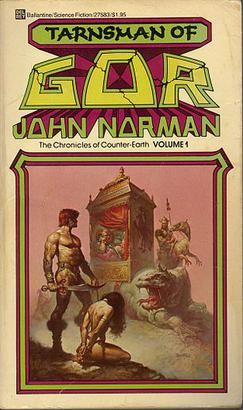
First published in 1966, Tarnsman of Gor is shown here with 1976 cover art by Boris Vallejo . This debut sword-and-planet novel launched John Norman’s controversial saga, which now spans 38 books.
There is so much to be said about this topic “Where to Start with the Books of Gor”, that I decided to split it in several parts:
- Part 1 – A Reading Guide for Newcomers
- Part 2 – Saga in Stages: Phases of the Gorean Journey
- Stage 1 – The Early Adventures (Books 1–6): From Earthman to Gorean Warrior
- Stage 2 – Broadening Horizons & Deeper Themes (Books 7–13): New Perspectives on Gor
- Stage 3 – The Jason Marshall Trilogy (Books 14–16): A New Tale of Submission and Identity
- Stage 4 – War and Upheaval (Books 17–25): The Epic Gorean War and Turning Point
- Stage 5 – The Saga Resumes (Books 26–33): New Century, New Faces, and the Gorean Renaissance
- Stage 6 – Climactic Conclusions (Books 34–38): A New Resolve and the Future of Gor
- Part 3 – The Philosophy Behind the Fantasy: How Gor Evolved (and Why It’s Not Just “Erotic Pulp”)
- Part 4 – Major Pivotal Books & Moments in the Saga
- Part 5 – Where to Find the Gor Books (Legally and Easily)
- Part 6 – Confronting the Controversies: Misconceptions and Reality-Checks
Stepping into the world of Gor can be exciting and daunting in equal measure. The Gorean Saga isn’t a single novel but a sprawling series of 38 books (and counting) written between 1966 and today . These stories mix classic adventure with provocative philosophy, all set on a counter-Earth (“Gor”) where society is shaped by honor, hierarchy, and the master-slave dynamic. In this guide, we’ll help you navigate the saga – outlining the major arcs (without heavy spoilers), suggesting reading orders, and highlighting how the series’ themes evolved over time. By the end, you’ll know where to begin your reading journey and what to expect as Gor’s epic unfolds. Along the way, I’ll also address common questions and controversies, demystifying the Gorean philosophy so you can appreciate the books with an open mind (and perhaps see why they’ve inspired a modern subculture ).
The World of Gor and Why It Matters
Before diving into individual books, it helps to understand the setting and scope of Norman’s universe. Gor is a fictional “Counter-Earth” planet that shares Earth’s orbit but remains hidden on the opposite side of the sun . In this world, walled city-states, nomadic tribes, and wilderness frontiers coexist, each modeled loosely on historical Earth cultures (from ancient Rome and Greece to Viking and tribal societies) . Society on Gor is fiercely hierarchical: people are classified by Caste (profession-based social order), united by loyalty to their city’s Home Stone, and often divided by feuds and wars. Overarching this human drama is a layer of science-fiction intrigue – alien “Priest-Kings” rule from the shadows, enforcing technological limits on humans, while another alien race, the ferocious Kurii, plot to conquer both Gor and Earth . These background conflicts (Priest-Kings vs. Kurii, Ar (land empire) vs. Cos (sea empire)) form a loose grand plot that threads through the series .
Most importantly for newcomers, Gor is a world obsessed with power and gender. The series unapologetically centers on dominance and submission: male warriors, masters, and raiders on one side, and often female slaves (kajirae) on the other. Slavery is normalized in Gor’s cultures, and many stories involve characters (often women from modern Earth) being captured, stripped of their former status, and forced to confront a more primal reality of masters and slaves . This is a provocative premise, and Norman uses it to explore ideas of “natural” gender roles, honor, and freedom in a deliberately extreme fashion. Early on, you’ll notice the books alternate between swashbuckling action – sword fights, tarn (giant eagle) rides, city sieges – and philosophical monologues on the nature of power, manhood, and womanhood. Reading Gorean novels is thus a dual experience: part pulp adventure, part social commentary. Keep this mix in mind; it’s what gives Gor its unique flavor and also what makes it controversial (more on that later).
How to Read the Gor Saga: Publication Order vs. Thematic Order
With 38 novels, a big question is: in what order should you read them? The simplest path is publication order, which is also the chronological order of the story. Starting from Tarnsman of Gor (Book 1, 1966) and moving forward means you follow the protagonist’s journey and the world’s development exactly as the author intended . This is highly recommended for newcomers, because the series does build on itself: characters recur, political situations evolve (e.g. city wars brewing in early books explode in later ones), and Norman’s philosophical themes deepen over time. By reading in publication order, you’ll catch foreshadowing and payoffs that might be lost if you jump around.
That said, some readers choose a thematic or character-based reading order after the first few books. For example, the core “Tarl Cabot” saga (the main hero’s storyline) is occasionally interrupted by side-narratives from others’ perspectives. A thematic approach might have you read all of Tarl’s primary adventures in sequence, then loop back to the stand-alone tales of other characters. For instance, one could read Books 1–6, skip to 8–10 (continuing Tarl’s travels), and defer Book 7 (Captive of Gor) until later since it features a different protagonist. Similarly, the novels told from a slave girl’s point of view (like Captive of Gor, Slave Girl of Gor, Kajira of Gor, Dancer of Gor, etc.) can be read together as an “illustrative sub-series” exploring female captive experiences. Another example: Books 14–16 form a self-contained trilogy about an Earth man and woman on Gor (more on that below), which some readers tackle separately.
However, unless you’re specifically trying to avoid spoilers or certain content, we suggest starting with the first book and progressing forward. The early books establish vital world-building and context for the later philosophical discussions. After you’ve read a dozen or so, you’ll have a feel for Norman’s patterns and can decide if you want to deviate. We’ll also highlight the major arcs below, so you know what to look forward to. As a newcomer, though, experiencing the saga as it unfolded historically can give you a richer perspective – you’ll see the tone shift from pulp adventure to deeper (and darker) themes, just as readers did in the 1960s–80s.
Quick tip: The first book, Tarnsman of Gor, is relatively short and fast-paced . It’s an excellent “test” to see if the setting intrigues you. If you enjoy it, the second and third books (Outlaw of Gor, Priest-Kings of Gor) will expand both the action and the underlying sci-fi plot. If you find the tone or content challenging, remember that many readers find different books in the series appeal to them differently – some prefer the adventure-heavy installments, others the psychological and culture-focused ones. Feel free to use the guide of the following posts to navigate to a phase of the saga that most interests you, but do be aware you’ll encounter references to prior events if you jump ahead.
I wish you well!
©2026 – Written by Azrael Phoenix
- Follow on Facebook: GorByPhoenix
You can read the full set of articles of this Series here:
- Series 1 – Start Here: Understanding the Gorean Lifestyle
- Series 2 – The Philosophy: Values Behind the Gorean Lifestyle
- 2.a – Honor, Responsibility and Discipline: The Core of Gorean Philosophy
- 2.b – Freedom, Choice and Voluntary Surrender: A Paradox at the Heart of Gor
- 2.c – Strength and Vulnerability: The Gorean View of Masculinity and Femininity
- 2.d – Understanding Gorean Natural Order: Philosophy and Modern Life
- 2.e – Aligning Words and Actions in Gorean Life
- Series 3 – Practicing a Gorean-Inspired Lifestyle (Safely & Ethically)
- Series 4 – Reading Gor: Guides, Themes, and Character Studies
- 4.a – Where to Start with the Books of Gor
- Part 1 – A Reading Guide for Newcomers
- Part 2 – Saga in Stages: Phases of the Gorean Journey
- Stage 1 – The Early Adventures (Books 1–6): From Earthman to Gorean Warrior
- Stage 2 – Broadening Horizons & Deeper Themes (Books 7–13): New Perspectives on Gor
- Stage 3 – The Jason Marshall Trilogy (Books 14–16): A New Tale of Submission and Identity
- Stage 4 – War and Upheaval (Books 17–25): The Epic Gorean War and Turning Point
- Stage 5 – The Saga Resumes (Books 26–33): New Century, New Faces, and the Gorean Renaissance
- Stage 6 – Climactic Conclusions (Books 34–38): A New Resolve and the Future of Gor
- Part 3 – The Philosophy Behind the Fantasy: How Gor Evolved (and Why It’s Not Just “Erotic Pulp”)
- Part 4 – Major Pivotal Books & Moments in the Saga
- Part 5 – Where to Find the Gor Books (Legally and Easily)
- Part 6 – Confronting the Controversies: Misconceptions and Reality-Checks
- 4.a – Where to Start with the Books of Gor
Series 3.e – Integrating Gorean Values Into a ‘Vanilla’ Public Life

Stepping into a Gorean lifestyle doesn’t mean leaving the modern world behind. Most Gorean lifestylers hold down jobs, have families, and interact daily with a society that might never guess what happens in their homes after dark. The challenge – and art – lies in integrating Gorean values into “vanilla” public life. How do you carry the discipline, honor, integrity, and even the blunt directness of Gor into your work and family, without crossing professional lines or social norms? How do you stay true to your chosen roles while respecting the boundaries of those who haven’t consented to your lifestyle? In this episode, we’ll explore applying core Gorean virtues in everyday settings, the importance of discretion for safety and professionalism, and how to maintain clear boundaries between your public identity and your private practice.

Along the way, we’ll also address a sensitive paradox at the heart of Gorean relationships – the idea that a woman’s ultimate devotion focuses on one man, while a man might naturally lead and love more than one woman. We’ll see why some call this the “Natural Order” of things, how it’s becoming more openly discussed, and ways to navigate such dynamics ethically (minimizing jealousy and maximizing trust). By the end, you should feel confident that you can live by Gorean principles in the modern world – thriving at work, at home, and in love – without painting a neon sign on your forehead. It’s about living your truth subtly but powerfully, integrating fantasy and reality into a life that’s both authentic and respectable.
1. Gorean Virtues at Work and Home: Honor, Discipline, and Directness

One of the biggest gifts the Gorean lifestyle offers is a framework of personal values – an “old-school” code of honor, responsibility, and discipline – that can make you a better employee, friend, partner, or parent. Goreans pride themselves on character. In fact, the philosophy teaches that a true Gorean man or woman is defined by their honor and integrity, not by costumes or titles. This emphasis on character means that in everyday life, your word genuinely means something. Modern Gorean practitioners take the idea of “my word is my bond” very seriously: if you promise to do something, you follow through. In a world where coworkers or relatives might shrug off little broken promises, a Gorean-influenced person strives to speak plainly and keep commitments. The Gorean ethic “pushes against that performance” of polite excuses and half-truths, favoring blunt honesty and clear commitments over social niceties. This doesn’t mean being rude – it means you don’t say “Sure, I’ll get to it” unless you genuinely intend to. Over time, this straightforward integrity earns you a reputation as someone trustworthy and accountable. At work, colleagues learn that if you say “I’ll have that report done by Friday,” you will – your boss doesn’t have to second-guess you. In family life, your relatives know you won’t just tell them what they want to hear – you’ll communicate with respect but also with refreshing directness. By aligning your speech and actions consistently, you carry yourself with a quiet dignity that others notice (even if they can’t quite pinpoint why). As the Gorean philosophy would put it, honor is “who you are when nobody is watching” – and living by it in public wins genuine respect.
Hand-in-hand with honor comes discipline – not in the sense of punishment, but in self-mastery and work ethic. Gorean training, for both dominant and submissive roles, involves cultivating internal discipline: doing the hard or boring things because they’re the right things. A Gorean Master is expected to be dependable, self-controlled, and decisive, not a slave to his own temper or whims. A kajira (submissive) likewise hones her discipline in service – consistency, devotion, and personal improvement are her daily goals. Now translate that to a vanilla context: A man who practices Gorean self-discipline might excel as a team leader or a protector of his family because he’s trained himself to shoulder burdens and stay calm under pressure. A woman who practices Gorean discipline may become remarkably organized, gracious, and diligent in her duties. In fact, many Gorean couples find that their lifestyle has practical side effects: the kajira who strives to serve with excellence often becomes more skillful, confident, and industrious in everyday tasks. She might start out shy or a bit lazy, but through training and pride in her role, she blossoms into someone with a formidable work ethic – something even her vanilla friends and coworkers can’t help but admire. The structure of Gorean life can shape you into a sharper version of yourself, much as a martial arts practice might. By embracing clear roles and goals at home, you may find you’re more focused and effective in daily life. A Gorean woman learns to take genuine delight in generosity and gets “a work ethic that impresses even vanilla friends” as she grows through service. And a Gorean man, by holding himself to a standard of honor and leadership in his household, often becomes more decisive, fair, and protective in all areas of life. In short, living by Gorean values can polish your character in ways that enhance your public life – you become that colleague who always delivers, that friend who can be counted on, or that partner/parent who leads by example.
Another virtue that Goreans carry with them is direct communication. Gor is not a place of polite equivocation; it’s a culture that values plain speaking and calling things as they are. Many people in modern life struggle with passive-aggressive hints or say “It’s fine” when they’re upset – Gorean-influenced folks try to avoid these murky habits. Instead, you practice saying what you mean (civilly, but clearly) and listening just as honestly. For instance, instead of stewing silently at work when a team member falls short, a Gorean-minded person might address it directly yet professionally: “I need us all to meet our commitments; what can we do to get you back on track?” If you’re a submissive at home, you might train yourself to speak respectfully but honestly to your partner about issues, rather than bottling them up – which ultimately makes for healthier relationships (we’ll see this again when we discuss jealousy). This habit of direct speech is part of Gorean discipline: “stop vague promises; say yes or no cleanly”, as one exercise suggests. It can be scary at first to drop the usual social masks, but it’s liberating and breeds far less confusion. Your coworkers and family always know where you stand and what you expect, and that clarity can be a relief in a world full of mixed signals.
Finally, living Gorean means taking responsibility for your choices and commitments. Gor’s ethos has a “no excuses” flavor – not to be harsh, but to foster strength. If you err, you own it and make it right, rather than blame others. A Gorean Master feels it’s his duty to provide and protect if he’s in charge (he does not dump blame downward), and a kajira takes pride in owning her tasks and any mistakes (she doesn’t make flimsy excuses). In public life, this translates to being the person who says “I screwed up that project, and here’s how I’ll fix it” rather than quietly covering your tracks. It means if you commit to coaching your child’s soccer game or helping a friend move, you show up and follow through. This kind of reliability is rare enough today that it sets you apart in a positive way. People might not know anything about Gorean philosophy, but they’ll notice that you “have a code” – an inner compass that guides you. Co-workers describe you as disciplined and honorable; friends know you as loyal and straightforward. These are the fruits of Gorean values in vanilla life. You’re not role-playing a conqueror at the office or a slave-girl at a PTA meeting – but you are quietly applying Gor’s core lessons: Honor your word. Take responsibility. Be disciplined. Speak truth. And those things make you shine anywhere.
2. Discretion and Professionalism: Knowing When to Keep It Private

While you weave Gorean principles into your daily behavior, it’s equally important to know when to not put your lifestyle on display. In Gorean terms, discretion is often the better part of honor – because flaunting your dynamic in inappropriate settings not only risks your own social and professional standing, it can also disrespect or even endanger others. The simple rule is: Gorean life is a private ethos, not a public spectacle. Just as a BDSM couple wouldn’t start acting out a scene in the middle of a restaurant, a Gorean couple shouldn’t drag unwilling bystanders into their power dynamic. Remember, everything in Gor is ultimately consensual – and the rest of the world has not consented to play along.
Consider your workplace. You might personally believe that men are naturally suited to lead, but if your boss is a woman, a Gorean view absolutely does not mean you refuse to respect her authority. A true Gorean man could take orders from a female CEO all day long and still be “dominant in his soul” – there’s no contradiction. Natural Order isn’t about strutting or ego in public; it’s a private understanding of roles in your relationship. So a Gorean practitioner in the office is just another professional: courteous, competent, and definitely not hitting on every woman or making creepy comments about “female submission.” In fact, if you did try to justify bad workplace behavior by saying “women are natural slaves, go make my coffee,” it’d be both absurd and a fast way to get fired. Gorean ethics demand that you follow the laws and norms of society when you’re operating in it. There’s no free pass to ignore consent or equality just because you read some philosophy – an ethical Gorean never uses their beliefs as an excuse to mistreat anyone outside their consensual dynamic. So, at work you treat colleagues – male or female, dominant or not – with professionalism and respect like any mature adult would. Your personal lifestyle remains your private business. If anything, living by a Gorean code should make you more respectful to others in public, because you hold yourself to high standards of honor.
The same goes for general public settings and friends. Pick your audience before you share details about being Gorean. Unfortunately, the lifestyle is widely misunderstood – people might conflate it with abusive patriarchy or think you’ve lost touch with reality. For your own and your partner’s safety (socially and even physically), it’s wise to keep the specifics private unless you truly trust someone. You might choose to come out to a close friend or two, or you might not. Many lifestylers find it easiest to maintain a vanilla appearance in mixed company. There’s nothing dishonest about that; it’s simply acknowledging that your intimate power exchange is private. You don’t owe the world an explanation, and you’re not “betraying your Gorean identity” by acting like a normal polite person in public. As one Gorean guide notes, plenty of couples “practice at home while functioning normally in public”. Think of it like having an inside joke or a secret between you – you might share a subtle knowing look or use a very discreet signal to acknowledge your roles, but to everyone else you’re just a loving couple. For instance, a kajira might quietly ask her Master’s permission for something with a certain phrasing or hand squeeze when others are around, and he gives a subtle nod – an unnoticed exchange of who leads and who follows. But outwardly, no one sees a power dynamic on display. You wouldn’t have her kneel at his feet in the middle of a supermarket or call him “Master” at a friend’s BBQ (unless you both enjoy causing a scene and accept the consequences). Goreans understand that there’s a time and place for everything. As the saying goes, “discretion and respect for others remain” key – she’s not going to kneel in the grocery store, and he’s not going to bark orders at a restaurant. What you do behind closed doors (or within your private group) is your business; in public, consent and common sense rule.
Safety and legality are big factors here too. Gorean roleplay, especially anything involving restraints, protocol, or multiple partners, must always obey the law. Actual slavery is illegal everywhere, and no adult can truly sign away their basic rights – no contract or collar can negate assault laws or personal liberties. This means that if you incorporate any edgy aspects (like perhaps a kajira dress code that could be seen as indecent exposure, or protocols that might cause public alarm), you simply don’t do those things in front of the unconsenting public. Keep anything sexual or intense strictly private or within closed communities. A Master who might spank or “punish” his submissive in play at home knows that if he hit someone in public, it’s just assault, not a consensual game. And a kajira who willingly endures a rough scene in private knows she can scream “no” for real at any point and be heard – but she shouldn’t be screaming “No, Master, please!” in the middle of a park where strangers will think a crime is occurring. In short, use your head: follow Safe, Sane, Consensual principles as you would in any BDSM context, and respect that the rest of the world did not opt into your dynamic.
Professionalism also means keeping Gorean life from sabotaging your career or reputation. If you work in a conservative field (say, education or corporate management), being publicly known as someone who has a “sex slave” at home could cause issues, fair or not. Thus, it’s often prudent to separate your lifestyle identity from your work identity. Online, you might use a pseudonym for FetLife or Gorean forums. When attending Gorean or kink community events, you typically agree not to out others – everyone has the same interest in privacy. The good news is there are like-minded communities where you can drop the mask safely. Many Goreans join online forums or local BDSM munches (casual meet-ups) to connect with others. In those spaces, using Gorean titles or speaking openly about your Master/slave dynamic is accepted. It feels liberating to be among people who get it. But even in those circles, Goreans still uphold courtesy and consent. For example, just because someone else is a submissive doesn’t mean you can treat her as your slave – “a true kajira is only deferential to her own chosen Master (and courteous to others)”, not automatically kneeling to every man in the room. And genuine Gorean Masters don’t waltz into a community munch acting superior to everyone; the seasoned ones actually emphasize humility and respect in public interactions. He doesn’t need to bully random women to prove he’s dominant; his dominance shows in how he conducts himself and cares for those under his wing. In other words, the loud, obnoxious guy at the bar bragging about owning women isn’t showing true Gorean mastery – the confident, courteous man who keeps his word is. Understanding this helps you navigate public life gracefully: you demonstrate your values through behavior, you don’t need to announce them.
To sum up, being Gorean in public is mostly about what you don’t do: you don’t force your dynamics on others, you don’t break laws or professional norms, and you don’t endanger your relationships by oversharing with the wrong audience. Instead, you let the positive qualities of Gor shine through you (strength, honor, composure, kindness) in a way that enriches your public life. Think of your Gorean identity as a flame – in private you can let it burn brightly, in a controlled hearth. In public, you bank the flame, keep it warm and glowing inside, but never let it blaze out uncontrolled. That way it illuminates your life without burning anyone. Discretion isn’t about shame; it’s about respect and wisdom. As one Gorean essay put it, it may not be possible to live “fully Gor 24/7” in reality, but you can absolutely live by Gorean principles within reality, “with much compromise and negotiation between all parties involved.” By day, you might look like any other accountant, teacher, or tech worker – but by night, within the walls of your home, you and your partner write your own story. And that private truth can give you a deeply satisfying sense of authenticity, even as you operate seamlessly in the vanilla world.
3. Boundaries: Separating Your Public Face from Your Private World

Living this dual life – Gorean at home, vanilla outside – requires a clear understanding of boundaries. It’s about drawing a line between who you are to the public and who you are within your consensual dynamic, and not letting one violate the integrity of the other. Some people worry that keeping the lifestyle private means they are “hiding” their true selves or being fake in public. But think of it differently: we all wear different hats in different contexts. You likely behave one way at a formal work meeting, another way with your close friends, another with your romantic partner – yet all are authentically you. Likewise, you can be a Master or kajira in your household and a respectful egalitarian with strangers, without either being a lie. You’re simply honoring the correct context for each relationship.
A key boundary for Goreans is understanding that your beliefs about Natural Order apply to your relationships, not to everyone in general. John Norman’s books might portray a world where practically all women are submissive, but real-life Goreans know that’s fiction. You don’t walk around assuming the cashier at the store should call you “Master” or that every man secretly wants to dominate you. That sounds obvious, but it bears saying: Believing in a male-led/female-submissive ideal for yourself does not entitle you to impose it on others. A Gorean man doesn’t think all women must kneel to all men – he isn’t out to rob any woman on the street of her autonomy or rights. He simply believes that many females (perhaps including his partner) naturally feel happier yielding to a worthy man’s leadership, and many males thrive when they take on a protective dominant role. But crucially, each individual must choose how they live. Even in the Gor novels there are proud Free Women who remain independent; modern Goreans note that every woman can decide if submission is part of her nature or not. Thus, in everyday interactions, a Gorean follower of Natural Order will still treat people as people. He’ll hold the door for a woman out of courtesy (just as he might for a man), but he isn’t going to grab some random lady and demand she obey him – that’s not just immoral, it’s delusional. And if he encounters a strong-willed woman who has no interest in male leadership, he respects that as her choice. The Gorean lifestyle is about what we craft in our home, not a crusade to rearrange society. As one writer put it, Natural Order is a personal framework, not a public policy – it guides how you structure your love life, not how you treat someone who never agreed to your rules. Keeping this boundary clear prevents a lot of potential toxicity. It reminds you that outside of consensual dynamics, all men and women interact as equals by default. You might privately think “if only they embraced their instincts they’d be happier,” but you never use that as an excuse to harass or belittle anyone. In fact, the Gorean code would consider it dishonorable to mistreat an innocent person just because they don’t share your views. A true Gorean shows self-control and courtesy in dealing with the wider world – he saves the explicit Mastery for the one woman who wants to receive it, and she saves her submission for the one man who’s earned it.
Within your relationship, maintaining boundaries often means setting aside “real life” time versus “Gor time.” Especially if you’re new to the lifestyle or are evolving from a vanilla relationship, it helps to consciously delineate when you’re in role and when you’re just a normal couple handling mundane tasks. Some couples even have codes – e.g. calling each other by first names versus titles – to distinguish a serious household discussion from a D/s moment. For example, if the family car breaks down on the highway, that might be a moment to drop formal protocol and solve the problem as partners (even if the Master leads the decisions, the two of you might operate more like a team for efficiency). Or if you have children, you might suspend certain Gorean protocols while the kids are awake, to avoid confusion. Having clear boundaries doesn’t weaken your dynamic; it strengthens it by containing it where it belongs. Think of it like a ritual mask: you put it on in your private sacred space, you take it off when interacting with the outside world. The person underneath is the same, but the mask’s expression changes. This separation can actually heighten the thrill – many find it exciting to have that secret life. It’s a bit like the Clark Kent/Superman dual identity: Clark Kent at work, Superman at home (or vice versa, depending on perspective!). The key is that both identities must uphold your core values. As Clark Kent, you’re still honorable, disciplined, caring – you’re just not flying around in a cape rescuing people overtly. As Superman, you unleash your full power exchange within ethical bounds. You don’t want the two to mix in a way that, say, you start bossing around a co-worker as if they were your kajira (terrible idea), or you start handling your kajira like she’s just a co-worker (that would break the dynamic’s magic). Compartmentalization is a skill: you learn to “flip the switch”. Perhaps as you walk through your front door after work, you and your partner have a little ritual – she kneels to offer your slippers, or you both change into symbolic attire – that mentally transitions you into your private roles. And before you go out to a public event, you might have a ritual to remind you both that now you’re in vanilla mode (maybe a simple phrase like “public protocols” that you say to each other). These cues help keep everyone on the same page and prevent awkward bleed-over.
It’s also healthy to have boundaries in the sense of personal space and identity. Being a Master or kajira is part of who you are, but it’s not all of who you are. You still have your individual interests, careers, friendships that are outside the Gorean context. Maintaining those can actually enrich your dynamic: absence (or independence) can make the heart grow fonder. For instance, a kajira might volunteer at an animal shelter or take a night class that has nothing to do with serving her Master – and that’s perfectly fine if it’s within whatever limits they agreed on. She returns to him fulfilled and with new energy, ready to serve with an even happier heart. A Master might have a hobby or professional duty that requires him to set aside the D/s mindset and just focus as an individual. These things don’t detract from Natural Order; they’re part of living in the modern world. The Gorean ideal is not to become a 24/7 robot who only thinks about collar tags and rituals. It’s to integrate a meaningful hierarchy into your life in a balanced way. By keeping some boundary between self and role, you ensure that the role remains a choice and a joy, not a smothering box. As the saying goes, absence of boundaries breeds chaos, but clear boundaries create a safe container where your chosen dynamic can flourish.
Lastly, let’s touch on emotional boundaries with others. Suppose you’re out with vanilla friends and someone starts bashing “sexist men” or makes a joke like “I’d never let a man tell me what to do!” If you’re the Gorean male in the room, you might feel a twinge of defensiveness inside, but this is not the time to jump on a soapbox. You can chuckle or just let it slide. Remember, your goal isn’t to convert others or defend Gor’s honor at every turn. Likewise, if you’re a submissive woman and your friends are complaining about “controlling husbands,” you don’t have to blurt, “Actually I love obeying mine!” You can simply empathize on the level that makes sense (“Everyone has different needs in relationships, huh.”). Save the deeper discussion for those who seek it. Think of yourself as an ambassador by example, not a missionary by words. Your friends should just know you as a happy, confident couple; if they one day ask, “What’s your secret? You two seem so solid,” then you might decide to peel back the curtain a little and share. Until then, your boundary is that your private life is private. And if anyone crosses a boundary – say a nosy coworker pries into why you have a strange jewelry (your collar disguised as a necklace) – you have every right to give a polite but firm non-answer (“Oh, it’s just something meaningful to me”) and move along. You don’t owe anyone your story unless you choose.
Boundaries, ultimately, enable you to live authentically and safely. By clearly defining when you’re in Gorean mode vs. vanilla mode, and by respecting the consent line between your household and the outside world, you actually protect the integrity of your lifestyle. You ensure that within your domain you can be as Gorean as you want, and outside it, you can engage with society without undue conflict. This separation also helps prevent burnout. If one of you feels overwhelmed, having a boundary means you can step out of role for a moment to communicate as plain equals (for example, using a safeword or saying “Time out, I need to speak freely”) – and that boundary will be honored because you both know it’s part of keeping the dynamic consensual and healthy. Far from weakening the power exchange, these agreed boundaries preserve trust. They let both partners know that their public dignity and personal autonomy are still respected, even as they choose to live in a privately unequal arrangement.
In closing this section, keep in mind a piece of wisdom: The Gorean lifestyle asks, “Can you live by your values even in a world that doesn’t?” If you can do that quietly and steadfastly, you gain a sense of inner honor. You’re not pretending to be something you’re not; you’re being exactly who you are with care. By day, no one may guess you bow your head to your Home Stone each night – and that’s okay. What matters is that you know, and those you love know. The boundary between public and private life is not a wall that imprisons you; it’s a filter that keeps your sacred world safe and lets you engage with the broader world on your own terms.
4. Devotion and Natural Order: One Master, Multiple Devoted Partners
No discussion of integrating Gorean values into modern life would be complete without addressing a topic that both captivates and unsettles many: the one-sided polygamy aspect of Gorean relationships. The Gorean books often depict a polygynous setup – that is, one man with several women under his leadership or in his collar. In those stories, it’s taken as almost natural that a strong man might have multiple slaves, or a high-status free man might have multiple companions, while women are devoted to their one Master. This raises an eyebrow (or ten) in our contemporary world, where the default expectation is typically monogamy on both sides. Is the idea of one man having multiple female partners – with those women being exclusively his – inherently chauvinistic fantasy? Or is there some truth to the Gorean claim that this pattern aligns with a “Natural Order” rooted in instinct? It’s a delicate question, but let’s explore it with both an open mind and a grounding in consensual reality.
First, from an evolutionary and historical perspective, the pattern of “one man, several women” has deep roots in human societies. Anthropologists have noted that polygyny (one man taking multiple wives) has been permitted in roughly 83% of pre-industrial cultures studied. It doesn’t mean most men in those societies had harems (often only wealthy or powerful men did), but it means the concept of polygyny was broadly accepted across history. By contrast, polyandry (one woman, multiple husbands) has always been exceedingly rare. Biologically, there’s a straightforward explanation: a man can father children with several women in the same year, but a woman can only carry one pregnancy at a time – so a male’s reproductive potential increases with multiple partners, whereas a female’s does not. This is seen throughout the animal kingdom and tends to nudge social structures toward polygyny when resources allow. Evolutionary psychologists also observe that, on average, men have a higher inclination towards desiring multiple sexual partners (the old “spread the seed” impulse), while women are often choosier and invest more deeply in one high-quality mate. Of course, these are general trends, not individual absolutes – plenty of men are monogamous by nature and some women prefer multiple partners. But the point is, the idea that men might bond with multiple women (and women tend to focus devotion on one man) is not some alien Gor invention; it has a basis in real-world biology and history. John Norman, in his provocative way, takes this to an extreme in the Gor novels with talk of women as the “slave sex” – implying a natural inclination to yield to a dominant male. Modern readers rightly critique that phrasing, but the underlying notion he’s playing with is this same anthropological trend: that male-female dynamics have a polar nature, and that one man balancing the energies of multiple women is in line with ancient patterns.
Now, modern society has largely built itself on monogamy – and certainly enforces monogamy legally in marriage (except in a few places). But even today, we see an increasing openness to non-monogamous arrangements. It’s no longer unheard of to know someone practicing consensual polyamory or open relationships. In fact, recent surveys found that over half of Americans under 30 believe open relationships are acceptable, and about 1 in 9 Americans of all ages have tried polyamory (having multiple loving partners) at some point. Another study across the US and Canada reported roughly 1 in 5 people have engaged in some form of consensual non-monogamy in their lifetime. Those numbers might surprise you – they indicate that ethical multi-partner relationships are becoming more common or at least more recognized in our culture. So while monogamy is still the norm and certainly a valid choice, there is a slow trend of people exploring alternative structures. What does this mean for a Gorean household? It means that if the idea of one Master with multiple kajirae appeals to you and your partners, you’re not utterly alone or “freakish” for desiring that. Society may not exactly cheer you on, but there are parallel communities (polyamorists, swingers, etc.) that have laid some groundwork for how to navigate multi-partner relationships openly and honorably.
Within the Gorean community itself, there’s a range of practices. Many Gorean relationships are one-on-one – a single Master and a single kajira – and there’s no requirement to have a harem. Gorean life is about the quality of the power exchange, not the number of partners. But for those who do feel naturally inclined to expand the household, Gorean culture provides some models and cautions. Typically, a Gorean man who has multiple partners will establish a clear structure: often there is a primary lady (perhaps a Free Companion, which is akin to a wife in Gorean terms) or a “First Slave” and then one or more secondary submissives or kajirae in service. Or he may have no formal “wife” figure and simply have two or three slave partners of different seniority. Importantly, all the women involved know about each other and consent to this arrangement – this is not about sneaking mistresses on the side; it’s a frank household structure. In a way, it’s more akin to a polyamorous family or a swinger “pod” in the vanilla world, except with the distinctive Gorean dynamic (clear hierarchy, roles, and perhaps the symbolism of collar and chains). And let’s not sugar-coat it: managing such a house is hard work for the Master and requires tremendous emotional intelligence from everyone. Those who have done it will tell you that it’s not about the male ego collecting trophies – if it were, things would implode quickly. It’s about creating a harmonious unit where everyone genuinely finds fulfillment and security. The Master carries even more responsibility when he has multiple hearts in his hands. He must communicate and care for each partner, ensure fairness, and never take anyone’s submission for granted. If a one-to-one Gorean relationship is like steering a ship, a one-to-three relationship is like captaining a fleet – challenging, but potentially very rewarding if done right.
One major issue that must be addressed in any multi-partner situation is jealousy. In Gorean fiction, it’s common for slave girls to be fiercely jealous and competitive – each one wanting to be the favorite who basks in the Master’s attention. The books often gloss over this by portraying jealousy as a natural spice of the harem life (and sometimes even a tool a Master uses to keep slaves on their toes). But let’s be realistic: in real life, unmanaged jealousy can poison a household. Vanilla or Gorean, human emotions are human emotions. The good news is, jealousy can be managed and even transformed, if everyone approaches it with maturity and openness. In polyamory circles, there’s a term compersion – which means feeling joy at your partner’s joy with someone else. It’s basically the opposite of jealousy. Achieving compersion is tough, but it’s a beautiful goal: imagine a kajira genuinely feeling happy that her sister kajira pleases their Master, because ultimately His happiness is the women’s top priority. In a Gorean twist, you might say a devoted kajira finds contentment in any scene that strengthens her Master – if another girl’s presence lifts His mood tonight, then that outcome is good for the whole House (and tomorrow it might be her turn to have His focus). This mindset doesn’t magically erase every pang of jealousy (we’re not robots!), but it reframes the situation from rivalry to a kind of team spirit. Gorean philosophy puts a strong emphasis on purpose and belonging; ideally, each person in a multi-partner House feels she has a secure, unique place – a role that’s hers, a set of strengths that she contributes – so she doesn’t feel interchangeable or inferior.
So how do successful multi-partner Gorean dynamics minimize jealousy and keep the sisterhood strong? Let’s break down a few practical strategies (many gleaned from real-world poly relationships and Gorean experiences):
- Structured Roles and Hierarchy: Clearly define each woman’s role and standing in the house. For example, perhaps one is the First Girl (a concept from Gor where the lead kajira has authority over others in day-to-day matters). She might handle organizing chores and mentoring the newer girl. Another could be the newer kajira in training. Or if one is a Free Companion and the rest are collared kajirae, make sure everyone understands the difference in their statuses and duties. When everyone knows where they stand – who has what authority or privileges – it prevents a lot of confusion and competition. Each woman should have a special niche so she can take pride in her contribution without feeling like she must compete on every front. Maybe one is the culinary whiz who delights the Master with her cooking, while another is the artistic soul who dances for him or manages the home’s finances. Specialization and a bit of hierarchy (with fairness) can turn potential rivalry into complementary teamwork. As we discussed back in Series 3.10, women in a polygynous house should ideally see each other as allies under the same Home Stone – “chain sisters” rather than rivals. When each kajira’s contributions are recognized and valued, it fosters sisterhood instead of jealousy.
- Individual Quality Time: One of the biggest triggers for jealousy is feeling left out or lesser in attention. A wise Master will ensure each partner gets some one-on-one time with him on a regular basis. This could be as simple as designating certain nights or hours for each woman. During “her” time, the others give space, knowing their turn will come. For instance, if one kajira gets a private dinner or an outing with the Master on Wednesday, the other knows she’ll have a date night on Thursday, etc. This kind of rotation and routine of attention helps each person feel seen and important. It also allows the Master to connect deeply with each woman, strengthening their individual bonds. The structure can be formal or flexible, but the goal is no one feels perpetually neglected. And importantly, when it’s not a particular kajira’s night, she learns to respect that boundary – no sulking outside the door or constant interruptions. In a way, each woman “shares” the Master’s love, but also has a part of it reserved just for her. This balance of shared life and private moments goes a long way to keeping envy at bay.
- Open Communication of Feelings: Gorean households are often strict about protocol (e.g. a slave shouldn’t “whine”), but bottling up jealousy is a recipe for disaster. It’s vital to foster an environment where a kajira can respectfully voice if she’s feeling hurt or insecure, without fear of punishment or ridicule. This might sound un-Gorean (aren’t slaves supposed to accept and endure?), but think of it this way: a kajira has given her heart completely; she should trust her Master enough to reveal her vulnerable emotions too. If kajira A feels a sting of jealousy because kajira B got a privilege she didn’t, she should be able to kneel and softly confess her feelings – “Master, I find I am troubled by…,” etc. A good Master will listen patiently and address it – maybe by reassuring her of her unique value, or explaining the reason behind a decision. Sometimes just being heard is enough to defuse jealousy. The worst thing is forcing everyone to pretend they never feel it – that just drives it underground where it turns into bitterness. Instead, shine light on it. A Master might even hold occasional “household meetings” where everyone can speak openly (still respectfully within roles) about any brewing tensions. It doesn’t undermine his authority; it strengthens trust. As we saw in Series 3.10, jealousy is like a toxin – the antidote is acknowledgment, fairness, and reassurance, not denial.
- Foster Sisterhood, Not Rivalry: The Master sets the tone that all the women are on the same team. Small actions can encourage this: perhaps the women have tasks they must do together (turning competition into cooperation). If one kajira excels at something, he praises her in front of the others and invites the others to also appreciate her achievement. And he never plays them against each other for sport – that is a juvenile move that breeds resentment. Each kajira should feel that her Master wants them all to flourish. The women can even develop genuine friendships and care for each other. In many historical polygynous households, co-wives or co-concubines often supported each other like sisters. That might not happen overnight, but with a fair and loving Master, the women can gradually build trust amongst themselves. They may share duties, confide in each other, even comfort one another on hard days. When a kajira sees that her value isn’t diminished by the presence of another, a lot of fear melts away. Masters can reinforce this by never showing cruel favoritism or allowing disrespect between the women. If one kajira sneers at or sabotages another, that should be corrected firmly – the law of the Home Stone is that they are sisters in service, not enemies. Over time, the household can form a little community of love, where yes, the Master is the sun at the center, but the kajirae orbiting that sun also shine on each other.
- Fairness and Consistency: “Fair” in a polygynous dynamic doesn’t always mean equal (one might have seniority or different rules), but it means each person perceives the system as just. If one sub feels that “Master always takes her side, not mine,” or “I get punished for X but the other gets away with worse,” then resentment will grow fast. The Master must hold himself to a standard of impartial justice in the house. Rules should be applied consistently; rewards and discipline should be proportionate and transparent. For example, if punctuality is a rule, all are expected to be on time to similar degrees – you don’t let the “prettier” girl constantly slack off while coming down hard on the other. Also, avoid obvious favoritism in affection that isn’t earned. It’s natural to have unique connections – one might share your love of chess, another your sense of humor – but ensure each woman feels cherished for who she is. The saying in multi-partner homes is “love is not a zero-sum game.” A Master’s heart can expand to love multiple people, each in their own way, without one love detracting from another. When a kajira truly believes this – that her Master’s affection for someone else does not threaten his affection for her – jealousy loses much of its bite. The Master’s honor is on the line in creating that trust. He must show through actions that he’s worthy of the devotion of more than one woman – meaning he is just, attentive, and caring enough that none feel shortchanged.
Despite these efforts, let’s be real: moments of jealousy may still flicker. But in a well-run Gorean house, those moments become opportunities for personal growth. A kajira who feels a pang of envy can use it as fuel to improve herself – not out of toxic competition, but as motivation to better her own service or deepen her surrender, thus turning negative energy into positive action. In fact, overcoming jealousy can be seen as part of a kajira’s self-discipline: mastering that impulse, rising above it, is very much in line with Gorean self-improvement. And for the Master, successfully harmonizing multiple relationships is a test of his leadership and empathy – a chance to prove he truly can embody “strength and fairness” simultaneously. Many who live this way report that, after an adjustment period, it feels natural and fulfilling – the women often find solace and camaraderie in each other (sharing the load of service and the joy of pleasing Him), and the Master feels enriched by the diverse love and energies flowing to him. In a way, it can hark back to an older sense of extended family or tribal living, which some people today quietly miss.
Of course, multi-partner dynamics are not for everyone – nor required to “be Gorean.” Monogamy is equally valid in Gor (the books even describe the “perfection of one man, one woman, in total union” as an ideal of its own for some people). The essence of Gorean living is the polarity of roles and the strength of the commitment, not the headcount. A one-Man/one-woman Gorean relationship can be just as intense and profound as a larger household – sometimes even more so, because all attention is focused. So, consider this aspect as optional. But if you do feel drawn to having or being part of a larger household, take heart that you’re “walking a path humans have walked for ages” and that with communication, structure, and empathy, it can indeed be a rewarding reflection of Natural Order. As one sociologist quipped (perhaps referencing our evolutionary tendencies), humans may not be strictly monogamous by nature – we’re “moderately polygynous” – but we are absolutely creatures capable of deep bonds. In a consensual Gorean house, it’s possible to have both: the deep bond of a loyal female to her one Master, and the broad bond of a Master with multiple loyal females – all intertwined in a tapestry of loyalty, love, and service. When it works, it truly can feel like coming home to a small kingdom of your own, running on its unique love and law.

Closing Thoughts: Integrating Gorean values into a vanilla world is all about balance. You take the spirit of Gor – honor, passion, structure, primal authenticity – and graft it onto your real life in ways that enhance rather than detract. We’ve seen that you can bring Gorean honor and discipline into your work and family to become a person of strong character. You can practice your Mastery or servitude privately while still navigating society with respect and discretion. You can draw lines between your public and private worlds so that each remains intact and harmonious. And even the more “out-there” aspects, like a Master with multiple kajirae, can be approached ethically and naturally, if done with consent, communication, and care. In short, living Gorean in the modern age means choosing your own path intentionally – not to rebel against society for the sake of it, but to fulfill something deep within you while still thriving as part of society. Many who walk this path say they end up happier, more confident, and more at peace because they’re no longer at war with themselves. They aren’t suppressing their instincts or values; they’re living them out in a realistic way. As we continue this series, we’ll keep exploring how to bridge any remaining gaps between the Gorean ideal and everyday life (rituals, community interactions, perhaps even dealing with skeptics or “red flags” to watch out for). In the meantime, feel free to revisit earlier posts like Series 2.8 – Natural Order: Philosophy and Modern Life for a deeper dive into the mindset behind these practices, or Series 3.10 – Crafting Your Ideal Household Structure which touches more on designing roles and hierarchy (essential reading if the multi-partner topic piqued your interest!). And as always, remember that your life is your own to create. You have the right to build a household and a love style that speaks to your soul – and you have the ability to do it in a way that is honorable, consensual, and enriched by the best of what humanity has learned.
Live boldly, love deeply, and let Gor guide you where it may – the real world is not an obstacle, but the stage on which you’ll craft your own Gorean saga. Tal! (until next time).
I wish you well!
©2026 – Written by Azrael Phoenix
- Follow on Facebook: GorByPhoenix
You can read the full set of episodes of this Series here:
- Series 1 – Start Here: Understanding the Gorean Lifestyle
- Series 2 – The Philosophy: Values Behind the Gorean Lifestyle
- 2.a – Honor, Responsibility and Discipline: The Core of Gorean Philosophy
- 2.b – Freedom, Choice and Voluntary Surrender: A Paradox at the Heart of Gor
- 2.c – Strength and Vulnerability: The Gorean View of Masculinity and Femininity
- 2.d – Understanding Gorean Natural Order: Philosophy and Modern Life
- 2.e – Aligning Words and Actions in Gorean Life
- Series 3 – Practicing a Gorean-Inspired Lifestyle (Safely & Ethically)
- Series 4 – Reading Gor: Guides, Themes, and Character Studies
- 4.a – Where to Start with the Books of Gor
- Part 1 – A Reading Guide for Newcomers
- Part 2 – Saga in Stages: Phases of the Gorean Journey
- Stage 1 – The Early Adventures (Books 1–6): From Earthman to Gorean Warrior
- Stage 2 – Broadening Horizons & Deeper Themes (Books 7–13): New Perspectives on Gor
- Stage 3 – The Jason Marshall Trilogy (Books 14–16): A New Tale of Submission and Identity
- Stage 4 – War and Upheaval (Books 17–25): The Epic Gorean War and Turning Point
- Stage 5 – The Saga Resumes (Books 26–33): New Century, New Faces, and the Gorean Renaissance
- Stage 6 – Climactic Conclusions (Books 34–38): A New Resolve and the Future of Gor
- Part 3 – The Philosophy Behind the Fantasy: How Gor Evolved (and Why It’s Not Just “Erotic Pulp”)
- Part 4 – Major Pivotal Books & Moments in the Saga
- Part 5 – Where to Find the Gor Books (Legally and Easily)
- Part 6 – Confronting the Controversies: Misconceptions and Reality-Checks
- 4.a – Where to Start with the Books of Gor
Series 3.d – Bridging Fantasy and Reality in Gorean Relationships
The Gorean lifestyle can be lived in many arenas – from the text-based chat rooms and virtual realms of the internet to the tangible reality of household living. In this episode, we explore how Gor exists online vs. offline, tracing the history of Gorean communities on the web, examining the differences between roleplay and real-life practice, and addressing challenges in translating fantasy into reality. Along the way, we’ll discuss the responsible (and optional) transition from online roleplay to real-world relationships. As always, the guiding principle is authenticity: keeping Gorean philosophy grounded in honor, choice, and mutual respect, whether behind a screen or under your own roof.
History of Online Gorean Communities

Gor found an early home on the internet. Starting in the mid-1990s – as soon as fans discovered they could connect via dial-up – Gorean chat rooms and forums began to emerge. In 1996 the first notable Gorean philosophy group, Silk & Steel, was founded as an online chat by three men (Bear, Marcus, and Zeb) and even held offline meet-ups . Many other groups soon followed, ranging from role-play realms (the books provide a rich fictional world to enact) to discussion groups for those serious about Gorean philosophy . Early Goreans congregated across platforms like IRC channels, AOL message boards, email lists, and dedicated websites . Over time, the community migrated with technology – from text-based forums to graphical social worlds.
By the 2000s, Gorean presence thrived in virtual worlds. The Palace Chat (with 2D avatars) and Second Life (with 3D immersive sims) became popular hubs, letting users visually recreate Gor’s cities and camps . Second Life in particular hosted dozens of Gorean regions (“sims”) where people role-played as Masters, Free Women, kajirae, warriors, or panther girls in a fully realized Counter-Earth. At its peak, Second Life’s Gor was one of the largest RP subcultures in that virtual world . These online spaces allowed a new generation to discover Gor – including many who were drawn in through role-play before ever reading the books. Indeed, scholars note that from the 1990s onward, Gorean subculture grew partly via online role-playing in chat rooms, attracting curious newcomers (sometimes teenage boys posing as powerful “Ubars”) and captivating even middle-aged women to play as kajirae . This mix of anonymity and fantasy could be a double-edged sword: on one hand it spread Gorean ideas to a wider audience; on the other, it sometimes led to deception or mismatched expectations (a point we’ll revisit when fantasy meets reality).
Modern online Gorean communities continue to evolve. Today you’ll find Goreans on Discord servers, FetLife groups (BDSM/kink forums), and even Reddit discussions . Second Life remains active (almost entirely for immersive role-play), and you might encounter Gorean-themed areas in newer VR platforms as well. There are also informational sites and Discords like Gorean Scribe’s community and our Blog Gorean Lifestyle which focus on education and philosophical discussion . In short, the internet has been crucial in keeping Gor alive, connecting isolated adherents worldwide into a community. Whether someone is interested in cosplay and story-driven RP or serious lifestyle talk, there’s likely an online space for them. The key is understanding which kind of community you’re engaging with – which brings us to the distinction between Gorean roleplay and Gorean real-life practice.
Roleplay vs. Real-Life Gorean Practice

Not all who explore Gor online live it offline – and that’s okay. There’s a spectrum between treating Gor as a game and embracing it as a lifestyle. On one end are the role-players, who immerse in Gor’s fictional world for entertainment or erotic escape; on the other end are the lifestylers (sometimes called literalists ), who incorporate Gorean philosophy and roles into their actual daily lives. Understanding the difference is crucial for anyone navigating between chat rooms and real households.
- Roleplay (Simulation/Emulation) – In roleplay, you act out a character inspired by the books. This could mean logging into a chat room or VR sim as Marcius of Ar, Ubar of a great city, or as Tanya, a newly-captured paga slave. Role-players often use fictional names and speak in Gorean formal language (“Tal, Master,” etc.). They might follow scripted scenarios – battles, collars, even “forced” captures – all agreed upon as part of the game. The focus is on fantasy enactment: creative writing, stylized interactions, and building a story. Importantly, everyone OOC (out of character) knows it’s make-believe. A person might play a haughty Free Woman of Gor online but be an egalitarian college student in real life. In roleplay, consent is assumed via the agreed fantasy – participants might simulate non-consent or punishment as plot devices, but these actions end when the scene ends. Also, roles in RP can be quite extreme or cartoonish (villains, slave girls who exist only to please, tyrannical masters) because it’s a dramatic medium.
- Real-Life Practice (Lifestyle Gor) – Living Gorean in real life means being yourself, but following Gorean principles and power dynamics in your everyday interactions. There is no “logging off” from your role – you actually embody it 24/7 to the extent you and your partner(s) desire. A lifestyle Gorean man, for example, may truly be the Head of Household for his family, the dominant leader and protector, not just during an online session but in finances, home decisions, and intimate life. A lifestyle kajira isn’t just typing florid serving posts; she’s potentially cooking his dinner, kneeling at his feet on a quiet evening, and choosing to obey real directives – all as genuine expressions of love and fulfillment. Real-life Gorean dynamics must operate within real laws and ethics (consent, respect, and safety are paramount, as we established back in Series 1.1 that anything else is abuse in a Gorean mask ). Unlike the scripted consistency of a roleplay sim, real life is full of bills, jobs, children, and stresses. Thus, practicing Gor offline requires adapting the ideal to practical reality.
Key differences to summarize: First, identity and commitment – roleplayers adopt a persona temporarily, whereas lifestylers integrate Gor into their core identity and relationships. Second, consent and limits – in a game, you might give blanket consent to whatever happens to your character (within the game’s rules), but in life, consent must be ongoing and revocable at any moment . A real Master cannot actually “own” someone in a legal sense; his partner stays by choice, so her boundaries and well-being remain important no matter the power exchange. Third, consequences – if an online scene becomes uncomfortable, you close the browser; if a real Gorean interaction causes emotional hurt, you can’t just delete it – you must address it and heal. Finally, level of fantasy – many online Goreans enjoy elaborate Gor lore (quoting the books, using detailed positions, pretending they live in Port Kar). Lifestylers might borrow some rituals and lingo for flavor, but they aren’t literally in the year 10,175 Contasta Ar; they know they’re modern people inspired by Gor, not actually on Gor. As one Gorean essay puts it, “the books show archetypes; your life must show integrity.”
It’s worth noting that lots of people blend these modes. Many lifestyle Goreans started in roleplay, then decided to pursue the philosophy seriously – they gradually shifted from pure simulation to a more authentic living of Gor’s values. Conversely, some real-life Gorean couples also enjoy occasional roleplay scenarios to spice things up, slipping into a full fantasy scene for a night. There is no hard line – but knowing which hat you’re wearing is vital. Problems arise when someone confuses fantasy with reality, or meets others under false pretenses. For instance, the 1990s saw cases of young men in chat rooms posing as mighty Gorean masters (concealing age or inexperience) and attracting women who believed their act . In an online context that might be just another odd tale; in real life, discovering your “Master” is actually a 17-year-old boy (or an otherwise unvetted stranger) can be dangerous and traumatic. Thus, separating play from life – and vetting those you engage with – is crucial.
From Fantasy to Reality: Common Pitfalls and How to Avoid Them

For those who do attempt to bring Gor from screen to real life, there are some well-trodden pitfalls to be mindful of. Many stem from taking roleplay habits and copy-pasting them into reality without translation. The good news is, each pitfall has a solution if approached with eyes open and a commitment to Gorean honor and honesty.
1. Mistaking Fiction for Consent: In Gor’s fiction (and in loose online RP), a Master might simply grab a woman and impose his will. But in real life, consent is the foundation, no matter how “strict” you think you are. A newcomer excited by Gor might wrongly assume that a woman who calls herself a “kajira” wants anything done to her with no limits. This is false – even in Gorean lifestyle, limits and safe words exist (we use them to ensure emotional safety ). How to avoid: Communicate in advance. If you’re transitioning from fantasy, sit down (out of role) and discuss exactly what each person truly wants and does not want. As we covered in Series 3.11, you must ground your dynamic in real-life negotiation and agreed boundaries – before collars and commands . Far from “ruining the magic,” this honest dialogue prevents harm and builds deeper trust.
2. “All Gor, All the Time”: In immersive roleplay, people often stay in-character constantly, using archaic speech and never breaking protocol. A mistake for new lifestylers is thinking they must do the same 24/7 – leading to burnout or skewed communication. Real life isn’t a permanent scene; even a devoted kajira can’t be kneeling 100% of the time (she may need to pay the pizza delivery guy, go to work, handle the kids, etc.). And Masters aren’t infallible warriors every minute – they have human vulnerabilities that need tending too. How to avoid: Integrate Gor into life gradually and realistically. It’s fine to have “high protocol” times (perhaps evenings or certain rituals) and “low protocol” times (when you discuss finances as equals or handle mundane tasks). As one guide suggests, make layers of consent: agree on when you are in your structured roles vs. when you’ll behave like a normal modern couple . This flexibility ensures the dynamic enhances your life rather than consuming it. It’s also healthy for a Master and kajira to occasionally speak candidly outside their roles – airing any issues in a calm, equal-footing conversation. Think of it as a “weekly check-in” where the Master welcomes the kajira’s unfiltered feelings (no fear of punishment), so small resentments or confusions can be resolved before they fester. Remember: Gorean hierarchy isn’t about stifling communication – honest communication upholds the hierarchy’s integrity .
3. Neglecting Emotional Aftercare: Gorean life can be intense. Perhaps you implement a strict discipline or your submissive undergoes a challenging ordeal (even something as simple as her first time kneeling naked in vulnerability). In roleplay, a dramatic scene simply ends when you’re done typing. But in life, emotions linger. A woman who has surrendered deeply might feel a wave of unexpected shame or fear afterward; a man exercising heavy authority might feel concern or doubt. If you two just “move on” without aftercare, the emotional bond can fray. How to avoid: Treat emotional safety as non-negotiable. After any particularly intense Gorean interaction (be it a punishment, a display of strictness, or an emotional confession of surrender), take time to reconnect lovingly. This might mean holding her, praising her submission, or talking through how each of you felt. Far from being un-Gorean, this strengthens your dynamic – it reassures the kajira that she is cherished and secure, and it reassures the Master that all is well in his household. In modern Gorean circles, aftercare and course-correcting mistakes are emphasized as signs of a healthy dynamic, not weakness .
4. Mishandling a Multi-Partner Household: Gorean fiction (and many online roleplays) frequently depict one Master with multiple slaves. It’s thrilling on the page – a single man commanding the ardent devotion of several beautiful women – and indeed this can be part of the lifestyle. However, newcomers often drastically underestimate the skill and balance required to make such arrangements work in reality. The most common issues that arise are jealousy, favoritism, and chaos. A man might impulsively take a second “slave” because Gor said he can, only to find his first kajira heartbroken and the new girl full of spite, turning the once-harmonious home into a battlefield of insecurities. How to avoid: First, don’t rush into multi-partner dynamics. Just because a man can have multiple women doesn’t mean every Master should – it requires maturity and a just heart. If you do choose to expand your household, set clear expectations and roles from the start. Many Gorean homes establish a pecking order – for example, appointing a trusted “first girl” (senior kajira) who helps mentor the others and maintain unity . All women involved should know they each hold a valued place in the Master’s life. The Master in turn must be eminently fair and transparent – playing girls against each other or keeping secrets will doom trust. Open communication (group discussions, individual check-ins) is key. Also, embrace the Gorean mindset of Natural Order here: rather than viewing jealousy as unsolvable, use the philosophy to frame the dynamic positively. Gorean doctrine holds that it’s natural for a strong male to lead and even love multiple females, and natural for women to thrive in sisterhood under one man’s leadership . Evolutionarily, polygyny has been far more common than strict monogamy – anthropologists note that the majority of human societies historically permitted polygynous marriage (one man, multiple wives) . Even today, consensual non-monogamy is increasingly visible; a recent study found 51% of adults under 30 consider open relationships acceptable . If framed with care, a kajira can take pride in being part of a larger household – not feeling “less” because another woman is present, but feeling honored to share in a mission of serving the Home Stone together. The Master must actively minimize rivalry by not showing capricious favoritism and by celebrating each woman’s unique contributions. When each female in the house feels treasured and secure in her submission, jealousy tends to subside into an almost sorority-like camaraderie. After all, each kajira ultimately shares the same goal: the pleasure and prosperity of her Master and household.
A harmonious Gorean household can include one Master and multiple devoted women. Clear roles (like a first girl to lead others), honesty, and mutual respect transform potential jealousy into sisterhood. Each woman’s monogamous devotion to the same man doesn’t diminish her; rather, it creates a family united under Natural Order.
5. Overdoing the “By the Book” Approach: This is a subtler pitfall – trying to replicate the novels literally in real life. We’ve touched on this in earlier posts (e.g. Series 2.8 – Natural Order): the books are inspiration, but reality must be humane and consensual . A common error is thinking everything from Gor must be imported: using Old Gorean language constantly, insisting your lover call herself “slavegirl” every second, or attempting dangerous book scenes (like actually abducting someone or imposing formal enslavement contracts without legal standing). How to avoid: Distill principles over theatrics. Norman’s novels were hyperbolic fantasies – they’re full of symbols and extreme scenarios meant to expose ideas. In practice, you don’t need to pretend you’re literally on Gor. Focus on the values behind the rituals: leadership, devotion, honor, primal attraction. By all means, enjoy the trappings that are safe and consensual (maybe she wears a collar jewelry, maybe you use phrases like “Tal” or have a private Home Stone ceremony). But remember Norman himself wrote an essay warning against confusing Gor with an excuse for unbridled cruelty; he acknowledged real human psychology is more complex than “women obey all men always” . In modern Gor life, a saying has emerged: “Function first, aesthetics second.” That is, get the power dynamic healthy and functional – then any roleplay-ish elements will be consensual fun on top. If a certain book practice would violate consent, trust, or law, do not do it. You can still be Gorean without reenacting every page.
In summary, the leap from online or imaginary Gor to real Gor is like stepping from a painting into the real world: the image becomes 3D, with textures, challenges, and responsibilities you didn’t have to face on canvas. Many have stumbled by failing to account for those new dimensions. But with self-awareness and guidance, each pitfall can transform into a learning curve, strengthening your grasp of Gor’s true spirit (not just its alluring surface). As we’ve echoed throughout this series, a Gorean lifestyle must be consensual, ethical, and chosen – or it is not truly Gorean at all .
Transitioning from Online Fantasy to Real-Life Relationships (Responsibly)

What if you’ve been enjoying Gor in a virtual space – perhaps as an avatar in a chat room or a text-based roleplay partner – and now you’re considering bringing it into your real love life? This can be both exciting and daunting. Some people meet online in a Gorean context (for example, a man and woman might roleplay Master/slave and feel a genuine connection behind the characters) and decide to pursue a relationship offline. Others might be solo roleplayers who want to find a real partner to live as Master or kajira. Here are some tips and reflections on transitioning – including knowing when not to.
– Vet and Verify: Online, it’s easy to idealize or even misrepresent. Before anything else, ensure you truly know who is behind the screen. Basic as it sounds, confirm age, identity, and general compatibility outside the fantasy. A person may have been a poetic tarnsman in chat, but video call them, meet in person in a public setting, and see if the chemistry holds when both of you drop the scripted roles. This protects you from catfishing or dangerous situations. It’s also a good time to discuss real-life logistics: Does either of you have obligations that conflict with a Gorean arrangement (existing marriage, kids, job situations)? Transparency now prevents heartbreak later.
– Align Expectations: Have a frank talk about what Gor means to each of you in reality. It’s common that one partner is more into the roleplay fantasy (liking the dress-up and old language), while the other is more into the philosophical lifestyle (wanting a 24/7 power-exchange with or without the theatrical elements). If you transition to a real relationship without reconciling this, you could disappoint each other. For example, an online “Master” might think his RP slave is ready to sign a full-time consensual slave contract and wear his collar in real life, but perhaps she only enjoyed pretending and actually wants a part-time, bedroom-only D/s. Or vice versa. Lay it all out: what aspects of Gor do each of you want to keep in daily life? Which are fantasy only? It can help to revisit concepts from earlier in this series – e.g., the values of Gor (honor, discipline, natural polarity) versus the setting of Gor (literal slave markets, Kaissa games, etc.). You might say, “I crave the male-led household and to serve you in earnest, but I don’t actually want to be treated as property outside our consensual scenes,” or “I love the idea of having you as my Free Companion in public life and my kajira in private, but I’m not comfortable with anything non-consensual or with abandoning my career.” Find the common ground.
– Go Slowly and Intentionally: It’s tempting to dive in headfirst – perhaps you’ve fantasized for ages and finally found someone on the same wavelength. Still, moving from online to living together in a Gorean dynamic is a big leap. Consider a transitional phase: start by incorporating Gor on weekends or short visits. For instance, the woman might stay at the man’s home for a trial weekend where they explicitly play out a Gorean dynamic (with pre-set limits and a safe word in place). Afterward, debrief: How did each of you feel living it, even temporarily? What unexpected issues arose? Gradually increase the duration and depth of the dynamic as comfort grows. Many couples benefit from establishing a Gorean contract or “House Rules” document – not as an iron-clad legal thing, but as a mutual understanding of roles, duties, and rights (much like a modern version of the Gorean Free Companionship vows) . This process of building your own “House of ___” step by step can be incredibly bonding. You’re effectively designing your shared life with conscious intention, rather than just fantasizing about it.
– Mind the Fantasy Bleed: One challenge in these transitions is what the Gazette of Gor article called “blurred lines between fantasy and reality” – some folks struggle to separate their RP persona from their real self . If you met someone in-character, you might actually be in love with the character, not the real person. Be prepared for the possibility that the romance might change offline. Maybe the Master who was supremely confident in text turns out shy face-to-face; maybe the feisty slave girl is actually quite introverted or vice versa. Give each other grace to reveal your real personalities beyond the Gorean roles. If you find you loved the fantasy but not the reality, have the courage to acknowledge that. It’s possible to amicably decide to keep it as an online fantasy and not pursue further – there’s no shame in that. Gor can be meaningful as a roleplay-only outlet for some, and forcing it into real life when it doesn’t fit could ruin the good that you did have.
– Prepare for Social and Practical Impacts: Taking Gor offline means your real world will be affected. Are you both ready to possibly explain your unusual lifestyle to a close friend or family member, if it comes out? (You don’t have to broadcast it, but secrets have a way of surfacing.) Living as Master and kajira might mean one or both of you make life changes – perhaps the kajira quits a job to take on a domestic role, or someone relocates to be together. Approach these like any major life decision: with careful planning, savings in place, contingency plans, and mutual agreement. Also, consider connecting with the wider Gorean lifestyle community for support. There are forums and groups (many private/anonymous) where you can ask advice from those who’ve done it. Some cities even have Gorean gatherings or at least BDSM munches where you might find Gorean-friendly folks. Having mentors or friends who understand can make the transition less isolating.
– Keep Emphasizing Consent and Adaptation: We can’t repeat this enough – what flies in pure fantasy must be adjusted for real-life ethics. As you move forward, periodically check in: “Is this dynamic still fulfilling both of us? Are there any needs not being met or boundaries we’re unintentionally crossing?” Consent in real life is not a one-time checkbox; it’s an ongoing conversation . If something isn’t working, you can change it. Adapting doesn’t mean “failing Gor” – it means making Gor truly yours. For example, maybe you discover that a full-time Master/slave arrangement is too intense, and you scale back to a Gorean-flavored traditional marriage (perhaps akin to a Free Companionship where the husband leads and wife is devoted, but not in formal “slavery”). That is still a valid expression of Gorean living if it honors Natural Order, voluntary surrender, and love . Ultimately, your Gor should uplift both of you.
In the end, transitioning from online to offline Gorean life is like stepping from a storybook into the real sun – the colors are richer, the light can be harsher, but the experience can be far more profound and “real”. Some will decide the book was better left closed – and that’s fine. Others will find that with patience and integrity, the life they craft surpasses the fantasy they once typed out on a screen. Done responsibly, moving from chat room Gor to real-world Gor can be a journey of deep personal growth – both for the Master, who learns to truly lead and care for flesh-and-blood devotees, and for the kajira, who discovers the joy of genuine service and belonging (as we explored in Series 3.12 ).
Closing thoughts: Whether you live Gor online, offline, or some mix of both, remember the core lesson from this entire series: Gorean life is about authenticity and conscious choice. A chat room persona or a VR roleplay can be a fun escape, but honor is proven in how you actually treat people. A real-world Master/slave household can be a beautiful embodiment of “Natural Order”, but it must rest on responsibility, strength tempered by care, and the consent of all involved – otherwise it betrays the very honor Gor extols. Gor, at its heart, isn’t the costumes, the titles, or the elaborate scenes – it’s the values and connections that underlie them. If you carry those values with you – online or offline – you’ll find that the Gorean lifestyle can flourish in any medium, evolving with technology and society yet staying true to its timeless principles. As one Gorean writer put it, “the books give us mythology… the lifestyle, done well, extracts principles and turns them into a home you can actually live in” . May your own journey, wherever it unfolds, be guided by principle, grounded in reality, and rich with the honor and passion that drew you to Gor in the first place. Ta Sardar Gor!
References & Further Reading:
- Gorean Community History & Online Platforms:
- On Polygyny in Nature & Society:
I wish you well!
©2026 – Written by Azrael Phoenix
- Follow on Facebook: GorByPhoenix
You can read the full set of episodes of this Series here:
- Series 1 – Start Here: Understanding the Gorean Lifestyle
- Series 2 – The Philosophy: Values Behind the Gorean Lifestyle
- 2.a – Honor, Responsibility and Discipline: The Core of Gorean Philosophy
- 2.b – Freedom, Choice and Voluntary Surrender: A Paradox at the Heart of Gor
- 2.c – Strength and Vulnerability: The Gorean View of Masculinity and Femininity
- 2.d – Understanding Gorean Natural Order: Philosophy and Modern Life
- 2.e – Aligning Words and Actions in Gorean Life
- Series 3 – Practicing a Gorean-Inspired Lifestyle (Safely & Ethically)
- Series 4 – Reading Gor: Guides, Themes, and Character Studies
- 4.a – Where to Start with the Books of Gor
- Part 1 – A Reading Guide for Newcomers
- Part 2 – Saga in Stages: Phases of the Gorean Journey
- Stage 1 – The Early Adventures (Books 1–6): From Earthman to Gorean Warrior
- Stage 2 – Broadening Horizons & Deeper Themes (Books 7–13): New Perspectives on Gor
- Stage 3 – The Jason Marshall Trilogy (Books 14–16): A New Tale of Submission and Identity
- Stage 4 – War and Upheaval (Books 17–25): The Epic Gorean War and Turning Point
- Stage 5 – The Saga Resumes (Books 26–33): New Century, New Faces, and the Gorean Renaissance
- Stage 6 – Climactic Conclusions (Books 34–38): A New Resolve and the Future of Gor
- Part 3 – The Philosophy Behind the Fantasy: How Gor Evolved (and Why It’s Not Just “Erotic Pulp”)
- Part 4 – Major Pivotal Books & Moments in the Saga
- Part 5 – Where to Find the Gor Books (Legally and Easily)
- Part 6 – Confronting the Controversies: Misconceptions and Reality-Checks
- 4.a – Where to Start with the Books of Gor
Series 3.c – The Joy of Service in Gorean Life

If you’ve followed our journey so far (from crafting Gorean household structure to ensuring emotional safety), you know Gor is about bringing ideals into daily life. Now we turn to the heartbeat of that daily life: service. What does it mean to live in a service-oriented role by choice – and how can it be done in a way that uplifts everyone involved?
Many newcomers flinch at the word “service.” We’re told servitude is demeaning or archaic. And yet, countless women who discover Gor feel a deep ache of recognition: “I want to give like that. I want to belong deeply. I want my care and effort to mean something.” In a healthy, consensual Gorean dynamic, service is not drudgery or humiliation – it’s a gift . It’s freely chosen, an expression of devotion, and it must be honored and cherished, not taken for granted . This episode will explore the many forms that gift can take, how to protect its goodness (for both Master and kajira), and the inner fulfillment that comes from “small” acts done with great love.
Before we dive in, remember: what we describe assumes consent and mutual respect. (As we established back in Series 1 and Series 2, anything else is just abuse wearing a Gorean mask .) When service is given willingly and received honorably, it becomes one of the greatest strengths of a Gorean household – whether that household is one Master and one kajira, or a broader House with multiple members. Let’s see how to make it so.
1) Forms of Service: Domestic, Organizational, Emotional – and Beyond

When people hear “a Gorean woman serves her Master,” they often picture a slave kneeling to pour wine or cook dinner. That is one form of service – but it’s far from the only one. In practice, service can span many domains, and a thriving kajira often wears several hats in her daily life of devotion:
- Domestic Service: The classic realm of chores and homemaking. This includes cooking meals to her Master’s taste, cleaning and maintaining the home with pride, doing laundry, running errands, or arranging an inviting space. Rather than see these tasks as “menial,” a true kajira treats them as acts of love. Polishing his boots, preparing his coffee each morning, laying out his clothes – each task is a concrete way to make her Master’s life smoother and more comfortable. In Gorean terms, “chores become honor” when done in the right spirit . She isn’t a maid obligated to drudge; she’s a devotee choosing to care for her household.
- Organizational Service: Not all service is scrubbing floors. Many kajirae take on administrative or organizational duties as part of serving. Think of things like managing the household schedule, keeping a calendar of appointments or events, budgeting or bookkeeping under her Master’s guidance, planning gatherings or trips, or even assisting in business tasks if it’s a family enterprise. If the Master is the head of the house, the kajira can be the right hand that keeps things running. For example, a kajira with a talent for planning might handle the household logistics (in a modern twist on the Gorean “scribe” caste skillset) . Another who’s detail-oriented might maintain inventories of supplies or ensure bills are paid on time. These organizational services are invaluable – they reduce the Master’s mental load so he can focus on leading, and they give the kajira a chance to shine in responsibility. In Gorean communities, you’ll often see that service-oriented personalities take pride in domestic AND emotional labor – keeping the home and keeping things on track.
- Emotional Service: This facet is subtle but profoundly important. A Gorean kajira doesn’t just serve with her hands; she serves with her heart. Emotional service means offering support, encouragement, and companionship. It’s listening at his feet when he’s had a hard day, massaging his shoulders to ease stress, or simply being a calming, joyful presence in the home. A devoted kajira often becomes her Master’s safe harbor – the one who greets him with warmth, who knows his moods and comforts him, who keeps the emotional weather steady in the household. She might journal her Master’s preferences and state of mind, learning to anticipate his needs. In Gorean fiction, the most prized slaves are not just those who cook or dance well, but those who “feel” their Master’s moods and respond with intuitive care. In real life, this translates to empathy, cheerfulness, loyalty, and even honest counsel when appropriate (in private, a kajira’s gentle truth can be a great service to a Master who trusts her insight). Emotional service is often less visible than scrubbing a floor, but its impact is huge: it nurtures the Master’s spirit and reinforces the bond of trust.
- Community or Organizational Service: Beyond the one-on-one, some in service roles extend their gift to a broader group. For instance, a Free Companion or a first girl kajira might help organize Gorean community events or trainings, serve guests in the household with hospitality, or mentor newer submissives. This is service to the Home Stone or House as a whole. It taps into leadership skills on the submissive side – running a kitchen for a feast, coordinating with other girls on duty rotations, or keeping the household’s social commitments. Such organizational service requires confidence and initiative (all under the Master’s direction), and when done well, it elevates the whole group. The key is that it’s done in the spirit of giving, not for personal ego. A kajira can lead within her sphere (say, as a First Girl overseeing other kajirae) precisely because she is so attuned to service and the welfare of those she serves.
Every kajira will have her own mix of these forms of service. Some are natural domestic goddesses; others excel at emotional support or behind-the-scenes management. Gorean philosophy encourages each person to know their strengths and embrace the role that lets them give their best . Just as a Warrior-type man might excel in protecting and leading, a service-oriented woman might find deep fulfillment in being the caretaker, organizer, or comforter in the home. Neither role is “higher” or “lower” in worth – both are vital, complementary halves of a harmonious whole .
A note on multiple kajirae: In some Gorean households, one Master may have more than one woman in service (we’ll discuss the dynamics of this more below). In such cases, different forms of service can be divided up or rotated. One kajira might focus on cooking and household cleaning, another on administrative tasks or personal attendant duties – or an experienced first girl may train a newer girl in all areas. Clear division of responsibilities is crucial here: when each woman knows her niche and her value, it fosters teamwork rather than competition . We explored this in Series 3.10 on household structure – the idea that women in a polygynous house should see each other as allies under the same Home Stone, “chain sisters” rather than rivals . Serving together, supporting each other, sharing pride in the House can create a genuine sisterhood instead of jealousy – especially when each kajira’s contributions are recognized. Keep this in mind as an advanced application of service roles: a well-led Master will encourage cooperation and complementary roles among multiple submissives, so that each feels secure in what she brings to the table.
2) Service vs. Servitude: Avoiding Exploitation, Burnout, and Resentment

Let’s address a critical point: service must remain healthy – for the one giving it and the one receiving it. The line between devoted service and exploitation can blur if the dynamic isn’t tended carefully. Remember, Gorean life is a choice, and “Natural Order” never excuses a Master to abuse or overwork his kajira . In fact, the Gorean ethos demands more of the Master precisely because the kajira gives so much (as we saw when discussing honor and responsibility in Series 2.5 ). Here’s how both sides can ensure service stays a gift of love, not a source of harm:
For the Master: Receiving service is a privilege. A wise Gorean Master understands that a kajira’s service is a precious offering – one that he must never take for granted or misuse . If a Master finds himself thinking, “Excellent, I have someone to do all the dirty work so I can relax,” that’s a red flag. Leadership in Gor is about burden and responsibility, not entitlement . A Master must actively care for the well-being of his kajira even as she cares for him. That means: setting reasonable expectations, giving clear instructions, and not “piling on” thoughtlessly. It means paying attention to her energy and morale. Is she looking exhausted or emotionally frayed? Is she losing the spark that made her service joyful? A true Master will check in regularly (some households even have a weekly sit-down or “Household Council” for everyone to voice concerns ). He will notice if certain tasks overwhelm her or if she’s taking on too much. Most importantly, he will show appreciation. Simple acknowledgments – “You’ve done well, I’m pleased” – or tangible rewards (an evening off, a small gift, affectionate praise) go a long way. Gorean books often depict Masters as harsh, but in modern practice, a good Master fills his kajira’s emotional cup even as she pours herself into service. As one Gorean principle states: “Devotion isn’t degradation. It’s chosen purpose.” and it flourishes best when it’s seen and valued .
If a Master fails in this duty – if he treats service as his due and gives nothing back – the dynamic decays. The kajira may obey out of habit or fear, but the spirit of love drains away. Ultimately, an exploitative Master is digging his own grave: a burnt-out, resentful kajira cannot serve with the same radiance, and the relationship will sour. Leadership means listening. A Gorean Master should encourage his slave to speak up (respectfully) if she is approaching burnout or if something feels wrong. In a healthy dynamic, “open conversations are normal, not un-Gorean” . The strongest Master is one who can hear his kajira say “I’m struggling” without ego, and who takes action to address it.
For the kajira: It might feel odd to talk about the “needs” of the one in service – after all, isn’t her role to fulfill needs, not have them? But here lies a beautiful paradox: a kajira also has needs, and meeting them enables her to serve even better. First and foremost, she needs respect, safety, and care. A kajira should never feel she must silently endure everything at the cost of her mental or physical health. Submissive burnout is real. It happens when the demands of your role wildly outweigh the nourishment and pleasure you get from it . Symptoms might be feeling emotionally exhausted, unappreciated, irritable, or like you’re “giving more than you’re receiving” . You might start feeling disconnected from your slave heart or secretly dreading tasks that used to bring you joy. If that ever happens, take it seriously – it’s not because you’re a “bad slave,” it’s because something in the dynamic is off balance.
Common causes of burnout and resentment for someone in service include: lack of communication (you’re afraid to ask for what you need, or you assume your Dominant can read your mind), unbalanced effort (you give and give, but you’re not receiving emotional support or downtime in return), perfectionism and guilt (feeling you must execute every duty flawlessly or you’re “unworthy”), and neglect of self-care . None of these are “your failing” as a kajira; they are signs that the dynamic needs adjustment.
So what can you do? Communicate, recalibrate, and care for yourself. A loving Master wants to know if his girl is nearing a breaking point – remember, your wellbeing is part of the bargain. Gorean slavery is consensual; you always retain the right to say “enough, I need rest” (truly, “no Master can stop her in a legal sense” if a woman withdraws consent, as we noted in Series 3.11 ). Bringing it up can be as simple as: “Master, I’ve been feeling very drained lately; may I speak openly about it?” A good Master will listen and respond with care, not anger . Together you might revisit your protocols or schedule – maybe lighten her load for a time, or adjust a rule that isn’t working. It’s also wise for a kajira to remember she’s more than just a servant: maintain hobbies, friendships, or alone-time that recharges you (with your Master’s permission). You are serving by choice, which means you must keep yourself in good shape to choose it joyfully each day.
Avoiding resentment is an ongoing project for both. One powerful tool is preventative aftercare. In BDSM contexts, aftercare usually means tending to each other after an intense scene. In Gorean lifestyle, aftercare is often more about the daily tone of the relationship. For example, after a long day of many tasks, perhaps the Master calls his kajira to curl at his feet while they watch a show – letting her relax and be off-duty except for snuggles. Or he might give her a treat (a bath he oversees, a massage, or simply verbal praise and affection) to thank her for her service. These moments act like emotional “refuelings,” preventing the buildup of bitterness. Likewise, a weekly check-in (as mentioned earlier) is essentially aftercare for the whole relationship – it’s time set aside to clear any brewing grievances or confusion so they don’t fester. Gorean households that thrive long-term tend to be those that treat honesty as sacred and never let the D/s structure become an excuse for not addressing issues. Resentment is poison, and the antidote is
(We saw in Series 3.10 that jealousyis another kind of poison in multi-partner homes – and the cure is structure, fairness, and reassurance . The same principles apply broadly to resentment: shine light on it, don’t punish or dismiss it. A Master should never sneer “a slave has no right to resent” and ignore the problem. Instead, he should ask why that feeling exists and solve the underlying issue. And a kajira, for her part, should strive to voice concerns before they curdle into full-blown resentment. In a well-run house, concerns can be voiced without retaliation.)
To sum up this section: Service is sustainable only when it’s rooted in mutual respect and open eyes. A kajira’s service thrives when she feels safe, appreciated, and balanced; a Master’s leadership shines when he takes care of the servant who takes care of him. Gor’s “Natural Order” is not about the strong exploiting the weak – it’s about complementary strengths. The Master carries the responsibility; the kajira carries the service; and they both carry each other. Keep that truth front and center, and service remains what it’s meant to be: an ongoing gift in the relationship, not a burden.
3) The Inner Joy of Service: How Small Acts Fulfill a kajira’s Heart

Outsiders often ask, “Why on Earth would someone want to be in service to another? Isn’t it exhausting? Degrading?” If you’re reading this as a person drawn to Gor, you probably already know the answer in your gut. There is a particular joy – difficult to describe but intensely real – that a kajira feels when she is in her flow of service. When done in a healthy way, serving doesn’t deplete her; it completes her. It gives her a sense of purpose, belonging, and yes, even freedom.
John Norman’s novels refer to this as “the paradox of the collar” – the idea that a woman can be most free when she is most securely owned. In one of the later books, a slave girl passionately declares: “I have never felt more free, more fulfilled, more me, more happy than I do in a locked collar, owned.” . That line strikes at the truth many real-life kajirae experience: in surrender, they find their truest self. When a submissive gives herself over – heart, mind, and body – to serving a worthy Master, all the fragmented pieces of life can fall into a coherent pattern. She doesn’t have to wear a dozen masks for the world or constantly second-guess her role; she knows exactly who she is to him. There’s extraordinary peace in that clarity.
How does this translate day-to-day? It means that even small actions become deeply meaningful. Folding laundry might not sound like a spiritual exercise – but if you’re folding your Master’s clothes, tenderly smoothing each shirt because you want him to always look sharp and cared-for, it feels different. It’s not “just laundry”; it’s love in fabric form. Cooking dinner becomes an act of devotion – you stir affection into each pot. Kneeling to serve his tea in the morning isn’t a mindless routine; it’s a conscious offering, a moment where you express “I am yours” without needing to say a word. As one Gorean writing put it, “every small ritual says, ‘This is who we are to each other.’” . This is the essence of coherence in service: your inner feelings and your outer actions line up perfectly. What you want to be (devoted, useful, pleasing) is exactly what you are being, in that very moment of polishing a glass or massaging his hand. It’s a state of flow and contentment that can honestly become addictive in the best way.
There’s also the joy of making a tangible difference in someone’s life. In modern relationships, partners often vaguely “support” each other, but the impact is hard to see day by day. In a Gorean-style dynamic, the impact of service is visible everywhere: the house is warm and tidy, the food is on the table, the Master steps out looking well-groomed and confident (because his kajira laid out his attire and bolstered his confidence), and the Master’s mood is strong (because he is sexually and emotionally satisfied by a loving slave at his feet). A kajira can look around and directly see the fruits of her love each day. That feedback loop is incredibly fulfilling. It’s similar to how a craftsman feels seeing a finished piece of art – except here, the “art” is a well-run life.
Importantly, the joy of service grows when the Master acknowledges and responds to it. This doesn’t mean he must constantly flatter or spoil his kajira (in Gorean dynamics, overt “pampering” is often less important than consistent calm attention). But when she sees His joy – a satisfied smile as he finishes the meal she cooked, or the relaxation in his shoulders after she’s massaged them – it sends a glow of pride through her. A kajira often measures her happiness by her Master’s happiness. Seeing Him pleased because of something she did is its own reward. In fact, Gorean slaves sometimes talk about “drinking in” their Master’s pleasure; it nourishes them. Modern psychology might call this a form of compersion or empathic joy – feeling happiness when someone you love is happy . In the context of service, it’s the rush of “Yes, I made his day better – I mattered.” Far from being a pathetic wish, that is a human deep desire: to matter to someone you revere.
There is also a less obvious source of joy: personal growth. Service, done properly, is a path of self-development. Earlier in Series 2, we discussed discipline and how it’s really about self-mastery for both parties . A kajira who commits to serving with excellence finds that over time she becomes more organized, more patient, more attentive, more skilled than she ever was before. Perhaps at first she had two left feet and felt shy kneeling; a year later she moves gracefully and speaks confidently as “kajira of House ___”. Maybe she struggled with selfish impulses or laziness; now she takes genuine delight in generosity and has a work ethic that impresses even vanilla friends. The structure of Gorean life shapes her into a sharper version of herself (much as it does the Master). That sense of growth is deeply satisfying. It’s the pride of the apprentice becoming an expert craftswoman of service. Every chore mastered, every challenge overcome, every internal hurdle passed (like learning to hold her tongue respectfully, or to truly empathize with another’s needs) gives a little jolt of accomplishment. Over time, the kajira realizes that in making her Master’s life better, she has also bettered herself – she’s stronger, more compassionate, more alive than she was before. This realization often brings a calm joy that radiates from within.
Finally, let’s touch on the spiritual or erotic thrill intertwined with service. Gor is a very sensual philosophy at its core. The dynamic between Master and slave is charged with masculine and feminine energy. So, even in everyday service, there can be an undercurrent of eroticism. A kajira might feel a flush of pleasure when she kneels or when she’s commanded to perform a task – not because the task itself is sexy, but because the meaning behind it is. She’s his. He is directing her. She is being found useful and pleasing. All those psychological triggers can turn something simple like drawing his bath into an experience of submissive arousal or deep contentment. The Master might play into this too – a slight tug on her hair as she scrubs the floor beside him, a word of praise that makes her blush with pride, or a quiet “good girl” as she completes a task. These little moments electrify the routine. They remind both parties that even here, in the mundane, we are living our chosen roles fully. The polarity (his dominance, her submission) is alive in every corner of life, not just the bedroom. And that realization – “we are truly living Gor each hour” – brings a joyful intensity that vanilla relationships often lack. It’s fulfilling on a soul-deep level.
In short, the inner joy of service comes from alignment. When a kajira’s actions align with her nature and values, when her efforts clearly make a positive impact, and when her bond with her Master is strengthened in the process, service stops feeling like work and starts feeling like life at its most meaningful. It might be hard for an observer to grasp why scrubbing a dish could make someone smile, but the observer isn’t seeing what the kajira sees: love made tangible in soap and water. As long as the service is voluntary and appreciated, these small acts become sources of strength, not weakness.
(If you are a kajira reading this and thinking, “Yes, I know exactly that warm glow that comes from bringing him his meal just right,” then you’re already tapping into this inner coherence. If you’re curious but haven’t felt it yet, give it time in your practice – many find that one day, maybe while kneeling in an afternoon sunbeam ready to serve, it clicks: a surge of quiet joy that tells you this is where you belong, doing what you were born to do.)
4) Reflection Prompts for Those in Service Roles

Living a life of service is an ongoing learning experience. One powerful habit for a kajira (or anyone in a service-oriented role) is regular journaling or self-reflection. Taking a few minutes to write down your feelings and thoughts can reveal whether your heart is truly content or hiding hurt, and it can highlight the moments of joy that you might otherwise overlook. Below are some journaling prompts and questions to reflect on. These are meant to be woven into your routine – perhaps in the evening before bed, or on a quiet morning at your Master’s feet. Be honest with yourself as you consider them; there are no right or wrong answers, only your truth:
- “What act of service today brought me joy?” – Describe one thing you did for your Master (or household) that made you feel happy, proud, or peaceful. Why did it have that effect? Noting these moments helps you identify what kind of service resonates most with your spirit, so you can seek more of it. It might be as simple as “I loved setting out his clothes this morning; seeing him wear the shirt I chose felt intimate” or “Cooking dinner while he watched me gave me butterflies – I felt so seen.” These little joys are the heart of service; treasure them.
- “What act of service today was most challenging?” – Be candid about anything that felt draining, frustrating, or triggered negative feelings. Did you feel irritated scrubbing the bathroom for the third time this week? Did a command at an inconvenient moment spark a flash of resentment? Acknowledge it. This isn’t complaining; it’s identifying friction points. Once you know what they are, you can either talk to your Master about adjusting something or work on reframing your attitude if it’s something that simply must be done. Small gripes caught early are much easier to address than bottled-up big ones.
- “Do I feel appreciated and seen in my service right now?” – This is crucial. Reflect on the past week or month. Are there times you felt invisible or taken for granted? Are there also times you felt deeply valued? Write about both. If you’re mostly feeling appreciated, that’s wonderful – consider sharing with your Master how much his acknowledgment means to you, so he keeps it up (Masters need positive feedback too!). If you’re often feeling underappreciated, think of gentle ways to bring this to his attention, or notice if you might be overlooking the subtle ways he shows it. Sometimes a Master’s style of appreciation is quiet – a content sigh, a smile – and learning to recognize those signs can reassure you that your efforts matter. If appreciation is truly lacking, it’s a sign to open dialogue before bitterness grows.
- “Am I maintaining myself while serving Him?” – Use this prompt to scan your self-care. Are you getting enough sleep, healthy food, exercise, and mental stimulation outside of service tasks? Have you kept up with any personal hobbies or relationships (within any limits set by your dynamic)? A happy kajira is usually one who is a whole person – remember, “a woman’s surrender only has meaning when she remains a whole person” (as we emphasized in Series 3.10) . If you realize you’ve let your world shrink too much, note one thing to reclaim (maybe you’ll ask Master for permission to visit a friend, or restart your painting habit on Sunday afternoons). Serving well does not mean destroying yourself. On the contrary, your service will flourish the more well-rounded and healthy you are.
- “What does being in service mean to me today?” – This is a more introspective, philosophical prompt. On this particular day, how would you describe the meaning of your role? Some days you might feel, “Being his kajira means being his calm in the storm,” other days, “It means proving my dedication through hard work,” or maybe, “It means learning humility and love in action.” By articulating the meaning, you renew your understanding of why you’re doing all this. If you ever find your answer is, “I’m not sure it means anything right now,” that’s a sign to seek guidance, inspiration, or a reset with your Master so you don’t lose the deeper purpose.
- “Is there anything I’m holding back or afraid to express?” – Use this prompt to sweep for any secrets or unspoken feelings. Maybe you’ve had a fantasy or desire in service you’re shy to admit (like wishing to perform a certain ritual or wear a certain symbol), or conversely maybe something in the dynamic is bothering you that you haven’t voiced (a rule that doesn’t sit right, or a limit you feel nearing). Writing it down for yourself is the first step. Then you can decide if it’s something to communicate. Remember, a Gorean slave can speak her heart to her Master – she just does so respectfully. Bottling up eventually leads to disconnection. Honest communication (in its proper time and form) leads to growth.
Feel free to add your own questions to this list. The goal is to stay self-aware and aligned. A kajira’s exterior is trained to be pleasing and compliant, but her interior mustn’t be neglected. Journaling is your private space to ensure your inner voice is heard – at least by you, and ultimately by your Master if needed. Many Gorean women find that journaling as a form of self-report to their Master can also be a beautiful practice: some Masters ask their kajirae to keep a diary of thoughts and present it weekly. This can enhance trust and understanding on both sides. Even if your Master doesn’t require it, you might offer it – “Master, would you like to read my reflections on my service? It may help you know me even better.” Just ensure you have permission for the privacy or sharing of your journal as fits your dynamic.
5) Closing Thoughts: Service as a Gift to Both of You

We titled this episode “Service as a Gift” for a reason. When embraced fully, service-oriented roles enrich not just the receiver, but the giver. A Master gains comfort, support, and the pride of having a well-run life – but a kajira gains purpose, growth, and the pride of creating that life. Together, you form a loop of giving and gratitude that reinforces what Gor is all about: polar unity. The dominant and submissive complement each other like two halves of a whole, each providing what the other lacks.
Modern society often struggles with this concept, but as Goreans we don’t flinch from it. We recognize that many women truly find fulfillment in devoting themselves to one man – pouring all their love and energy into serving and adoring a single Master . We also accept that many men have the natural capacity to lead and even love multiple women honorably – expanding a household in strength and fairness (if all involved consent), without it being “wrong” or “weird” . This pattern – one man as the central rock, and one or several women as devoted petals around him – has deep roots in history and human nature. Anthropologists note that polygyny (one man, multiple wives) has been widely practiced across cultures – roughly 83% of pre-industrial societies allowed it in some form – whereas one-woman-with-multiple-husbands was exceedingly rare. In evolutionary terms, it aligns with the idea that males often have the drive to spread their care and leadership more broadly, while females often focus on one strong mate . And today, we see these ideas resurfacing in consensual ways: open relationships and poly-households are more common (or at least more openly discussed) than one might think – surveys show about 1 in 5 people have engaged in consensual non-monogamy in their lifetime, and over half of young adults are open to it .
Why do we mention this here? Because the concept of service as a gift is intimately tied to this natural polarity. A kajira’s gift is often exclusive devotion – “I am yours, Master, and you alone hold my heart.” A Master’s gift, in turn, may be expansive leadership – “I have the strength and love to care for all who consent to wear my collar.” Neither model is “better” or “mandatory” – some Gorean couples choose beautiful one-on-one Free Companionships or Master/slave bonds (it’s often called “the perfect bondage” when one man and one woman fulfill each other completely) . But as we explored in Series 3.10, monogamy in Gorean life is a configuration, not an absolute rule . Many find that when they strip away modern expectations, their genuine comfort is with a male-led, multi-female household. And done right, this can be a profound source of joy for all involved – because each woman’s service is honored and each woman feels the other is a sister, not a threat.
If you are structuring such a dynamic, remember: the same principles of healthy service apply, magnified. The Master must be even more disciplined and fair (we laid out those pillars in Series 3.10, section 5) , and each kajira must receive the guidance and appreciation she needs to thrive. When that happens, one kajira’s gift of service doesn’t diminish another’s – they increase each other. They can share the load, learn together, and revel in a unique camaraderie, all under the approving eye of their Master. If jealousy arises, it’s addressed openly and kindly (jealousy is not punished as failure; it’s soothed as a hurt) . The result can be a House that feels like a small kingdom of its own – orderly, loving, and alive with the energy of people living in truth to their nature.
No matter the household structure – one Master/one kajira, or one Master/multiple kajirae – the core message remains: Service, freely given, is beautiful. It is not a sign of female inferiority or weakness. On the contrary, it takes incredible strength, courage, and self-awareness to say “I choose to devote myself to elevating another”. And it takes an equally strong man to be worthy of that devotion and to guide it honorably. This is the living heartbeat of Gor’s “Natural Order” ideal: not men and women in conflict, but in complementary roles that bring out the best in both.
Ask yourself as we close: How do you feel about embracing service – either giving it or receiving it – in your own life? Does the idea spark excitement? Nerves? A sense of coming home? Wherever you are in your path, know that exploring these roles is a journey. Take it step by step. Infuse each day with one conscious act of service and see how it feels. If you are a Master, find one new way to show appreciation or attentive leadership and note the result. Gradually, the dynamic will deepen.
Live it, observe it, adjust as needed, and above all, honor it. Service is a gift – treat it like one.
I wish you well, and I invite you to share your thoughts or experiences in the comments. For those living Gorean or curious about it: What form of service gives you the most joy? And how do you keep your flame of devotion burning bright through life’s ups and downs? Your insights might be the very encouragement another reader needs on their own journey in understanding Gor.
(Stay tuned for future episodes, and feel welcome to revisit earlier posts like Series 2.8 – Natural Order or Series 3.10 – Household Structure if you want to connect these ideas back to the broader philosophy. Until next time – serve with pride, lead with honor, and continue crafting your own piece of this grand Gorean tapestry.)
I wish you well!
©2026 – Written by Azrael Phoenix
- Follow on Facebook: GorByPhoenix
You can read the full set of episodes of this Series here:
- Series 1 – Start Here: Understanding the Gorean Lifestyle
- Series 2 – The Philosophy: Values Behind the Gorean Lifestyle
- 2.a – Honor, Responsibility and Discipline: The Core of Gorean Philosophy
- 2.b – Freedom, Choice and Voluntary Surrender: A Paradox at the Heart of Gor
- 2.c – Strength and Vulnerability: The Gorean View of Masculinity and Femininity
- 2.d – Understanding Gorean Natural Order: Philosophy and Modern Life
- 2.e – Aligning Words and Actions in Gorean Life
- Series 3 – Practicing a Gorean-Inspired Lifestyle (Safely & Ethically)
- Series 4 – Reading Gor: Guides, Themes, and Character Studies
- 4.a – Where to Start with the Books of Gor
- Part 1 – A Reading Guide for Newcomers
- Part 2 – Saga in Stages: Phases of the Gorean Journey
- Stage 1 – The Early Adventures (Books 1–6): From Earthman to Gorean Warrior
- Stage 2 – Broadening Horizons & Deeper Themes (Books 7–13): New Perspectives on Gor
- Stage 3 – The Jason Marshall Trilogy (Books 14–16): A New Tale of Submission and Identity
- Stage 4 – War and Upheaval (Books 17–25): The Epic Gorean War and Turning Point
- Stage 5 – The Saga Resumes (Books 26–33): New Century, New Faces, and the Gorean Renaissance
- Stage 6 – Climactic Conclusions (Books 34–38): A New Resolve and the Future of Gor
- Part 3 – The Philosophy Behind the Fantasy: How Gor Evolved (and Why It’s Not Just “Erotic Pulp”)
- Part 4 – Major Pivotal Books & Moments in the Saga
- Part 5 – Where to Find the Gor Books (Legally and Easily)
- Part 6 – Confronting the Controversies: Misconceptions and Reality-Checks
- 4.a – Where to Start with the Books of Gor
Series 3.b – Emotional Safety in Gorean Dynamics: Limits and Aftercare

Embarking on a Gorean-inspired relationship is not a free-for-all of dominance; it’s a deliberate dance built on trust, clarity, and care. In fact, the deeper the power-exchange goes, the more important it is to ground it in consent, open communication, and proper aftercare. This ensures that what you’re building is mutually fulfilling and safe, not a warped excuse for abuse (a critical distinction we established back in Series 1.1 ).
In this episode, we’ll explore how to negotiate a dynamic (especially if you’re evolving gradually from a vanilla relationship), how to safeguard emotional well-being with limits and safewords, and why aftercare and course-correcting mistakes are non-negotiable. Along the way, we’ll also touch on an often misunderstood aspect of Gorean life: the idea of one man with multiple women – and how devotion, honesty, and “Natural Order” come into play in making such arrangements work. By the end, you’ll see that a Gorean-inspired hierarchy thrives only when words and actions align with mutual respect, and that strong communication is what turns a fiery fantasy into a sustainable way of life.
Negotiation in Evolving Dynamics – Building Trust Step by Step

Entering into a power-exchange relationship requires negotiation up front – but what if your journey into Gorean dynamics is a gradual evolution from a vanilla partnership? In that case, negotiation isn’t a single event; it’s an ongoing conversation. Every new step (a new rule, a new level of surrender, a new aspect of dominance) should be discussed, agreed upon, and understood by both sides. Consent in real life is continuous and revocable, not a one-time checkbox you sign and forget . Modern Goreans know that even if a woman has vowed submission, she retains the right to halt or withdraw if something crosses a line – “no Master can truly stop her in a legal sense” if she says “enough” or leaves . This doesn’t undermine the dynamic; it protects its integrity. After all, a power-exchange that isn’t truly voluntary at all times is nothing more than coercion wearing a Gorean costume .
How do you negotiate when things evolve gradually? Start with a frank discussion about the general shape of the dynamic you both desire. For example, you might agree to adopt a Gorean-style marriage (analogous to a Gorean Free Companionship) where the husband has final say in major decisions and the wife consents to follow certain forms of address and service . In return, the husband pledges to provide, protect, and cherish – listening to her needs even as he leads. From this broad “global consent” (the agreement that yes, we are doing a male-led/female-submissive relationship), you can get more specific :
- Define the Scope: What areas of life will the dynamic cover? Perhaps you decide the household is run Gorean-style (roles, protocols, and expectations are clearly outlined at home ), but at work or in public you appear like any other equal couple (she won’t be kneeling in the grocery store, and he won’t bark orders at a restaurant – discretion and respect for others remain, as discussed back in Series 2.9). Clarity here prevents confusion. As one Gorean guide suggests, break consent into layers – “Are we doing this at all? Which areas does it cover (household leadership, intimacy, public behavior)? And in each moment, do we both still say yes?” . This layered approach means you have a framework that’s agreed upon, but also a habit of checking in.
- Set Limits Early: Even as you gradually explore, talk about hard limits and boundaries before you hit them. A Gorean-inspired couple transitioning from vanilla might not know all their limits initially – which is why communication must stay active. Maybe she’s okay with adopting the title “kajira” at home and following certain protocols, but she’s not comfortable with extreme pain play or with being “lent out” to anyone (a perfectly valid boundary!). He might draw lines of his own – for instance, he may say financial control stays equal, even if he leads in other aspects. Write these understandings down if that helps – some couples even create a written “House Law” or statement of values attached to a symbolic Home Stone . Putting things in writing (or concrete rituals) isn’t about formality for its own sake; it ensures everyone is literally on the same page regarding roles and limits.
- Stay Flexible and Honest: As you try new Gorean practices, agree that you’ll review how each change feels. Maybe you experiment with him choosing her clothing each day as a show of dominance. Set a checkpoint: after a week or two, sit down as equals and discuss honestly how it affected each of you. Did it deepen your connection? Did it trigger any unexpected discomfort? No feeling is “wrong.” If something isn’t working – perhaps she felt more self-conscious than cherished, or he felt burdened rather than respected – you can adjust or scrap the rule. This gradual, feedback-driven negotiation is crucial when you didn’t map everything out on Day 1. Remember, “explicit limits” and the ability to pause/stop/renegotiate are part and parcel of ethical Gorean dynamics . In practice, that could mean having a pre-agreed signal or phrase (yes, essentially a safeword) that either party can use to say “Hold on, we need to talk now.” Far from being un-Gorean, this kind of safety check is exactly what keeps the power exchange consensual and healthy.
Finally, don’t underestimate the value of outside perspective and education. If you’re new to this, reading resources on BDSM negotiation or power-exchange contracts can be illuminating (even if the Gorean flavor is unique, the safety principles overlap heavily with BDSM). Frameworks like SSC (Safe, Sane, Consensual) or RACK (Risk-Aware Consensual Kink) are widely used to structure negotiations. Our earlier posts (Series 1.1 and Series 2.6) likewise hammer home that “consent is the moral compass” and it must be informed and ongoing . In short, never assume you both magically know each other’s limits or desires just because you share love. Talk it out – early, clearly, and often. That foundation will give you the confidence to explore deeper levels of Gorean living without fear of truly hurting one another.
Emotional Safety: Limits, Safewords, and Honest Communication

A Gorean Master/slave dynamic might look unapologetically intense on the outside – commands, obedience, perhaps even rituals of discipline. But what outsiders don’t see is the bedrock of emotional safety that supports such intensity. Beneath the steel of a collar is the unbreakable understanding that the woman wearing it is there by choice and can set it aside if needed. Emotional safety in this lifestyle means each partner knows they will be heard and respected if vulnerability or discomfort arises.
Establishing Limits: We’ve touched on this in negotiation, but let’s underscore it – know your limits and communicate them. In any power-exchange (Gorean or otherwise), limits come in two flavors: “hard limits” (absolute no-go zones) and “soft limits” (things that are possible but approached with caution). For example, a couple might agree that real physical damage (scarring, severe pain, unsafe sex) is a hard limit – these things are never on the table. Soft limits might be areas like mild bondage or public display of the dynamic; they’re approached slowly and can become hard limits if either party can’t handle them. By identifying these, you create a safety map for your relationship.
Crucially, respecting limits is a two-way street. Yes, in a male-dominant/female-submissive setup, it’s often the woman (kajira) who has more obvious limits for her safety. But men have limits too – emotional ones, comfort ones – and a caring submissive should also be attentive to her Master’s boundaries. Perhaps he says, “If I’m ever truly angry or not in the right headspace, I won’t engage in a scene – that’s my limit, because I fear I’d go too far.” She needs to honor that as much as he honors her boundaries. This reciprocal respect reinforces what we keep saying: Gorean power-exchange is a choice between equals in human worth , even if their roles are not “equal” in authority. Each person’s well-being matters.
Safewords and Safe Signals: In the BDSM world, safewords (like “red”, “yellow”, or any agreed word not likely to come up in normal play) are the norm – they allow a submissive to instantly communicate if things need to slow down or stop, without breaking role or needing elaborate explanation in the moment. Some Gorean purists bristle at the concept, arguing that a “true kajira” wouldn’t have a safeword. But let’s be very clear: in modern, real-world Gorean-style relationships, there absolutely must be a safety mechanism to prevent harm. You can call it whatever you want – safeword, signal, code – but have one. In practice, many Gorean couples do quietly incorporate safewords; others might prefer a subtle gesture or a particular phrase if they want to maintain immersion (perhaps the slave girl says “Talena has reached her limit, Master” as an in-character code, or simply, “Please, my Master” in a certain tone that means stop). The exact method is less important than the principle: either person can call a timeout, instantly and without repercussions.
Why would a Master ever stop if he’s supposedly in charge? Because a wise Master knows that his responsibility is his slave’s safety and growth, not his ego. In Series 2.6 we discussed how true Mastery is seen as a burden of care and honor – the Master must be worthy of trust, exercising restraint and protection as much as dominance . Ignoring a desperate safeword or plea is not an act of dominance; it’s a betrayal of the dynamic. Research on BDSM has noted that “mutual, informed consent” is the bright line separating power-exchange from abuse . A good Master would rather pause a scene and tend to his partner than push through and cause trauma. In short, safewords don’t make you less Gorean; they keep your Gorean life sustainable. (And yes, a Master can have a safeword too – dominance doesn’t mean you have infinite emotional stamina. If a situation overwhelms him unexpectedly, he should be able to call stop as well. Consent and well-being go both ways.)
Open Communication (In and Out of Role): Healthy Gorean dynamics often develop a kind of “dual communication” style. In role (during formal scenes or daily protocol), you might stick to high protocol speech – she speaks in third person or with “Master” every other sentence, he might project stoic authority. But wise couples also make space outside of those roles for raw, honest talk. Think of it as a “check-in” mode: maybe it’s once a week over coffee, or a nightly pillow-talk after the formalities are done, where the slave can drop the “Master, may this girl speak freely?” language and just say what’s on her heart as one human to another. Use these check-ins to discuss how each of you is feeling about the dynamic. Are there anxieties or emotional pangs that haven’t been voiced? Is she struggling with a new rule emotionally? Is he feeling that something is missing or going too fast? By airing these thoughts in a judgement-free context, you prevent small issues from festering.
Communication is also vital during intense scenes or training. Subtle non-verbal cues (moans, tense posture, tears) can tell a lot – a perceptive Master watches for signs of genuine distress versus pleasurable challenge. And a responsible slave communicates proactively too: if she’s nearing a breaking point (emotionally or physically) and the Master hasn’t noticed, she uses that safeword or says “Master, please, I beg a moment.” There’s no virtue in silence if you’re suffering in a way that harms you. Gorean life is about voluntary surrender feeling fulfilling, not about breaking a person down into actual trauma. As we noted in prior discussions, “a chosen dance between equals in worth” can only thrive when both partners trust that their voices matter .
In summary, emotional safety in a Gorean dynamic is like the banks of a river: it gives shape and direction to the powerful currents of D/s energy. By clearly marking the edges (limits), having bridges across the waters when needed (safewords), and keeping the water clean of toxic debris (honest communication), you ensure that the flow of your natural dynamic doesn’t flood into chaos or harm. Consent, negotiation, and emotional care are essential on this journey – they are what allow a Master and kajira to delve deep into intense roles while both remain secure in the knowledge that they are valued, heard, and safe.
Aftercare – Tending the Fire After the Storm

One aspect of Gorean life that newcomers might not anticipate (especially if they’ve only read the novels) is aftercare. In the books of Gor, you won’t exactly find a chapter where a triumphant Warrior tenderly cuddles his slave after disciplining her – but in real life, good Masters absolutely do. Aftercare means the thoughtful attention given to a partner after an intense encounter or emotional high/low. In BDSM circles, aftercare is considered so important that its absence can be viewed as a consent violation . Why? Because scenes and power-exchange can stir up incredibly powerful emotions and physiological responses – without a caring cooldown, a submissive (and sometimes a dominant as well) can be left feeling hurt, abandoned, or deeply unsettled.
In a Gorean-inspired dynamic, aftercare might take different forms depending on the individuals, but its purpose is consistent: to comfort, reassure, and bond after an intense experience. Imagine a kajira who has just been through a challenging evening – perhaps a strict training session where she was pushed to display her obedience and conquered some of her fears, or an emotional moment of kneeling and confessing deeper submission. In the moment, it might have been hot, profound, even cathartic – but afterwards, she could be trembling (from adrenaline or emotion), her mind racing with “Did I do well? Is he pleased? How do I feel about this new depth we reached?” A caring Master doesn’t simply say “Go to your mat, goodnight.” He tends to her. This could be as simple as wrapping her in a warm blanket and holding her, telling her she has pleased him and she is safe. It might include giving her water, a snack if her blood sugar is low, massaging sore spots if any physical strain was involved. It certainly includes kind words – affirming her (“You were wonderful tonight,” “I’m proud of how you handled that”).
Aftercare is also a time for gentle reflection. While still in each other’s arms, or perhaps the next morning, the pair can softly talk about the experience. What emotions came up? What did each of you particularly enjoy? Was there any moment either of you felt uneasy or unexpectedly intense? This doesn’t have to be a heavy “debrief” every single time, but it’s an opportunity to learn from each experience. Maybe she admits, “When you bound my hands, I panicked for a second – I’m not sure why.” That’s vital information; he now knows to either avoid hand-binding or approach it differently (perhaps with more soothing words) next time. Or he might share, “When I saw you submit so gracefully, it moved me deeply,” which reassures her that her efforts are deeply valued. These conversations build intimacy and trust. In essence, aftercare ensures that the arc of a kinky encounter ends on a note of love and mutual understanding, not confusion or isolation .
One might ask, is aftercare really necessary if the dynamic is “real” 24/7 and not just a scene? Yes – because even in a 24/7 lifestyle, there will be heightened moments (a punishment, a very intense ritual, a dramatic display of dominance/submission) that can leave one or both partners psychologically raw. Consider aftercare the “cool-down” phase of an emotional workout. Skipping it is like running hard and then not bothering to catch your breath or hydrate – you’ll feel awful later. In fact, psychologists note that lack of aftercare is frequently cited as a red flag in kink communities – a sign that what happened might not have been fully consensual or positive . Conversely, providing attentive aftercare “cements a foundation of consent from start to finish” . It shows that the dominant cares about the submissive as a person, not just a plaything, and it allows the submissive to release any lingering stress and bask in the sense of safety.
What might Gorean aftercare look like? It can be wonderfully tender. Picture a Master, having challenged his slave, now shifting from stern mode to a more nurturing mode: he might let her lay her head in his lap while he strokes her hair, or even carry her to bed. He might use her name (or beloved nickname) rather than “slave” for a moment, to remind her that she’s cherished. Some couples have little aftercare routines – maybe sipping tea together, taking a warm bath (yes, a Master can wash his kajira gently – care is not un-Gorean; remember, Master’s care is an integral part of Gorean Mastery in practice). It’s also a two-way gift: a slave often wants to care for her Master after an intense session too. She might softly kiss any marks she left on him (emotional or literal), or simply express gratitude and love. This mutual soothing strengthens the polarity between them rather than diminishing it, because it reinforces the trust at its core.
In short, aftercare is the conclusion that every intense chapter of your dynamic deserves. It doesn’t make the preceding dominance any less authentic; if anything, it makes the relationship behind the roles more authentic. By ensuring both of you come down from the emotional high safely and happily, aftercare closes the loop of consent – it says “What we did was with care and agreement from beginning to end.” And practically speaking, it means you’re both ready and eager for the next adventure, rather than nursing wounds (physical or emotional).
Course-Correcting When Something Feels Wrong

Even with the best negotiation, clearest communication, and most diligent care, mistakes and miscommunications can happen. Perhaps a boundary is crossed that you didn’t realize was there, or a new exercise in power exchange unearths an unexpected emotional trigger. What truly defines a healthy Gorean (or any D/s) dynamic is not never having something go wrong – it’s how you handle it when it does. Course-correction is not just a practical necessity; it’s a chance to demonstrate your commitment to each other’s well-being and to the principles of honor and responsibility that Goreans hold dear.
Recognize the Red Flags: The first step is acknowledging when something is wrong. This might sound obvious, but in the heat of a lifestyle where endurance and devotion are praised, there can be a temptation to ignore your inner alarm bells. A slave might tell herself, “I must endure; if I complain, I’m not a true kajira.” A Master might think, “If I admit I pushed too far, I’ll look weak.” Discard those thoughts. Gorean philosophy prizes honor and truth—lying to yourself or your partner about being “fine” when you’re not is contrary to that code. If you feel a lingering distress, resentment, or fear after an interaction, that’s a sign something went off-course. Likewise, if the dominant senses a change in the submissive’s behavior (she’s unusually quiet, or flinches at touch, or seems depressed) – those are his alarm bells to heed. Sometimes the sign is as clear as the submissive using a safeword or bursting into tears; other times it’s subtler gut feelings. Trust those signals.
Pause and Communicate: As soon as you realize something is wrong, stop the dynamic (temporarily). This can be as straightforward as the Master saying, “Let’s pause – I feel something’s not right,” or the slave saying, “Master, may I speak freely? I’m troubled by what happened.” Step out of your roles if needed and ensure you’re speaking as two concerned partners now. If emotions are high (say, one person is very upset or angry), you might take a short breather to collect your thoughts, but don’t “sweep it under the rug.” Set a time to talk as soon as possible.
When you talk, adopt an open, non-accusatory tone. This is about solving a problem together, not blaming. A useful approach is often, “When X happened, I felt Y.” For example: “Master, when you raised your voice and ordered me to do that display in front of your friend, I felt humiliated in a bad way and it’s been eating at me.” Or from the Master’s side: “When you disobeyed me in that moment, it really angered and hurt me, and I’m worried our trust was damaged.” Laying it out plainly is important. Identify exactly what felt wrong and why, as best you can. Maybe the issue was consent (you hadn’t agreed to involve a friend in any capacity, so that was beyond bounds). Maybe it was a misunderstanding of a limit (“I never knew you’d react so negatively to being scolded; can you tell me what it brought up for you?”). Maybe it’s uneven expectations (“I thought being Gorean meant you’d never question me – but I see now that’s unrealistic; we need to refine what authority means in our marriage”). Often, these conversations reveal gaps in your initial agreements or new emotional insights. This is valuable information! It’s how your dynamic evolves and matures.
Take Responsibility and Forgive: Course-correcting requires humility on both sides. If you, as Master, realize you genuinely erred – own it. Apologizing does not diminish your dominance; on the contrary, it shows immense strength of character. You might say, “I’m sorry – I misjudged that situation and I see now I violated your trust. That was not Gorean of me, it was selfish, and I will do better.” Likewise, a kajira can own her mistakes: “I’m sorry I didn’t tell you sooner that I was uncomfortable; I was afraid to disappoint you. I see that hiding it only made things worse.” Embrace the Gorean virtue of honor here: honor isn’t about never messing up, it’s about handling it with integrity when you do.
Then comes forgiveness. Once the issue is understood and responsibility taken, let it go. Don’t hold grudges. If you’ve agreed to a solution, move forward and implement it rather than revisiting the hurt over and over. Both of you should feel that the air has been cleared. Often, a reaffirmation ritual helps – maybe the submissive formally reaffirms her consent (“Master, I remain yours – thank you for hearing me and keeping me safe”) and the Master reaffirms his guardianship (“You are under my protection and I treasure your well-being above all”). This can symbolically “reset” the dynamic on a stronger footing.
Adjust and Learn: Now, change whatever needs changing. If a certain practice crossed a line, either modify it or drop it entirely. Perhaps the course-correction talk revealed that a rule you tried is not actually healthy for you two. It’s okay to say, “We tried requiring you to ask permission to speak, but it caused more harm than good – let’s shelve that rule.” Or maybe the resolution is, “We’ll still do it, but only in private, not around friends.” You might put new safeguards in place: “From now on, anytime we’re going to include someone else in any way, even just having a friend over while you’re in role, we’ll discuss it beforehand.” If an emotional trigger was discovered (e.g., the slave had a past trauma that something inadvertently poked at), you might decide to avoid that trigger or approach it with professional guidance if you ever want to work through it. It’s also smart to revisit your negotiated agreement and update it with any new limits or understandings you’ve gained.
Sometimes course-correcting might even mean seeking outside help. There is no shame in that either. Talking to fellow Gorean lifestylers or a kink-aware counselor can provide insight if you hit a complex issue (for instance, if jealousy or personal insecurities are creating repeated conflicts – more on jealousy in a moment). The goal is always to get back to a place where both partners feel respected, secure, and excited about the path forward.
Rebuild Trust: After a serious mishap, trust might take a dent. The submissive might feel nervous to let herself be so vulnerable again; the dominant might worry “Will they trust me after I messed up?” Rebuilding trust is a gradual process, but it starts with consistent, trustworthy behavior. Stick to whatever new agreements you made. Show through actions that lessons were learned. The Master may need to prove he will not repeat that mistake – and the only way to prove it is over time, by actually not repeating it and by honoring the new boundary every single time. The kajira may need to prove she will communicate more promptly (if her failing was not speaking up early) – so she practices doing so, even if it’s hard, and the Master positively reinforces it when she does (“Thank you for telling me how you feel, I value that”). With patience, you often find the relationship emerges even stronger. You’ve weathered a storm and come out united on the other side.
To put it simply, course correction is part of the journey. No lifestyle handbook can predict every scenario or reaction you’ll have. What you can do is commit to treating each other with the honor, responsibility, and love that a true Gorean relationship entails – especially when facing a challenge. If you do that, every “wrong turn” can become an opportunity to refine and deepen your bond.
Devotion and “Natural Order” – Monogamous Women, Polygynous Men, and Managing Jealousy

No discussion of Gorean dynamics would be complete without addressing a delicate topic: the idea, drawn from John Norman’s world and oft-debated among fans, that it’s natural for a female to be utterly devoted (and even monogamous) to one male, while that male may have multiple females in his care/service. In plain terms, Gor often reflects a polygynous setup: one man, several women. In the fictional context, Gorean men frequently own multiple slave girls, and free men can have multiple companions (or wives) in certain cultures. Modern Gorean lifestylers sometimes emulate this by forming households where one Master has two or more kajirae. It’s a concept that raises eyebrows – and intense emotions – in our contemporary world, where monogamy is the default expectation in relationships.
So is this just chauvinistic fantasy, or is there something to the idea of one-sided multiple partnerships being “natural”? Let’s explore carefully, with both evidence and practical wisdom:
Evolutionary and Historical Perspective: Anthropologically speaking, the notion that men might bond with multiple women (and women tend to focus on one man) has deep roots. Biologically, a male can father far more offspring with multiple partners than a female can produce with multiple partners – a basic fact of sperm vs. egg investment that often “pushes things in the direction of polygyny” in mammals . Our primate cousins and human ancestors bear this out: 83% of indigenous human societies before modern influence allowed polygyny (men taking multiple wives), whereas strict monogamy was a minority practice . In these cultures, typically only the most resourceful or high-status men had multiple wives, while others had one; but the key is that polygyny was a broadly accepted norm across history . Meanwhile, polyandry (women with several husbands) has always been exceedingly rare by comparison . The Gor novels amplify this concept with the idea of “Natural Order” – the males, being on average stronger and more dominant by evolutionary design, lead and often collect harems; the females, being naturally inclined to yield to a worthy male, devote themselves to one man’s strength . In the saga’s provocative phrasing, men sometimes say “women are the slave sex” (not literally that every woman is enslaved, but implying a natural proclivity to follow a man’s lead) . While that language is extreme, the underlying idea is that males and females are different by nature, and complementary – a polar union of dominant and submissive energies, one man potentially balancing multiple women.
Modern evolutionary psychology echoes parts of this: men, on average, do have more predisposition to desire multiple sexual partners (in theory, to spread genes), whereas women often exhibit choosiness and investment in one high-quality mate . This is not to say all individuals fit that pattern – human behavior is immensely varied – but it suggests there’s nothing inherently “freakish” about a consensual arrangement where one man has several devoted female partners. In fact, even today we see a rise in openly non-monogamous lifestyles. Surveys in recent years found that over half of Americans under 30 consider open relationships acceptable, and about 1 in 9 Americans has tried polyamory (multiple loving partners) at some point . Another study across the U.S. and Canada reported 1 in 5 people have engaged in consensual non-monogamy of some form in their lifetime . These numbers indicate that ethical multi-partner relationships are becoming more common or at least more recognized – it’s no longer such a taboo topic, even if monogamy remains the majority preference .
Within the Gorean Lifestyle: Many Goreans still choose to practice monogamous Master/slave relationships (one Master, one kajira) – there is no requirement for a harem! But for those who do feel inclined to expand the household, the Gorean community provides a framework for it. It’s often done in the spirit of a household or tribe: all members know their place and role. A man might have a Free Companion (an upper-caste wife, so to speak, in Gorean terms) and also one or more kajirae (slave girls). Or he may have no Free Companion and simply have two or three kajirae who serve different needs. In a real-life adaptation, this could look like a live-in polyamorous triad or quartet, or even a Master with multiple long-distance or online submissives. The crucial part is consent and transparency with all involved. Every woman in such an arrangement must willingly embrace that structure – it’s not something to spring as a surprise after commitment. Many Gorean men will tell you that managing multiple submissives is not about indulging ego; it’s a serious responsibility (multiple hearts and minds to guide and care for) and it requires even more communication and fairness than a one-on-one relationship.
Managing Jealousy: Let’s face it – jealousy can arise even in a regular monogamous relationship. Introduce a second woman into the mix, and you’ve doubled the potential for envy, insecurity, and competition. In Gor’s fiction, slave girls are in fact depicted as often jealous and competitive – they vie for the Master’s attention, and the most beautiful or favored can become targets of the others’ envy . The books shrug it off as natural; but in real-life, unmanaged jealousy can poison a household. The good news is, jealousy can be managed and even transformed, with maturity and effort. Polyamory practitioners use the term “compersion” – a state of feeling joy at your partner’s joy with someone else, the opposite of jealousy . In a Gorean context, think of it as a kajira finding genuine happiness in seeing her Master pleased by another kajira’s cooking, dancing, or simply presence, because ultimately His happiness is her top priority. This mindset doesn’t erase all pangs of jealousy (human emotions don’t disappear), but it reframes the situation positively. Gorean philosophy also emphasizes purpose and belonging – each person in a multi-partner house should feel they have a unique place rather than feeling interchangeable .
Practical tips for minimizing jealousy in a Gorean multi-partner dynamic:
- Structured Roles: Give each woman a clear role or area of responsibility. Perhaps one is designated “first girl” (a concept from the books where the lead kajira has authority to oversee others) and handles organizing household tasks; another might be newer and in training, mentored by the first. Or, one could be the companion (with wifely privileges and duties) and others are submissives in more specific capacities. When everyone knows where they stand in the hierarchy and what special contribution they bring, it lessens the feeling of having to constantly compete on the same metric.
- Individual Quality Time: A Master should strive to give each partner some one-on-one attention. Even if one woman is the “primary” in terms of love or status, each needs to feel seen and valued. For instance, he might have a routine where each evening one kajira gets private time (a walk, a cuddle, a conversation) while the other respectfully gives space. Rotating quality time ensures no one feels perpetually sidelined. The women too can agree on schedules and respect those boundaries, which prevents a lot of accidental hurt (like one barging in when it’s the other’s special hour).
- Open Acknowledgment of Feelings: Suppressing jealousy (“slave girls are not jealous!”) doesn’t actually eliminate it. Encourage an environment where a kajira can respectfully express if she’s feeling insecure or envious, without fear of being ridiculed or punished for it. It might sound un-Gorean to allow a slave to voice a complaint, but think of it this way: she’s entrusted her whole heart to her Master, so she must trust him with her vulnerable feelings too. If kajira A feels a sting that kajira B got to accompany Master on an outing while she stayed home, she should be able to kneel and honestly admit her sorrow. A loving Master can then address it – maybe by reassuring her of her importance, or promising her a turn next time, or even explaining the reason (“I brought her because her family was visiting, not because I favor her over you”). Often, just being heard and understood can soothe a jealous heart. The worst thing is letting silent resentments fester.
- Foster Sisterhood, not Rivalry: Masters can set the tone that the women are on the same team, not true rivals. In a healthy Gorean house, the kajirae may even form deep bonds of friendship (or more) with each other. Encourage them to support each other rather than constantly compare. Perhaps they have tasks to do together – one cooks, the other preps ingredients – turning potentially competitive situations into cooperative ones. If one achieves something (say, she learned a new dance to please Master), the Master can praise her in front of the other and also invite the other to applaud her sister. Lead by example: never cruelly pit them against each other, and never tolerate disrespect or sabotage among them. Each woman should trust that her value isn’t diminished by the presence of another – it might sound paradoxical, but a Master’s heart can make room for loving pride in multiple people, each in their own way. When a kajira truly absorbs that her Master’s love or regard is not a zero-sum game, it becomes easier for her to feel secure.
- Equality in Rules, Fairness in Treatment: While roles might differ, basic fairness is key. Jealousy will spike if one sub feels that the rules only apply to her and not the other. If punctuality, attire, speech protocols are required, they should apply (perhaps proportionately to experience level) to all. Avoid obvious favoritism: for example, if one is always punished harshly and another seems to get away with lapses, resentment is inevitable. Fair doesn’t always mean “identical”, but it means each knows that the expectations and consequences are just. The Master’s honor is on the line here – he must be seen to rule his house with justice and consistency, not caprice.
Remember that jealousy isn’t something to be ashamed of – it’s something to be mastered. A Gorean woman striving to overcome jealousy is actually following the Gorean ideal of self-improvement and discipline. And a Gorean man managing a multi-partner house is demonstrating his capacity to lead with wisdom and care. Done correctly, some report that these arrangements feel very natural and fulfilling: the women might even find solace and companionship in each other, forming a little community centered on the Master. In a way, it harkens back to old tribal or extended family structures, which many people today miss.
Of course, this setup is not for everyone. It adds complexity and requires emotional maturity all around. It’s perfectly fine to be Gorean and not have or want multiple partners. Monogamy can absolutely be practiced within the Gorean lifestyle – the emphasis is on the polarity of roles, not the number of partners. But if you do venture into polygyny, take heart that you’re walking a path humans have walked for ages (in many cultures), and that with communication, structure, and empathy, it can be a rewarding reflection of “Natural Order.” As one sociologist quipped, humans may not be strictly monogamous by nature – we’re somewhat “moderately polygynous” – but we are definitely creatures who form deep bonds . In a consensual Gorean house, it is possible to have the deep bond of a loyal female to her one Master, and also the broad bond of a Master with multiple devoted females, all intertwined in a tapestry of loyalty, love, and service.

Closing Thoughts: Consent, communication, and aftercare – these might sound like modern buzzwords far removed from the primitive arenas of Gor, but as we’ve seen, they are absolutely essential to bring the spirit of Gor into our lives ethically and joyfully. The true Gorean path is not about mindless domination or submission; it’s about conscious domination and submission – voluntary, mutual, and constantly affirmed through actions. When done right, a Gorean-inspired relationship can be intense yet safe, hierarchical yet deeply loving.
We’ve now covered how to set up your dynamic’s foundations and keep it healthy. In upcoming posts, we’ll continue to bridge the gap between Gorean ideals and real-world practice – from crafting rituals that reinforce your roles, to identifying red flags vs. green flags in the community, and more . If you’ve found yourself intrigued or yearning to learn more, I encourage you to explore earlier in the series (for example, Series 2.8 on Gorean Natural Order delves into the evolutionary philosophy behind these gender roles , and Series 2.5, 2.6 and 2.7 discuss core values like honor, discipline, freedom and how they translate to daily life). And as always, feel free to share your thoughts or questions – this blog is here to spark discussion and understanding.
In the end, a Gorean lifestyle is a journey of choice – a choice to live by a certain structure of nature and honor. When that choice is reinforced with clear consent, heartfelt communication, and diligent care for one another, the result is nothing short of beautiful. It becomes, as the Goreans would say, “living in fullness, according to one’s true nature”, with each day an adventure and each night at peace under the watchful stars of your own Home Stone.
Til next time, gratitude for reading, and may your path be lit by both wisdom and passion – in equal measure.
I wish you well!
©2026 – Written by Azrael Phoenix
- Follow on Facebook: GorByPhoenix
You can read the full set of episodes of this Series here:
- Series 1 – Start Here: Understanding the Gorean Lifestyle
- Series 2 – The Philosophy: Values Behind the Gorean Lifestyle
- 2.a – Honor, Responsibility and Discipline: The Core of Gorean Philosophy
- 2.b – Freedom, Choice and Voluntary Surrender: A Paradox at the Heart of Gor
- 2.c – Strength and Vulnerability: The Gorean View of Masculinity and Femininity
- 2.d – Understanding Gorean Natural Order: Philosophy and Modern Life
- 2.e – Aligning Words and Actions in Gorean Life
- Series 3 – Practicing a Gorean-Inspired Lifestyle (Safely & Ethically)
- Series 4 – Reading Gor: Guides, Themes, and Character Studies
- 4.a – Where to Start with the Books of Gor
- Part 1 – A Reading Guide for Newcomers
- Part 2 – Saga in Stages: Phases of the Gorean Journey
- Stage 1 – The Early Adventures (Books 1–6): From Earthman to Gorean Warrior
- Stage 2 – Broadening Horizons & Deeper Themes (Books 7–13): New Perspectives on Gor
- Stage 3 – The Jason Marshall Trilogy (Books 14–16): A New Tale of Submission and Identity
- Stage 4 – War and Upheaval (Books 17–25): The Epic Gorean War and Turning Point
- Stage 5 – The Saga Resumes (Books 26–33): New Century, New Faces, and the Gorean Renaissance
- Stage 6 – Climactic Conclusions (Books 34–38): A New Resolve and the Future of Gor
- Part 3 – The Philosophy Behind the Fantasy: How Gor Evolved (and Why It’s Not Just “Erotic Pulp”)
- Part 4 – Major Pivotal Books & Moments in the Saga
- Part 5 – Where to Find the Gor Books (Legally and Easily)
- Part 6 – Confronting the Controversies: Misconceptions and Reality-Checks
- 4.a – Where to Start with the Books of Gor
Series 3.a – Gorean Living: Crafting Your Ideal Household Structure

If you’ve been following this series, you’ll recognize the pattern: Gor isn’t a costume—Gor is a structure of living. The books give us mythology, symbols, and extremes. The lifestyle—when done well—extracts principles and turns them into a home you can actually live in: stable, sensual, honorable, and consciously chosen.
This episode is about designing your own Gorean-inspired household without falling into the trap of “copy-paste Gor.” We’ll focus on building a home where:
- leadership is real (not performative),
- devotion is chosen (not coerced),
- and daily life becomes the quiet forge where polarity and trust are strengthened.
You may also want to revisit earlier foundations that this post builds on:
- Series 2.5 — Honor, Responsibility & Discipline
- Series 2.6 — Freedom, Choice & Voluntary Surrender
- Series 2.8 — Natural Order: Philosophy and Modern Life
- Series 2.9 — Aligning Words and Actions
1) Household Structure: Roles, Bonds, and Hierarchy
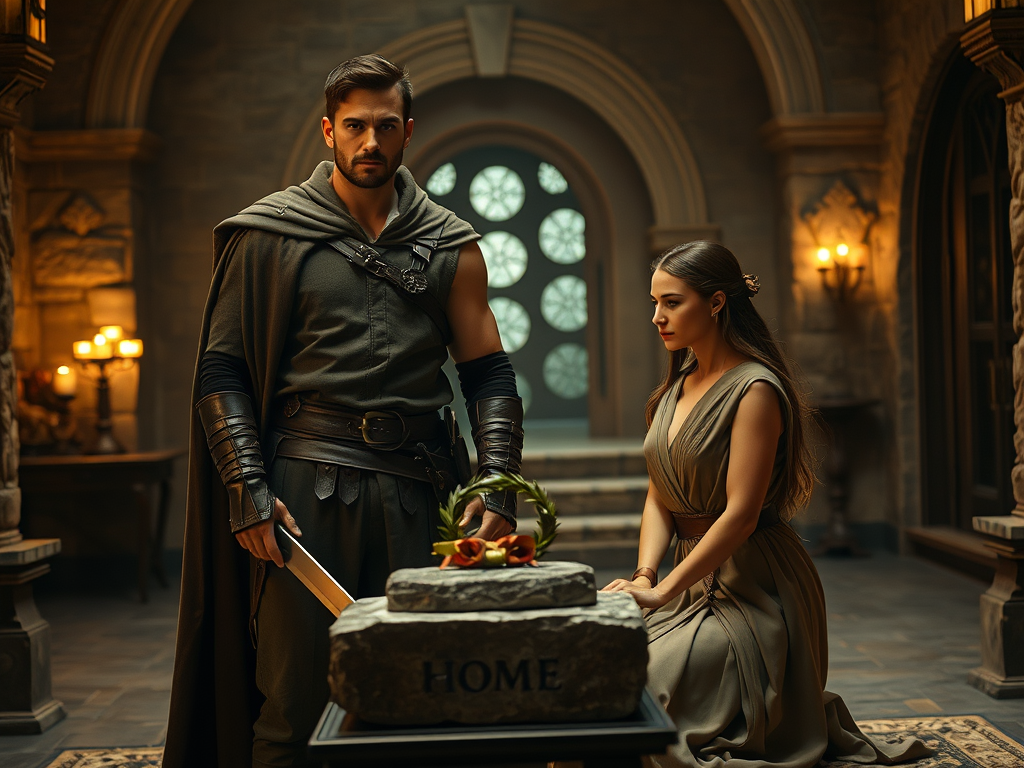
A Gorean home doesn’t become “Gorean” because you own a collar, use a few terms, or read the books twice. It becomes Gorean when the shape of the household is clear—and lived.
Most modern relationships fail not from lack of love, but from ambiguity:
Who leads? Who decides? Who carries what? Who is responsible for the emotional weather? Who is keeping the home? Who is “in charge” when no one wants to be?
A Gorean-inspired household answers these questions deliberately. It doesn’t pretend that hierarchy is “evil” or that roles are automatically oppression. It assumes something different: that many people actually thrive when roles are defined, consistent, and meaningful—especially in intimate relationships where polarity is part of the desire.
Detailed foundation (what this means in practice):
- Hierarchy is not cruelty. It’s structure.
- Belonging isn’t weakness. It’s stability.
- Leadership isn’t entitlement. It’s burden + responsibility.
- Devotion isn’t degradation. It’s chosen purpose.
Once that foundation is understood, then titles and rituals become what they should be: symbols of an already functional dynamic, not decorations covering chaos.
Bullet summary (structure options):
- Core bond: usually a male household leader (Master/Dominant) + a devoted female role (Free Companion and/or kajira/submissive).
- Formal bonds: collaring, Free Companionship, household charter, “Home Stone” symbolism.
- Informal hierarchy: rank, roles inside the home (e.g., First Girl), boundaries between household members.
- Community identity: “House of ___” mindset—shared values, shared rhythm, shared purpose.
2) Principles Over Copy-Paste: Define Roles Without Reenacting Harm

Let’s say this plainly: the novels contain darkness. They are fiction. They are written to provoke, intensify, and push extremes—especially around slavery, capture, and social domination.
A modern Gorean lifestyle, if it is to be healthy and honorable, must operate by a different standard: consent, legality, and ethical care. That doesn’t dilute the polarity. It refines it.
The mistake many beginners make is thinking “authentic” means “literal.”
But mature Gorean living understands this:
The books show archetypes. Your life must show integrity.
Detailed foundation (how to design roles properly):
A Gorean-inspired household is not created by harshness—it is created by clarity + consistency.
You don’t “become dominant” by barking orders. You become dominant by being dependable, stable, decisive, protective, disciplined, and emotionally contained. That is what makes surrender feel safe and desirable.
And a woman doesn’t become “submissive” by disappearing. She becomes submissive by choosing devotion with pride, mastering her service, and making her obedience an offering—not a collapse.
In other words: function first, aesthetics second.
Bullet summary (principle-based role design):
- Clarity: define what each role does (responsibilities, authority, boundaries).
- Consent: structure must be chosen, informed, and continuously respected.
- Responsibility: leadership means duty; surrender means honesty and follow-through.
- Coherence: your dynamic must show up daily (not only in fantasy moments).
- No harmful reenactment: drop coercion, humiliation-as-default, anger-based “punishment,” secrecy, isolation.
3) Daily Structure: Rituals of Respect, Chores, and Decision-Making

A Gorean household isn’t built in “big scenes.” It’s built in Tuesday mornings. It’s built in who gets up first, how the house is kept, how decisions are made, and how respect is shown when nobody is watching.
This is where many couples discover a surprising truth: structure is erotic.
Not because chores are sexy—but because clarity is sexy. Leadership is sexy. Devotion is sexy. Reliability is sexy. The household becomes a living language: every small ritual says, “This is who we are to each other.”
Detailed foundation (why routines matter):
Rituals are not childish roleplay. In Gorean thinking, rituals are anchors—tiny repeated acts that keep the mind aligned with the bond. They prevent drift. They prevent resentment. They prevent the household from becoming a messy “roommate relationship” where polarity dies slowly under undone dishes and unspoken expectations.
A woman who is naturally inclined toward devotion often blossoms when her service is seen, valued, and given shape. A man who is naturally inclined toward leadership becomes stronger when his leadership is tested daily in small responsibilities, not just dramatic claims.
Bullet summary (daily structure ideas):
- Rituals of respect: greetings, posture, service moments, forms of address.
- Chores as honor: defined standards + ownership + acknowledgment.
- Decision structure: domains (hers/his/shared), escalation rules, calm dispute process.
- Check-ins: weekly “Household Council” to adjust structure and prevent silent resentment.
4) “The Perfect Bondage”: A Beautiful Unicorn, Not a Universal Rule

Some promote strict monogamy using this Gorean quote:
“He had chosen the perfection of one man, the complete master, and one woman, the total slave… It is called the perfect bondage…” (Slave Girl of Gor)
It’s a powerful idea. The image of one man and one woman perfectly matched—each completely fulfilling the other—touches something romantic and absolute.
But here’s the problem: people sometimes use that line as a rule, rather than what it really is: an idealized peak, a poetic “unicorn bond,” a rare alignment.
Detailed foundation (what’s actually being described):
That quote describes a perfect fit between two individuals, not a universal law of nature. In real life—and even in the broader Gorean mythos—humans are not identical units. Capacity varies. Temperament varies. Desire varies. Some men are built to pour everything into one woman. Some men are built to lead a wider household. Some women are deeply satisfied in exclusive devotion. Some women can share, provided emotional security and structure are strong.
This is why monogamy, in a Gorean-inspired lens, tends to read as a configuration—sometimes chosen, sometimes imposed by circumstance—rather than the assumed default.
Now add a wider human-historical lens: across cultures, polygyny has been widely permitted in many societies, while strict socially enforced monogamy becomes dominant in particular cultural and legal systems for reasons often linked to social stability, inheritance, and reducing competition among men. (If you want an external reading rabbit hole: Joseph Henrich’s “The puzzle of monogamous marriage” is a well-known overview of why “socially imposed monogamy” spreads culturally, even when polygyny remains common in the broader anthropological record.)
The discreet Gorean implication:
- Many women are naturally oriented toward focused devotion—emotionally centering on “their man.”
- Many men are naturally capable of expansion—the ability (and often desire) to receive devotion from more than one feminine presence, if they can lead it well.
This doesn’t mean everyone should live that way. It means the impulse isn’t automatically “wrong,” “misogynistic,” or “unnatural.” It becomes wrong only when it becomes coercive, dishonest, or careless.
Bullet summary (the takeaway):
- “Perfect Bondage” is a rare ideal bond—not a universal rule.
- Monogamy can be valid—but often functions as a chosen constraint or circumstance.
- Polygyny appears frequently in Gorean fiction and human history; in lifestyle, it must be ethically designed.
5) If Your Household Leans Polygynous: Making It Work Without Breaking Women
Let’s speak plainly: a one-man / multi-female household is not “the easy mode” of Gor.
It is the higher burden.
It is not a fantasy of collecting bodies. It is a test of whether a man can become what the Gorean ethos quietly demands: a steady center, a leader whose presence creates safety, whose word creates certainty, whose discipline creates order, and whose fairness creates peace.
When a man cannot do that, polygyny becomes chaos dressed up as “Natural Order.” When a man can do that, the household can become something rare in the modern world: a living structure of belonging, with rhythm, purpose, and a deep, sensual stability that makes everyone involved feel more real.
Why it can be natural—without making it a law
Human nature is not a single straight line. It’s a set of instincts, shaped by survival, shaped by time, shaped by the reality that men and women often desire differently.
Many cultures across history have allowed or lived some form of one-man / multi-woman household—sometimes openly, sometimes quietly—especially when a man had the resources and status to support it. Modern society, particularly in the West, tends to normalize strict monogamy as a moral default. That doesn’t automatically mean monogamy is “wrong.” It means monogamy is a system—one that suits certain goals: social stability, simpler inheritance, fewer rivalries among men, cleaner legal definitions.
But a Gorean-inspired life isn’t built to satisfy a system. It’s built to satisfy truth.
And the truth many discover—especially once polarity is embraced rather than diluted—is this:
- A great many women are naturally oriented toward focused devotion. Not casual sharing of attention, not endless rotating romance, but the deep instinct to center emotionally on one strong male presence: my man, my Master, my home.
- A great many men are naturally capable of expansion, provided they have the strength to hold it: the ability to lead, protect, and receive devotion from more than one woman—without becoming careless, dishonest, or weak.
In Gorean terms, it isn’t “male entitlement.” It is male capacity—and only honorable men should attempt to live at the edge of that capacity.
So no: polygyny is not a universal rule. But yes: it often emerges as the more natural shape of a household when a man is strong enough to lead it well and the women involved are truly willing.
Why it can enrich everyone—when it’s a House, not a hobby
A healthy polygynous household, done with honor, doesn’t reduce women. It can actually elevate them—because it creates a structure where devotion is not a lonely burden, but a shared culture.
Done well, it can enrich the household in several ways:
For the man:
He cannot hide behind charm. He cannot “wing it.” He must become consistent. Fair. Present. Disciplined. He must lead as a daily practice—not as a mood. In many ways, polygyny forces a man to grow up spiritually and emotionally, because more people are depending on him to be stable. One woman may tolerate a man’s inconsistency for a while. Two or more will expose it quickly.
For the women:
A strong House can become a kind of sanctuary. Not because life becomes easy—but because life becomes ordered. The women can specialize, support each other, share burdens, and feel part of something larger than their personal insecurity. A woman who thrives in devotion often blossoms when she has not only a Master, but a House identity—standards, rituals, meaning. And in a well-led household, “sisterhood” is not a slogan: it becomes a real bond forged through shared service and shared pride.
For the bond itself:
The household stops being a fragile romance dependent on constant novelty. It becomes a living system: rituals, rules, respect, and continuity. It develops gravity. It feels like a “place” in the world. And that can be deeply erotic in the Gorean sense—the eroticism of belonging, of structure, of knowing one’s place and wearing it without shame.
But—and this matters—a polygynous household is never stable unless it protects the feminine heart.
Which brings us to the real point.
The unglamorous truth: polygyny is a jealousy management system
Jealousy is not proof that a woman is broken.
Jealousy is proof that her devotion is real.
Most women who are naturally wired for monogamous devotion don’t experience jealousy as a casual emotion. They experience it as a threat to safety and place. If you ignore that, you will create a household of tension, quiet resentment, and eventual sabotage.
So, in a Gorean House, jealousy isn’t “punished.” It is contained, guided, and transformed through structure and reassurance.
A Master who says, “Nature is nature, deal with it,” is not leading. He is avoiding responsibility.
A Master who says, “Your place is secure, I will not abandon you, and I will prove it daily,” is leading.
How to make it work well (without breaking women)
Here are the pillars that keep multi-female households stable. These are not “soft.” They are House law.
a) Clarity is kindness
Ambiguity is romantic in movies. In a multi-female household, it’s poison.
You need clarity about:
- roles (Companion, kajira, First Girl—whatever language you use)
- rank (who has authority, who does not)
- boundaries (what is shared, what is private)
- expectations (daily rituals, standards, rules)
When roles are vague, women compete for security. When roles are clear, women can relax into belonging.
b) No secrecy—ever
If you want harmony, remove secrecy like you remove mold from a wall.
Secrecy creates imagination. Imagination creates fear. Fear creates jealousy. Jealousy creates instability.
An honorable Master is transparent by default. Not because he owes anyone a court trial of his feelings—but because he understands that a woman’s surrender cannot coexist with uncertainty.
c) Predictable reassurance is not weakness—it is masculine leadership
A woman can share a strong man when she feels:
- seen
- valued
- protected
- and secure in her place
The Master must give each woman private moments of certainty. Not only sexual attention—emotional attention. The quiet, steady “you matter.”
If he cannot provide that, he should not be leading multiple women.
d) Fairness is not sameness
Fairness doesn’t mean identical. Women are not clones.
Fairness means:
- consistent rules
- stable standards
- no careless favoritism
- time handled responsibly
- and no woman treated as disposable
Perceived favoritism is the fastest path to a broken House. An honorable Master is careful with attention the way a wise king is careful with justice.
e) Structure among women: sisters, not rivals
In a stable House, women learn to view each other as:
- allies under the Home Stone
- contributors to the same banner
- “chain sisters” rather than opponents
Shared rituals help:
- serving together
- training together
- household tasks done as a team
- celebrating House pride together
When women share purpose, competition fades. They stop fighting for crumbs and start building something larger.
f) Never use humiliation as household glue
Humiliation can exist in consensual erotic play when a woman truly desires it.
But humiliation must never be the operating system of your home.
Do not pit women against each other for entertainment.
Do not use comparison as a weapon.
Do not shame feelings.
A House held together by humiliation is not Gorean. It is simply unstable dominance.
g) Agreements are sacred (even if you don’t call them “contracts”)
You don’t need a legal template. You need a clear House understanding:
- what is promised
- what is expected
- what is forbidden
- what happens when someone struggles
This is where Series 2.9 matters: words must align with actions. A multi-female household depends on that alignment more than anything else. When promises are broken repeatedly, women don’t just feel disappointed—they feel unsafe.
h) Autonomy and dignity must remain intact
A woman’s surrender only has meaning when she remains a whole person.
A healthy House ensures:
- consent is real
- communication is safe
- exit is possible
- outside life is not weaponized as control
A Master who needs to trap women to keep them has already admitted his weakness.
The discreet truth about monogamy vs. polygyny (without preaching)
Monogamy can be a beautiful configuration, sometimes even a perfect fit.
But in many cases it functions as a modern default, not a timeless law—especially for people who lean strongly into polarity. When devotion becomes deep and masculine leadership becomes clear, it is not unusual that a man feels called to expand his household and that women—secure in their place—can accept sharing him rather than rejecting the truth of who he is.
When it is honest, consensual, and well-led, it does not degrade women.
It builds a House.
Summary: the rule of thumb
If a man wants multiple women, he must become:
- more disciplined
- more honorable
- more consistent
- more fair
- more emotionally steady
Not less.
Polygyny is not a loophole.
It is not a license.
It is a standard.
And only a man worthy of devotion should attempt to carry it.
6) Household Checklist: A Monthly “House Scan”
This isn’t meant to be printed—it’s meant to be revisited. A Gorean household is a living system, and systems drift without maintenance.
Detailed foundation (why this matters):
Most relationships don’t collapse from one event. They collapse from slow misalignment: small broken promises, unspoken resentments, unclear responsibilities, neglected rituals, and the gradual death of polarity.
A monthly “scan” prevents drift. It forces the House to stay awake.
Bullet checklist (scan points):
- Clarity: do we all understand our roles right now?
- Consistency: are rituals lived, or only talked about?
- Authority: is leadership functional—or symbolic chaos?
- Safety: can concerns be voiced without retaliation?
- Coherence: do words match actions daily? (see Series 2.9)
- Devotion: is service seen, valued, and reinforced?
- Growth: are we becoming better humans in this structure?
- Stability: is attention predictable and fair?
- Community: are we grounded or isolated in unhealthy ways?
7) Reflection Questions: Design Your House, Not Someone Else’s

Every Gorean household should be crafted, not copied. Reflection questions help you build from truth rather than fantasy.
Detailed foundation (how to use these):
Don’t answer these quickly. Sit with them. Journal them. Speak them aloud. Most household problems can be traced back to one of these: unclear desire, unspoken fear, or misaligned expectations.
These questions aren’t “therapy.” They’re House-building tools.
Reflection prompts:
- What do we want our household to feel like—daily?
- Where do I naturally thrive—leading or serving—and in which domains?
- What does “respect” look like in our home (speech, rituals, posture, boundaries)?
- Which rules would make our home calmer—not just stricter?
- If monogamous: is that our nature, or our current circumstance/capacity?
- If polygynous-curious: is the motive leadership/structure—or novelty/escape?
- What would instantly increase emotional security for the submissive partner(s)?
- What would instantly raise the dominant’s leadership standard?
- What are our non-negotiables for consent, dignity, and safety?
Closing: Build a House Worthy of Devotion

A Gorean-inspired household is not defined by vocabulary, props, or perfect imitation. It’s defined by something far rarer:
- leadership worthy of surrender
- devotion offered freely
- structure lived daily
- honor practiced in small things
Some households will be one man and one woman. Some will expand naturally beyond that. The moral question isn’t “how many.” The real question is:
Is your House stable, honest, consensual, and honorable—and does it make the people inside it more alive?
If yes, you’re not playing at Gor. You’re living an aligned life.
I wish you well!
©2026 – Written by Azrael Phoenix
- Follow on Facebook: GorByPhoenix
You can read the full set of episodes of this Series here:
- Series 1 – Start Here: Understanding the Gorean Lifestyle
- Series 2 – The Philosophy: Values Behind the Gorean Lifestyle
- 2.a – Honor, Responsibility and Discipline: The Core of Gorean Philosophy
- 2.b – Freedom, Choice and Voluntary Surrender: A Paradox at the Heart of Gor
- 2.c – Strength and Vulnerability: The Gorean View of Masculinity and Femininity
- 2.d – Understanding Gorean Natural Order: Philosophy and Modern Life
- 2.e – Aligning Words and Actions in Gorean Life
- Series 3 – Practicing a Gorean-Inspired Lifestyle (Safely & Ethically)
- Series 4 – Reading Gor: Guides, Themes, and Character Studies
- 4.a – Where to Start with the Books of Gor
- Part 1 – A Reading Guide for Newcomers
- Part 2 – Saga in Stages: Phases of the Gorean Journey
- Stage 1 – The Early Adventures (Books 1–6): From Earthman to Gorean Warrior
- Stage 2 – Broadening Horizons & Deeper Themes (Books 7–13): New Perspectives on Gor
- Stage 3 – The Jason Marshall Trilogy (Books 14–16): A New Tale of Submission and Identity
- Stage 4 – War and Upheaval (Books 17–25): The Epic Gorean War and Turning Point
- Stage 5 – The Saga Resumes (Books 26–33): New Century, New Faces, and the Gorean Renaissance
- Stage 6 – Climactic Conclusions (Books 34–38): A New Resolve and the Future of Gor
- Part 3 – The Philosophy Behind the Fantasy: How Gor Evolved (and Why It’s Not Just “Erotic Pulp”)
- Part 4 – Major Pivotal Books & Moments in the Saga
- Part 5 – Where to Find the Gor Books (Legally and Easily)
- Part 6 – Confronting the Controversies: Misconceptions and Reality-Checks
- 4.a – Where to Start with the Books of Gor
 Gorean Lifestyle - House of Phoenix