Gorean Lifestyle - House of Phoenix
A view of the Gorean Lifestyle and Philosophy based on the Books
Series 4.a – Where to Start with the Books of Gor – Part 1: A Reading Guide for Newcomers
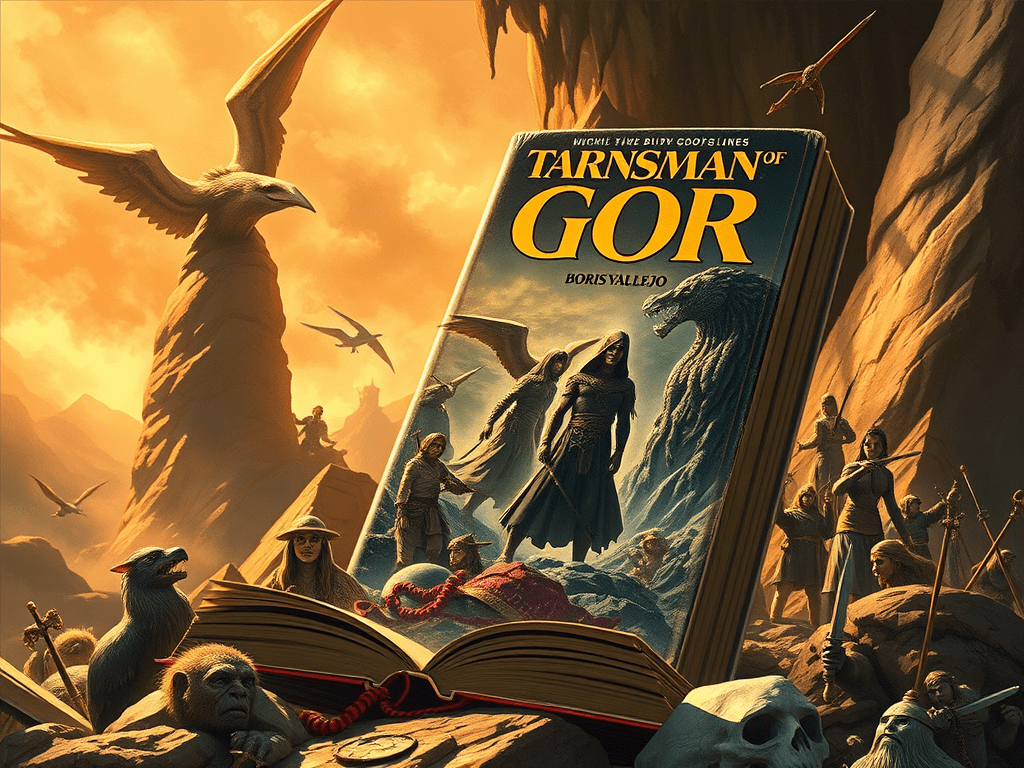
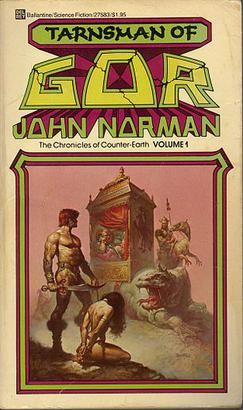
First published in 1966, Tarnsman of Gor is shown here with 1976 cover art by Boris Vallejo . This debut sword-and-planet novel launched John Norman’s controversial saga, which now spans 38 books.
There is so much to be said about this topic “Where to Start with the Books of Gor”, that I decided to split it in several parts:
- Part 1 – A Reading Guide for Newcomers
- Part 2 – Saga in Stages: Phases of the Gorean Journey
- Stage 1 – The Early Adventures (Books 1–6): From Earthman to Gorean Warrior
- Stage 2 – Broadening Horizons & Deeper Themes (Books 7–13): New Perspectives on Gor
- Stage 3 – The Jason Marshall Trilogy (Books 14–16): A New Tale of Submission and Identity
- Stage 4 – War and Upheaval (Books 17–25): The Epic Gorean War and Turning Point
- Stage 5 – The Saga Resumes (Books 26–33): New Century, New Faces, and the Gorean Renaissance
- Stage 6 – Climactic Conclusions (Books 34–38): A New Resolve and the Future of Gor
- Part 3 – The Philosophy Behind the Fantasy: How Gor Evolved (and Why It’s Not Just “Erotic Pulp”)
- Part 4 – Major Pivotal Books & Moments in the Saga
- Part 5 – Where to Find the Gor Books (Legally and Easily)
- Part 6 – Confronting the Controversies: Misconceptions and Reality-Checks
Stepping into the world of Gor can be exciting and daunting in equal measure. The Gorean Saga isn’t a single novel but a sprawling series of 38 books (and counting) written between 1966 and today . These stories mix classic adventure with provocative philosophy, all set on a counter-Earth (“Gor”) where society is shaped by honor, hierarchy, and the master-slave dynamic. In this guide, we’ll help you navigate the saga – outlining the major arcs (without heavy spoilers), suggesting reading orders, and highlighting how the series’ themes evolved over time. By the end, you’ll know where to begin your reading journey and what to expect as Gor’s epic unfolds. Along the way, I’ll also address common questions and controversies, demystifying the Gorean philosophy so you can appreciate the books with an open mind (and perhaps see why they’ve inspired a modern subculture ).
The World of Gor and Why It Matters
Before diving into individual books, it helps to understand the setting and scope of Norman’s universe. Gor is a fictional “Counter-Earth” planet that shares Earth’s orbit but remains hidden on the opposite side of the sun . In this world, walled city-states, nomadic tribes, and wilderness frontiers coexist, each modeled loosely on historical Earth cultures (from ancient Rome and Greece to Viking and tribal societies) . Society on Gor is fiercely hierarchical: people are classified by Caste (profession-based social order), united by loyalty to their city’s Home Stone, and often divided by feuds and wars. Overarching this human drama is a layer of science-fiction intrigue – alien “Priest-Kings” rule from the shadows, enforcing technological limits on humans, while another alien race, the ferocious Kurii, plot to conquer both Gor and Earth . These background conflicts (Priest-Kings vs. Kurii, Ar (land empire) vs. Cos (sea empire)) form a loose grand plot that threads through the series .
Most importantly for newcomers, Gor is a world obsessed with power and gender. The series unapologetically centers on dominance and submission: male warriors, masters, and raiders on one side, and often female slaves (kajirae) on the other. Slavery is normalized in Gor’s cultures, and many stories involve characters (often women from modern Earth) being captured, stripped of their former status, and forced to confront a more primal reality of masters and slaves . This is a provocative premise, and Norman uses it to explore ideas of “natural” gender roles, honor, and freedom in a deliberately extreme fashion. Early on, you’ll notice the books alternate between swashbuckling action – sword fights, tarn (giant eagle) rides, city sieges – and philosophical monologues on the nature of power, manhood, and womanhood. Reading Gorean novels is thus a dual experience: part pulp adventure, part social commentary. Keep this mix in mind; it’s what gives Gor its unique flavor and also what makes it controversial (more on that later).
How to Read the Gor Saga: Publication Order vs. Thematic Order
With 38 novels, a big question is: in what order should you read them? The simplest path is publication order, which is also the chronological order of the story. Starting from Tarnsman of Gor (Book 1, 1966) and moving forward means you follow the protagonist’s journey and the world’s development exactly as the author intended . This is highly recommended for newcomers, because the series does build on itself: characters recur, political situations evolve (e.g. city wars brewing in early books explode in later ones), and Norman’s philosophical themes deepen over time. By reading in publication order, you’ll catch foreshadowing and payoffs that might be lost if you jump around.
That said, some readers choose a thematic or character-based reading order after the first few books. For example, the core “Tarl Cabot” saga (the main hero’s storyline) is occasionally interrupted by side-narratives from others’ perspectives. A thematic approach might have you read all of Tarl’s primary adventures in sequence, then loop back to the stand-alone tales of other characters. For instance, one could read Books 1–6, skip to 8–10 (continuing Tarl’s travels), and defer Book 7 (Captive of Gor) until later since it features a different protagonist. Similarly, the novels told from a slave girl’s point of view (like Captive of Gor, Slave Girl of Gor, Kajira of Gor, Dancer of Gor, etc.) can be read together as an “illustrative sub-series” exploring female captive experiences. Another example: Books 14–16 form a self-contained trilogy about an Earth man and woman on Gor (more on that below), which some readers tackle separately.
However, unless you’re specifically trying to avoid spoilers or certain content, we suggest starting with the first book and progressing forward. The early books establish vital world-building and context for the later philosophical discussions. After you’ve read a dozen or so, you’ll have a feel for Norman’s patterns and can decide if you want to deviate. We’ll also highlight the major arcs below, so you know what to look forward to. As a newcomer, though, experiencing the saga as it unfolded historically can give you a richer perspective – you’ll see the tone shift from pulp adventure to deeper (and darker) themes, just as readers did in the 1960s–80s.
Quick tip: The first book, Tarnsman of Gor, is relatively short and fast-paced . It’s an excellent “test” to see if the setting intrigues you. If you enjoy it, the second and third books (Outlaw of Gor, Priest-Kings of Gor) will expand both the action and the underlying sci-fi plot. If you find the tone or content challenging, remember that many readers find different books in the series appeal to them differently – some prefer the adventure-heavy installments, others the psychological and culture-focused ones. Feel free to use the guide of the following posts to navigate to a phase of the saga that most interests you, but do be aware you’ll encounter references to prior events if you jump ahead.
I wish you well!
©2026 – Written by Azrael Phoenix
- Follow on Facebook: GorByPhoenix
You can read the full set of articles of this Series here:
- Series 1 – Start Here: Understanding the Gorean Lifestyle
- Series 2 – The Philosophy: Values Behind the Gorean Lifestyle
- 2.a – Honor, Responsibility and Discipline: The Core of Gorean Philosophy
- 2.b – Freedom, Choice and Voluntary Surrender: A Paradox at the Heart of Gor
- 2.c – Strength and Vulnerability: The Gorean View of Masculinity and Femininity
- 2.d – Understanding Gorean Natural Order: Philosophy and Modern Life
- 2.e – Aligning Words and Actions in Gorean Life
- Series 3 – Practicing a Gorean-Inspired Lifestyle (Safely & Ethically)
- Series 4 – Reading Gor: Guides, Themes, and Character Studies
- 4.a – Where to Start with the Books of Gor
- Part 1 – A Reading Guide for Newcomers
- Part 2 – Saga in Stages: Phases of the Gorean Journey
- Stage 1 – The Early Adventures (Books 1–6): From Earthman to Gorean Warrior
- Stage 2 – Broadening Horizons & Deeper Themes (Books 7–13): New Perspectives on Gor
- Stage 3 – The Jason Marshall Trilogy (Books 14–16): A New Tale of Submission and Identity
- Stage 4 – War and Upheaval (Books 17–25): The Epic Gorean War and Turning Point
- Stage 5 – The Saga Resumes (Books 26–33): New Century, New Faces, and the Gorean Renaissance
- Stage 6 – Climactic Conclusions (Books 34–38): A New Resolve and the Future of Gor
- Part 3 – The Philosophy Behind the Fantasy: How Gor Evolved (and Why It’s Not Just “Erotic Pulp”)
- Part 4 – Major Pivotal Books & Moments in the Saga
- Part 5 – Where to Find the Gor Books (Legally and Easily)
- Part 6 – Confronting the Controversies: Misconceptions and Reality-Checks
- 4.a – Where to Start with the Books of Gor
Discover more from Gorean Lifestyle - House of Phoenix
Subscribe to get the latest posts sent to your email.
 Gorean Lifestyle - House of Phoenix
Pingback: Series 4.b – 10 Scenes That Shaped the Gorean Lifestyle Community (and Why) – Part 8: On Earth, There Are Many Males – But Few Men – Gorean Lifestyle – House of Phoenix
Pingback: Series 4.b – 10 Scenes That Shaped the Gorean Lifestyle Community (and Why) – Part 7: “I Was Gorean – I Was Male” – Tarl Cabot’s Epiphany of Masculine Identity – Gorean Lifestyle – House of Phoenix
Pingback: Series 4.b – 10 Scenes That Shaped the Gorean Lifestyle Community (and Why) – Part 6: Honor and Choice in Love: Two Women, Two Paths (Ar’s Court, Assassin of Gor) – Gorean Lifestyle – House of Phoenix
Pingback: Series 4.b – 10 Scenes That Shaped the Gorean Lifestyle Community (and Why) – Part 4: “La Kajira” — An Earth Woman’s First Surrender of Self – Gorean Lifestyle – House of Phoenix
Pingback: Series 4.b – 10 Scenes That Shaped the Gorean Lifestyle Community (and Why) – Part 3 – From Proud Beauty to Serving Slave – Aphris of Turia’s Surrender – Gorean Lifestyle – House of Phoenix
Pingback: Series 4.b – 10 Scenes That Shaped the Gorean Lifestyle Community (and Why) – Part 2 – The Fall of Tharna – When Natural Order Overturns a Matriarchy – Gorean Lifestyle – House of Phoenix
Pingback: Series 4.b – 10 Scenes That Shaped the Gorean Lifestyle Community (and Why) – Part 1 – The Home Stone of Port Kar – Loyalty and Belonging in Action – Gorean Lifestyle – House of Phoenix
Pingback: Series 4.a – Where to Start with the Books of Gor – Part 6: Confronting the Controversies: Misconceptions and Reality-Checks – Gorean Lifestyle – House of Phoenix
Pingback: Series 4.15 – Where to Start with the Books of Gor – Part 5: Where to Find the Gor Books (Legally and Easily) – Gorean Lifestyle – House of Phoenix
Pingback: Series 4.a – Where to Start with the Books of Gor – Part 4: Major Pivotal Books & Moments in the Saga – Gorean Lifestyle – House of Phoenix
Pingback: Series 4.a – Where to Start with the Books of Gor – Part 3: The Philosophy Behind the Fantasy: How Gor Evolved (and Why It’s Not Just “Erotic Pulp”) – Gorean Lifestyle – House of Phoenix
Pingback: Series 2.a – Honor, Responsibility and Discipline: The Core of Gorean Philosophy – Gorean Lifestyle – House of Phoenix
Pingback: Series 2.b — Freedom, Choice and Voluntary Surrender: A Paradox at the Heart of Gor – Gorean Lifestyle – House of Phoenix
Pingback: Series 2.c — Strength and Vulnerability: The Gorean View of Masculinity and Femininity – Gorean Lifestyle – House of Phoenix
Pingback: Series 2.d – Understanding Gorean Natural Order: Philosophy and Modern Life – Gorean Lifestyle – House of Phoenix
Pingback: Series 2.e – Aligning Words and Actions in Gorean Life – Gorean Lifestyle – House of Phoenix
Pingback: Series 1.a – Understanding the Gorean Lifestyle: Myths and Realities – Gorean Lifestyle – House of Phoenix
Pingback: Series 1.b – From Page to Practice: How People Moved From the Books of Gor to a Modern Lifestyle – Gorean Lifestyle – House of Phoenix
Pingback: Series 1.c – Key Gorean Concepts for Beginners: Home Stone, Caste, Natural Order & More – Gorean Lifestyle – House of Phoenix
Pingback: Series 1.d – Common Misconceptions About the Gorean Lifestyle – Gorean Lifestyle – House of Phoenix
Pingback: Series 4.15 – Where to Start with the Books of Gor – Part 2: Saga in Stages: Phases of the Gorean Journey – Stage 6 – Gorean Lifestyle – House of Phoenix
Pingback: Series 4.15 – Where to Start with the Books of Gor – Part 2: Saga in Stages: Phases of the Gorean Journey – Stage 5 – Gorean Lifestyle – House of Phoenix
Pingback: Series 4.15 – Where to Start with the Books of Gor – Part 2: Saga in Stages: Phases of the Gorean Journey – Stage 4 – Gorean Lifestyle – House of Phoenix
Pingback: Series 4.15 – Where to Start with the Books of Gor – Part 2: Saga in Stages: Phases of the Gorean Journey – Stage 3 – Gorean Lifestyle – House of Phoenix
Pingback: Series 4.15 – Where to Start with the Books of Gor – Part 2: Saga in Stages: Phases of the Gorean Journey – Stage 2 – Gorean Lifestyle – House of Phoenix
Pingback: Series 4.15 – Where to Start with the Books of Gor – Part 2: Saga in Stages: Phases of the Gorean Journey – Stage 1 – Gorean Lifestyle – House of Phoenix