Gorean Lifestyle - House of Phoenix
A view of the Gorean Lifestyle and Philosophy based on the Books
Series 4.b – 10 Scenes That Shaped the Gorean Lifestyle Community (and Why) – Part 1 – The Home Stone of Port Kar – Loyalty and Belonging in Action
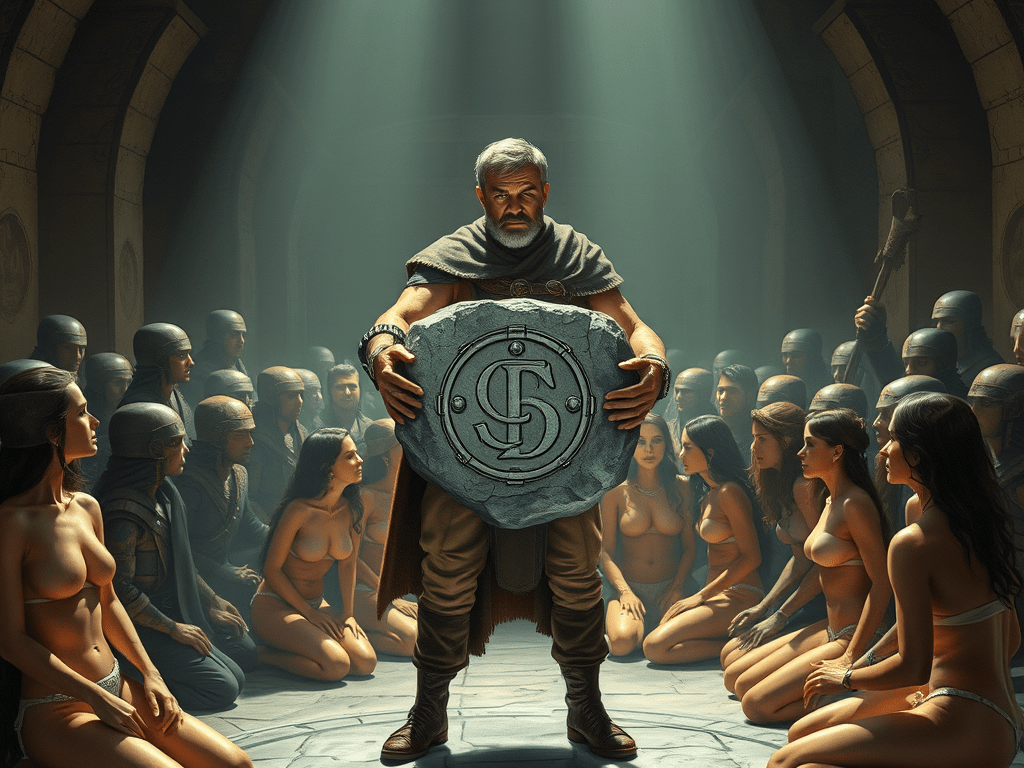
In this special set of articles, I’ll dive into ten memorable scenes from John Norman’s Gor novels that have profoundly influenced the Gorean lifestyle community (and me personally). Each scene is described without explicit detail, focusing on the philosophy or dynamic it illustrates. I’ll also explore how those intense fictional moments translate into real-life practices – offering healthier, consensual ways to express similar dynamics today.
Throughout these articles, we reinforce a key theme: Gor is not BDSM. Gorean Lifestyle is a holistic philosophy woven into daily life – something you live continuously, not just a role-play you dip into occasionally . By examining these scenes, we demystify the Gorean “Natural Order” mindset and show why many find it a natural, even evolutionary, way to live.
The Pivotal Moment in Raiders of Gor
I still remember the jolt of emotion I felt reading the scene in Raiders of Gor when Port Kar – infamous as the only city on Gor without a Home Stone – finally claimed one. In that pivotal chapter, with enemy fleets approaching and morale in ruins, Tarl Cabot (alias Bosk of Port Kar) stood among dispirited captains and did the unthinkable. “She has no Home Stone,” one man said of Port Kar . And it was true: “Port Kar, of all the cities on Gor, was the only one that had no Home Stone. I did not know if men did not love her because she had no Home Stone, or that she had no Home Stone because men did not love her.” Without a Home Stone, the men had no united cause, no symbol of honor to defend, and one officer even suggested the city be abandoned to its foes . It was a dark moment of despair and cynicism.
But then everything changed. I was riveted as Bosk turned the question around: “How many of you think that Port Kar has no Home Stone?” he asked the room . The men were confused – everyone “knew” Port Kar had none – until Bosk’s friend, Tab, ventured softly that “she might have one.” How could that be? Bosk guided them to the answer: “How does a city obtain a Home Stone?” he prompted. “Men decide that she shall have one,” Tab answered . In that simple exchange, the heart of the matter is laid bare: a Home Stone exists because people will it so, by their collective choice and belief.
What followed gave me goosebumps. Bosk summoned a young slave boy named Fish and ordered him: “Go outside and find a rock, and bring it to me.” When the boy returned with a common gray stone “somewhat bigger than my fist,” Bosk carved into it the block-letter initials of Port Kar . Holding the rock up, he asked, “What have I here?” Quietly, Tab spoke the words: “The Home Stone of Port Kar.” In that electrifying moment, a city’s soul was born out of nothing more than will and a piece of rock. Bosk turned to the man who had urged flight and challenged him: “Now, shall we fly?” The man gazed at the simple stone, perhaps feeling its weight of meaning for the first time in his life. “I have never had a Home Stone before,” he whispered. Would he still flee? “Not if we have a Home Stone,” he said .
I still get chills rereading the climax of that scene. Bosk raised the stone high: “Do we have a Home Stone?” he asked the assembly. The first answer rang out from the least expected source: “I will accept it as my Home Stone,” declared Fish – a lowly slave boy . No one mocked him. “The first to accept the Home Stone of Port Kar was only a boy, and a slave. But he had spoken as a Ubar.” In Gorean culture, the Ubar is the paramount leader, one who can unite men. In that instant, a child and slave showed the heart of a leader by being the first to swear loyalty to the new Home Stone. It was as if the honor of belonging to a Home Stone elevated even the lowliest person to nobility. Immediately, Bosk’s mighty allies – Thurnock, Clitus, Tab – all shouted “And I!” one after another, pledging themselves to Port Kar’s Home Stone . The room erupted in joy. More than a hundred weapons flashed from their sheaths to salute the stone. Weathered sea-thieves wept openly, brandishing swords in triumph. “There was joy in that room then such as I had never before seen… there was a belonging, and a victory, and a meaningfulness… and, in that instant, love.” The grim, maligned city of Port Kar had found its soul. Against all odds, a mere rock and the idea behind it ignited loyalty, honor, and hope where before there had been only cynicism and selfish survival. The next day, united under their new Home Stone, the men of Port Kar – every captain, mercenary, dockhand and slave – flung themselves at the invading fleets of Cos and Tyros and drove them back in a stunning victory . The Home Stone had transformed a den of pirates into an army of heroes.
The Symbolic Power of the Home Stone in Gorean Society
This scene is powerful not just as storytelling, but as an illustration of what a Home Stone means in Gorean society. On Gor, the Home Stone is far more than a rock; it embodies the heart, honor, and identity of a community. As one saying goes, “A palace without a Home Stone is a hovel; a hovel with a Home Stone is a palace.” (Slave Girl of Gor, p.142) . In other words, wealth or walls mean nothing without the spirit and unity that a Home Stone represents. The love Goreans have for their city is “invested in the Home Stone, that in many respects is the very soul of a city.” It is the tangible symbol of their sovereign community and its shared values. To possess a Home Stone is to be part of something larger than oneself – a people, a history, a destiny.
No wonder, then, that talking about Home Stones is considered almost sacred on Gor. “There is a saying on Gor… that one who speaks of Home Stones should stand, for matters of honor are involved.” (Tarnsman of Gor, p.27) . One does not speak of such things lightly. A Home Stone is a point of honor and home. It is said that “the sharing of a Home Stone is no light thing in a Gorean city.” (Slave Girl of Gor, p.394) – to share a Home Stone with someone means you are Ours, bound together as fellow citizens or housemates. This is why the men of Port Kar felt such triumph and love when they finally had their own Home Stone. In accepting that stone, they were not just agreeing to hold a bit of carved rock – they were accepting each other. They became brothers in a way they never were before. The pirate captains, the thieves, the fishermen, even the bond servants – all became one people of Port Kar in that moment, because now they shared a common heart. The Home Stone dissolved prior divisions: caste rivalries, personal grudges, even the barrier between free and slave momentarily vanished. As I read it, I realized that by Gorean belief a Home Stone’s power “unites such people and they will support and protect all those who share it.” The men of Port Kar had found something worth dying for besides gold: honor.
What strikes me most is how consciously created this symbol was. Port Kar didn’t stumble upon an ancient mystical stone or receive one from the Priest-Kings – Bosk and his men simply decided to have one. A Home Stone, in the end, is a matter of choice and commitment. “Men decide that she shall have one,” as Tab said . The scene beautifully illustrates a kind of social contract: the value of the symbol comes from the faith and honor people invest in it. Bosk even emphasizes this principle when his companion Telima incredulously says people are shouting that Port Kar has a Home Stone (when “everyone knows” it has none). He answers her, “If men will that there be a Home Stone in Port Kar… then in Port Kar there will be a Home Stone.” . This line is philosophical: reality on Gor is partly a matter of will. The Home Stone became real the moment people willed it into being and behaved as if it were real – a very existential notion.
Loyalty, Honor, and Identity Forged in Stone
The philosophical implications of this scene run deep, touching on loyalty, honor, civic identity, and even personal transformation. Loyalty is perhaps the most obvious theme: once the Home Stone existed, the men’s loyalty to Port Kar was ignited like a flame. Men who mere minutes before were ready to abandon the city were suddenly willing to lay down their lives for it. The symbol gave shape to an loyalty that had lain dormant. This resonates with a truth I’ve observed in life: people need something larger than themselves to believe in. Psychology recognizes that belonging to a group or cause fulfills a fundamental human motivation . When people feel they belong, it profoundly affects their emotions and behavior. In Port Kar’s case, the collective decision to embrace a Home Stone satisfied that deep need to belong to a community – turning a mob of individuals into a unified force. Modern social psychology research even confirms that having a shared symbol (like a flag or logo) makes a group feel more “real” and united to its members . The Home Stone served exactly that function: it made “Port Kar” tangible and real in the hearts of her people, perhaps for the first time ever. It’s no coincidence that in the throes of accepting the Home Stone, those hardened seamen felt “a belonging… and a meaningfulness” that they had never known before . The symbol unlocked a powerful group cohesion.
Closely tied to loyalty is honor. Gor is a world where personal honor is paramount, yet honor is usually conceptualized in terms of codes (like the Warrior’s Codes) or personal reputation. The Home Stone scene adds another dimension: honor as a shared, civic value. Defending one’s Home Stone is the highest honor a Gorean could ask for. Indeed, the Codes of the Warrior all but demand that a warrior defend his city’s Home Stone to the death. Before that night, Port Kar’s mercenaries had a reputation as honorless – they fought for coin or pleasure, not principle. But with a Home Stone, suddenly they had an honorable cause. One might say Bosk restored honor to Port Kar by giving its men something honorable to defend. The man who had never had a Home Stone before spoke for perhaps many of them when he said those words with wonder. It is very poignant: a veteran killer, who likely scoffed at honor, admitting in awe that now he has honor – because now he has something pure to fight for beyond himself. Gorean philosophy often emphasizes that meaning and honor derive from what one is willing to serve or protect beyond one’s selfish needs. The Home Stone epitomizes that principle. As one Gorean proverb puts it, “The loyalty and pride in your Home Stone seems to release the floodgates of hidden strengths.” Even a peasant or a pirate becomes formidable when fighting for his Home Stone. I felt this viscerally as those men brandished their swords and wept with fierce pride around that simple rock.
The scene also speaks to civic identity. Port Kar went from “that city of thieves” to our city literally overnight. A shared symbol can transform how people see themselves in relation to their community. Sociologists like Émile Durkheim long ago noted that common rituals and symbols help forge social unity . By participating in that impromptu oath-taking (it was effectively a citizenship ceremony happening organically), each man of Port Kar reforged his identity as a citizen not just a lone rogue. The Home Stone became the locus of a new civic identity that transcended the factions and even the multiple Ubarates that had split Port Kar’s governance. In fact, following this victory, Port Kar abolished its competing Ubars and was governed by its Council of Captains – unified, at last, under one flag (or rather, one stone) . It’s a reminder of how a society can reinvent itself by rallying around a new symbol and narrative. Anthropologists talk about “imagined communities” – groups of people who unite around shared stories, symbols, and memories even if they’ll never all meet. The Home Stone allowed Port Kar to imagine itself as a true city with a common heart. That shared narrative – “we are of Port Kar, we now have a Home Stone!” – gave every man from pirate prince to galley slave a point of common pride. It unified them as a community and galvanized collective action.
Finally, there is the thread of personal transformation. This runs quietly through the scene and the broader novel. Consider Tarl Cabot himself: earlier in the story he had betrayed his own Warrior’s code and lived as a despairing exile, “a man who had lost his honor.” In Port Kar he even took a cynical alias (“Bosk”) and wallowed in the city’s brutality, feeling that “There was nothing of worth in Port Kar, nor in all the worlds of all the suns.” Yet in choosing to give Port Kar a Home Stone instead of giving up, Tarl redeems himself. He steps back into honor and leadership. The label of Ubar – which he initially recoiled from – becomes something he earns not by crown or decree but by action. By risking himself to create hope for others, he transforms back into the honorable warrior he once was. And he transforms others: the slave boy Fish, who speaks as a Ubar in that moment, goes through his own metamorphosis from property to patriot (we later learn Fish was in fact the son of a former Ubar, living in disguise – making his acceptance of the Home Stone even more poignant). The men in that room, too, are transformed – fear melts into courage, despair into determination. Even absent characters are changed: I imagine how Telima, listening from afar, must have felt when she heard the roar of allegiance echo through Port Kar. Earlier that night she had clung to Tarl, begging him to flee: “Will you not fly?” she had pleaded, in tears . She feared for his life, knowing the treachery of Port Kar. But Tarl’s decision to stand his ground for the Home Stone likely transformed Telima as well – forcing her to confront her own cynical hatred of the city. In subsequent books, we see Gorean free women and slaves alike derive pride and identity from their city’s Home Stone; I suspect Telima, in spite of herself, felt a stirring of respect and pride then. Indeed, Port Kar’s Home Stone was born out of masculine will and honor, but its effects would embrace all – male and female, free and slave. When a man finds something noble to lead and protect, the people in his care also find purpose and belonging.
Universal Lessons: The Need for Belonging and Shared Symbols
One reason this scene resonates so deeply, even outside the context of Gor, is that it taps into a universal human truth: we all crave belonging, and we uplift symbols to represent that belonging. Psychology and sociology both affirm this. In their classic work on the “need to belong,” Baumeister and Leary concluded that the human desire for strong, positive group affiliations is “a powerful, fundamental, and extremely pervasive motivation.” When people lack belonging, they suffer; when they find it, they thrive. I see this in the men of Port Kar – once they felt connected to each other through the Home Stone, they were alive with passion and courage. Modern research on group psychology has even shown that simply having a symbol can make a random collection of individuals perceive themselves more strongly as a real group . In one study, groups that adopted a flag or logo were seen as more unified and even more formidable . The Port Kar story could be a case study in this effect: as soon as Bosk held up that inscribed stone, the psychological entitativity (group unity) of those men skyrocketed. They truly became one entity – the People of Port Kar – in their own eyes and thus gained the strength to act as one. Anthropologists similarly note that communal rituals and symbols (be it a totem pole, a flag-raising, or a shared Home Stone) have the power to knit individuals into a cohesive tribe . Durkheim’s insight over a century ago was that when a community venerates a symbol together, they are really venerating their own unity. The Home Stone of Port Kar is a fictional example, but it rings true with what we know about human nature. We give meaning to bits of cloth or stone and rally around them because doing so fulfills a deep social and spiritual need. We need that sense of “this is ours; we stand together.”
I believe this is why that Home Stone scene can nearly bring a tear to my eye – it speaks to the longing in each of us to find our own tribe, our own guiding symbol. For some, it’s a national flag or a community tradition. For Goreans, it’s the Home Stone, the very concept of home made concrete. Even here on Earth, we have analogues: consider how people feel about their country’s flag. A Gorean would say the flag is but a pale shadow; on Gor, if someone were to burn a city’s Home Stone it would be an act deserving of death . That is how sacred the symbol of belonging is. While we may not share that extremity on Earth, we can recognize the sentiment. Humans everywhere uphold symbols – whether a crucifix, a wedding ring, a team jersey – that stand for their group loyalty and identity. We invest these objects with emotion and meaning, much as the men of Port Kar did with their stone, and in return those symbols inspire us, comfort us, and challenge us to be better members of our communities.
Living the Home Stone in Modern Gorean Life
As a Gorean lifestyle practitioner in the modern world, I often reflect on Port Kar’s Home Stone when considering how to bring Gorean principles into daily life. Obviously, we are not defending walled cities from invaders here on Earth. But the symbolic and philosophical lessons of the Home Stone are remarkably applicable to our homes and relationships. For those of us who embrace the Gorean ethos, establishing a “Home Stone” in one’s household can be a deeply meaningful act. This doesn’t necessarily mean literally placing a rock in your living room (though some do choose a physical token – a stone or sculpture – to represent their Home Stone). It’s about creating a shared sense of home, honor, and purpose within the family or household circle.
In my own home, we actually instituted a Home Stone ritual after being inspired by Port Kar’s story. I selected a small smooth stone from a river near our house – nothing fancy, but that was the point. My partner and I sat down and discussed what our home and partnership stood for. We talked about our values (trust, loyalty, growth) and in a simple yet intimate ritual, I carved our initials into that stone. We pledged, hand over heart, that this stone would be our Home Stone, symbolizing the life we build together. It felt momentous, and indeed it has had a lasting impact. That stone sits in a central place in our living area. Every so often, if we face a tough decision or conflict, one of us will literally pick it up and say, “This is our Home Stone – remember what we stand for.” It’s amazing how a small object can diffuse an argument or strengthen resolve; it reminds us that our bond and common values come first. In a way, it’s our equivalent of a family flag or crest, but far more personal.
I know other Gorean households that have their own Home Stone practices. Some hold a yearly Home Stone ceremony where each member of the household (even the children, even any collared slaves in the house) reaffirms their fidelity to what the Home Stone represents. It might be as simple as touching the stone and saying “I keep faith” or as formal as reciting an oath. What matters is the renewal of shared identity. As the Port Kar scene showed, such rituals can unite and emotionally recharge everyone involved. I’ve seen a household of dear friends establish a Home Stone when they formed a new household. In a moving private ceremony, the head of house (a stern yet kind man I greatly respect) produced a beautiful polished stone he had prepared, and one by one the members of the house (his free companion, two household slaves, and even a close ally who is often at their home) laid their hands on it and spoke their pledge to uphold that household’s honor and welfare. There were tears of joy, even laughter, and a tangible sense of “this is who we are now.” It reminded me so much of that night in Port Kar – minus the swords!
The concept of the Home Stone also helps us modern Goreans clarify our values and roles. In Gor, the Home Stone often symbolizes the Natural Order of society – every person has a place and a duty around it. I’ve written before about Gor’s Natural Order and how it typically envisions the male as leader and protector, and the female as devoted supporter and nurturer of the home (whether Free Companion or kajira) – roles that complement each other in harmony. The Home Stone in a household can crystallize this dynamic in a positive way.
For Gorean couples or communities today, a Home Stone can be any symbol you jointly embrace: it might be an actual stone, a flag with a family emblem, or even a specific ritual spot in your home (a hearth, a fire bowl, etc.) where you gather to re-affirm your unity. The key is that everyone involved chooses it and honors it. It’s not coercive or dogmatic – it’s voluntary and heartfelt, or it’s meaningless. When done right, it serves as a constant beacon of shared values. It helps keep petty squabbles and individual ego trips in perspective, because you can always point to the Home Stone (literally or figuratively) and say, “This is what we serve.” In a Gorean household, that might translate to the family words or motto – perhaps an ideal like “Courage” or “Freedom” etched into the stone – something that, when times get tough, everyone can rally around. And yes, for those of us who structure our households around a dominant male and a submissive female, the Home Stone naturally reinforces that hierarchy of honor. The male, as holder of the Home Stone, carries the mantle of Ubar of the house – not a tyrant, but a servant-leader whose charge is the welfare and glory of those under the roof. The female, by pledging herself to that Home Stone, expresses her faith in his leadership and finds pride in her devotion. It’s a far cry from empty chauvinism; it’s a two-way street of responsibility and trust. Like in Port Kar, each person in the household, from the strongest warrior to the humblest kajira, draws purpose from the Home Stone and in return gives it their loyalty. I find that profoundly beautiful.
Conclusion: A Stone That Still Inspires
The saga of Port Kar’s Home Stone in Raiders of Gor is more than just a thrilling episode in a novel – it’s a lesson in human nature and a source of inspiration for living. I often encourage fellow readers (especially those exploring the Gorean lifestyle) to revisit that chapter and really absorb its message. It shows how loyalty, honor, and identity are forged when we choose to affirm a common bond. It shows that even the most jaded souls can find redemption in loyalty to a higher value. And it shows the natural satisfaction that comes when a man steps into leadership and a community (or a family) comes together in trust under him. John Norman’s writing might be called “fantasy,” but the Home Stone of Port Kar feels very real to me. It reminds me why I gravitated to Gor’s philosophy in the first place – the emphasis on belonging, on purposeful hierarchy, and on symbols that carry deep meaning.
I hope this reflection on Port Kar’s defining moment has been both informative and stirring. I wrote it to stand alone for anyone curious about Gorean concepts, but it’s also part of a larger journey. If you found value here, you might enjoy exploring related topics I’ve written about – such as the Gorean Caste System (another way society on Gor creates identity and order), the Gorean view of Natural Order between the sexes, or even practical tips on structuring a Gorean household in the modern world. All these aspects intertwine to paint a fuller picture of what it means to live by Gorean principles.
In the end, the Home Stone scene teaches a timeless lesson: we become what we choose to honor. In Port Kar, a rough crowd chose to honor a stone – and in doing so, they became a proud people. In my own life, I choose to honor the Home Stone I have set, and it continues to shape me into a better man and a better leader. Like those weathered seamen crying tears of belonging, I have found that it is in giving ourselves to something greater – a Home Stone, a home, a principle – that we truly find ourselves. And that, dear reader, is a realization as worth fighting for as any treasure on Gor.
I wish you well!
©2026 – Written by Azrael Phoenix
- Follow on Facebook: GorByPhoenix
You can read the full set of articles of this Series here:
- Series 1 – Start Here: Understanding the Gorean Lifestyle
- Series 2 – The Philosophy: Values Behind the Gorean Lifestyle
- 2.a – Honor, Responsibility and Discipline: The Core of Gorean Philosophy
- 2.b – Freedom, Choice and Voluntary Surrender: A Paradox at the Heart of Gor
- 2.c – Strength and Vulnerability: The Gorean View of Masculinity and Femininity
- 2.d – Understanding Gorean Natural Order: Philosophy and Modern Life
- 2.e – Aligning Words and Actions in Gorean Life
- Series 3 – Practicing a Gorean-Inspired Lifestyle (Safely & Ethically)
- Series 4 – Reading Gor: Guides, Themes, and Character Studies
- 4.a – Where to Start with the Books of Gor
- Part 1 – A Reading Guide for Newcomers
- Part 2 – Saga in Stages: Phases of the Gorean Journey
- Stage 1 – The Early Adventures (Books 1–6): From Earthman to Gorean Warrior
- Stage 2 – Broadening Horizons & Deeper Themes (Books 7–13): New Perspectives on Gor
- Stage 3 – The Jason Marshall Trilogy (Books 14–16): A New Tale of Submission and Identity
- Stage 4 – War and Upheaval (Books 17–25): The Epic Gorean War and Turning Point
- Stage 5 – The Saga Resumes (Books 26–33): New Century, New Faces, and the Gorean Renaissance
- Stage 6 – Climactic Conclusions (Books 34–38): A New Resolve and the Future of Gor
- Part 3 – The Philosophy Behind the Fantasy: How Gor Evolved (and Why It’s Not Just “Erotic Pulp”)
- Part 4 – Major Pivotal Books & Moments in the Saga
- Part 5 – Where to Find the Gor Books (Legally and Easily)
- Part 6 – Confronting the Controversies: Misconceptions and Reality-Checks
- 4.b – 10 Scenes That Shaped the Gorean Lifestyle Community (and Why)
- 4.a – Where to Start with the Books of Gor
Discover more from Gorean Lifestyle - House of Phoenix
Subscribe to get the latest posts sent to your email.
 Gorean Lifestyle - House of Phoenix
Pingback: Series 4.b – 10 Scenes That Shaped the Gorean Lifestyle Community (and Why) – Part 7: “I Was Gorean – I Was Male” – Tarl Cabot’s Epiphany of Masculine Identity – Gorean Lifestyle – House of Phoenix
Pingback: Series 4.b – 10 Scenes That Shaped the Gorean Lifestyle Community (and Why) – Part 6: Honor and Choice in Love: Two Women, Two Paths (Ar’s Court, Assassin of Gor) – Gorean Lifestyle – House of Phoenix
Pingback: Series 4.b – 10 Scenes That Shaped the Gorean Lifestyle Community (and Why) – Part 4: “La Kajira” — An Earth Woman’s First Surrender of Self – Gorean Lifestyle – House of Phoenix
Pingback: Series 4.b – 10 Scenes That Shaped the Gorean Lifestyle Community (and Why) – Part 3 – From Proud Beauty to Serving Slave – Aphris of Turia’s Surrender – Gorean Lifestyle – House of Phoenix
Pingback: Series 4.b – 10 Scenes That Shaped the Gorean Lifestyle Community (and Why) – Part 2 – The Fall of Tharna – When Natural Order Overturns a Matriarchy – Gorean Lifestyle – House of Phoenix