Gorean Lifestyle - House of Phoenix
A view of the Gorean Lifestyle and Philosophy based on the Books
Series 4.b – 10 Scenes That Shaped the Gorean Lifestyle Community (and Why) – Part 2 – The Fall of Tharna – When Natural Order Overturns a Matriarchy
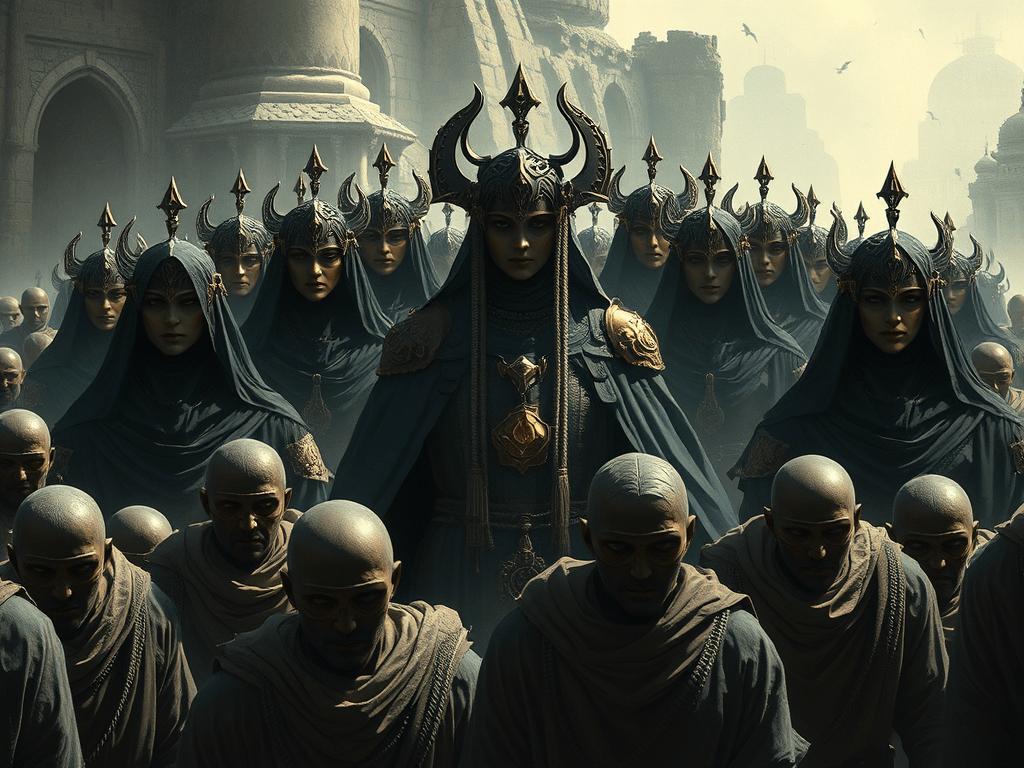
In John Norman’s Gor saga, few events illustrate the clash between imposed social order and “natural order” as starkly as the fall of Tharna. In Outlaw of Gor, the city of Tharna stands out as an anomaly on Gor – a matriarchal stronghold ruled by a queen (the Tatrix) and her all-female council. This was utterly contrary to the usual Gorean norms, where men hold power and women (whether free or enslaved) occupy clearly subordinate roles. Here in Tharna, women held privilege and power, enforcing a cold, authoritarian regime over the city’s men. By the end of the book, however, Tharna’s experiment in female rule collapses spectacularly.
The “natural order” – the Gorean ideal of male dominance and female submission – reasserts itself with full force, overturning the matriarchy. As someone who has studied both Gorean philosophy and real-world human behavior, I find the tale of Tharna’s fall deeply telling. In this article, I’ll recount the fall of Tharna and explore how it resonates with natural evolutionary tendencies and modern lifestyle choices. My goal is to demystify the “Natural Order” mindset and show that there is nothing inherently wrong – in fact, perhaps something very natural – in people choosing to live with the man as Dominant and the female as submissive. Along the way, I’ll draw links to science and history, and even offer thoughts on making such relationships work (minimizing jealousy and fostering harmony) in today’s world.
Tharna’s Matriarchy: A City Turned Upside-Down

From the moment Tarl Cabot (the saga’s male protagonist) enters Tharna, it’s clear this city is unlike any other on Gor. Tharna’s women walk freely in public, faces hidden behind silver masks, while men shuffle by in drab garments, careful never to even brush against them. In fact, physical contact between a man and a woman is literally a crime in Tharna – an offense punishable by harsh penalties. The usual Gorean customs – free women modestly confined to homes, veiled and speaking only to male relatives – are upended. Instead, in Tharna women command and men obey. Slavery of any kind has been outlawed in the city, so even the thought of a man owning a woman or a woman serving a man is anathema there.
At first glance, one might think Tharna’s female-led system is liberating for women. Even Tarl admits he initially felt a spark of approval that in at least one city women had such “privilege and opportunity”. But this matriarchy is no paradise – it is a dystopia. The ruling Tatrix (at the time, Lara’s usurper Dorna the Proud) and her cohorts impose oppressive and sadistic rule. The society is joyless and strained: the masked women of Tharna are described as beautiful but cold, and the men as sullen and downtrodden. We later learn that even the powerful women are internally miserable. They have tried to reject the natural order so completely that they deny their own biology and emotions. It’s hinted that many of Tharna’s women secretly yearn for the very dominance they have outlawed. Indeed, the author makes a point that Tatrix Lara’s notorious “hatred” of men stemmed from fear – fear of the powerful desire she actually felt to be dominated by a man. In other words, her loathing was rooted in the denial of her own nature, a nature that craved male mastery even as she ruled as a queen.
Overall, Tharna before the fall is painted as an unnatural social experiment – a matriarchy sustained by rigid laws, masks, and intimidation. No one is truly happy in Tharna, neither the men subjugated by women, nor the women themselves who live in constant denial of their natural urges. The stage is set for upheaval, because on Gor (as perhaps in nature), you can only suppress natural dynamics for so long before they erupt back to the surface.
Rebellion and the Fall of Tharna
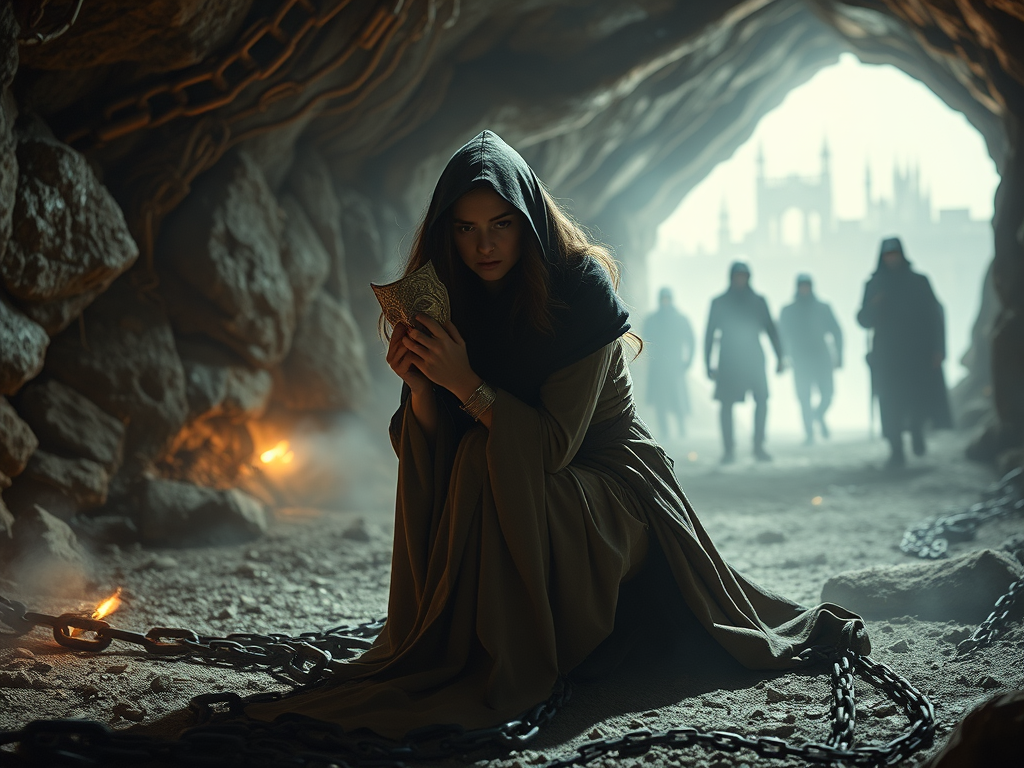
The turning point comes in Outlaw of Gor when Tarl Cabot finds himself imprisoned in Tharna’s silver mines among male slaves. What follows is a dramatic slave rebellion that ignites a wider revolution. The men of Tharna finally rise up against female rule – a revolt “ripping the city apart” as they overthrow the Tatrix and her council. Tarl plays a catalytic role: initially captured and forced into the brutal gladiatorial “Amusements of Tharna,” he manages to escape and even kidnap Lara, the reigning Tatrix, using her as leverage to free other prisoners. In the chaos that ensues, Lara’s scheming second-in-command (Dorna the Proud) attempts to usurp power, but Tarl returns just in time with the real Tatrix (Lara, now humbled and changed) to set things right.
The imagery of Tharna’s fall is striking: men breaking their chains in the depths of the mines, arming themselves and flooding into the city; slaves and warriors uniting to topple the female oligarchy. Natural order asserts itself in a very literal sense – the physically stronger sex, long suppressed, rises and reclaims dominance. Recently “men have regained total control over Tharna through a male slave rebellion initiated by then-prisoner Tarl Cabot”. The all-female government is overthrown. Dorna flees for her life, and the reign of the masked women crumbles.
One fascinating aspect is that victory doesn’t simply mean replacing a female tyrant with a male tyrant. Tarl doesn’t install himself as ruler; instead, he actually restores Lara to the throne – but on new terms. The men initially balk at the idea of any woman ruling again (understandably, as they “were fighting against the rule of women”). However, they relent only after seeing that Lara is not the same woman who once enforced their subjugation. In captivity, Lara herself has undergone a profound transformation. She experienced a taste of life as a captive/slave (when she was temporarily enslaved during the turmoil) and emerged deeply changed – warmer, wiser, and openly respectful of men. Tarl persuades the rebels that this new Lara no longer “hates men” or views them as beasts, and thus she can be a just leader. In essence, Lara has embraced the natural order in her own soul – relinquishing the cold mask of female supremacy and acknowledging the rightful strength of men. Only with that understanding is she accepted back, and the civil war can end.
This resolution is key: it’s not about men versus women annihilating each other; it’s about realigning society with what Norman portrays as the natural balance. Lara’s internal surrender to her suppressed submissive nature symbolizes the return of harmony. And practically speaking, the outcome in Tharna is sweeping – nearly the entire female population of Tharna ends up enslaved by the men in the aftermath (shockingly, with Lara’s own approval). Those proud free women in silver masks are given a simple choice: accept a man’s authority or be collared. Lara decrees that all former free women of Tharna have six months to find a male companion (a Free Companion, essentially a husband) who is willing to claim them – otherwise, any woman remaining alone after half a year will be made a slave. This edict comes from the once proud Tatrix herself! It’s as though she’s saying that a woman unclaimed by a man belongs in a collar, for her own good.
Many women of Tharna do end up in bondage as a result, willingly or unwillingly entering the “natural” state of the Gorean female. By the end of the novel, Tharna has been utterly reshaped into a more “normal Gorean city” – in other words, a patriarchy. Men now rule openly (Lara retains the title of Tatrix but notably adds men to her high council, and her power is clearly curbed by male authority). The once vaunted masks are abolished. Relations between the sexes revert to what Goreans consider healthy: women either become dutiful companions to men or their devoted slaves, and men resume their role as leaders and protectors. In an epilogic note, Tarl reports that under Lara’s renewed (and male-advised) leadership, Tharna is implementing reforms and that “positive effects are already being felt throughout the city, and throughout all Gor”. It’s as if Gor itself heaved a sigh of relief at Tharna’s return to the fold of natural order.
Gorean Philosophy: Natural Order Restored
As a long-time reader of the Gorean saga and a student of its philosophy, I interpret the Fall of Tharna as John Norman’s grand illustration of his core belief: Nature will triumph over social artifice. In Norman’s worldview (often called the “Gorean philosophy” by fans), men and women are inherently different and happiest when fulfilling their natural roles – the man as master or leader, the woman as companion or slave (submissive).
Tharna tried to invert that, imposing a top-down matriarchy that flouted those instincts. The result? Misery, repression, and eventual violent correction. When they say “natural order” on Gor, they specifically mean male dominance and female submission as the way things are supposed to be. It’s a controversial idea, no doubt. But Norman doesn’t shy away – through Tharna’s story he essentially argues that a society run by women will either collapse under its own denial of nature or have to change course to survive.
One telling detail is Lara’s personal journey. She embodies the archetype of the proud, unfulfilled woman who secretly yearns for a strong man’s dominance. Her “fear of her desire to be dominated” is what fueled her extreme behavior against men. How familiar does that sound? In the Gorean mindset, many women who stridently seek power over men or profess to despise men are, deep down, at war with their own feminine submissive longing.
It’s almost a Freudian touch – the thing you hate is the thing you unconsciously want. Once Lara finally experiences true submission (briefly as a slave and then as Tarl’s obedient ally), that inner conflict in her dissolves. She becomes more content, compassionate, and whole. The implication is that women find their truest happiness in yielding to male dominance, not in wielding power themselves. The post-revolution Tharna, where women either have a male companion or are collared, is portrayed as a far more peaceful and joyous place than the old Tharna of masked mistresses. The “unnatural” experiment ended, and harmony returned.
Now, it’s crucial to note – and Norman always did through Tarl’s perspective – that this isn’t about men mindlessly subjugating women out of cruelty. The Gorean natural order is as much burden as privilege for men. A Gorean man must be strong, honorable, and worthy of the total power he wields. He is expected to cherish and protect his woman (or women), even as he commands them. In Tharna’s case, the men endured years of humiliation under female rule, but when they took power, they didn’t become wanton monsters.
Instead, under Tarl and Lara’s influence, they allowed a just settlement: Lara herself remained as figurehead (after learning her lesson), and only the women who refused any companionship were ultimately enslaved. One could argue even that was for their own good – in Gor’s philosophy, a woman without a man to belong to is thought to be deeply unhappy on some level. Better a collar at a strong man’s feet than lonely “freedom” in misery. It’s a provocative view, yet within the books it is often borne out by the narratives of countless slave-girls who discover joy once they stop fighting their nature.
As I recount Tharna’s fall, I am struck by how resonant it is with certain evolutionary and historical perspectives on gender. Norman was writing fantasy, but he peppered his work with pseudoscientific justifications for male dominance – many drawn from real anthropology, biology, and history (albeit selectively). Let’s step back and consider: Is there any factual basis to the idea that polygyny (one man, multiple women) and female monogamy (one woman bonded to one man) might be a “natural order” for humans? The answer is complex, but there are some intriguing links.
Evolutionary Echoes: Are We “Wired” for Male Dominance and Polygyny?

Modern science tells us that human mating systems have varied widely across cultures and history – yet certain patterns do emerge. Anthropology in particular reveals that monogamy (pairing one man and one woman exclusively) is actually somewhat unusual when you look at the broad sweep of human societies. One comprehensive cross-cultural analysis found that about 85% of pre-industrial societies permitted polygynous marriage (polygyny meaning a man can have multiple wives).
In other words, before modern era norms and laws imposed monogamy in many places, the vast majority of human cultures were flexible enough to allow a successful man to take two, three, or more wives. Monogamy as a strict norm became globally prevalent only relatively recently – roughly in the last 10,000 years, coinciding with the rise of agriculture and complex civilizations. Before that, in the more “natural” context of nomadic or tribal life, humans likely practiced a mix of mating strategies with a strong dose of polygyny. In fact, some biologists characterize humans as “mildly polygynous” by nature – not as extremely polygynous as, say, gorillas, but not purely monogamous either. We show physical and behavioral signs of a species where males competed for mates and often the highest-status males had disproportionate reproductive success.
Genetic evidence bears this out in a startling way: historically far more women than men have passed on their genes to future generations, implying that many women shared relatively few men as mates. One genetic study from the Max Planck Institute examined DNA from populations around the world and concluded “overall, more women reproduced than men” throughout human history.
Why would that be? The researchers explain: “not all men are able to afford wives, or sometimes a few men will have many wives”. In other words, in many societies a minority of men (the most successful, powerful, or desirable) fathered children with multiple women, while less successful men left no offspring at all. This kind of reproductive pattern is classic polygyny – and it has left its mark in our genes. It suggests that, in broad evolutionary terms, men who could attract multiple women did so, and women, rather than each having a unique one-to-one mate, often ended up sharing high-value men (whether as formal co-wives or as concubines, mistresses, etc.).
From an evolutionary psychology standpoint, this aligns with differences in male and female mating strategies. Females (who have high investment in pregnancy and child-rearing) tend to be choosy, often seeking a mate who is capable, resourceful, and dominant – even if that means he already has another mate. Males, by contrast, can increase their reproductive success by mating with multiple females (since, biologically, a man can potentially father many more children in a year than a woman can bear).
Thus, it’s argued that men have an innate drive to seek multiple partners, and women have an innate inclination to focus their devotion on one strong partner – even if that man might not be exclusively hers. I see a direct parallel here to the Gorean natural order: the Gorean male expects to have several women serving him (if he has the means), and the Gorean female is expected to be utterly devoted to her one man (whether as his Free Companion or his slave). Far from being a purely fictional kink, this setup echoes patterns that have appeared repeatedly in human history and even prehistory. Consider ancient harems of kings, polygamous marriages in biblical times.
Even in ostensibly monogamous societies, powerful men often had mistresses or concubines on the side (e.g., Emperor Louis XIV of France famously kept official mistresses who bore him many children). Serial monogamy (divorcing and remarrying younger women, as Henry VIII did) is another way male leaders have effectively monopolized multiple women over a lifetime. All these real-world examples point to one thing: there is nothing bizarre or perverted about one man having multiple women in his life; it has been common and “normal” throughout history.
Monogamy has its advantages too, of course – it became the dominant norm in modern times for various social and economic reasons (inheritance issues, egalitarian ideals, etc.). But biologically, polygyny remains a persistent underlying tendency. To put it simply, our species wouldn’t have the genetic patterns it does if we were truly strictly monogamous by nature.
I want to be clear: saying something is “natural” in an evolutionary sense doesn’t automatically make it morally right or right for everyone. However, it does suggest that those who choose to live in a male-dominant, polygynous arrangement are aligning with an ancient, evolution-tested pattern. There’s a certain resonance or ease that can come from that, which many people feel even if they can’t articulate it. I’ve spoken with women in the Gorean lifestyle who describe a profound feeling of “coming home” when they finally submit fully to one man’s authority. Likewise, men often describe a sense of groundedness and purpose when they embrace their role as protector/leader of their women. It’s as if these roles are part of our deep cultural DNA.
Modern Reflections: Polygyny and Devoted Women in Today’s World

One might ask: All this Gor talk and evolutionary history is fine, but what about now? Isn’t one-man-many-women an outdated practice? You may be surprised to learn that plural relationships and consensual power-exchange lifestyles are not only still around – they’re quietly on the rise. While society at large remains very much monogamy-centric (and gender-equality oriented), there’s a growing subculture exploring alternatives that look a lot like the Gorean model (minus the literal aliens and swords!).
Consider the phenomenon of consensual non-monogamy. Recent surveys in the United States found that about 1 in 5 people has engaged in some form of consensual non-monogamous relationship in their lifetime. That could include swinging, open relationships, polyamory, or polygamy. At any given time, an estimated 4–5% of the population is currently in an openly non-monogamous setup. These numbers are not negligible – that’s millions of people. And the interest in such relationships has been growing in the last decade.
Now, not all of these are polygyny per se (some are polyamory where women also have multiple partners, etc.), but the point is that monogamy is no longer a one-size-fits-all given. Society is slowly acknowledging that different arrangements can work for different people. Polygyny in particular continues in many parts of the world (from West Africa to segments of the Middle East and Asia), and even in the West we see it in certain communities (for example, fundamentalist Mormon groups practice plural marriage, and some African or Middle Eastern immigrant communities maintain polygynous families).
Moreover, a less formal type of polygyny is arguably at play in the dating world – it’s often observed that a relatively small percentage of the most attractive or wealthy men end up dating or sleeping with a large pool of women (thanks to dating apps and social media, the effect of a few men “cornering” the market has been commented on by researchers). It seems the Gorean-like dynamic of high-status men having multiple women is sneaking back into mainstream consciousness, albeit without the open social recognition it once had.
Additionally, the Dominant/submissive (D/s) lifestyle has gained notable visibility and interest – partially propelled by books/films like Fifty Shades of Grey, which, while not Gorean, tapped into similar fantasies of a powerful man and devoted woman. Thousands of couples today incorporate consensual power dynamics into their relationships, with some even identifying as 24/7 Master/slave couples. Within these circles, it’s not unheard of for a Master to have more than one slave or submissive.
It’s done ethically and with consent, but it mirrors that “harem” structure in a modern, negotiated way. I personally know several triads or quads where one male Dominant has two or three female submissives who love the arrangement – they often describe each other as “sister slaves” or “sister-wives”, supporting one another emotionally while serving the same man. Far from being constantly jealous or oppressed, many of these women report a strong sense of sisterhood and shared purpose. After all, they chose this life because it fulfills them.
One Psychology Today article even noted that polygyny can have upsides for women: co-wives may come to enjoy each other’s company, help each other with domestic duties and child-rearing, and the addition of younger wives can reduce the workload on the first wife while even enhancing her status in the family. This doesn’t mean it’s all sunshine and roses – but it undercuts the simplistic assumption that multiple women with one man is automatically a miserable scenario for the women. In fact, some women genuinely prefer to share a great man rather than have a mediocre man all to themselves.
In evolutionary terms, this makes sense too – better to be the second (or third) wife of a strong, resource-rich male than the only wife of a weak, incapable male (a dynamic observed in many polygynous cultures). We see echoes of this even in modern dating; for example, studies show wealthy or high-status men are much more likely to attract female interest, even if those men are known to be less faithful. It’s as if many women subconsciously would rather be one of many in a high-status man’s life than the sole focus of a low-status man.
Let’s not pretend jealousy never exists in such arrangements – it does. Jealousy is a natural human emotion, and even the most dedicated Gorean-style woman can feel its pangs when her Master brings a new girl into the household. However, jealousy can be managed and minimized. I often emphasize communication and emotional honesty as key. In Tharna’s fictional case, of course, the women were conquered and had to accept the new order. But in a willing polygynous or D/s relationship today, everyone must communicate their needs and feelings.
Modern research on polyamorous families has introduced the idea of “compersion,” which is essentially the opposite of jealousy – feeling happiness or joy at your partner’s happiness with someone else. Achieving compersion is challenging, but not impossible. A recent psychological study identified factors that help people feel positive rather than jealous in non-monogamous setups. Top among them were emotional closeness among all parties, clear, honest communication about the relationships, and a reduction in possessive mindset. In a polygynous marriage, this translates to fostering solidarity and friendship between co-wives.
If two women see each other as sisters or teammates rather than rivals, jealousy dwindles into the background. In my experience, a wise Dominant man will encourage bonding among his women – perhaps having them spend time together, work on projects jointly, or openly acknowledge each woman’s special place in his life so none feel insecure. It’s also crucial that he remains fair and attentive: showing favoritism or neglecting one partner is a sure way to ignite envy. Gorean masters in the books often handle this by establishing a clear hierarchy (e.g., a “First Girl” among slaves who has certain responsibilities) and making sure each woman knows what is expected and also what care she will receive. Structure and clarity go a long way in preventing jealousy.
Additionally, a devoted female in such a lifestyle can work on her mindset to reduce jealousy. This might involve building confidence in her value to her man and embracing the idea that his love/ownership isn’t a zero-sum game. One woman’s beauty or service doesn’t negate another’s. A practical tip I give is to focus on the positive aspects of having a sister-wife or co-submissive: she can be a friend and companion to you, someone who understands your world. You can learn from her strengths, and she can learn from yours.
When jealousy twinges arise, instead of letting them fester, talk about them with your partner in a respectful way (“Master, I find myself feeling insecure when I see you with her, can you help me with this?”). A good Dominant will reassure and guide his women through these feelings, not scold them for it. In the end, the goal is a harmonious household where, much like a well-run Gorean city, everyone knows their role and finds contentment in it.
It’s worth noting that studies of consensually non-monogamous folks find that they do experience jealousy (they’re human!), but they tend to report less distress about it and more strategies to cope. This is encouraging: it means jealousy doesn’t have to be the downfall of plural relationships. With openness, empathy, and maybe a dash of “compersion” practice, multiple adults can indeed love and serve together under one roof. I’ve seen it work beautifully – and ironically, those families sometimes have less drama than some monogamous couples I know, because they’ve had to develop stellar communication skills and intentional relationship practices.
Embracing the Natural Order – Nature Usually Wins

Looking back at Tharna’s rise and fall, I not only see an adventurous story – I see a mirror held up to some fundamental truths about sex and power. The Fall of Tharna shows a society course-correcting to what its members truly need: men reclaiming purpose and agency, women finding fulfillment in devotion and service. It’s an extreme, fictional scenario, but the underlying message hits a chord with me as a proponent of the Gorean philosophy (in its consensual modern form).
There is nothing evil or “wrong” about a man assuming his natural dominant role, nor about a woman yielding to her natural submissive role – if anything, it can be beautiful and enriching for both. This dynamic, when entered willingly and lived honorably, aligns with millennia of human experience and our very biology. Far from being some kind of twisted perversion, a polygynous or D/s lifestyle can be seen as a return to an ancient “tribal” model of family – one that our ancestors often lived and that our genes remember.
Of course, every individual and couple (or triad, etc.) is different. The Gorean path is not for everyone, just as monogamy is not for everyone. The wonderful thing about the times we live in is that more people are waking up to the idea that they can design their relationships in the way that brings them the most joy and authenticity – societal convention be damned. For some, that might be a strict 1-1 egalitarian marriage. For others, it might be a Master with his harem of adoring kajirae (slave-girls). Many will find themselves somewhere in between. The key is choice and consent, guided by a recognition of what truly makes you feel alive.
As an individual, I write about these topics not to pressure anyone into a lifestyle, but to shed light on an option that is often misunderstood. The “natural order” mindset – the idea that many women want to love one man with fierce singular loyalty, and many men want (and even deserve) to lead multiple women – is certainly counter-cultural today. It can be misinterpreted as misogyny or chauvinism by those who only see the surface. But I hope this analysis of Tharna helps demystify it. When done consensually, a male-led, polygynous relationship can be nurturing and deeply satisfying. It taps into something primal: the proud protective male and the adoring female(s) who revolve in his orbit, each completing the other.
The Fall of Tharna is just one scene in the rich tapestry of the Gor chronicles, but it’s a pivotal one. It invites us to question modern assumptions and at least consider that our “civilized” norms (like strict monogamous matriarchy – or even our more extreme experiments in gender role reversal) might not always align with the heart’s truth or nature’s design. Gor, in its pulp-fiction way, invites readers to explore those uncomfortable ideas. And perhaps that’s why the series and the subculture around it endure.
I encourage you, if this topic intrigues you, to continue exploring this blog series and the world of Gor in general. In upcoming posts, I’ll be delving into other dramatic moments and themes from the books – each offering a lens on topics like honor, instinct, master/slave dynamics, and more. Whether you’re simply a curious reader or someone seeking a more fulfilling relationship paradigm, the Gorean philosophy has nuggets of insight (and yes, titillation!) that are worth your time.
Tharna fell because it had to fall – natural order reasserted itself, and in the end, both men and women of Tharna were better for it. It’s a lesson in both story and symbolism. As I reflect on it, I find myself quietly affirming the path I’ve chosen in life – one that embraces my nature rather than fights it. After all, in the long run, nature usually wins. And when it comes to love, sex, and power, perhaps the happiest outcome is when we allow it to win – consciously, respectfully, and passionately in our own lives.
Tal (greetings/good fortune) to you, dear readers, and thank you for reading this deep dive into Scene 2 of our series. Stay tuned for more explorations of Gor’s wisdom and wonder in the next installment!
References
- Tharna | Gorean Wiki | Fandom
- Tharna | What Women Wore
- Outlaw of Gor | Gorean Wiki | Fandom
- Humans rank between meerkats and beavers in monogamy ‘league table’
- The Pros and Cons of Polygamy | Psychology Today
- Polygamy – an overview | ScienceDirect Topics
- News – Genetic Study Offers Evidence of Polygyny in Human History – Archaeology Magazine
- The Pros and Cons of Polygamy | Psychology Today
- Updated Estimate of Number of Non-Monogamous People in U.S. | Psychology Today
- Study identifies key factors boosting compersion in non-monogamous relationships
- What Is Compersion? Unpacking The Opposite Of Jealousy | mindbodygreen
I wish you well!
©2026 – Written by Azrael Phoenix
- Follow on Facebook: GorByPhoenix
You can read the full set of articles of this Series here:
- Series 1 – Start Here: Understanding the Gorean Lifestyle
- Series 2 – The Philosophy: Values Behind the Gorean Lifestyle
- 2.a – Honor, Responsibility and Discipline: The Core of Gorean Philosophy
- 2.b – Freedom, Choice and Voluntary Surrender: A Paradox at the Heart of Gor
- 2.c – Strength and Vulnerability: The Gorean View of Masculinity and Femininity
- 2.d – Understanding Gorean Natural Order: Philosophy and Modern Life
- 2.e – Aligning Words and Actions in Gorean Life
- Series 3 – Practicing a Gorean-Inspired Lifestyle (Safely & Ethically)
- Series 4 – Reading Gor: Guides, Themes, and Character Studies
- 4.a – Where to Start with the Books of Gor
- Part 1 – A Reading Guide for Newcomers
- Part 2 – Saga in Stages: Phases of the Gorean Journey
- Stage 1 – The Early Adventures (Books 1–6): From Earthman to Gorean Warrior
- Stage 2 – Broadening Horizons & Deeper Themes (Books 7–13): New Perspectives on Gor
- Stage 3 – The Jason Marshall Trilogy (Books 14–16): A New Tale of Submission and Identity
- Stage 4 – War and Upheaval (Books 17–25): The Epic Gorean War and Turning Point
- Stage 5 – The Saga Resumes (Books 26–33): New Century, New Faces, and the Gorean Renaissance
- Stage 6 – Climactic Conclusions (Books 34–38): A New Resolve and the Future of Gor
- Part 3 – The Philosophy Behind the Fantasy: How Gor Evolved (and Why It’s Not Just “Erotic Pulp”)
- Part 4 – Major Pivotal Books & Moments in the Saga
- Part 5 – Where to Find the Gor Books (Legally and Easily)
- Part 6 – Confronting the Controversies: Misconceptions and Reality-Checks
- 4.b – 10 Scenes That Shaped the Gorean Lifestyle Community (and Why)
- Part 1 – The Home Stone of Port Kar – Loyalty and Belonging in Action
- Part 2 – The Fall of Tharna – When Natural Order Overturns a Matriarchy
- 4.a – Where to Start with the Books of Gor
Discover more from Gorean Lifestyle - House of Phoenix
Subscribe to get the latest posts sent to your email.
 Gorean Lifestyle - House of Phoenix
Pingback: Series 4.b – 10 Scenes That Shaped the Gorean Lifestyle Community (and Why) – Part 7: “I Was Gorean – I Was Male” – Tarl Cabot’s Epiphany of Masculine Identity – Gorean Lifestyle – House of Phoenix
Pingback: Series 4.b – 10 Scenes That Shaped the Gorean Lifestyle Community (and Why) – Part 6: Honor and Choice in Love: Two Women, Two Paths (Ar’s Court, Assassin of Gor) – Gorean Lifestyle – House of Phoenix
Pingback: Series 4.b – 10 Scenes That Shaped the Gorean Lifestyle Community (and Why) – Part 4: “La Kajira” — An Earth Woman’s First Surrender of Self – Gorean Lifestyle – House of Phoenix