Gorean Lifestyle - House of Phoenix
A view of the Gorean Lifestyle and Philosophy based on the Books
Series 4.b – 10 Scenes That Shaped the Gorean Lifestyle Community (and Why) – Part 5: The Ritual of Serving Wine – The Joy and Dignity of Service

Introduction: In this fifth installment of our “Top 10 Scenes That Shaped the Gorean Lifestyle Community,” we explore one of the most cherished rituals in Gor: a kajira (slave girl) serving wine to her Master. This simple act – pouring and presenting a drink – is elevated to an art form on Gor. It’s not about the beverage itself; it’s about what the ritual symbolizes.

The scene of a slave kneeling gracefully with a cup of wine epitomizes the joy and dignity of service in Gorean philosophy. By examining this iconic ritual, we will discuss the deeper dynamic it illustrates, how Goreans adapt such practices in real life, and why Gor is a full-time philosophy – not a casual BDSM scene. We’ll also touch on how Goreans handle a lifestyle where a man might have multiple partners under his care, and a woman devotes herself to one man, “Natural Order” style.
Importantly, while the Gorean novels are fantasy, the values behind this ritual (honor, devotion, beauty in service) resonate strongly with real-life Goreans. Let’s dive into the scene and its meaning, demystifying why serving wine is so much more than a chore – it’s an expression of love, loyalty, and chosen roles. (For a broader look at core Gorean values, see Series 2.d – Understanding Gorean Natural Order: Philosophy and Modern Life, and for a prior discussion on the joy of service, see Series 3.c.)
An Iconic Gorean Scene: Serving Wine as a Ritual of Devotion
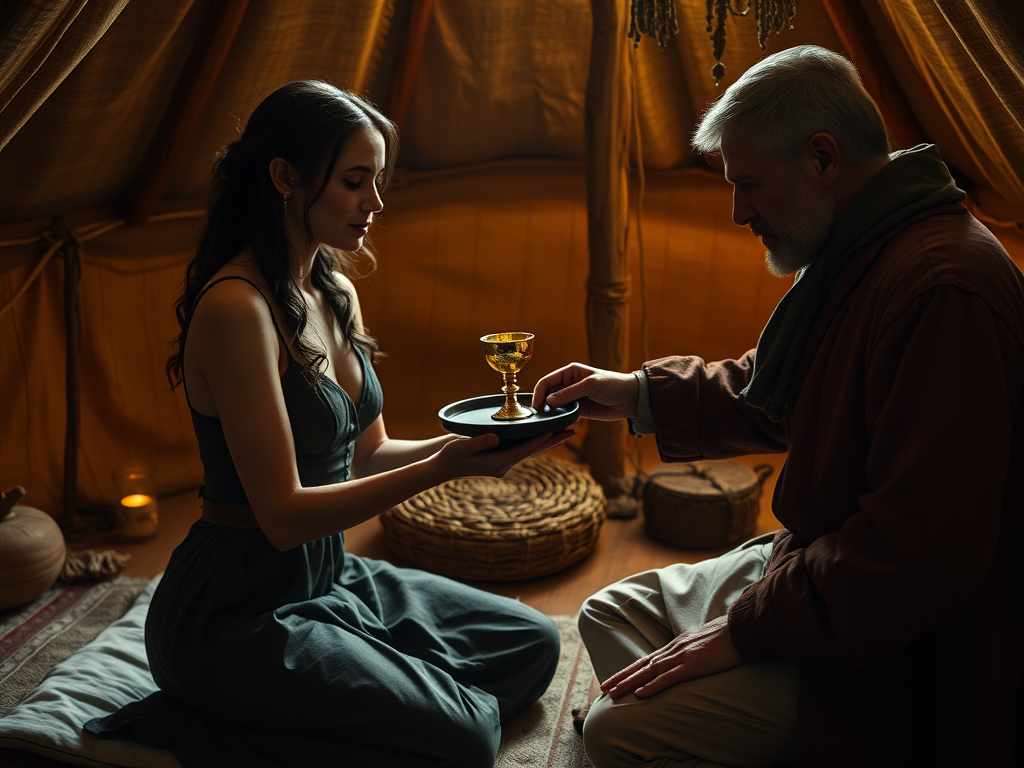
Imagine a grand hall on Gor after a feast. A beautiful slave girl has just finished a graceful dance for the gathered warriors. At the end of her dance, she is given a cup of wine, which she carries to a young man. She kneels before him in the position of a Pleasure Slave – back straight, head bowed, arms extended – and reverently proffers the wine. The man takes the cup and drinks while she remains deferentially posed. In that moment, the exchange is far more than performer-and-spectator or server-and-drinker; it is an intimate ritual. The kneeling girl offers refreshment as if offering her very self – a wordless symbol of submission and pleasure to serve.
Such scenes occur often in the Gor novels, each time highlighting different nuances of the master-slave dynamic. In Nomads of Gor, for example, we meet Aphris of Turia – once a proud, high-born free woman – who finds herself in a situation where she must serve a warrior named Kamchak. Aphris, in an act both humiliating and profound, fetches a bottle of fine Ka-la-na wine from Ar and brings a pouring vessel (crater). “May I serve you?” she asks, now seeking permission to serve the man she once defied.
Under Kamchak’s keen eye (he even watches to be sure she doesn’t secretly poison the wine), Aphris breaks the bottle’s seal, then kneels before him “in the position of the Pleasure Slave”, head down and arms extended, offering him the filled wine crater. In that pose, her former arrogance is gone – she embodies submission, yet there is dignity in her careful, elegant movements. The narrative notes that Kamchak’s eyes glint with approval. By pouring and presenting the wine in this ritualistic manner, Aphris demonstrates a deep change in herself; she has gone from a haughty beauty to a willing servant, and the very act of serving wine is the proof.
Gorean literature spares no detail in describing the grace and care a trained kajira puts into serving. In one scene, a Master commands, “Serve me wine.” The slave – who has been trained in proper service protocol – does not merely slosh wine into a cup and hand it over. Instead, she approaches the task with almost ceremonial precision. In Captive of Gor, a slave girl in a warlord’s tent takes a bottle of vintage Ka-la-na and pours a portion into a small copper bowl. She sets this bowl over a fire to warm (since Goreans often warm their red wine). After a short time, she tests the bowl’s heat against her cheek, ensuring it’s warm but not scalding. Only then does she pour the warm wine into a beautiful serving goblet (a black, red-trimmed wine crater designated for masters).
With a final deep breath to steady herself, she rises and approaches her Master. She then drops gracefully to her knees before him. With both hands, arms extended, head bowed in respect, she holds out the wine-filled crater and says softly, “I offer you wine, Master.” The Master takes the cup. The girl watches anxiously as he sips. When he smiles in approval, her heart leaps – she nearly faints with relief and joy, thankful that she has pleased him and will not face his discipline. This entire sequence shows how a Gorean slave finds purpose in perfecting even a simple service; every motion is done “in service” to honor her owner.
Another striking detail from the books is the custom of a slave kissing the rim of the drinking vessel before handing it to the Master. This kiss is a silent, symbolic gesture – the girl’s way of physically showing that the cup (and by extension, she herself) is offered with love and submission. In Slave Girl of Gor, a newly-enslaved woman initially forgets this detail in her nervousness. Trembling, she fills her captor’s goblet with paga (ale) and extends it to him, but he does not take it. At first she is confused – until she realizes her mistake. “I had, in my confusion and distress, forgotten to place my lips upon the goblet in subservience,” she thinks.
Chastened, she swiftly presses her lips to the metal cup in a quick token kiss. Then, overcome by the emotion of the moment, she boldly kisses it again – lingeringly, lovingly, her eyes closed, as if kissing her Master’s lips by proxy. “I had never kissed a boy on Earth with the helplessness and passion that I bestowed upon the mere goblet of my Gorean captor,” she reflects. “It was as though, with the cup, I was giving myself to him.” When she finally offers the goblet up after this display, her Master accepts it – and in doing so, accepts her devotion. This scene has become almost legendary in the Gorean community for illustrating the total surrender of self a kajira feels in serving: the act of offering the drink is an act of love.
There are countless variations of the wine-serving ritual in the saga, each reinforcing the same message. A trained slave may be ordered to serve any guest present, not just her own master, and she must do so with equal grace. For instance, in Assassin of Gor, a White Silk (virginal) slave named Lana makes a misstep by first offering wine to a stranger (a guest) before her own Master at a banquet – a breach of protocol that earns her a harsh rebuke. “How is it that you first serve wine to a strange man at the table of your master?” scolds Ho-Tu, the House’s Slave Master . Chastened and frightened, Lana tries again. This time she approaches the guest properly – delicately, head down, body posed in a flattering way – and whispers, “Wine, Master?” in a voice that is essentially an invitation.
On Gor, at formal feasts, it’s customary for a host to extend one of his slave girls to serve (and companion) an honored guest for the evening . Each eligible kajira will at some point approach the guest and offer wine. By accepting a cup from a particular girl, the guest is signaling that he chooses her for his pleasure that night . So when Lana offers “Wine, Master?” she is really saying, without saying it, “Do you find me pleasing? May I serve not just this drink, but you?” The guest’s answer – “Yes, I will have wine” – is accompanied by a meeting of eyes and a knowing smile . Lana pours for him, bowing her head and backing away shyly after he takes the cup. In that gentle exchange, we see the joy and dignity of service shine through. The girl is overjoyed to have been chosen; the act of serving wine was both a test of her obedience and an honor she hoped to earn.
It’s worth noting that even those new to bondage in Gor quickly learn that service is an honor, not a humiliation. In Hunters of Gor, a proud woman named Verna watches one of her captive girls pour wine for Marlenus of Ar (a powerful male) after being enslaved. “She poured it differently than she had before. She knelt, her head down… I could see it in her shoulders. She, a slave girl, poured wine for masters. That she was owned was revealed, beautifully, in her serving.”
In other words, once a woman accepted her collar, even something as simple as pouring a drink was transformed – her posture, her attitude, the energy she put into the task all proclaimed her new status with a kind of pride. The ritual of serving wine crystallizes this transformation in a single moment. It’s a dance of submission performed in public, yet done with such beauty and respect that it ennobles both the server and the served. The Master’s dominance and the kajira’s surrender complement each other in the flow of the ritual. When done correctly, both feel a deep satisfaction: he in being respectfully served, and she in finding purpose and joy through service.
The Philosophy Behind the Pour: Joy and Dignity in Service
Why do Goreans put so much emphasis on a seemingly mundane act like handing someone a drink? Because for Goreans, service is a language of devotion. It’s not viewed as menial labor or “just doing chores” – it is a heartfelt expression of love, loyalty, and fulfillment in one’s role. A kajira on Gor exists to serve her Master’s pleasure and comfort, yes, but this is not portrayed as degrading drudgery. Rather, it’s depicted as the natural joy of the submissive female to please the man she adores. The books repeatedly illustrate that a slave derives deep emotional satisfaction from bringing happiness to her Master through her service. When her Master is pleased, she is proud; when he is displeased, she is distraught (not merely from fear of punishment, but from genuine regret at having failed in her purpose).
This mindset is a defining element of Gorean philosophy. It might sound counterintuitive to outsiders – how can serving someone be joyful? The answer lies in Gorean notions of Natural Order and personal purpose. Gor’s ethos holds that being true to one’s nature brings fulfillment. Men on Gor are generally dominant, protective, and desire to lead; women (at least the ones who end up as slaves) are naturally submissive, service-oriented, and desire to yield – when those two halves meet, both find balance. A Gorean slave finds dignity in service because she is actualizing what she feels to be her rightful place in life, just as a Gorean Master finds dignity in protecting and guiding those in his care. It’s a consensual power exchange writ large as a lifestyle.
Modern Gorean practitioners echo this sentiment. They often describe service as “the kajira’s heart song” – an act that, when done consensually, feels right and affirming. In fact, as we’ve discussed before, many who live the lifestyle say that submitting or dominating felt like coming home. The blog previously noted that Gorean “Natural Order” means if you are a man who feels meant to lead and protect, or a woman who feels happiest serving and yielding, you shouldn’t be shamed for it – that’s your nature, and you can live it proudly . This concept is descriptive (for those who resonate with it), not prescriptive for all humanity . In other words, Goreans believe some people are naturally built for these roles, and when they embrace them, it’s beautiful – as illustrated when a slave’s pride shines through in how beautifully she pours wine for her Master.
The dignity of service in Gor is also reinforced by how masters are expected to cherish good service. A true Gorean Master does not take a well-trained, devoted slave’s service for granted or treat it with scorn. On the contrary, in the books, we often see Masters compliment a girl who serves exquisitely or reward her with a smile, a kind word, or a gentle touch. That positive reinforcement is everything to the slave – it validates her efforts and makes her glow with pride.
Consider the scene above where the Master sips the wine and smiles: that smile was the slave’s reward, and to her it was worth more than gold. John Norman (the author of Gor) frequently portrays the psychology of the slave as finding her highest happiness in such moments. When a kajira kneels and presses the cup to her bosom before offering it, or kisses the cup before handing it over, she’s effectively saying, “I give you my whole self along with this drink.” When the Master accepts it graciously, he is saying, “I receive your gift, and I acknowledge you.” This completes a subtle circuit of intimacy and trust between them.
It’s important to demystify a potential misunderstanding: Gorean slaves are not brainwashed robots or miserable drudges. They feel intense emotions and take personal pride in their skills and service. We saw this with the girl who feared she was “not even a good slave” when she nearly spilled the paga – her anxiety wasn’t just fear of punishment, but fear of letting down the man she had already come to love . When she redeemed herself by the beautiful gesture of kissing the goblet, it was a triumphant reclaiming of her dignity as a slave: “See, I remember my duty, and I give my all to it.”
This emotional dimension is why Gorean slaves often describe service as blissful or meaningful. One might recall the saying: “Slavery, done willingly, is a thousand times more fulfilling than freedom accepted resentfully.” While hyperbolic, it captures the Gorean belief that a woman who chooses (in real life) to submit to a worthy man can find tremendous joy in that choice, even in the daily acts of cooking, cleaning, or serving him a drink. It resonates with some people’s innermost desires – to devote themselves completely to someone they adore, or to take care of someone as their prized possession. In Gor, these desires are not only validated but celebrated.
Modern Gorean lifestyle couples often incorporate a version of the wine-serving ritual in their own homes – not as forced theater, but as a mutually cherished routine. For instance, a wife or girlfriend (who consensually identifies as a kajira to her partner) might each evening kneel and serve her companion a glass of wine or tea in a special way. She may have her own elegant style of presenting it – perhaps using a specific graceful pose they both enjoy – and he, in turn, might have a ritual of acknowledging her (maybe taking the drink and then kissing her forehead or saying, “You serve beautifully, my love”).
These kinds of private rituals reinforce their bonds. Far from feeling oppressed, the submissive partner feels seen and valued for her gift of service, and the dominant partner feels honored and satisfied. It’s a positive feedback loop that outsiders may not “get,” but those within the dynamic thrive on. (Many readers who follow our blog know this from personal experience or from witnessing Gorean couples interact – the radiance of a content kajira serving her Master is hard to fake.)
In Gor’s fiction, a slave’s entire day is structured around service – from warming his bath water, to cooking his meals, to laying out his clothes, and yes, to pouring his wines. The consistency of these acts is what makes the Gorean lifestyle so different from a casual BDSM scene. Which brings us to an essential point: Gorean life is a life, not a role-play.
Gor vs. BDSM: A Lifestyle of 24/7 Philosophy, Not Occasional Play

At a glance, someone might see a kneeling woman offering a cup and think, “Ah, this is just a kinky BDSM tea ceremony.” But Goreans assert that Gor is not BDSM – at least, not in the way people normally understand BDSM. Yes, both involve power exchange, and you’ll find masters and slaves in both Gorean circles and BDSM dungeons. However, the intent and scope are vastly different. BDSM is often regarded as a bedroom activity or a set of erotic role-playing scenarios – something people do for a few hours to spice things up, then go back to egalitarian life when the scene ends.
Gor, by contrast, is an entire philosophical worldview and way of life. One Gorean writer, Ubar Luther, put it succinctly: “Gor is not simply a subset of BDSM or D/S. Though there are some similarities…, the differences far outweigh [the similarities]. Gor encompasses a vast array of additional matters that have nothing to do with BDSM or D/S.” In other words, Gor goes beyond the bedroom – it’s about living according to certain principles (honor, order, responsibility, natural roles) every day, in all aspects of life.
So when a Gorean slave serves her master wine, it’s not a scripted “session” – it’s just Tuesday evening in their household. The dynamic doesn’t turn off when the wine is drunk. She remains in her submissive role and he in his dominant role seamlessly, whether they’re in private or public (within the bounds of what’s socially acceptable in public, of course – a Gorean couple in public might be subtler, but the hierarchy between them remains).
This is why we say the Gorean lifestyle cannot be partial or occasional. A person who identifies as Gorean embraces those values full-time. It’s integrated into daily routines and relationships. As one series article explained, “Gor isn’t a costume – Gor is a structure of living.” You don’t play a master or slave on weekends; you are one, continuously aligning to that identity in how you act and even think.
This doesn’t mean Goreans ignore consent or safety – quite the opposite. In fact, Goreans often stress that because their power exchange is so deep and continuous, it requires even more awareness and ethical grounding than a casual BDSM scene. We discussed this in Series 3.b on Emotional Safety: “Embarking on a Gorean-inspired relationship is not a free-for-all of dominance; it’s a deliberate dance built on trust, clarity, and care. In fact, the deeper the power-exchange goes, the more important it is to ground it in consent, open communication, and proper aftercare.” Gorean or not, Safe, Sane, Consensual still applies. The difference is that Goreans are trying to live a consistent D/s polarity within a real relationship (often a loving marriage or partnership), not just during erotic play. This approach actually parallels what some in the BDSM community call “24/7 lifestyle D/s,” but Goreans live it with their unique lore and philosophy from Norman’s books.
To illustrate the contrast: In a BDSM context, a submissive might perform a formal “wine service” as a one-time scene in a dungeon or at a fetish party, possibly in costume and following a high-protocol script, and then once the scene is over, that formality is dropped. In a Gorean home, a similar ritual might happen nightly at dinner, because it’s simply their way of maintaining the respectful dynamic between Master and kajira. The first scenario is essentially entertainment or erotic roleplay; the second is an expression of genuine hierarchy and affection embedded in their relationship. Neither is inherently better or worse – but they are different in tone and intention.
Goreans also broaden the scope beyond personal sexuality. The philosophy entails ideas about honor, duty, courage, self-improvement, connection to nature, community, and more – elements not typically part of BDSM. John Norman was a philosophy professor, and through Gor he explores what he imagines as a more “natural” way humans might organize society and relations if stripped of certain modern norms. Thus, Gor has its own codes (Warriors have their codes of honor, for example), its emphasis on honesty (a Gorean’s word is like law, as noted in Series 2.9), on facing challenges, etc. Slavery is just one facet (albeit the most sensational) of a much broader tableau.
In the Gorean community, you will meet people who focus on the philosophical side – discussing evolution, societal structures, the Home Stone concept of home/family loyalty – as much as, if not more than, the erotic side. This again sets them apart from a typical BDSM crowd where the focus is usually on the play and fetish aspects. One could say BDSM is an activity, whereas Gor is an identity and lifestyle (with activities flowing from it).
As Ubar Luther noted, the general public often mistakenly lumps Gor in with BDSM because of the master/slave imagery, but those who study it realize Gor is its own beast . The lifestyle has diverse practitioners: some who do elaborate role-play online as if living on Gor, some who approach it more intellectually (weaving Norman’s ideas into self-help or relationships), and some who are lifestylers living as master and slave in the real world. What unites them is a shared acceptance of Gorean philosophy to whatever degree suits them.
For our purposes, focusing on real-life lifestylers: A Gorean couple might look, on the surface, not too different from a traditional patriarchal couple or a Master/slave BDSM couple. But mentally, they see themselves through the Gorean lens. The Master might hold himself to a standard of Caste-like responsibility (even if Castes aren’t literal on Earth, he may value being excellent at his profession as part of being Gorean) and personal honor.
The slave might pride herself on being utterly feminine and pleasing “in the modality of the female,” as Norman would phrase it, which includes domestic service as well as sensuality. Both often feel that Gorean ethos gives deeper meaning to their roles – it’s not just “I like being dom and sub,” but “I believe men should lead and women thrive when they yield, and we’re living according to that belief.” They might even incorporate rituals described in the books (like wine serving, ceremonial recitation of “I am your slave,” etc.) to reinforce that identity.
Another key philosophical difference: Choice. In the fictional world of Gor, slaves have no choice – they are owned as property in a very literal sense. But obviously in real life, consent is the foundation. Gorean lifestylers acknowledge that the only ethical way to live this out on Earth is for all parties to agree to it. We’ve emphasized before (and it bears repeating) that a Gorean-style relationship in reality is only valid if it’s voluntary on all sides . The novels give the fantasy of “no choice” because that heightens the drama, but actual people always have a choice; as we often say, “slave by choice” is the operative concept.
In fact, Norman paradoxically frames absolute submission as a woman’s ultimate choice – the idea that a woman chooses to surrender as the fullest expression of herself . Whether one agrees with that or not, it underscores that will and consent are crucial even in embracing a seemingly traditional role. A real-life kajira is not truly property under law – she’s a consenting adult who chooses to live as if she were her partner’s property. It’s an important distinction that responsible Gorean lifestylers keep in mind to avoid crossing into abuse.
So, while a Gorean Master might not use a safeword (since they don’t consider their life a “scene” to safeword out of), he absolutely has ongoing, informed consent from his partner for the overall dynamic. If that consent were ever withdrawn, the relationship would fundamentally change (or end). This is similar to any 24/7 Master/slave arrangement in the BDSM world – you consensually negotiate a power dynamic that stays in effect long-term, but the submissive always retains the ultimate right to revoke consent (even if, within the role, she behaves as if she has no rights).
Good Gorean couples communicate extensively about limits, desires, and emotional well-being, just as any healthy couple should. In fact, many Gorean community leaders actively educate newcomers to avoid abusive fakes who might misuse Gorean rhetoric. They stress red flags, like any man who says “I’m a Gorean Master, you must obey me because the books say women are slaves” to a stranger – that’s nonsense and a sign of a predator. Gorean relationships, like BDSM ones, require mutual respect and trust. Without those, you have toxicity, not Gor.
From Page to Practice: Adapting the Wine Ritual in Real Life

Now, given that understanding, how do modern Goreans practically express something like the wine-serving ritual in a healthy way? It’s all well and good to read about voluptuous slave girls trembling with passion as they serve Ka-la-na, but how does a 21st-century couple make use of this idea without it becoming either corny play-acting or, worse, crossing someone’s comfort boundaries? Here are some insights and adaptations:
- Set the Stage Together: Communication is key. A couple interested in Gorean dynamics should discuss which rituals excite them and why. If the idea of a formal serving ritual appeals, talk about what it will involve. For example, the submissive might wear something special (or be nude, if in private and comfortable), assume a certain graceful posture, and use specific words (“Your wine, Master,” etc.). The dominant should reciprocate with appreciative words or gestures. Designing the ritual together ensures it’s consensual and meaningful for both. Maybe the Master enjoys the aesthetic of his lady kneeling; maybe the kajira enjoys the feeling of focusing completely on a task of pleasing him. Include those elements. The goal is to create a moment that both find fulfilling.
- Keep it Safe and Comfortable: In the books, a slave may be in bondage or an uncomfortable position for dramatic effect. In real life, ensure the position chosen is physically safe. For instance, a common Gorean pose is nadu (kneeling with thighs open, back straight). Many women find this elegant and not too uncomfortable for short periods – it can be used while serving. But if one has bad knees, you adjust (maybe kneel on a cushion, or do a standing bow instead). If hot liquids are involved (say, tea or coffee analogous to black wine), be careful – no one wants real burns from a fantasy! A modern kajira can certainly warm her master’s drink as described in the books, but she should test temperature cautiously (Norman’s detail of testing against the cheek is actually a good safety tip!). Always remember that the real beverage is less important than the attitude. If spilling is a concern, practice with water until confident. A caring Master would rather have a sincere but imperfect service than see his partner anxious to the point of shaking. Gorean service is about love, not perfectionism.
- Emotional Safety and Aftercare: Yes, aftercare – a term from BDSM, but applicable here too. If either partner finds the ritual emotionally intense (and it can be, as that Slave Girl of Gor scene shows!), make time afterwards to reconnect in a relaxed, loving way. Maybe after the Master finishes the drink, he pulls his slave into his arms and thanks her, or they cuddle. The novels rarely show explicit aftercare, but remember, those are often action-adventures where the emotional processing isn’t on the page. In real life, do check in with each other. A simple “How did that feel for you?” goes a long way. Ideally, it felt erotic and bonding. But if something felt off (perhaps the slave felt self-conscious, or the Master felt awkward maintaining a stern facade), talk about it and adjust next time. The ritual should strengthen your connection, not create distance.
- Consistency with Flexibility: If you adopt a ritual like nightly wine service, consistency helps it become a cherished tradition. However, life is life – sometimes you’re too tired, or kids are around, or company is over. A Gorean lifestyle doesn’t mean you must perform a formal serve no matter what. Adapt to circumstances. Maybe when alone you do the full ritual; in subtle public settings, the slave might simply pour quietly and give a knowing glance instead of kneeling – a private signal of the dynamic. Goreans are not interested in violating public decency or local laws (remember “when in Rome, do as the Romans do” – Goreans are mindful to blend in to avoid trouble ). So the ritual might be symbolic in those times (e.g., she always hands him his drink first at a restaurant, with a subtle “Tal, Master” under her breath that only he hears). The understanding between them is what counts.
- Training and Mastery: Many in the Gorean lifestyle enjoy the training aspect – the Master teaching the slave how he likes things done. The wine ritual is a perfect example. A Master might spend time showing his kajira the exact way to hold a goblet, how low to bow her head, how to time her words, etc. This can be a very erotic and bonding experience in itself. It’s essentially a loving form of instruction and obedience practice. The slave learns to be attuned to his preferences; the Master learns to be patient and clear in his expectations. Over time, as the kajira’s skill grows, both will take pride in how polished and “Gorean” their private ceremony looks and feels. It becomes their thing. If mistakes happen, a Gorean Master doesn’t fly into a rage – ideally, he corrects calmly (unless they both enjoy a bit of theatrical discipline as kink). The point is to eventually achieve that near wordless perfection where she knows just how he likes his wine and he can trust it will be done beautifully. This deepens trust on both sides.
- Remember the Romance: Gorean relationships are intense, but they are also deeply romantic in a traditional sense. The wine-serving scene, at its heart, is romantic: a woman expressing devotion; a man showing acceptance and gentle appreciation. Focus on that feeling when you do it. It shouldn’t feel like a cold obligation or a meaningless gesture. Small touches – like maintaining eye contact for a moment as he takes the cup, or him brushing her cheek after – keep the warmth in it. Some couples even incorporate sayings: The slave might whisper “La kajira” (“I am a slave girl”) as she offers the cup, reaffirming her identity in a loving way, and the Master might respond with something like “You are mine” as he accepts – whatever words give them butterflies. Make it yours, make it affectionate.
By adapting the spirit of the Gorean ritual to modern life, couples find that these acts can create a powerful anchor for their dynamic. One real-life kajira shared that each time she kneels with her husband’s evening drink, “my love for him just overflows – it’s like a meditation on our roles.” Another Gorean Master wrote that the first sip of wine his slave offers each day “tastes like loyalty, if loyalty had a flavor.” These poetic sentiments show how ritual can enrich a relationship when approached in a consensual, mindful manner. The actual wine or beverage is irrelevant – it could be fine mead or a can of soda – it’s the intent behind the serving that carries weight.
And importantly, no one is perfect 100% of the time. There will be days your pour is clumsy or the Master is grumpy and barely notices the nice job you did – we’re all human. Gorean philosophy isn’t about play-acting flawless characters; it’s about striving for an ideal but also showing forgiveness and flexibility. A kajira can still feel joy in service even if her Master sometimes just says a curt “thanks” and not much more – because she knows, in the larger picture, that he values her deeply. Likewise, a Master might usually hold high standards but occasionally chuckle if his beloved slave accidentally tracks in mud while kneeling – he’s allowed to be amused and loving, not stern 24/7. The genuine affection and understanding between them is what makes the dynamic stable.
Natural Order in Action: One Master, Multiple Kajirae – and Why It “Feels Natural”

We cannot discuss the ritual of serving wine without touching on a related aspect that often raises eyebrows: in many Gorean scenes, one man is being served by multiple women. At that banquet in Assassin of Gor, for instance, there were fifteen slave girls present, all eager to serve the men . In the books, it’s common for a wealthy or powerful Gorean man to own a harem of slaves, and even free companions (wives) accept that their men might have additional slave concubines. This reflects what Goreans call the “natural order” or complementarity of the sexes: the male’s instinct to lead, spread his line, and command multiple females, and the female’s instinct to devote herself to a worthy male (and, if necessary, share him).
To many modern people, especially given our monogamy-centered culture, this idea sounds provocative or even offensive. But Goreans argue that history and biology are on their side when it comes to polygyny (one man, multiple women) being a natural, if not predominant, pattern for humanity. Anthropological research does show some fascinating data: about 85% of pre-industrial human societies permitted polygynous marriage (i.e. a man could have more than one wife).
In other words, before modern norms enforcing strict monogamy took over in many places, the vast majority of cultures accepted plural wives for those men who could afford to support them. Monogamy as the near-universal standard is actually a relatively recent development in human history (roughly in the last 10,000 years, coinciding with agriculture and more complex societies).
Our Stone Age ancestors, living in nomadic or tribal settings, likely practiced a mix of mating strategies – some pair-bonds, but also a lot of polygyny among high-status males. Biologists even characterize humans as “mildly polygynous” by nature, meaning that while we’re not as extremely polygynous as, say, gorillas (where one alpha male monopolizes many females), we’re also not truly monogamous like certain bird species. There are physical and social indicators that prehistoric males often competed for mates and that successful males had multiple female partners, whereas many less successful males had none .
Genetic evidence is especially striking: DNA studies suggest that throughout human history, far more women than men have reproduced. One genetic analysis found that “overall, more women reproduced than men” – meaning many women shared a smaller pool of men as fathers of their children . The researchers explained it bluntly: “not all men are able to afford wives, or sometimes a few men will have many wives.” In many societies, a minority of men (the most desirable or powerful) fathered children with multiple women, while a significant number of low-status men left no progeny .
This is classic polygyny at work, leaving a deep imprint in our gene pool. It implies that, from an evolutionary standpoint, men who could attract or acquire multiple women did so, and women often opted to be the second or third wife/partner of an high-quality man rather than the only wife of a lesser man. This is sometimes called the “female choice” in polygyny – women are not mindless chattel in this equation historically; often, they preferred sharing a strong provider to having a weak provider all to themselves.
Evolutionary psychology builds on this: human males, with their relatively limitless reproductive potential (a man can biologically father dozens of children in a year, whereas a woman can bear one child in that time), often have a drive to mate with multiple partners to spread genes. Females, with their high investment in each offspring (pregnancy, nursing, etc.), tend to be choosier and seek a mate of high status, resources, or genetic quality – even if that means he might have other mates.
In raw terms, a woman might rationally prefer being the cherished second wife of a rich, strong man than the only wife of a poor, weak man. Thus, women’s innate inclination might be to focus devotion on one strong partner, even if he isn’t exclusively hers (provided her needs and her children’s needs are met), while men have an innate inclination to seek multiple partners once they have resources/power .
Sound familiar? It’s basically the Gorean model in scientific terms. A direct parallel is drawn in the text: “men have an innate drive to seek multiple partners, and women have an innate inclination to focus their devotion on one strong partner – even if that man might not be exclusively hers.” This is exactly how Gorean “Natural Order” is structured. The Gorean Master expects to have several women serving him (if he has the means and merit), and the Gorean kajira is expected to be utterly devoted to her one Master (setting aside jealousy, trusting in his protection and care).
Far from being some outlandish sci-fi kink fantasy, this setup echoes a pattern we see repeatedly in human history and across cultures . Consider historical examples: ancient kings and emperors commonly had harems; polygamy is recorded in the Bible and practiced in many traditional societies; even in ostensibly monogamous European societies, powerful men often kept mistresses or serially married multiple young women over their lives. All these point to one thing: “there is nothing bizarre or perverted about one man having multiple women in his life; it has been common and ‘normal’ throughout history.”
That said, just because something was common doesn’t mean it’s easy or without challenges – especially in a modern context. Jealousy is a human emotion that certainly exists on Gor (slave girls in the books frequently struggle with jealousy of each other) and it certainly exists in real-life poly-style relationships. The difference is, in the Gorean ideal, jealousy is something a slave girl is taught to overcome as part of her submission. In the books, a kajira who shows open jealousy or attempts to undermine a fellow slave might be punished.
She is reminded that she is a slave and must gracefully accept her Master’s right to own others; her focus should be on being the best she can be, not on resentment. Of course, fiction can will away a lot of messy feelings or have them resolved via a firm whipping – real life is more complex. In a consensual modern arrangement where, say, a husband has two consenting partners (perhaps one is his legal wife and the other an agreed-upon secondary partner or slave), you cannot simply whip away feelings of jealousy or insecurity. You have to manage them with communication, empathy, and fairness.
The good news is, multiple-adult relationships can work – many people (especially in polyamorous or swinger communities) have created happy triads, harems, and other configurations. Goreans specifically tend toward a polygynous model (one Master, several women who are either slaves or perhaps one First Wife and several slave-girls). We ourselves see this dynamic in our community – there are Gorean households with one Master and two or more kajirae living in harmony. How do they do it? A few key ways, which any aspiring Gorean dominant with multiple submissives should heed:
- Strong Leadership with Fairness: The Master must be emotionally intelligent and fair in his dealings. He should give each woman attention and make each feel valued for her unique contributions. In practical terms, this might mean scheduling quality time with each, not always favoring one over others in a way that breeds resentment (unless one is the “First Girl” in the pecking order, but even then a wise Master shows care to all). The Master sets the tone: if he acts like the women are interchangeable toys, they will feel insecure and jealousy will rage. If he instead fosters a sense of family or team – “you are all mine, and I care for each of you” – then the women can bond and support each other rather than compete viciously.
- Open Communication & Reassurance: In any non-monogamous setup, transparency and reassurance are vital. The Master should encourage his partners to voice concerns or feelings privately to him without fear. And he should actively reassure them of their place. As one poly relationship guide suggests, “assure [your partners] of your love and that despite constraints of physical together time, your emotional commitment to them is full time and unchanged… Reassure them when they need it; it’s a chance to show your love.” In a Gorean context, a Master might say to a jealous kajira, “You are mine and I cherish you. Yes, I have another, but that does not diminish your value to me.” Simple affirmations can do wonders. Also, ensure each woman knows what her strengths are – maybe one is the best at cooking, another at singing to him, another at intellectual conversation – so she can feel proud rather than thinking she’s in competition on every metric.
- Define Roles and Hierarchy: Goreans often establish a clear hierarchy among multiple slaves to reduce conflict. For example, a “First Girl” (senior slave) may be appointed – she helps keep the others in line, and in return enjoys a bit of extra privilege or responsibility. The others know to respect her position. This can channel rivalry into a productive avenue: if a lower girl is jealous, her avenue to “rise” is by improving herself, not by tearing down her sister. The Master can use mild competition positively (“who can decorate the serving tray more beautifully tonight?”) but should never tolerate malicious sabotage or disrespect between his women. They are all on the same team – his team – and he should remind them of that. Also, each needs clearly defined duties so they aren’t all jostling for the same task. One might be in charge of pouring wine, another of fetching his slippers – then each has a sphere where she shines.
- Emphasize Sisterhood (Chain-Sisters): Gorean slaves owned by the same Master often refer to each other as “chain-sisters.” A good Master cultivates camaraderie among his slaves. He might have them work together on projects (like two girls performing a tandem dance, or collaborating to prepare a feast). Shared positive experiences build friendship. If the women genuinely like or at least respect each other, jealousy decreases. Many polygamous families in real life report that the wives became close friends – almost like sisters – and provided support for one another. In a Gorean household, while the dynamic is different (one is not a legal wife but a slave), friendship can absolutely blossom. The Master can encourage this by never playing them against each other in a cruel way and by praising teamwork.
- Internalize the Philosophy: Ultimately, the women in a Gorean multi-partner setting need to truly believe in the lifestyle’s tenets to find peace. A kajira who understands and accepts Natural Order will remind herself that “He is Master; it is natural he may have many. I am slave; it is natural I am devoted to him.” This doesn’t erase twinges of envy, but it frames them. In the books, slaves often have to undergo a personal growth where they conquer their ego and jealousy, learning to delight in their Master’s happiness even if it’s another girl currently pleasing him. In real life, that level of selflessness is challenging, but it’s a noble ideal to work towards. Masters can help by being consistent and not showing favoritism whimsically – if the women know that the Master’s love is abundant and each has her secure spot, it’s easier for them to relax and even take joy in watching another sister please him (some get vicarious pleasure from it, sharing in the happiness rather than feeling threatened).
The trend today is that such alternative arrangements, while not mainstream, are more visible and accepted than before. Consensual non-monogamy – whether open relationships, polyamory, or polygamy – is quietly on the rise. Surveys in the US and elsewhere suggest about 1 in 5 people have tried some form of consensual non-monogamous relationship in their lifetime, and around 4–5% of the population is currently in one . That’s millions of people.
And interestingly, many of these modern arrangements echo the polygynous style (one man with multiple women) – not because of sexism, but often because it naturally emerges from common desires. Even in the broader polyamory scene (which is usually egalitarian), there are plenty of “vee” relationships (one person with two partners) where that one person is male and the two partners are female. Society is slowly acknowledging that monogamy isn’t one-size-fits-all, and that for some, multiple partners works better . The Gorean community is a specific subculture within that broader phenomenon, one that adds a distinctive power-exchange flavor and traditional male-led household structure to the mix.
We should note that ethical non-monogamy requires all parties’ consent. In Gorean terms, a Free Companion (wife) must consent if her companion takes on a slave-girl as a lover, otherwise he’s just cheating under another name (not honorable!). And any new slave or partner introduced should know the arrangement upfront. Honesty is crucial – deceit is anti-thetical to Gorean honor. Many Gorean men actually remain monogamous in real life despite the ideal, either because they don’t have the opportunity or they choose to focus on one relationship. But the concept that it’s “natural” for a man to have more than one woman is generally accepted in the community, and if the chance arises and all agree, it’s embraced without guilt.
For the female Gorean (slave or free companion), it’s often emphasized that jealousy is a sign of not fully embracing your role. That may be a bit harsh – jealousy is natural – but the idea is to encourage a mindset shift. Rather than seeing a second woman as a threat, a Gorean woman tries to see her as an expansion of the household, someone who brings additional skills or companionship to the group (and who may take pressure off her in serving the Master, even!).
It’s a very different perspective from modern Disney-style romance where one True Love supplies 100% of everything. Goreans are more pragmatic and, they’d say, realistic about human nature. They might argue that many monogamous men secretly or eventually take lovers or second wives (historically), so why not approach it honestly and within a value system that makes it harmonious? Whether one agrees or not, it’s a viewpoint rooted in both their read of history and their personal inclinations.
Of course, the Master must also manage his own feelings. He may not feel “jealousy” in the same way if his women are only his, but he must guard against favoritism or neglect. And if his slave shows jealousy, he shouldn’t react with scorn or anger alone; he should also show leadership by addressing the underlying need. Maybe one girl feels insecure that he doesn’t spend time with her lately – the fix might be as simple as a planned day out with just her.
Assure, then reassure, as the poly advice goes: “Assure them of your love… Reassure them when they need it… Console them when they miss you.” These compassionate actions do not make a Master “weak”; on the contrary, they show he is in full command of his household’s emotional well-being. A Gorean Master takes responsibility for the happiness and health of those under him (just as a patriarch in olden days would tend to the welfare of his family, servants, etc.). This sense of responsibility is evident in the books too – masters often discipline jealousy not just to be cruel, but to restore order and peace in the harem, which ultimately is for everyone’s good.
Finally, it’s worth reinforcing: while Gor allows a man many slaves, it absolutely expects monogamy from the women. A slave must be totally devoted to her one Master. In fact, in Gorean law, if a slave girl even looks at another man without permission, it’s a punishable offense. Now in real life, obviously a slave isn’t a legal property, but the spirit remains: a committed kajira chooses to make her Master the center of her world. This one-sided exclusivity rubs some people the wrong way (“so he can play with many, but she can only have him?”), but Goreans would argue it’s a natural asymmetry – again citing biology (women invest more, are choosier, etc., so they select one mate; men can spread, so they don’t stick to one).
And critically, the women involved agree to this. A female who wants multiple partners for herself probably wouldn’t be happy in Gor; Gorean lifestyle is more appealing to those women who want that one heroic figure to serve and aren’t interested in other men anyway. It’s a personality thing. When everyone’s inclinations align (the man comfortable with multiple partners, the women content with one man), these arrangements can actually be quite stable and loving. There are Gorean families (and poly families in general) that last decades, raise children, etc., debunking the myth that such setups are inherently doomed.
Conclusion: Service as the Heart of Gor’s Lifestyle

The ritual of serving wine distills many of the themes we’ve discussed across this blog series: honor, trust, beauty in traditional roles, and the idea that fulfilling one’s nature brings satisfaction. It’s a scene that the Gorean community holds up as iconic because in that simple interaction – a woman kneeling with a cup, a man accepting it with a look – you see a entire philosophy at play. The kajira demonstrates submission, love, excellence in service; the Master demonstrates command, appreciation, magnanimity in receiving it. Both demonstrate choice – she chooses to serve with joy, he chooses to lead and care for her (and perhaps others) with fairness.
For newcomers reading this, it’s crucial to understand that everything is consensual despite the unequal roles. The slave wants to be there, serving that wine; the master earns that devotion by being the kind of man she can trust and idolize. When those elements click, the act isn’t degrading at all – it’s uplifting. One might even liken it to a dance or a religious ritual, something almost sacred to the participants. Indeed, many Gorean couples describe their dynamic in spiritual terms: the slave finds freedom in surrender, the master finds purpose in responsibility. The wine serve is simply one of the clearest outward expressions of that inner bond.
If you find yourself drawn to these ideas, you’re not alone – and you’re not strange. As we’ve shown, aspects of the Gorean lifestyle echo age-old human practices and desires. There’s no “right way” that fits everyone, but for those who resonate with it, living with a Gorean ethos can feel deeply authentic. Whether it’s incorporating small rituals like this into your love life or fully embracing a 24/7 consensual power exchange, the key is to do it with open eyes and open hearts. Communication, consent, and ethical behavior are what separate a beautiful Gorean relationship from a toxic situation.
For many, Gor offers a framework to explore male dominance and female submission beyond the bedroom, anchored in values and continuous commitment. It’s definitely not politically correct or mainstream – but that’s part of why it speaks to some, offering an alternative to modern egalitarian norms that, for them, is more satisfying. As we demystify these concepts, it becomes clear Gor isn’t about hate or oppression; it’s about mutual fulfillment through complementary roles. The wine ceremony exemplifies how something as ordinary as serving a drink can be elevated into a meaningful exchange of honor and devotion when viewed through the Gorean lens.
In closing, the ritual of serving wine has indeed shaped the Gorean community by giving them a tangible practice to rally around. Attend any Gorean gathering (online or in person), and sooner or later you’ll witness a version of this serve – each slightly unique, but all done with that recognizable mix of pride and reverence. It inspires newcomers and reaffirms veterans. It reminds everyone that “slave” is not an insult in this context, but a cherished role, and “master” is not a tyrant, but a beloved leader.
Next in this series, we will continue examining scenes from Gor that have influenced how lifestylers live and love. From legendary love stories to tests of loyalty, each has lessons to impart. We hope this deep dive into the “Joy and Dignity of Service” encourages you to explore further. If this topic intrigued you, consider reading Series 3.12 – The Joy of Service in Gorean Life which delves even further into how service functions as a “language of devotion” in Gorean relationships, or Series 2.6 – Freedom, Choice, and Voluntary Surrender to understand the paradox of finding freedom in chains.
Thank you for reading, and Tal (greetings) until next time! Serve with joy, lead with honor, and drink deeply of life – that’s the Gorean way.
Sources & References:
- Norman, John. Outlaw of Gor. (Quote on dance ending with wine serve) .
- Norman, John. Nomads of Gor. (Aphris of Turia serving Kamchak) .
- Norman, John. Assassin of Gor. (Lana’s corrected wine offering and guest selection ritual) .
- Norman, John. Captive of Gor. (Detailed wine warming and serving ceremony by a slave) .
- Norman, John. Hunters of Gor. (Owned status revealed beautifully in how a slave pours wine) .
- Norman, John. Slave Girl of Gor. (Slave passionately kissing the goblet in subservience) .
- Gorean Lifestyle Blog – GOR vs BDSM (by Ubar Luther) – on differences between Gorean lifestyle and BDSM .
- Gorean Lifestyle Blog – Series 3.b: Emotional Safety in Gorean Dynamics – on grounding power exchange in consent and care .
- Gorean Lifestyle Blog – Demystifying Natural Order – explaining Gor’s natural order as embracing one’s nature, not enforcing a universal rule .
- Polyamory resource (UK) – advice on handling jealousy by assuring love and commitment despite time constraints .
I wish you well!
©2026 – Written by Azrael Phoenix
- Follow on Facebook: GorByPhoenix
You can read the full set of articles of this Series here:
- Series 1 – Start Here: Understanding the Gorean Lifestyle
- Series 2 – The Philosophy: Values Behind the Gorean Lifestyle
- 2.a – Honor, Responsibility and Discipline: The Core of Gorean Philosophy
- 2.b – Freedom, Choice and Voluntary Surrender: A Paradox at the Heart of Gor
- 2.c – Strength and Vulnerability: The Gorean View of Masculinity and Femininity
- 2.d – Understanding Gorean Natural Order: Philosophy and Modern Life
- 2.e – Aligning Words and Actions in Gorean Life
- Series 3 – Practicing a Gorean-Inspired Lifestyle (Safely & Ethically)
- Series 4 – Reading Gor: Guides, Themes, and Character Studies
- 4.a – Where to Start with the Books of Gor
- Part 1 – A Reading Guide for Newcomers
- Part 2 – Saga in Stages: Phases of the Gorean Journey
- Stage 1 – The Early Adventures (Books 1–6): From Earthman to Gorean Warrior
- Stage 2 – Broadening Horizons & Deeper Themes (Books 7–13): New Perspectives on Gor
- Stage 3 – The Jason Marshall Trilogy (Books 14–16): A New Tale of Submission and Identity
- Stage 4 – War and Upheaval (Books 17–25): The Epic Gorean War and Turning Point
- Stage 5 – The Saga Resumes (Books 26–33): New Century, New Faces, and the Gorean Renaissance
- Stage 6 – Climactic Conclusions (Books 34–38): A New Resolve and the Future of Gor
- Part 3 – The Philosophy Behind the Fantasy: How Gor Evolved (and Why It’s Not Just “Erotic Pulp”)
- Part 4 – Major Pivotal Books & Moments in the Saga
- Part 5 – Where to Find the Gor Books (Legally and Easily)
- Part 6 – Confronting the Controversies: Misconceptions and Reality-Checks
- 4.b – 10 Scenes That Shaped the Gorean Lifestyle Community (and Why)
- Part 1 – The Home Stone of Port Kar – Loyalty and Belonging in Action
- Part 2 – The Fall of Tharna – When Natural Order Overturns a Matriarchy
- Part 3 – From Proud Beauty to Serving Slave – Aphris of Turia’s Surrender
- Part 4 – “La Kajira” — An Earth Woman’s First Surrender of Self
- Part 5 – The Ritual of Serving Wine – The Joy and Dignity of Service
- 4.a – Where to Start with the Books of Gor
Discover more from Gorean Lifestyle - House of Phoenix
Subscribe to get the latest posts sent to your email.
 Gorean Lifestyle - House of Phoenix
Pingback: Series 4.b – 10 Scenes That Shaped the Gorean Lifestyle Community (and Why) – Part 8: On Earth, There Are Many Males – But Few Men – Gorean Lifestyle – House of Phoenix
Pingback: Series 4.b – 10 Scenes That Shaped the Gorean Lifestyle Community (and Why) – Part 7: “I Was Gorean – I Was Male” – Tarl Cabot’s Epiphany of Masculine Identity – Gorean Lifestyle – House of Phoenix
Pingback: Series 4.b – 10 Scenes That Shaped the Gorean Lifestyle Community (and Why) – Part 6: Honor and Choice in Love: Two Women, Two Paths (Ar’s Court, Assassin of Gor) – Gorean Lifestyle – House of Phoenix