Gorean Lifestyle - House of Phoenix
A view of the Gorean Lifestyle and Philosophy based on the Books
The Natural Order in Intimacy: Surrender That Is Offered

“The deepest surrender is never taken. It is offered.”
There are moments in the Gor saga that transcend plot and become something larger inside the minds of readers. They stop being merely scenes in a fictional world and become mirrors through which people begin examining themselves, their desires, their relationships, and the emotional tensions of modern life.
Few scenes have had that kind of impact on the Gorean lifestyle community as deeply as the recurring idea that a woman, encountering authentic masculine strength and certainty, may not merely accept leadership — but long for it.
For outsiders, this concept is often immediately misunderstood.
Some see only domination. Others see weakness, misogyny, or fantasy-driven escapism. Yet for many people who found themselves profoundly moved by Gorean philosophy, the emotional resonance of these scenes had little to do with crude power fantasies and far more to do with something modern life often struggles to provide: polarity, clarity, purpose, structure, emotional safety, and meaningful surrender.
This final article in the “Top 10 Scenes” series explores one of the most controversial — and simultaneously one of the most transformative — ideas within Gorean philosophy: the concept of Natural Order in intimacy.
Not as coercion.
Not as performance.
But as a deeply chosen relational alignment between masculine leadership and feminine devotion.
Before continuing, readers unfamiliar with the foundations of the Gorean lifestyle should first explore:
- The Gorean Lifestyle: Myths, Realities and What It Really Is
- Freedom, Choice and Voluntary Surrender: The Gorean Paradox
- Emotional Safety in Gorean Dynamics: Limits and Aftercare
- Bridging Fantasy and Reality in Gorean Relationships
Why This Scene Became So Influential
Throughout the Gor books, John Norman repeatedly returns to a particular emotional pattern: a woman encountering a man whose strength, confidence, calm authority, and certainty awaken in her the desire to yield emotionally, relationally, and even spiritually.
The modern world often teaches people to interpret surrender as defeat.
Gor presents a radically different possibility.
In Gorean philosophy, surrender is not portrayed as humiliation when freely chosen. It is portrayed as alignment. It is the emotional relief of no longer struggling against one’s own nature. It is the discovery that devotion can feel liberating rather than restrictive when given to someone worthy of receiving it.
That distinction is essential.
Because the scene that shaped the Gorean community was never truly about kneeling.
It was about recognition.
Recognition of polarity.
Recognition of emotional complementarity.
Recognition that some people feel most alive not in equality of role, but in harmony of opposites.
Many women who resonated with Gorean philosophy did not describe their attraction in terms of wanting to be oppressed. Instead, they described longing for emotional certainty, masculine direction, stability, decisiveness, and the freedom that comes from trusting someone strong enough to lead.
Likewise, many men drawn to Gor were not seeking empty authority. They were seeking permission to fully embody responsibility, protection, discipline, structure, and masculine purpose without shame or apology.
That emotional recognition became one of the defining forces behind the Gorean lifestyle community.
Gor Was Never Meant to Be “Occasional”
One of the greatest misunderstandings surrounding Gor is the assumption that it is merely another variation of BDSM.
While there can certainly be overlap in practices or aesthetics, the philosophical foundation is profoundly different.
Most BDSM dynamics are compartmentalized. They are scenes, negotiated experiences, roleplay sessions, or temporary exchanges of power that exist within defined moments. People may enter and leave those dynamics at will, returning afterward to otherwise conventional relational structures.
Gor approaches things differently.
Gorean philosophy attempts to shape life itself.
It speaks not merely about intimacy, but about identity. Not merely about sexuality, but about purpose, values, discipline, conduct, emotional orientation, and the structure of the household itself.
This is why serious Goreans often insist that Gorean living cannot simply be “turned on” for an evening.
It is not intended to be a costume worn occasionally for excitement.
At least philosophically, Gor proposes an integrated way of living:
- how one speaks,
- how one leads,
- how one serves,
- how one protects,
- how one behaves publicly,
- how one structures relationships,
- how one develops discipline and character.
Without that deeper integration, many Goreans believe the dynamic loses its essence and becomes little more than erotic theater detached from meaning.
This theme was explored further in:
The Question of “Natural Order”
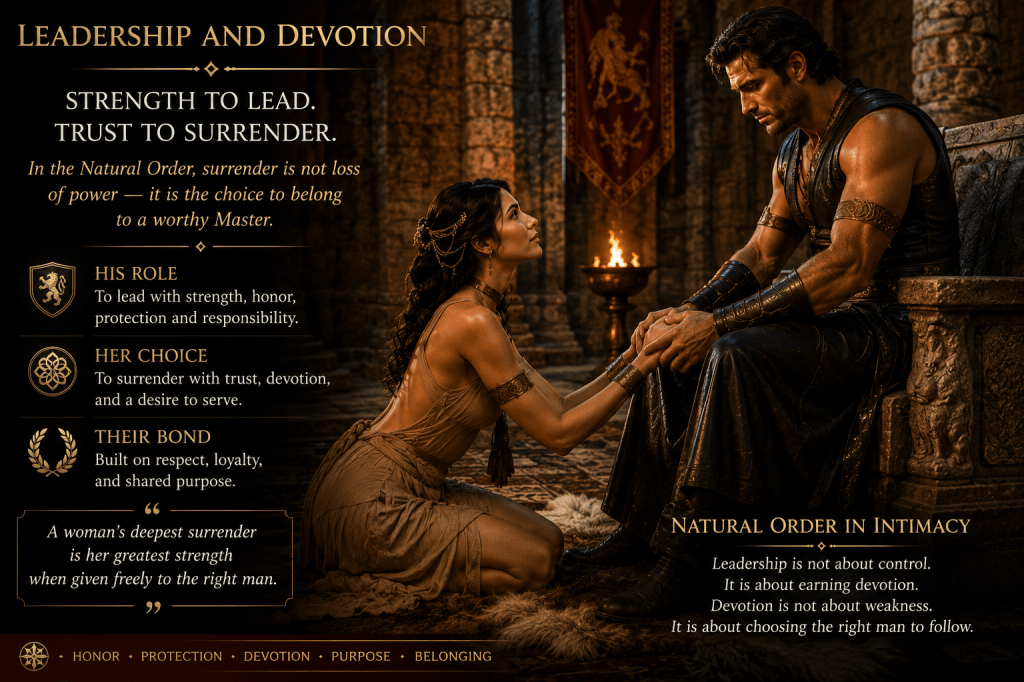
The phrase “Natural Order” often creates immediate resistance because modern culture has become deeply suspicious of hierarchy in intimate relationships.
Yet human beings are not emotionally neutral creatures.
Throughout history, cultures across the world have consistently formed structures based on polarity, leadership, protection, nurturance, and differentiated relational roles. Evolutionary psychology and anthropological research repeatedly demonstrate that attraction patterns frequently correlate with confidence, competence, strength, emotional stability, fertility cues, security, and social status. (frontiersin.org)
This does not mean all men are naturally dominant or all women naturally submissive.
Human beings are extraordinarily diverse.
However, it also means it is intellectually dishonest to pretend that dynamics involving masculine leadership and feminine receptivity are somehow artificial social inventions with no basis in human nature.
Many people genuinely feel emotionally fulfilled in relationships where:
- the man leads,
- the woman follows,
- polarity is strong,
- and emotional roles are asymmetrical.
The modern discomfort with that reality often emerges because hierarchy is immediately equated with oppression.
Gorean philosophy challenges that assumption by proposing that hierarchy can become nurturing, stabilizing, protective, and deeply fulfilling when rooted in consent, responsibility, emotional intelligence, and honor.
The key word is always:
consent.
Without consent, there is no Gorean philosophy.
There is only abuse wearing philosophical clothing.
Female Devotion and the Desire to Belong
One of the reasons Gor emotionally impacted so many women is because it articulated something modern culture rarely allows women to admit openly: the desire to belong completely to a man they deeply admire.
Not because they are incapable of independence.
Not because they lack intelligence or agency.
But because emotional surrender, when freely chosen, can feel profoundly intimate and psychologically grounding.
Modern society frequently glorifies permanent emotional self-protection. Vulnerability is often treated as dangerous. Dependence is framed as weakness. Relational surrender is interpreted as loss of power.
Yet many women privately describe something very different.
They speak about longing to stop carrying masculine emotional burdens. They describe the relief of feeling protected by strength instead of competing against it. They speak about the emotional intensity of trusting someone enough to soften completely in his presence.
Gor gave symbolic language to those feelings.
Likewise, many men discovered in Gorean philosophy a vision of masculinity centered not on aggression, but on earned authority. The Gorean ideal male is expected to lead with discipline, calmness, responsibility, decisiveness, self-control, and protective strength.
A man demanding devotion while lacking integrity is not celebrated in serious Gorean philosophy.
He is considered fundamentally unworthy of surrender.
And perhaps this is why the phrase “the Gorean girl begs for a Master” resonated so deeply. The emotional meaning was never merely about obedience.
It was about yearning to belong to someone strong enough to deserve it.
The Controversial Question of Multiple Women
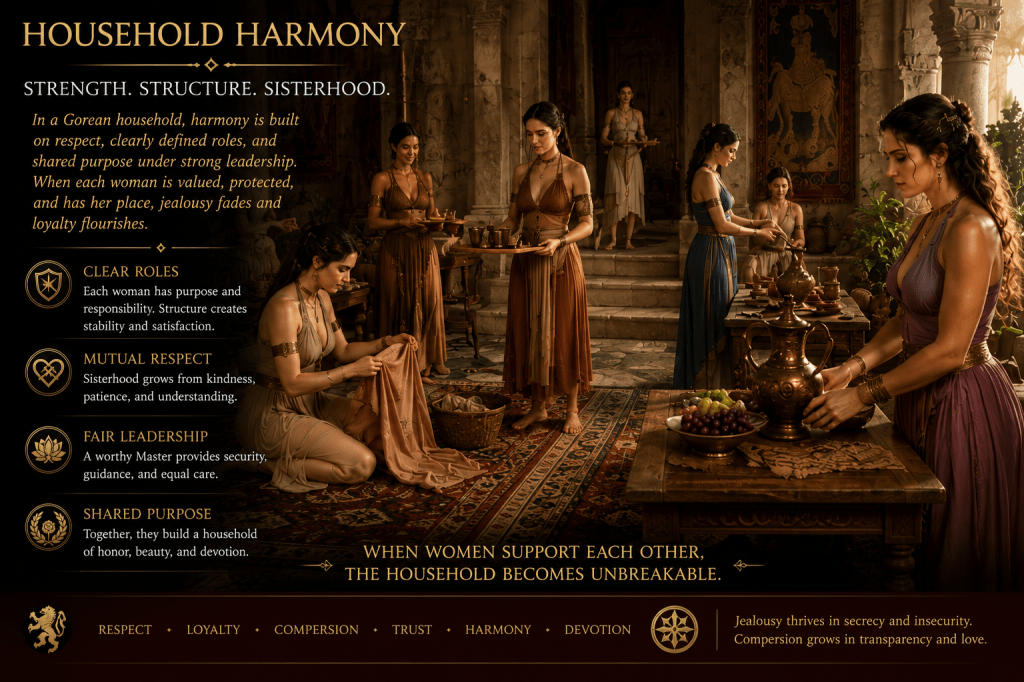
No aspect of Gorean philosophy provokes stronger reactions than the acceptance of male-led households involving multiple women.
And yet, historically speaking, forms of polygyny have existed throughout much of human civilization. Anthropological research suggests that while practical monogamy has often been common, socially accepted polygynous structures have existed across a majority of cultures at different periods of history. (frontiersin.org)
Modern consensual non-monogamy has also become increasingly visible. Studies indicate that consensually non-monogamous relationships can achieve levels of satisfaction and emotional stability comparable to monogamous relationships when communication, transparency, and emotional maturity are present. (theguardian.com)
What distinguishes the Gorean model from much contemporary polyamory is the emphasis on structure, hierarchy, loyalty, emotional direction, and stable masculine leadership.
In many Gorean-inspired households, the woman is emotionally devoted to one man entirely, while the man assumes responsibility for more than one woman. The dynamic is not intended to function as chaotic romantic competition, but rather as an ordered household where each woman has a meaningful place, emotional security, and recognized value.
Whether modern society agrees with such structures is ultimately irrelevant to one fundamental reality:
Consenting adults are free to build relationships aligned with their values and emotional needs.
The more important question is whether such households can function healthily.
The answer is yes — but only under very demanding emotional conditions.
Jealousy, Emotional Security, and Household Harmony
One of the greatest challenges in multi-female dynamics is jealousy.
Gorean philosophy does not pretend jealousy magically disappears simply because a woman embraces devotion.
Jealousy is human.
What matters is how it is handled.
Successful households tend to rely heavily on emotional transparency, fairness, reassurance, clearly defined roles, and strong leadership. Women who feel emotionally secure, valued, protected, and genuinely loved are often far less destabilized by sharing a household than outsiders assume.
The man’s behavior becomes absolutely critical.
If leadership is selfish, inconsistent, manipulative, or emotionally careless, the household deteriorates rapidly into insecurity and resentment.
But when leadership is stable and responsible, something different can emerge: a form of feminine sisterhood grounded not in competition, but in shared devotion, mutual support, and common purpose.
Modern research into consensual non-monogamy increasingly explores concepts such as compersion — the ability to experience positive feelings regarding a partner’s happiness with another partner. (pubmed.ncbi.nlm.nih.gov)
Compersion does not mean the absence of jealousy. Rather, it reflects emotional maturity strong enough to move beyond possessiveness and insecurity.
Gorean philosophy often frames this differently: not as suppression of emotion, but as transcendence through trust, structure, and belonging.
The Ethical Reality of Modern Gorean Living
It is essential to state clearly that the Gor books are fiction.
They are powerful fiction. Influential fiction. Philosophically provocative fiction.
But fiction nonetheless.
No fictional world overrides real-world ethics.
Modern Gorean practice must therefore reject:
- coercion,
- emotional manipulation,
- abuse,
- isolation,
- non-consensual degradation,
- and the use of “Natural Order” rhetoric to justify harm.
A woman choosing devotion freely is not powerless.
In many ways, she demonstrates extraordinary strength because authentic surrender requires immense trust, vulnerability, and emotional courage.
Likewise, a man worthy of leadership never needs to destroy a woman’s autonomy to receive her devotion. If submission must be forced, manipulated, or psychologically engineered, it has already lost its authenticity.
The healthiest Gorean relationships are not built upon fear.
They are built upon admiration.
Why This Final Scene Endures

This scene shaped the Gorean lifestyle community because it touched something emotionally ancient in many readers.
The desire to belong.
The desire to protect.
The longing for certainty.
The beauty of devotion.
The relief of surrender.
The comfort of structure.
The intensity of masculine-feminine polarity.
Whether one ultimately agrees with Gorean philosophy or not, its emotional impact cannot be denied. For many readers, Gor articulated desires and relational instincts that modern society either mocks, suppresses, or pathologizes.
And perhaps that is why this final scene belongs at the end of the series.
Because no idea shaped the Gorean lifestyle community more profoundly than this one:
That surrender, when freely given to someone worthy, can become not weakness — but one of the deepest expressions of love, trust, and human connection imaginable.
Further Reading
Internal Articles
- Strength and Vulnerability: Gorean Masculinity and Femininity
- Gorean Natural Order: What It Means in Modern Life
- The Joy of Service: Why Serving Can Feel Like Freedom
- Gorean Aliveness: The Contrast with Earth Civilization
External References
- Schacht & Kramer — Are We Monogamous? A Review of the Evolution of Pair-Bonding in Humans (frontiersin.org)
- Blumenthal et al. — The Neurobiology of Love and Pair Bonding (pmc.ncbi.nlm.nih.gov)
- Flicker et al. — Compersion Research (pubmed.ncbi.nlm.nih.gov)
- Quinlan — Human Pair Bonds and Ecological Variation (wpcdn.web.wsu.edu)
I wish you well!
©2026 – Written by Azrael Phoenix
- Follow on Facebook: GorByPhoenix
You can read the full set of articles of this Series here:
- Series 1 – Start Here: Understanding the Gorean Lifestyle
- Series 2 – The Philosophy: Values Behind the Gorean Lifestyle
- Series 3 – Practicing a Gorean-Inspired Lifestyle (Safely & Ethically)
- Series 4 – Reading Gor: Guides, Themes, and Character Studies
- 4.a – Where to Start with the Books of Gor
- Where to Start with the Books of Gor: A Reading Guide
- Part 2 – Saga in Stages: Phases of the Gorean Journey
- The Gor Saga Stage 1: The Early Adventures (Books 1–6)
- The Gor Saga Stage 2: Deeper Themes (Books 7–13)
- The Gor Saga Stage 3: The Jason Marshall Trilogy (Books 14–16)
- The Gor Saga Stage 4: War and Upheaval (Books 17–25)
- The Gor Saga Stage 5: The Saga Resumes (Books 26–33)
- The Gor Saga Stage 6: Climactic Conclusions (Books 34–38)
- Why Gor Is Not Just Erotic Pulp: The Philosophy Behind It
- The Gor Saga’s Pivotal Books and Turning Points
- Where to Find the Gor Books Legally
- Gor’s Controversies: Misconceptions and Reality Checks
- 4.b – 10 Scenes That Shaped the Gorean Lifestyle Community (and Why)
- The Home Stone of Port Kar: Loyalty and Belonging
- The Fall of Tharna: When Natural Order Overturns a Matriarchy
- Aphris of Turia: From Proud Beauty to Serving Slave
- La Kajira: An Earth Woman’s First Surrender of Self
- The Ritual of Serving Wine: Dignity in Service
- Honor and Choice in Love: Two Women, Two Paths
- I Was Gorean, I Was Male: Tarl Cabot’s Epiphany
- On Earth There Are Many Males, But Few Men
- Gorean Aliveness: The Contrast with Earth Civilization
- The Natural Order in Intimacy: Surrender That Is Offered
- 4.a – Where to Start with the Books of Gor
Discover more from Gorean Lifestyle - House of Phoenix
Subscribe to get the latest posts sent to your email.

